
Healthy ecosystems produce better-tasting bacon
breakfast buffet. He had a sausage link wiggling on the end of his fork and was smelling it with a foul look on his face. “Take a deep breath!” he said. “That’s the smell of industrial pork production. You can smell the manure!” I wrinkled my nose at him as if to dismiss his idiocy, then took a whiff of the sausage. Sure enough! The aroma was unmistakable. Will continued to pontificate as he drew a crowd. I slunk away to eat my breakfast, not as excited as before.
As I ate, (yes, I still ate the sausage even after Will’s buzzkill) and I tasted all of the aromatics faithfully preserved in that miracle of nature, pork fat (it doesn’t lie!), I remembered the dozens of times I’ve watched a pig flop down under the shade of a chestnut tree, belly-up, legs twitching, snout covered with drool-covered crumbs, while cicadas buzzed overhead and the wind danced through the tall grass. That, right there, is a picture of livestock health. It’s not something you maintain with a needle or with a log on a spreadsheet. It’s not a number on a carcass yield chart or a production goal in a confinement barn. It’s health that shows up in the gleam of a cow’s coat and the richness of the cream in your coffee. It’s the strength in a pig’s stride as it systematically roots for grubs. It’s the vibrant orange yolk of a chicken’s egg still warm from the nest.
Health is what happens when animals are raised as part of living ecosystems, rather than lifeless confinement rectangles of misery. You can smell it. You can taste it. It’s the scent of dew on the morning grass, acorns crunching underfoot — the taste of a crisp apple on a bright blue day and the sizzle of thick-cut, pasture-raised bacon on a cast-iron skillet. That, my friend, is what real food smells like.
What Makes Livestock Healthy?
“What makes livestock healthy?” is a fundamental question. Is it antibiotics, vaccines and “feed rations” made of GMO corn, soybeans, and who-knows-what from the rendering plant? Keeping them indoors so they don’t “catch” some sort of disease? Or is it a diverse, functioning ecosystem that mimics nature, teems with life, and allows animals to express their full range of natural behaviors?
If you’ve read Restoration Agriculture, you know where I stand. The modern, input-based agricultural system is like a junkie on life support. If you take away the drugs (chemical fertilizers, pesticides, antibiotics and synthetic de-wormers) right away, the whole thing would collapse in a heap. Industrially raised animals aren’t thriving in this system — they’re surviving just long enough to reach slaughter weight.
Put a pig in a concrete pen with a steel nipple to drink from and “feed” made from nutrient-deficient annual row crops, and you get a pig that needs antibiotics just to stay upright. Put that same pig under a bur oak tree in a diverse oak savanna system and that oinker’s going to root, wallow, forage and come home with a gleam in its eye, glistening fat, and meat that’s so flavorful it’ll make your vegan cousin cry.
What Is Health, Really?
Health isn’t just the absence of disease. It’s vigor. It’s fertility. It’s immune function that doesn’t need a syringe. And here’s the secret: your animals are only as healthy as the ecosystem that sustains them. Animal health is ecosystem health. If the soil is mineral deficient, the trees are gone, the water’s polluted, and the only green things around are rows of GMO corn sprayed with glyphosate, that is what’s in your sausage.
We ecological farmers raise our animals somewhere on the spectrum between 100 percent confinement and free-range animals wandering around in paradise. If you’re reading this, you are probably someone who is moving toward more ecological methods. This is why a knowledge of ecological succession (change in ecosystem structure and function through time) and plant communities (which perennials are found growing with which other ones) is important. We know where our system currently is in successional time, and we know where this ecosystem can go on its road to health. We can also know approximately how long it might take to get to a highly productive stage and how to keep it there.
By understanding succession, we can breathe a sigh of relief because we realize that the process will take time — years, or even decades. It will take the rest of our lives, which is a good thing! Job security! Your developing ecosystem will experience occasional disturbances that change the site conditions. You may cause many or most of them!
This is all part of the normal process of becoming an eco-farmer. We don’t have to do everything all at once (we can’t, really). If we’re really looking at the state of the world and all of the issues we face, we will be prudent to begin restoring our farm ecosystems to health immediately, one step at a time. This will allow us to use fewer toxins, fewer synthetic fertilizers and fewer financial resources.
Healthy ecosystems can tolerate disturbances: ice storms, hurricanes, tornadoes, droughts, floods, wildfires. Healthy ecosystems can regenerate themselves. This takes time and requires us to begin now.
Build the System and Let It Feed You
Here’s what I tell folks who are new to eco-agriculture: don’t farm pigs. Don’t farm chickens. Don’t farm cows. Restore an ecosystem that includes those animals. Allow those animals to act and interact the way they were meant to. Let the oak savanna (or whatever plant community is native to your region) be your template. Don’t just raise animals — raise the entire ecosystem that supports those animals.
When you do that, the health of your livestock takes care of itself. The vet bills drop. The feed bills disappear. Your labor goes down. And suddenly, your food tastes so good that your neighbors stop asking you, “Why do you do it that way?” and start asking, “Can I buy some?”
Before settlers plowed it under and filled it with corn and soybeans, most American farmland was a park-like landscape of grasslands, open-grown trees, oaks, chestnuts, and hickories scattered among prairie grasses and wildflowers. It was home to elk, bison, deer, turkeys, bears, and yes — lots of pigs! (In humid regions and higher elevations, pre-European vegetation was closed-canopy forest. We’ll address this in future articles.) When we re-create the grasslands and savannas of this continent, we create ecosystems that support delicious, healthy animals.
Healthy, functioning ecosystems are eminently restorable. We don’t need high-tech tools or USDA grants to get started. All we need is some fencing (or a professional border collie!), a herd of animals, a few tree seedlings or seed we collected, and the willingness to observe, interact and seek feedback from the land.
Plant oaks. Plant hazelnuts. Plant chestnuts and persimmons. Rotate your animals through paddocks. Let them disturb the soil just enough to stimulate new growth, and then move them on before they turn it into a moonscape. Stack enterprises for multiple income streams. Stack species for multiple yields from the same acre of ground. Harvest multiple crops, with multiple markets, for overall economic stability.
Help the whole system build itself, little by little through the years — one acorn or one walnut at a time. In time, you’ll have something that looks more like a national park than a farm, but it will produce more protein, more health, more nutrition and more flavor per acre than any cornfield ever could.
Polyculture Isn’t a Buzzword — It’s a Blueprint
In the wild, you’ll rarely find a single species growing all by itself and never in perfect rows. That’s not how nature works. Nature is messy. It’s dynamic. It’s diverse. If we want to raise healthy livestock — and, ultimately, healthy people — we’ve got to stack functions, mimic natural ecosystems, and think in terms of guilds, layers, and systems, not isolated species and stand-alone enterprises.
In a polyculture, pigs root for acorns and dig up grubs. Cattle mow the grass and stimulate new growth. Chickens follow behind, spreading manure and gobbling ticks. Trees provide shade and drop nutrient-dense forage. Fungi decompose the detritus. Microbes cycle nutrients.
Every species supports every other. The waste from one is food for another. And the farmer becomes the conductor of the orchestra.
Delicious Food Grows in Complex Systems
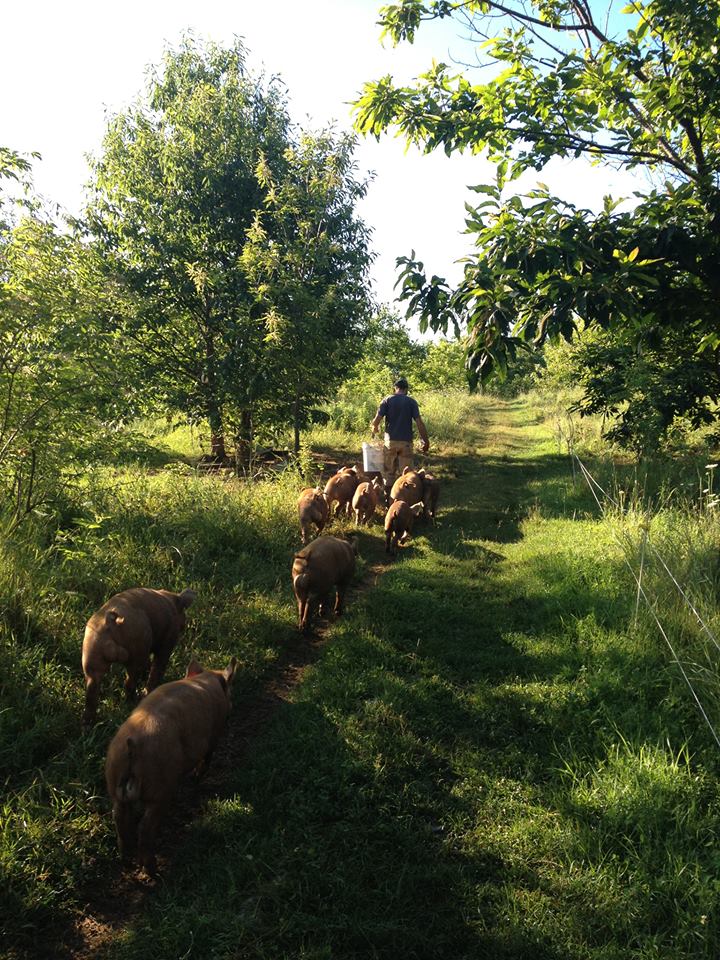
Let’s get to the good stuff — food. At the end of the day, that’s what people care about. Yes, we’ve got to pay our bills, but let’s eat well! Nothing gets folks excited more about ecological farming than a plate of perfectly seared pork chops, fresh duck eggs, hazelnut-fed chicken, or grassfed steak with marbled fat that melts in your mouth like butter.
Remember this and preach it far and wide: the flavor and nutrient density of food is a direct reflection of the system it came from. The hotel sausage Will Winter turned his nose up at was raised on biologically dead land. The meat was bland (smelled like hog manure, actually), tough, and minimally nutritious. When livestock are raised within complex, living systems, though — with deep soils, diverse forage, clean water, and freedom to move and choose — their meat tastes like it used to before the industrial revolution.
Ever tasted pork from pigs that gorged themselves on acorns? More often these days you can find it. If you look at the price per ham (I just did a quick search and found some for $1,800 apiece) you can see how lucrative silvopasture pork can be! You might make most of your current income by raising conventional confinement hogs, but step-by-step, year-by-year, you can add more and more silvopasture pork to your system, until in 10-15 years you find yourself selling 100 percent nut-finished pork direct to the consumer. Even if you’re only getting $1,800.00 for a whole pig, that sure beats conventional prices (right now, in May 2025, the Des Moines average price is $93.02 per carcass).
Imagine what you can do if you have an oak savanna! What would the pork taste like if the pigs were finished on persimmons? Apples? Beechnuts? Shiitake mushrooms? Ever had chicken that scratched and pecked through an insect-rich, diverse silvopasture? The skin crisps up like caramel. The eggs are deep orange. The flavor lingers on your tongue.
This isn’t just anecdotal — it’s chemical. Real food grown in real systems is higher in Omega-3s, conjugated linoleic acid (CLA), fat-soluble vitamins, trace minerals, and flavor compounds that you can’t synthesize in a lab. Real food is factually different.
If we want healthy animals, we’ve got to give them a healthy home. And the healthiest home you can give an animal is a diverse polyculture modeled on the plant communities of your area — North America’s original food forest.
The good news is that we don’t need to ask permission. We can start today. Plant a tree. Rotate a paddock. Plant more trees. Observe. Interact. Let nature be your guide.
And when you sit down to eat — whether it’s sausage from your acorn-fed pigs or a grassfed steak kissed with hickory smoke — you’ll taste something that’s been missing for generations.
Mark Shepard is a land designer and consultant and is the author of Restoration Agriculture, Water for Any Farm and the Water for Any Farm Technical Manual.