

I was surprised to find that Brix levels were highest in areas that had received the most grazing pressure
As someone relatively new to the world of cattle and pasture management, I’ve been fortunate to spend time learning from experienced cattle managers. We recently had Steve Campbell and Will Winter visit our farm, and they offered invaluable insights. It quickly became clear how much there is to learn — not just from these mentors, but directly from the land and cattle themselves.
I’m excited about our upcoming on-farm event, where Steve, Will and Gary Zimmer will return for a hands-on day with our cattle. Steve will demonstrate his “red solo cup theory,” aimed at identifying the best-performing cattle on grass. From his observations, my herd has both strengths and areas to improve upon, making this especially valuable. Will plans to discuss holistic herd management, and Gary Zimmer will share insights on dairy nutrition in grazing systems.
Grazing Pressure and High Brix Scores
During Will’s previous visit, he stuck a refractometer in my hands — a simple device for measuring sugar content, or Brix level, in plant sap. Though I’m far from an expert, I was immediately intrigued by what this tool might reveal about our pastures.
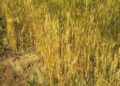
After measuring several paddocks, an interesting pattern emerged: areas grazed more consistently and frequently showed higher Brix levels — often 12 or above. Both Steve and Will indicated that grass with a Brix level of 12 or higher is ideal for finishing cattle on pasture.
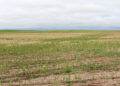
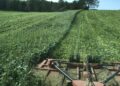
Some of the best results appeared in former waterways from when our land was under soybean and corn rotations. These waterways consistently yielded higher Brix readings, possibly due to their lower-lying locations or because established grasses improve more quickly under grazing than newly seeded fields. These areas were intensively grazed from the start, providing some of the highest readings we’ve recorded.

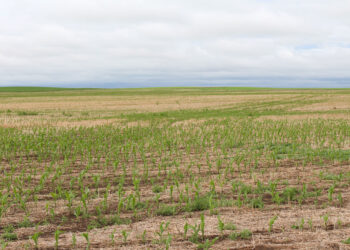
In contrast, pasture areas grazed less frequently or rested for extended periods typically showed lower Brix levels, usually around 8 to 10. Not surprisingly, cattle quickly found and preferred the higher-Brix areas, despite visually similar forage across the pastures.
Hay Residue
Another noteworthy observation involved testing grass growth through areas covered by hay residue left on the ground through winter. I initially expected minimal differences but was surprised to find a substantial variation: grass growing where there was hay residue had a Brix level of 15, compared to 9 in adjacent uncovered areas. It was reassuring to realize the nutritional value we gain from what might otherwise be considered waste.
Exploring forage with a refractometer has genuinely been enjoyable, forming hypotheses based on appearance and location. While I’m certainly no expert in soil biology, it’s clear the grass thrives and appears more nutrient-rich in residue-covered and intensively grazed areas.
These observations have reinforced my understanding of the subtle yet significant interconnectedness between cattle, grass and soil. Grazing management isn’t solely about nutrition for the cattle — it also profoundly influences conditions that the land itself responds positively to.
Patience and Future Challenges
These findings support the idea of “staying ahead” of grass growth. With our current stocking rates, fully utilizing available pastures remains a challenge. Given today’s high cattle prices, expanding the herd quickly presents economic challenges. Each calf born on the farm reinforces my instinct to be patient and allow natural herd growth rather than rushing to purchase additional cattle.
I’m at the beginning of this journey, and the refractometer has offered fascinating insights into what our cattle truly consume. Every measurement feels like a step toward understanding the bigger picture.
As I continue to learn and observe, I look forward to sharing these discoveries and hearing from others about their experiences. I hope you’ll join our on-farm event, experience our pastures and cattle firsthand, and perhaps enjoy the scenic views that our animals — and even our books — enjoy daily here in Viroquo, Wisconsin.
Taylor Henry is the owner and CEO of Acres U.S.A. and of Henry Pastures (henrypastures.com).