Acres U.S.A.® Magazine
  • Articles
    • News
    • Ecological farming
      • Climate
      • Environmental Issues
      • Farm management & planning
      • Human health
    • Livestock
    • Farm
    • Crop
      • Crop management practices
        • Ag technology
        • Cover crops
        • Crop nutrition
          • Crop protection
          • Diseases
        • Crops
        • Fruits
    • Soil
    • Opinion
  • Resources
    • Magazine
    • Online Learning
    • Newsletters
    • Free Articles
    • Blog
  • Magazine Issues
    • 2026
      • February 2026
      • January 2026
    • 2025
      • December 2025
      • November 2025
      • October 2025
      • September 2025
      • August 2025
      • July 2025
      • June 2025
      • May 2025
      • April 2025
      • March 2025
      • February 2025
      • January 2025
    • 2024
      • December 2024
      • November 2024
      • October 2024
      • September 2024
      • August 2024
      • July 2024
      • June 2024
      • May 2024
      • April 2024
      • March 2024
      • February 2024
      • January 2024
    • 2023
      • December 2023
      • November 2023
      • October 2023
      • August 2023
      • July 2023
      • June 2023
      • May 2023
      • April 2023
      • March 2023
      • February 2023
      • January 2023
    • 2022
      • December 2022
      • November 2022
      • October 2022
      • September 2022
      • August 2022
      • July 2022
      • June 2022
      • May 2022
      • April 2022
      • March 2022
      • February 2022
  • About Us
    • Our History
    • Our Staff
    • Contact Us
    • Community
      • Soil Health Primer Resources
  • Events
    • Eco-Ag Conference
    • Farm Weird Event
    • Viroqua On Farm Event
  • Subscribe
  • Login
  • Register
No Result
View All Result
  • Articles
    • News
    • Ecological farming
      • Climate
      • Environmental Issues
      • Farm management & planning
      • Human health
    • Livestock
    • Farm
    • Crop
      • Crop management practices
        • Ag technology
        • Cover crops
        • Crop nutrition
          • Crop protection
          • Diseases
        • Crops
        • Fruits
    • Soil
    • Opinion
  • Resources
    • Magazine
    • Online Learning
    • Newsletters
    • Free Articles
    • Blog
  • Magazine Issues
    • 2026
      • February 2026
      • January 2026
    • 2025
      • December 2025
      • November 2025
      • October 2025
      • September 2025
      • August 2025
      • July 2025
      • June 2025
      • May 2025
      • April 2025
      • March 2025
      • February 2025
      • January 2025
    • 2024
      • December 2024
      • November 2024
      • October 2024
      • September 2024
      • August 2024
      • July 2024
      • June 2024
      • May 2024
      • April 2024
      • March 2024
      • February 2024
      • January 2024
    • 2023
      • December 2023
      • November 2023
      • October 2023
      • August 2023
      • July 2023
      • June 2023
      • May 2023
      • April 2023
      • March 2023
      • February 2023
      • January 2023
    • 2022
      • December 2022
      • November 2022
      • October 2022
      • September 2022
      • August 2022
      • July 2022
      • June 2022
      • May 2022
      • April 2022
      • March 2022
      • February 2022
  • About Us
    • Our History
    • Our Staff
    • Contact Us
    • Community
      • Soil Health Primer Resources
  • Events
    • Eco-Ag Conference
    • Farm Weird Event
    • Viroqua On Farm Event
  • Subscribe
No Result
View All Result
Acres U.S.A.® Magazine
No Result
View All Result
Home Ecological farming Farm management & planning

A Rose By Any Other Name

Nigel Palmer by Nigel Palmer
March 13, 2024
in Farm management & planning, March 2024, Vegetables, Weeds
2
A Rose By Any Other Name
0
SHARES
587
VIEWS
Share on FacebookShare on Twitter

Weeds are nature’s mineral redistribution system and a way to sequester carbon at many depths in the soil

Nigel Palmer

A rose by any other name … weeds are often misunderstood. 

Consider your definition of a weed. I would like to propose an alternative paradigm — a slightly different model or context for considering weeds: weeds are nature’s mineral redistribution system and a way to sequester carbon at many depths in the soil. In order to appreciate this point of view, let’s review some characteristics of plants. Most importantly, plants absorb minerals into their frames in different proportions than the proportion of those minerals in the soil. By bringing these specific mineral proportions up and laying them down on the surface year after year, the minerals on top of the soil become different compared to lower down. Because of this, as time goes by, the plants that grow in this space will change. Consider a field that is no longer cultivated and the transitions that take place over time.

We know that plants send exudates into the soil through their roots. These are sugars — carbon — that feed the soil biology. The microbes consume them, poop, and are eaten by larger animals and die. Some of this life is eventually transformed into humic substances — relatively stable forms of carbon that become sequestered in the soil at various depths, depending on the root structure of the plants doing the exuding. Those lovely deep-rooted weeds in your garden or fields — the docks, dandelions, parsnips, thistles and more — are hard at work bringing the soil back into balance by transferring minerals from deep within the soil to the surface and extending the depth of humic substances into the soil.

We are lucky to have these amazing plants growing in soils that we have degraded — sometimes significantly. Consider the soil life that grows after a volcano blows the top off a mountain, or after a large oil spill or nuclear accident, or in an agricultural field that has had years of tilling with strong pesticides, fungicides and herbicides applied multiple times per year. Nature still offers us life that is able to grow in these spaces, sometimes creating brand-new, never-before-seen varieties to the rescue that will remediate even these toxic landscapes — i.e., super weeds!

A weed that proliferated in my garden before I began to understand this point of view was quackgrass — not an uncommon weed variety in many a garden. When at first I tried removing her from the garden space, discarding the material onto the compost pile, the green blades aboveground would snap at the root interface, leaving those stubborn roots in the ground to continue growing. While “weeding” these unwanted grasses from my garden one day, I thought about them in the context of nature’s remineralization program and wondered what minerals might be in quack grass. I decided to gather some, make a fermented plant juice with them, and send the juice to a lab to evaluate all 18 of the minerals we are taught that plants need. By this time, analyzing homemade mineral amendments was a standard procedure for me. I had demonstrated that all plants had all of these eighteen minerals in them and that they differed in their proportions. Dr. James Duke’s USDA Phytochemical and Ethnobotanical database demonstrates these characteristics as well.

Table 1.

 

Mineral analysis of quackgrass fermented plant juice. All values in parts per million (ppm).

The analysis results revealed high concentrations of needed trace minerals (see Table 1). The quackgrass was indeed mining the minerals that this garden space needed and bringing them to the surface. The long runner roots were exuding sugars into the soil, feeding specific soil biology that mined these minerals. The quackgrass was remediating my soil, and I was hindering the work by disrupting the soil and moving the plant material to the compost pile. Why not change this perspective and work with the plants and nature to facilitate this activity, as well as growing food? 
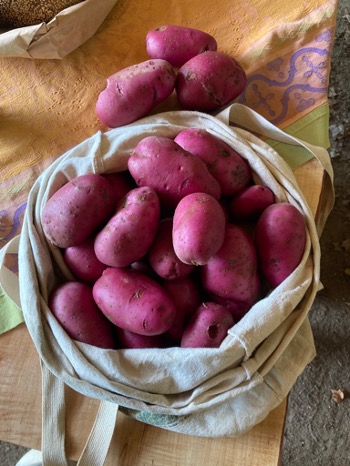
Using this method produced 27 potatoes from a single plant.

I now distribute quackgrass fermented plant juice on my garden space, speeding up the process of redistributing these minerals. I never take plant material from the garden but make rows of “little compost piles” of the entire plant in the garden space. Nature worked so hard to create these carbon materials that to remove them just doesn’t make sense. The quackgrass has since subsided, but it has not been eliminated. I still utilize her assistance.

The beginning of spring brings early plants coming up all around the garden area, some of them the weeds we defined earlier, some the plants that I left to seed the previous year: dandelions, red clover, violets, parsnips, cilantro, dill, kale, collards, nettles, yellow doc, garlic and more. By letting plants go to seed, encouraging their natural cycles, they become my weeds. I much appreciate them all, especially in areas where the tomatoes will go into the ground sometime in June when soil temperatures get to 70 degrees Fahrenheit (21 C). A diverse cover crop is already established with various depth of roots feeding the soil for free with little or no labor. I manage the area by knocking the area down one or two times before the tomatoes go in, adding their leaves and stems as a green mulch to the soil, always leaving the roots intact, allowing some to go to maturity and other seeds below to germinate. 
As the organic matter in the soil increases, the soil loosens up, and pulling these plants at the time of planting becomes much easier. The stinging nettles that populate the garden pull up easily, with long strands of densely packed root hairs and soil aggregates clinging to them. These are laid between the cultivars with other weeds and existing mulch residue to facilitate the work of bringing a different spectrum of minerals to the soil surface and to add organic matter. 
Rather than removing plants from the garden space, I am working with nature. Adding mineral rock dusts, compost, homemade mineral amendments, crushed oyster and/or shrimp shells contributes to producing a side dress that will nurture the plants throughout the growing season. Nature’s hard work never leaves the garden!

So, the next time you are confounded by the weeds growing in your fields or beds, consider making a fermented plant juice of the plant material and finding out what minerals they contain. You may be surprised to find a mineral complement that is exactly what is needed.

Fermented Plant Juice Recipe

  • Pick plant material when it is wet with dew; don’t wash
  • Mix plant material with organic brown sugar, approximately 1:1 by weight
  • Fill crock or glass jar with the plant and the sugar; cover top surface of material with sugar
  • Weigh contents down and cover with a cloth
  • Store out of sunlight at room temp for a week
  • Strain out the liquid for use as a foliar or drench, diluted starting at 1:500. Store at room temperature.

Nigel Palmer is a former aerospace engineer and is an instructor at the Institute of Sustainable Nutrition in Connecticut. He is the author of The Regenerative Grower’s Guide to Garden Amendments. Learn more, including complete analysis of farm-made mineral amendments at nigel-palmer.com.

← Previous Control Pathogens with Microbial Diversity Next Carbon Cashflow →
Tags: CarbonSoil biologyWeed Management
Nigel Palmer

Nigel Palmer

Nigel Palmer is a former aerospace engineer and is an instructor at the Institute of Sustainable Nutrition in Connecticut. He is the author of The Regenerative Grower’s Guide to Garden Amendments. Learn more, including complete analysis of farm-made mineral amendments at nigel-palmer.com.

Next Post
Carbon Cashflow

Carbon Cashflow

Please login to join discussion
  • Trending
  • Comments
  • Latest
The Most Important Livestock in Our Fields

The Most Important Livestock in Our Fields

July 1, 2024
Glyphosate Does What It’s Designed to Do — Kill

Glyphosate Does What It’s Designed to Do — Kill

February 19, 2025
The Take-Half, Leave-Half Fallacy

The Take-Half, Leave-Half Fallacy

July 1, 2025
White snakeroot

Toxic Forages?

September 1, 2025
We Don’t Need Another Bridge — We Need an Off-Ramp

We Don’t Need Another Bridge — We Need an Off-Ramp

3
Under One Roof

Under One Roof

3
A Rose By Any Other Name

A Rose By Any Other Name

2
Terra Preta’s Biological Advantage

Terra Preta’s Biological Advantage

2
Don’t You Dare Disparage Sugar!

Don’t You Dare Disparage Sugar!

February 3, 2026
February 2026 • Issue #656

February 2026 • Issue #656

February 1, 2026
Fungal Exchange Capacity

Fungal Exchange Capacity

February 1, 2026
ECO-MEETINGS

ECO-MEETINGS

February 1, 2026

Recent News

Don’t You Dare Disparage Sugar!

Don’t You Dare Disparage Sugar!

February 3, 2026
February 2026 • Issue #656

February 2026 • Issue #656

February 1, 2026
Fungal Exchange Capacity

Fungal Exchange Capacity

February 1, 2026
ECO-MEETINGS

ECO-MEETINGS

February 1, 2026

About ACRES USA

Acres U.S.A.® Magazine

Acres U.S.A.® is North America’s oldest publisher on production-scale organic and regenerative farming. For more than 50 years, our mission has been to help farmers, ranchers and market gardeners grow food profitably and sustainably, with nature in mind.

Visit Our Advertisers

Magazine Issues

  • News
  • 2025
    • June 2025
    • May 2025
    • April 2025
    • March 2025
    • February 2025
    • January 2025
  • 2024 Articles
    • December 2024
    • November 2024
    • October 2024
    • September 2024
    • August 2024
    • July 2024
    • June 2024
    • May 2024
    • April 2024
    • March 2024
    • February 2024
    • January 2024
  • December 2023
    • December 2023
    • November 2023
    • October 2023
    • August 2023
    • July 2023
    • June 2023
    • May 2023
    • April 2023
    • March 2023
    • February 2023
    • January 2023
  • December 2022
    • November 2022
    • October 2022
    • September 2022
    • August 2022
    • July 2022
    • June 2022
    • May 2022
    • April 2022
    • March 2022

Contact Acres U.S.A

  • Contact Us
  • About Us
  • Advertise With Acres U.S.A.
  • My Subscription

Learn

  • Resources
  • Events
  • Magazine
  • Newsletters
  • Free Articles
  • Webinars
  • Online Courses
  • Bookstore

Our All Socials

Follow With Us...

  • My account
  • News
  • Ecological farming
  • Refund and Returns Policy
  • Privacy & Policy

© 2024 Acers USA Magazine

Welcome Back!

Login to your account below

Forgotten Password? Sign Up

Create New Account!

Fill the forms below to register

All fields are required. Log In

Retrieve your password

Please enter your username or email address to reset your password.

Log In
No Result
View All Result
  • HOME
  • ARTICLES
    • News
    • Farm
    • Ecological farming
    • Livestock
    • Crop
      • Crop management practices
      • Cover crops
      • Crop nutrition
      • Crop protection
      • Crops
      • Ag technology
    • Soil
    • Opinion
  • RESOURCES
    • Magazine
    • Online Learning
    • Newsletters
    • Blog
    • Free Articles
  • MAGAZINE ISSUES
    • 2025
      • June 2025
      • May 2025
      • April 2025
      • March 2025
      • February 2025
      • January 2025
    • 2024
      • December 2024
      • November 2024
      • October 2024
      • September 2024
      • August 2024
      • July 2024
      • June 2024
      • May 2024
      • April 2024
      • March 2024
      • February 2024
      • January 2024
    • 2023
      • December 2023
      • November 2023
      • October 2023
      • August 2023
      • July 2023
      • June 2023
      • May 2023
      • April 2023
      • March 2023
      • February 2023
      • January 2023
  • ABOUT US
    • Our History
    • Our Staff
    • Contact Us
    • Community
      • Soil Health Primer Resources
  • EVENTS
    • Eco-Ag Conference
    • On-Farm Viroqua Event
    • Farm Weird
  • SUBSCRIBE
  • Login
  • Sign Up
  • Cart

© 2024 Acers USA Magazine

Are you sure want to unlock this post?
Unlock left : 0
Are you sure want to cancel subscription?