

Delaying grazing on different pastures every year can help even spread nutrients and push roots deeper
Have you ever made hay or silage and then noticed a week or two later that your livestock were suddenly ahead of the grass? The fields you just hayed won’t be ready to graze for weeks.
This used to happen to me all the time before I started using the holistic grazing plan as a forward planning tool instead of just a calendar. As spring wanes and we start to go into summer, grass growth usually slows down. A key principle of grazing is to move stock faster when grass grows fast and slow down as growth slows so your livestock do not return to the pasture before plants have fully recovered.
If you simply keep grazing the same number of animals on the same area when grass growth slows, you are forced move your animals faster to get the same amount of forage into them because there is less grass in the paddocks. If you find the grass is not keeping up with demand and don’t take proactive action, the need to speed up the grazing round only gets steadily worse — just as a roll of toilet paper spins ever faster when a toddler goes walking away with the end of it.
Andre Voisin, who studied rotational grazing in France in the 1950’s, called this mismanagement that shrinks pasture production “untoward acceleration”. Don’t commit untoward acceleration unless you are willing to leave money on the table. Yet Alan Savory created an ingenious way to avoid this when he designed the holistic grazing plan.
Growing Grass Faster
Savory designed his grazing plan to help graziers work out how long cows need to graze in each pasture so that they will return to each pasture after the amount of time that pasture needs to recover.
Every pasture is a different size and grows grass at a different rate. For instance, the pasture up on the hill often doesn’t seem to feed stock for as long per acre as the productive pastures on the river flats. A holistic grazing plan takes this and many other considerations into account.
By monitoring how fast grass is growing, and by taking proactive actions like destocking, adding hay paddocks back into the grazing round, or bale grazing to supplement grass shortage, you make your plan adaptive. These actions can shorten or lengthen the occupation time in each paddock so it is appropriate for the weather. Changing your round speed only according to how much feed is in the paddock usually slows it down when grass is growing fast and speeds it up when pasture grows slower — the opposite of what will produce the most grass for the whole season. Using a feed budget program or app to determine the speed of a grazing round is a surefire way to miss out on the productivity benefits of nailing optimal recovery timing. Once you use the planning process and stay loyal to monitoring your plants and livestock, your farm will start to teach you much more than you were learning without it.
Delayed Grazing
The biggest mistake I made in my early days of grazing organic dairy cows was cutting out too much area for silage and hay. We discovered that delayed grazing is a cost-effective tool for pushing spring surplus pasture into summer, and we planned this into our holistic grazing plan.
We started by not cutting about 20 percent of the area we normally set aside for silage and keeping it in the grazing round in the early spring. We “flash grazed” the herd quickly through this extra area to keep it vegetative, as holistic management educator Ian Mitchell-Innes taught us when he came to our farm in 2011. Because we had more than enough area to graze, before we knew it, we grew even more surplus than usual. Because we were following the paddock occupation times our grazing plan generated, we knew exactly when we had reached true surplus and didn’t have to guess like I used to do.
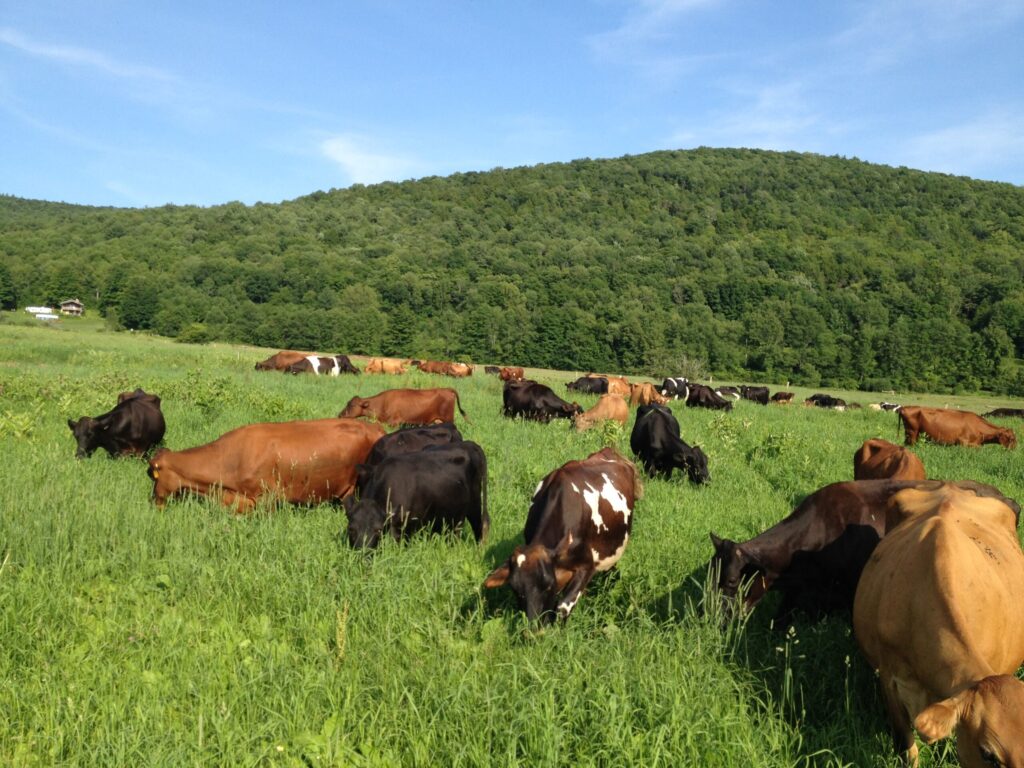
As soon as the residual pasture our cows left after a graze got too high to provide the pasture quality we wanted in the next round, instead of keeping our cows in the pastures longer to chew them down lower, we skipped some recovered pastures to delay grazing that paddock so it could rest an extra 20-25 days. If we had slowed the rotation by keeping animals in each paddock longer without reducing the area to be grazed that month, we would have fallen off our grazing plan and let the pasture plants recover beyond our target (remember: when grass grows fast, move stock fast). In the spring, before summer solstice, our target recovery was the TIME it took for the grasses we wanted more of to reach the boot stage, or just before they headed out.
(Siobhan Griffin)
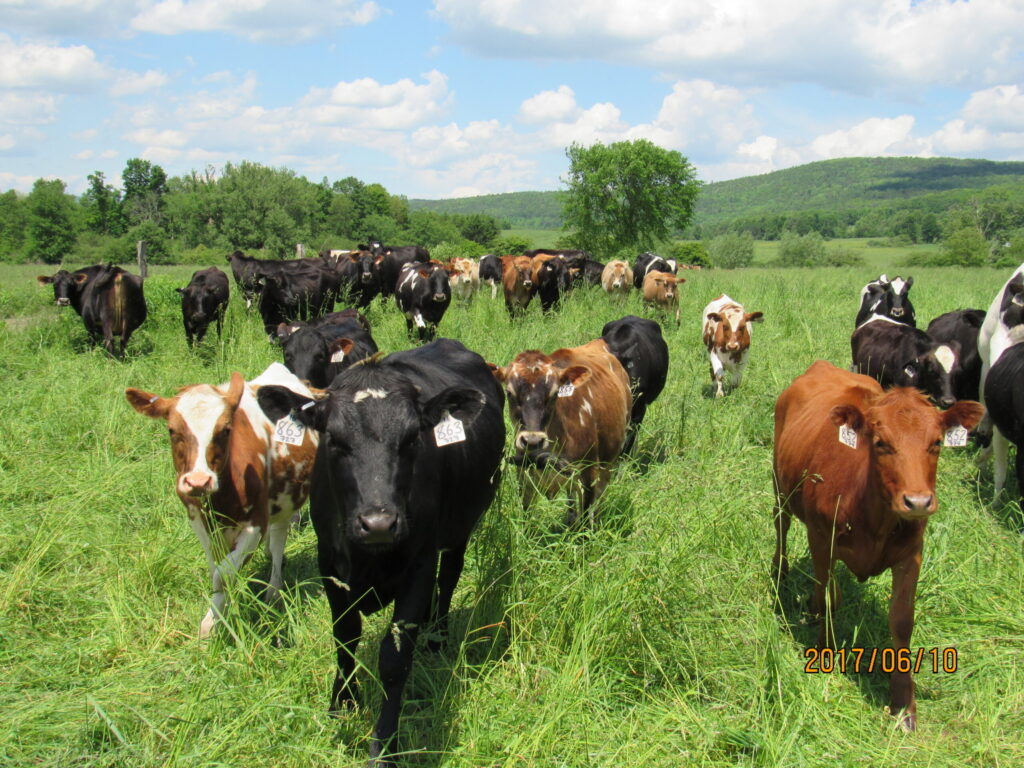
In Central New York and Vermont, where I had farmed, pasture growth usually slowed in June, before the paddocks we cut for baleage or hay were ready to graze again. We could add the delayed pastures back into the grazing round to prevent untoward acceleration. We strip-grazed these tougher but still green pastures with either the dairy herd or with dry cows and heifers, only harvesting one third of the volume grown to keep our cows performing, and trying to trample most of the rest.
(Raindance Farm)
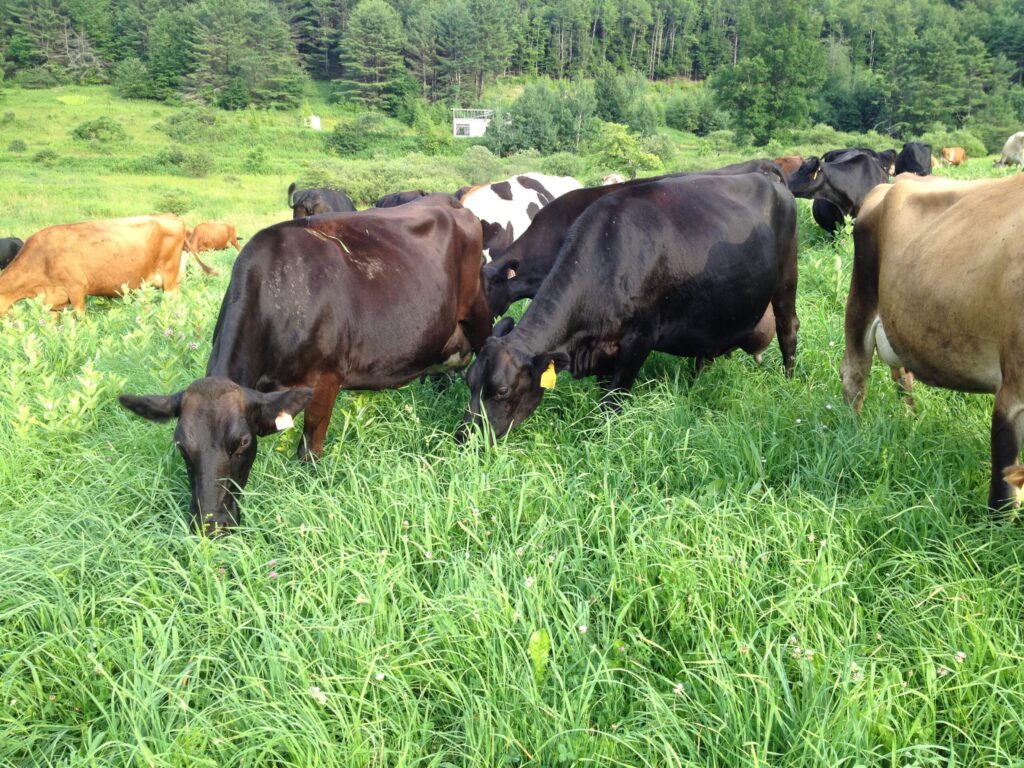
Thirty or so days later, when our desirable grasses had grown as many green leaves as they could before the first new pointed leaves started to go yellow, the delayed pasture was ready to graze again. We had thick, dairy-quality grass ready to graze even with only as little as half an inch of rain because we had let light down to the growing points of the plants, fed the soil biology, and shaded the soil.
(Raindance Farm)
The longevity of green in the summer would then persist in these paddocks for years. If it was a rainy season and we still had a surplus of grass at the end of June, we would graze the delayed pastures anyway, so they did not turn brown. In that case we would delay different pastures, giving new areas the opportunity to push roots down deeper. Some grazers call this “rolling deferred grazing.” We tried to delay different pastures every year to evenly spread nutrients and push roots deeper to develop deeper carbon sponge.
We likewise changed up the pastures we bale grazed in winter. The last pastures we bale grazed in winter were good candidates for delayed grazing, to give nutrients time to cycle. The thistles in delayed grazed pastures trample down easier than in shorter pastures because they develop weaker stems. My clients highlight weedy paddocks on their grazing plan so they remember to delay them next time they have a surplus of grass.
Don’t Be Afraid of Green Grass
While our holistic grazing plan helped us grow more grass, it didn’t by itself give us the quality we needed going into summer. Mobbing up the cows was the key to keeping the pasture quality that our dairy cows, growing youngstock, and finishing beef steers needed. Ian Mitchell-Innes taught us to selectively graze with our cattle, so they grew and milked well, and to non-selectively trample the uneaten grass stems. By giving our cattle their daily area of pasture in two, three or four separate breaks, they ate more vigorously and trampled more stemmy grass and weeds to let light down to growing points so fresh green grass and clover tillers could grow thickly.
After five years of holistic planned grazing, I was able to sell my plow, discs, grass-seeder, and drill because I no longer needed to re-grass. After each grazing, our cows left a mosaic of some desirable grasses and clovers that they did not eat in the pastures because they randomly got soiled. These were able to go to seed, so we didn’t only favor unpalatable grasses and weeds that cows didn’t want to eat. This, along with sticking to the grazing plan so we didn’t overgraze high-energy plants like timothy, kept our pastures from getting worn out.
We didn’t need to let entire pastures go to seed on purpose either to replenish our seed bank because the 15 or so percent of the tillers that we let go to seed randomly in our pastures was more than enough seed for perennial pasture. After six years of planned grazing, we had lifted our soil organic matter by 2.5-3 percent, and our pasture growth no longer slowed down as much in dry weather. Fifteen years from when we started our holistic journey, soil organic matter was persisting at these higher levels of 8.5 percent.
More Pasture Rest
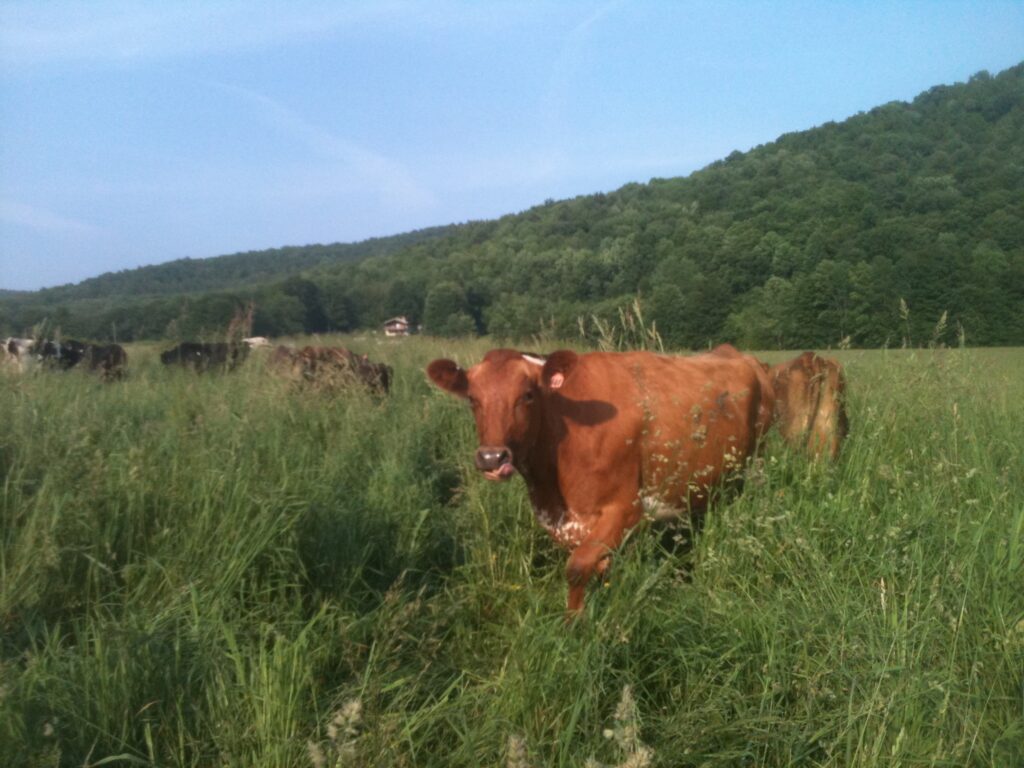
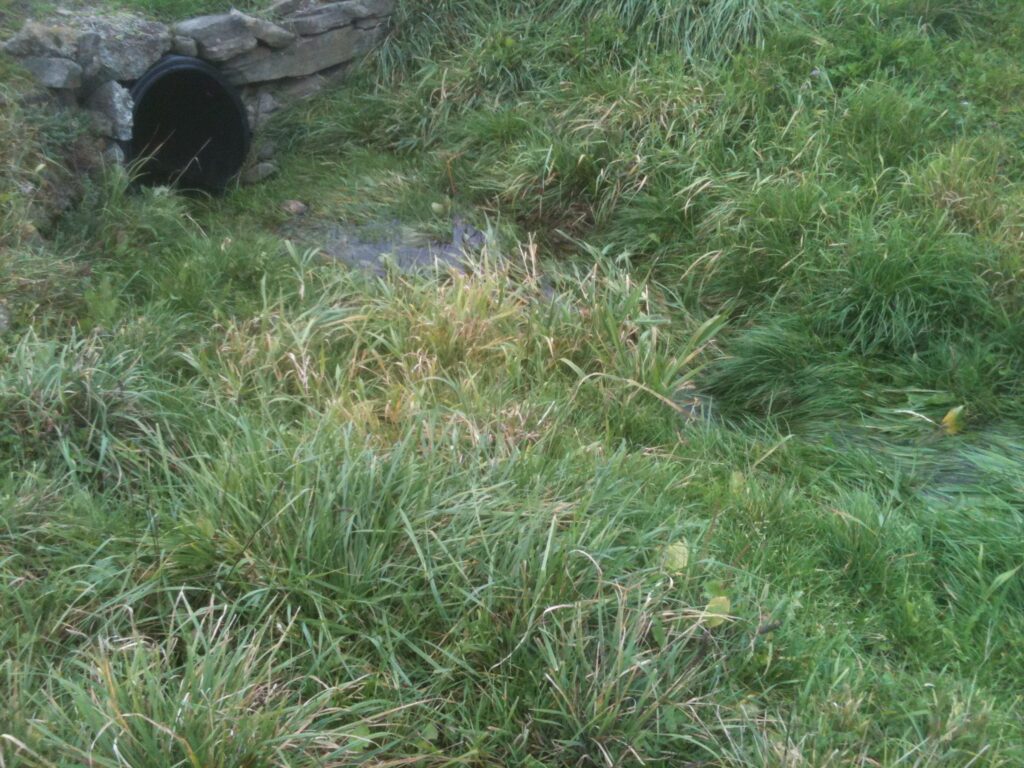
Although I think keeping grass green and growing fast was key to feeding our soil biology and lifting soil carbon, sometimes we would let grass get taller than the cows’ backs for environmental reasons. The Farm Service Agency helped us pay for new fence around two riparian areas on the farm. When the FSA regional supervisor came to inspect the fencing work on the final section, I explained that I had been grazing the area that had a seasonal stream running through it for years and planned to continue to do so. We only allowed cattle to have access in dry weather, which was usually in summer. In wet years we didn’t graze these riparian areas at all. The result was canary grass, orchard grass, and brome grass as tall as me in the summer. We had much fewer forbs and clovers here because long pasture rest periods favor grasses. The milking herd always dropped in milk production on this paddock, so we preferred to graze it with heifers.
(Siobhan Griffin)
When we first bought the farm in 1997, the stream banks were vertical and bare from set stocking by the previous owner. By mob grazing our cows, however, they had gently bevelled the stream banks so grass could fully cover them. If we grazed and trampled the paddock in August, by winter we had boot-high thick green grass that acted as a protective soil cover. If we had a gully-washing deluge and the stream became a torrent, the water pushed grasses down flat as if it were a thatched roof over the soil, but their deep, strong roots never gave way. Even the flood waters after Hurricane Irene in 2011 ran crystal clear the length of the farm.
(Siobhan Griffin)
To calm the fears of the FSA employee who thought cattle should never graze a streambank, I assured her that any dung my cows left would be fully assimilated by the soil biology in less than 30 days, like in all my other pastures. Hardly any manure could enter the water, and we prevented tons of soil from eroding from the streambanks.
Right then she pointed behind me to the largest megafaunal dung pat I have ever seen and demanded to know, “Then what is THAT?!?” With my cheeks reddening, I ran over and tipped up the dried dung pat. To the surprise of us both, it turned out to merely be a large, upside-down bowl. All the fertilizing contents were long gone, pulled down under by worms to feed a city of soil-dwelling tiny creatures. The worms were clever enough to leave a thin protective astrodome of dried dung over their heads so they could work during the hot summer days, as well as at nighttime, protected from our ever-more-abundant bird population. Isn’t nature amazing?
It Takes an Ecosystem
We started to see our indigenous New York savanna ecosystem re-emerge after several years of holistic planned grazing on our farm. As we mowed less area for hay and instead delay grazed, we saw a lot more ground nesting birds around, like the lovely bobolink, with their pretty song, and red-winged blackbirds. More bird predators came around, like bald eagles, Cooper’s hawks and kestrels. Our labor, fuel and equipment cost went down too. Even though we spent the same on fertilizer every year, our pasture production went up because we grew more grass in the summer by not letting our solar panel shrink.
We all know the expression “it takes a village to raise a child.” Well, it takes an entire ecosystem to build soil. The soil under the grasslands where most crops are grown around the planet was built by teeming grazing animals and other symbiotic life in the first place. Crop farmers who want to rapidly build soil can do this most effectively by including several years of grazed perennial pasture into their crop rotation.
Siobhan Griffin is a regenerative livestock farmer and grazing consultant based in New Zealand. Learn more about her at nextlevelgrazing.com.