Acres U.S.A.® Magazine
  • Articles
    • News
    • Ecological farming
      • Climate
      • Environmental Issues
      • Farm management & planning
      • Human health
    • Livestock
    • Farm
    • Crop
      • Crop management practices
        • Ag technology
        • Cover crops
        • Crop nutrition
          • Crop protection
          • Diseases
        • Crops
        • Fruits
    • Soil
    • Opinion
  • Resources
    • Magazine
    • Online Learning
    • Newsletters
    • Free Articles
    • Blog
  • Magazine Issues
    • 2026
      • June 2026
      • May 2026
      • April 2026
      • March 2026
      • February 2026
      • January 2026
    • 2025
      • December 2025
      • November 2025
      • October 2025
      • September 2025
      • August 2025
      • July 2025
      • June 2025
      • May 2025
      • April 2025
      • March 2025
      • February 2025
      • January 2025
    • 2024
      • December 2024
      • November 2024
      • October 2024
      • September 2024
      • August 2024
      • July 2024
      • June 2024
      • May 2024
      • April 2024
      • March 2024
      • February 2024
      • January 2024
    • 2023
      • December 2023
      • November 2023
      • October 2023
      • August 2023
      • July 2023
      • June 2023
      • May 2023
      • April 2023
      • March 2023
      • February 2023
      • January 2023
    • 2022
      • December 2022
      • November 2022
      • October 2022
      • September 2022
      • August 2022
      • July 2022
      • June 2022
      • May 2022
      • April 2022
      • March 2022
      • February 2022
  • About Us
    • Our History
    • Our Staff
    • Contact Us
    • Community
      • Soil Health Primer Resources
  • Events
    • Eco-Ag Conference
    • Farm Weird Event
  • Subscribe
  • Login
  • Register
No Result
View All Result
  • Articles
    • News
    • Ecological farming
      • Climate
      • Environmental Issues
      • Farm management & planning
      • Human health
    • Livestock
    • Farm
    • Crop
      • Crop management practices
        • Ag technology
        • Cover crops
        • Crop nutrition
          • Crop protection
          • Diseases
        • Crops
        • Fruits
    • Soil
    • Opinion
  • Resources
    • Magazine
    • Online Learning
    • Newsletters
    • Free Articles
    • Blog
  • Magazine Issues
    • 2026
      • June 2026
      • May 2026
      • April 2026
      • March 2026
      • February 2026
      • January 2026
    • 2025
      • December 2025
      • November 2025
      • October 2025
      • September 2025
      • August 2025
      • July 2025
      • June 2025
      • May 2025
      • April 2025
      • March 2025
      • February 2025
      • January 2025
    • 2024
      • December 2024
      • November 2024
      • October 2024
      • September 2024
      • August 2024
      • July 2024
      • June 2024
      • May 2024
      • April 2024
      • March 2024
      • February 2024
      • January 2024
    • 2023
      • December 2023
      • November 2023
      • October 2023
      • August 2023
      • July 2023
      • June 2023
      • May 2023
      • April 2023
      • March 2023
      • February 2023
      • January 2023
    • 2022
      • December 2022
      • November 2022
      • October 2022
      • September 2022
      • August 2022
      • July 2022
      • June 2022
      • May 2022
      • April 2022
      • March 2022
      • February 2022
  • About Us
    • Our History
    • Our Staff
    • Contact Us
    • Community
      • Soil Health Primer Resources
  • Events
    • Eco-Ag Conference
    • Farm Weird Event
  • Subscribe
No Result
View All Result
Acres U.S.A.® Magazine
No Result
View All Result
Home Crop management practices

Reduce to Produce

Melvin Fisher by Melvin Fisher
June 3, 2026
0
Kale (Melvin Fisher)

Beautiful kale produced on a farm using minimal nitrogen inputs.

0
SHARES
39
VIEWS
Share on FacebookShare on Twitter

Two rapid, systems-thinking ways to reduce your dependence on off-farm nitrogen inputs

Melvin Fisher

Nitrogen management is an important discussion and one that I am very passionate about, perhaps because there is often strong debate around how it should be handled. Conventional growers and agronomists often think they need to apply lots of it, while others think the stuff is evil.

The truth is that all plants desperately need nitrogen. Without it, they will not grow. They cannot be dark green. They cannot photosynthesize and produce sugars. They cannot make proteins. They cannot produce fats, oils, omega-3s, or any of the other important and healthful compounds we need. 

The all-important question “Do plants need nitrogen?” is “Where is the nitrogen coming from?” From the atmosphere? Cover crops? Manure? Synthetic nitrogen applications? 

The Ideal and the Challenge

How does the system work naturally? How did God design it to work? 

The air we breathe is 78 percent nitrogen, which means there are approximately 32,000 tons of nitrogen over every acre of land. However, this nitrogen cannot be directly accessed and used by plants; it has to be “fixed” into the soil first. 

There are two critical pieces that have to be in place for that to happen at scale: First, soils have to be well aggregated, with minimal compaction present in the top 6-12 inches, so that this atmospheric nitrogen can be inhaled into the soil during the earth’s natural inhaling process every evening. Secondly, this nitrogen needs to be fixed into the soil either by soil biology (particularly nitrogen-fixing bacteria) or by legumes that are nodulating (the nodules actually need to be pink inside).

It’s easy enough to say that we need very active soils for reduced dependency on nitrogen inputs. It’s quite another to actually achieve that, because nitrogen is critical for photosynthesis, a process that is critical for feeding the soil microbes, which are critical for active soil. So we come around full circle. 

The challenge is to bridge that gap, and until you have done that, you have to be very careful. You have to earn the right to reduce nitrogen inputs. 

What makes this all the more challenging is that soluble forms of nitrogen are actually very hard on soil biology. They actively suppress the very thing we are trying to achieve. 

The Approaches
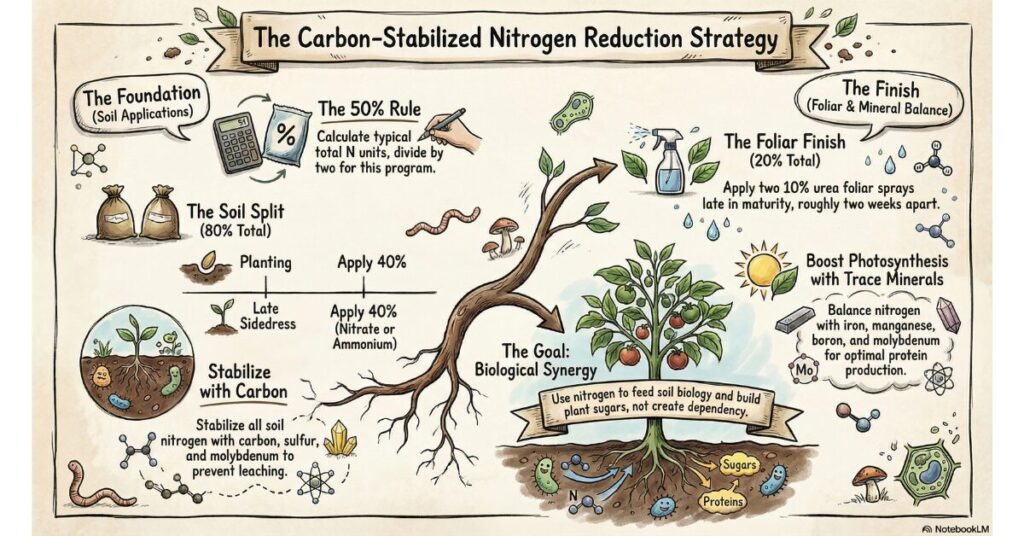
Stabilized specific forms of conventional nitrogen, for specific plant stages, can enable lower application rates that don’t shut down the biological processes we are trying to build.

Given the challenges we just described, what approach should we take to successfully become less dependent on off-farm nitrogen inputs? 

Essentially, there are two good systems-thinking, rapid-response approaches that I’m familiar with. I will start with specifically mentioning the nitrogen aspects and then circle back to the overall concept because the reality is that both approaches must be rooted in biology or they will not reduce nitrogen inputs long term. 

The first is to use bedding pack manure and aggressive cover cropping strategies. Many farmers quickly discover that manures and legumes, especially clovers, can do wonders for improving depleted soils and providing nitrogen for the following crops. As the soils improve, past the initial cover crop, they quickly move to more diverse cover crops and grazing systems — because diversity is key to soil regeneration. 

The second approach is to use nitrogen inputs carefully while on the path to becoming less dependent on off-farm inputs. For organic growers, this obviously has to be organic forms. For other growers, it means using specific forms of conventional nitrogen for specific plant stages and stabilizing them so that lower application rates can be used and so that they don’t shut down the biological processes we are trying to build. 

Here is the short version of what this looks like. First, divide the total units of nitrogen you typically apply by two. If you historically apply 200 units, your answer is 100 units when using this program. Split that into four applications. The first two applications are in the form of nitrate or ammonium, with 40 percent of total units being applied at planting (broadcast or 2×2), and the second application is applied as a sidedress as late as possible, also at 40 percent of total units applied. The key is that both of these applications have to be stabilized with carbon, sulfur, and molybdenum, in such a way that all the nitrogen is no longer in a soluble, water-leachable form. 

The last two applications are foliar in the form of urea, applied as late in the maturity stage as possible and about two weeks apart. The rate for each is 10 percent of the total units being applied. For some crops, this rate may need to be adjusted downward to avoid burning effects. 

The key in all of this is to use nitrogen to build sugars and proteins so that plants photosynthesize well (and thus feed and enhance soil biology) without becoming dependent on nitrogen and shutting down the very biological systems we are trying to build. In my opinion, from the perspective of photosynthesis, this means also looking at other minerals in addition to nitrogen. The healthiest plants I see have adequate levels of total nitrogen but are balanced with trace minerals, including iron, manganese, boron, and molybdenum. Use them wisely to increase photosynthesis and protein production. 

Whichever approach you decide to try, you can start either in spring or fall, although the most effective time to start is in the fall, since this is when soil organic matter is built the easiest. 

Ideally, you would start by looking at soil compaction and remediating it with intentional tillage or disturbances (usually subsoiling in fields). This is important because microbes do not thrive in soil that doesn’t have good gas exchange. You don’t want compaction to hinder the inhaling effect that brings the nitrogen into your soil and starts this process. 

The next step is to sow good, diverse-species cover crop blends. Diversity is the key to regeneration. A seed treatment can be applied that contains nitrogen-fixing bacteria and mycorrhizae. There are many on the marketplace that cost only a few dollars per acre and are well worth the money. 

Another well-worthwhile approach is to apply a soil primer program of biostimulants and microbial inoculants to the soil, usually once the cover crop is several inches tall. The purpose of this is to jumpstart the soil biological system on a broad scale. Remember: this is a system, and when you improve one part of the system, the whole system improves. You will get better nutrient release from the soil, which improves photosynthesis, which feeds more microbes. The other approach we often take is foliar feeding cover crops with trace minerals and either amino acids or urea-based nitrogen — again, with the intent of increasing photosynthesis. 

If all this sounds complex, it is. It’s not easy at first. But neither is conventional farming. It’s a system, and the better we work with God’s design, the better off we will be in the long run. Start somewhere, start small, and be intentional. But try it. 

← Previous Bog to Basics Next AMF: Agriculture’s Missing Factor →
Tags: nitrogen
Melvin Fisher

Melvin Fisher

Melvin Fisher is a soil and crop consultant for Keystone Bio-Ag in Lancaster County, Pennsylvania. Melvin is passionate about helping farmers understand how the soil and plant ecosystem works and how to harness the benefits.

Next Post
N efficiency chart (Please cover over “Panel A”) (National Agriculture Statistics Service; farmdoc estimates) — Average N applied per bushel, 2002–2024.

Fertilizer for Thought

  • Trending
  • Comments
  • Latest
The Most Important Livestock in Our Fields

The Most Important Livestock in Our Fields

July 1, 2024
Glyphosate Does What It’s Designed to Do — Kill

Glyphosate Does What It’s Designed to Do — Kill

February 19, 2025
USDA organic seal over American farm land

Losing Organic Farms

January 27, 2026
The Take-Half, Leave-Half Fallacy

The Take-Half, Leave-Half Fallacy

July 1, 2025
We Don’t Need Another Bridge — We Need an Off-Ramp

We Don’t Need Another Bridge — We Need an Off-Ramp

3
Under One Roof

Under One Roof

3
A Rose By Any Other Name

A Rose By Any Other Name

2
Terra Preta’s Biological Advantage

Terra Preta’s Biological Advantage

2
Running Dry

Running Dry

September 10, 2026
What Are Lactating Steers Trying to Tell Us?

What Are Lactating Steers Trying to Tell Us?

September 3, 2026
Remembering Wendell Berry

Remembering Wendell Berry

September 2, 2026
Manure spreader

ECO-GRAPHIC

September 1, 2026

Recent News

Running Dry

Running Dry

September 10, 2026
What Are Lactating Steers Trying to Tell Us?

What Are Lactating Steers Trying to Tell Us?

September 3, 2026
Remembering Wendell Berry

Remembering Wendell Berry

September 2, 2026
Manure spreader

ECO-GRAPHIC

September 1, 2026

About ACRES USA

Acres U.S.A.® Magazine

Acres U.S.A.® is North America’s oldest publisher on production-scale organic and regenerative farming. For more than 50 years, our mission has been to help farmers, ranchers and market gardeners grow food profitably and sustainably, with nature in mind.

Visit Our Advertisers

Magazine Issues

  • News
  • 2025
    • June 2025
    • May 2025
    • April 2025
    • March 2025
    • February 2025
    • January 2025
  • 2024 Articles
    • December 2024
    • November 2024
    • October 2024
    • September 2024
    • August 2024
    • July 2024
    • June 2024
    • May 2024
    • April 2024
    • March 2024
    • February 2024
    • January 2024
  • December 2023
    • December 2023
    • November 2023
    • October 2023
    • August 2023
    • July 2023
    • June 2023
    • May 2023
    • April 2023
    • March 2023
    • February 2023
    • January 2023
  • December 2022
    • November 2022
    • October 2022
    • September 2022
    • August 2022
    • July 2022
    • June 2022
    • May 2022
    • April 2022
    • March 2022

Contact Acres U.S.A

  • Contact Us
  • About Us
  • Advertise With Acres U.S.A.
  • My Subscription

Learn

  • Resources
  • Events
  • Magazine
  • Newsletters
  • Free Articles
  • Webinars
  • Online Courses
  • Bookstore

Our All Socials

Follow With Us...

  • My account
  • News
  • Ecological farming
  • Refund and Returns Policy
  • Privacy & Policy

© 2024 Acers USA Magazine

Welcome Back!

Login to your account below

Forgotten Password? Sign Up

Create New Account!

Fill the forms below to register

All fields are required. Log In

Retrieve your password

Please enter your username or email address to reset your password.

Log In
No Result
View All Result
  • HOME
  • ARTICLES
    • News
    • Farm
    • Ecological farming
    • Livestock
    • Crop
      • Crop management practices
      • Cover crops
      • Crop nutrition
      • Crop protection
      • Crops
      • Ag technology
    • Soil
    • Opinion
  • RESOURCES
    • Magazine
    • Online Learning
    • Newsletters
    • Blog
    • Free Articles
  • MAGAZINE ISSUES
    • 2026
      • June 2026
      • May 2026
      • April 2026
      • March 2026
      • February 2026
      • January 2026
    • 2025
      • December 2025
      • November 2025
      • October 2025
      • September 2025
      • August 2025
      • July 2025
      • June 2025
      • May 2025
      • April 2025
      • March 2025
      • February 2025
      • January 2025
    • 2024
      • December 2024
      • November 2024
      • October 2024
      • September 2024
      • August 2024
      • July 2024
      • June 2024
      • May 2024
      • April 2024
      • March 2024
      • February 2024
      • January 2024
    • 2023
      • December 2023
      • November 2023
      • October 2023
      • August 2023
      • July 2023
      • June 2023
      • May 2023
      • April 2023
      • March 2023
      • February 2023
      • January 2023
  • ABOUT US
    • Our History
    • Our Staff
    • Contact Us
    • Community
      • Soil Health Primer Resources
  • EVENTS
    • Eco-Ag Conference
    • Farm Weird
  • SUBSCRIBE
  • Login
  • Sign Up
  • Cart

© 2024 Acers USA Magazine

Lost Password?