Acres U.S.A.® Magazine
  • Articles
    • News
    • Ecological farming
      • Climate
      • Environmental Issues
      • Farm management & planning
      • Human health
    • Livestock
    • Farm
    • Crop
      • Crop management practices
        • Ag technology
        • Cover crops
        • Crop nutrition
          • Crop protection
          • Diseases
        • Crops
        • Fruits
    • Soil
    • Opinion
  • Resources
    • Magazine
    • Online Learning
    • Newsletters
    • Free Articles
    • Blog
  • Magazine Issues
    • 2026
      • June 2026
      • May 2026
      • April 2026
      • March 2026
      • February 2026
      • January 2026
    • 2025
      • December 2025
      • November 2025
      • October 2025
      • September 2025
      • August 2025
      • July 2025
      • June 2025
      • May 2025
      • April 2025
      • March 2025
      • February 2025
      • January 2025
    • 2024
      • December 2024
      • November 2024
      • October 2024
      • September 2024
      • August 2024
      • July 2024
      • June 2024
      • May 2024
      • April 2024
      • March 2024
      • February 2024
      • January 2024
    • 2023
      • December 2023
      • November 2023
      • October 2023
      • August 2023
      • July 2023
      • June 2023
      • May 2023
      • April 2023
      • March 2023
      • February 2023
      • January 2023
    • 2022
      • December 2022
      • November 2022
      • October 2022
      • September 2022
      • August 2022
      • July 2022
      • June 2022
      • May 2022
      • April 2022
      • March 2022
      • February 2022
  • About Us
    • Our History
    • Our Staff
    • Contact Us
    • Community
      • Soil Health Primer Resources
  • Events
    • Eco-Ag Conference
    • Farm Weird Event
  • Subscribe
  • Login
  • Register
No Result
View All Result
  • Articles
    • News
    • Ecological farming
      • Climate
      • Environmental Issues
      • Farm management & planning
      • Human health
    • Livestock
    • Farm
    • Crop
      • Crop management practices
        • Ag technology
        • Cover crops
        • Crop nutrition
          • Crop protection
          • Diseases
        • Crops
        • Fruits
    • Soil
    • Opinion
  • Resources
    • Magazine
    • Online Learning
    • Newsletters
    • Free Articles
    • Blog
  • Magazine Issues
    • 2026
      • June 2026
      • May 2026
      • April 2026
      • March 2026
      • February 2026
      • January 2026
    • 2025
      • December 2025
      • November 2025
      • October 2025
      • September 2025
      • August 2025
      • July 2025
      • June 2025
      • May 2025
      • April 2025
      • March 2025
      • February 2025
      • January 2025
    • 2024
      • December 2024
      • November 2024
      • October 2024
      • September 2024
      • August 2024
      • July 2024
      • June 2024
      • May 2024
      • April 2024
      • March 2024
      • February 2024
      • January 2024
    • 2023
      • December 2023
      • November 2023
      • October 2023
      • August 2023
      • July 2023
      • June 2023
      • May 2023
      • April 2023
      • March 2023
      • February 2023
      • January 2023
    • 2022
      • December 2022
      • November 2022
      • October 2022
      • September 2022
      • August 2022
      • July 2022
      • June 2022
      • May 2022
      • April 2022
      • March 2022
      • February 2022
  • About Us
    • Our History
    • Our Staff
    • Contact Us
    • Community
      • Soil Health Primer Resources
  • Events
    • Eco-Ag Conference
    • Farm Weird Event
  • Subscribe
No Result
View All Result
Acres U.S.A.® Magazine
No Result
View All Result
Home Soil & plant health Soil/plant biology

AMF: Agriculture’s Missing Factor

Joe Ailts by Joe Ailts
June 3, 2026
0
One of the most important species on the planet.

AMF - Arbuscular mycorrhizal fungi (AMF)

0
SHARES
14
VIEWS
Share on FacebookShare on Twitter

Arbuscular mycorrhizal fungi act as a powerful underground partner, extending plant roots and improving access to water and nutrients – in the right soil conditions

Joe Ailts

I believe that arbuscular mycorrhizal fungi (AMF) is one of the most important species on the planet.  

Nearly all plants on Earth (notably, grasses) create a mutually beneficial relationship with this fungus. Once established, plant roots feed sugar to AMF. In return, AMF explore the far reaches of the soil profile and supply root tips with water, nutrients, and other plant defensive goodies. AMF are also the primary microbe responsible for releasing glomalin, the glue that holds soil aggregate particles together. 

All of that almost sounds too good to be true, eh? Imagine going to the fertilizer store and buying a product that supplies your crops with water, nutrients, and defense, all in one package. The Creator designed an amazing organism here.   

While too small to see with the naked eye, this microbial good guy establishes a highly complex underground network of spider-web-like filaments that connect plant root tips with areas of the soil profile that the roots cannot reach. In fact, it has been reported that a teaspoon of soil can have one to eight miles of mycorrhizal filaments (hyphae) in it. Wrap your head around that — miles of pipeline in a teaspoon. It’s almost too much to comprehend. Native prairie soils and undisturbed woodlands will lean towards the eight-mile number, whereas ag soils typically have much smaller amounts of AMF. 

Because this microbe creates long lasting underground webs, it’s obvious how modern agricultural practices like tillage disrupt the network. Strong data shows that farm fields tend to be quite low in AMF populations (we can pretty easily measure the presence or lack thereof of this organism).   

You can see why I’ve targeted this microorganism as the lowest-hanging fruit on the biological product tree. Farming practices that favor soil health systems (minimizing tillage, incorporating cover crops, etc.) tend to enhance native populations of AMF. 

It is possible to introduce AMF in through dry seed treatments. I have been exploring this the past four years as an independent agronomist, and the results are very encouraging. I can say with a certain degree of confidence that using the right AMF product, in the right environment, can result in positive ROI harvests.  

Before sharing examples of where this idea has worked, I want to share where I’ve learned that it doesn’t work. I applied for and received a grant from the Wisconsin Department of Agriculture, Trade and Consumer Protection to explore the question, “Does AMF-treated corn impact nitrogen use efficiency?” Partnering with Huntsinger Farms in Eau Claire, we established a 25-acre, 40-block research design where a split planter of AMF-treated vs untreated corn was planted. Across this plot, five unique nitrogen rates were applied at plant and sidedress to determine if AMF would influence nitrogen efficiency. 

After crunching all the weighed yield data at harvest, I found a -1.9 percent response in the myco-treated corn vs untreated across all the nitrogen rates. This was the best-designed, most robust AMF trial I’ve ever conducted, and the outcome was a big letdown.  
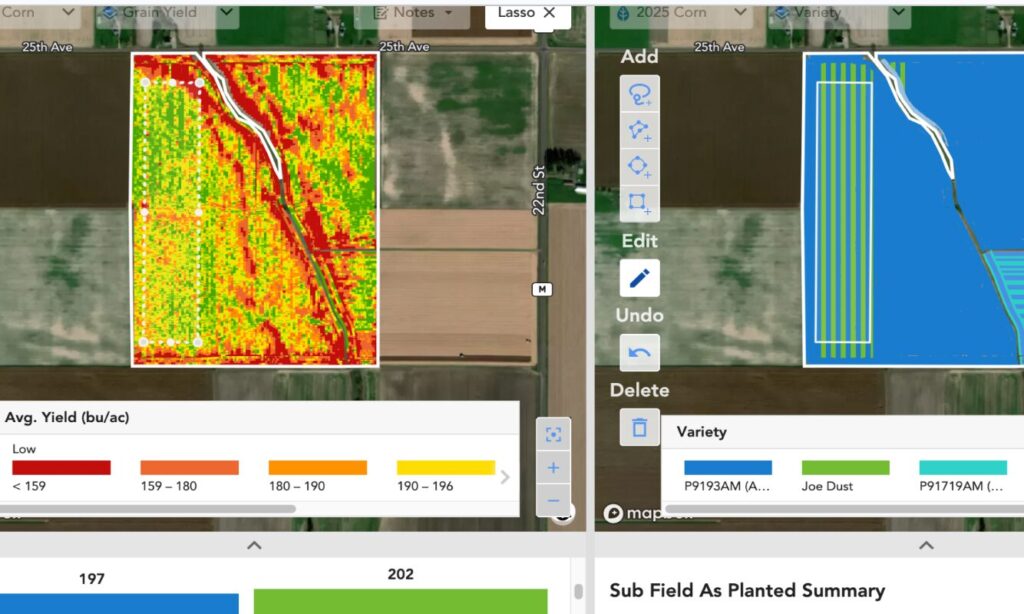
AMF seed treatment produced a 14-bushel response in corn on a high-productivity field.
Yield map

What happened? Science has identified that in the presence of high soil phosphorus, AMF-plant-root associations are highly diminished. It’s as if the plant knows there’s a buffet loaded with food in its root zone and it doesn’t need the “Door Dash” service that AMF provides. Sure enough, soil test P on this field was high enough to imply that the lack of response in this trial was to be expected. We’ll try again this year in a low-P field. 

I believe AMF inoculant does not work on high-soil-P fields. I believe it provides meaningful responses on low-P fields. Over the years, I’ve documented numerous split-planter trials where the AMF signature is indisputable. Of note, I was present when a 17-bushel difference was weighed on a low-organic-matter, low-P soil. I found a similar response on historically fumigated potato ground. All told, my summary of responses over the years implies a five- to seven-bushel average gain in corn and a four- to six-bushel average gain in soybeans.  

I’m not trying to sell a product. I don’t sell products, but I am trying to sell you on an idea: that if you can sift through all the hype in this ag-biological space, there are products and concepts that have legitimate merit. AMF as a seed inoculant is one of the practices that I believe has the brightest future. 

Lastly if the concept of mycorrhizal fungi captures your interest, I recommend reading Mycorrhizal Planet by Michael Phillips. It’s a great book written for the non-scientist that will leave you believing that AMF might just be some of the most important species on the planet.

← Previous Reduce to Produce Next Mulch Ado about Something →
Tags: AMF
Joe Ailts

Joe Ailts

Joe Ailts is an agronomist based in Deer Park, Wisconsin. Learn more at ailtsagronomy.com, and read the interview we did with Joe in the August 2025 issue of Acres U.S.A.

Next Post
N efficiency chart (Please cover over “Panel A”) (National Agriculture Statistics Service; farmdoc estimates) — Average N applied per bushel, 2002–2024.

Fertilizer for Thought

  • Trending
  • Comments
  • Latest
The Most Important Livestock in Our Fields

The Most Important Livestock in Our Fields

July 1, 2024
Glyphosate Does What It’s Designed to Do — Kill

Glyphosate Does What It’s Designed to Do — Kill

February 19, 2025
USDA organic seal over American farm land

Losing Organic Farms

January 27, 2026
The Take-Half, Leave-Half Fallacy

The Take-Half, Leave-Half Fallacy

July 1, 2025
We Don’t Need Another Bridge — We Need an Off-Ramp

We Don’t Need Another Bridge — We Need an Off-Ramp

3
Under One Roof

Under One Roof

3
A Rose By Any Other Name

A Rose By Any Other Name

2
Terra Preta’s Biological Advantage

Terra Preta’s Biological Advantage

2
Building Ag Research

Building Ag Research

June 23, 2026
Encouraging Small Meat Processors?

Encouraging Small Meat Processors?

June 17, 2026
Screwworm Is Back

Screwworm Is Back

June 10, 2026
Who Owns American Farmland?

Who Owns American Farmland?

June 2, 2026

Recent News

Building Ag Research

Building Ag Research

June 23, 2026
Encouraging Small Meat Processors?

Encouraging Small Meat Processors?

June 17, 2026
Screwworm Is Back

Screwworm Is Back

June 10, 2026
Who Owns American Farmland?

Who Owns American Farmland?

June 2, 2026

About ACRES USA

Acres U.S.A.® Magazine

Acres U.S.A.® is North America’s oldest publisher on production-scale organic and regenerative farming. For more than 50 years, our mission has been to help farmers, ranchers and market gardeners grow food profitably and sustainably, with nature in mind.

Visit Our Advertisers

Magazine Issues

  • News
  • 2025
    • June 2025
    • May 2025
    • April 2025
    • March 2025
    • February 2025
    • January 2025
  • 2024 Articles
    • December 2024
    • November 2024
    • October 2024
    • September 2024
    • August 2024
    • July 2024
    • June 2024
    • May 2024
    • April 2024
    • March 2024
    • February 2024
    • January 2024
  • December 2023
    • December 2023
    • November 2023
    • October 2023
    • August 2023
    • July 2023
    • June 2023
    • May 2023
    • April 2023
    • March 2023
    • February 2023
    • January 2023
  • December 2022
    • November 2022
    • October 2022
    • September 2022
    • August 2022
    • July 2022
    • June 2022
    • May 2022
    • April 2022
    • March 2022

Contact Acres U.S.A

  • Contact Us
  • About Us
  • Advertise With Acres U.S.A.
  • My Subscription

Learn

  • Resources
  • Events
  • Magazine
  • Newsletters
  • Free Articles
  • Webinars
  • Online Courses
  • Bookstore

Our All Socials

Follow With Us...

  • My account
  • News
  • Ecological farming
  • Refund and Returns Policy
  • Privacy & Policy

© 2024 Acers USA Magazine

Welcome Back!

Login to your account below

Forgotten Password? Sign Up

Create New Account!

Fill the forms below to register

All fields are required. Log In

Retrieve your password

Please enter your username or email address to reset your password.

Log In

Create a free account, or log in.

Gain access to read this article, plus limited free content.

Yes! I would like to receive new content and updates.

Upgrade your subscription

Support Acres USA and get full access to all content.
Upgrade Now
No Result
View All Result
  • HOME
  • ARTICLES
    • News
    • Farm
    • Ecological farming
    • Livestock
    • Crop
      • Crop management practices
      • Cover crops
      • Crop nutrition
      • Crop protection
      • Crops
      • Ag technology
    • Soil
    • Opinion
  • RESOURCES
    • Magazine
    • Online Learning
    • Newsletters
    • Blog
    • Free Articles
  • MAGAZINE ISSUES
    • 2026
      • June 2026
      • May 2026
      • April 2026
      • March 2026
      • February 2026
      • January 2026
    • 2025
      • December 2025
      • November 2025
      • October 2025
      • September 2025
      • August 2025
      • July 2025
      • June 2025
      • May 2025
      • April 2025
      • March 2025
      • February 2025
      • January 2025
    • 2024
      • December 2024
      • November 2024
      • October 2024
      • September 2024
      • August 2024
      • July 2024
      • June 2024
      • May 2024
      • April 2024
      • March 2024
      • February 2024
      • January 2024
    • 2023
      • December 2023
      • November 2023
      • October 2023
      • August 2023
      • July 2023
      • June 2023
      • May 2023
      • April 2023
      • March 2023
      • February 2023
      • January 2023
  • ABOUT US
    • Our History
    • Our Staff
    • Contact Us
    • Community
      • Soil Health Primer Resources
  • EVENTS
    • Eco-Ag Conference
    • Farm Weird
  • SUBSCRIBE
  • Login
  • Sign Up
  • Cart

© 2024 Acers USA Magazine

Are you sure want to unlock this post?
Unlock left : 0
Are you sure want to cancel subscription?