

Historically Low Colorado River Levels Threaten Southwestern Agriculture
On August 15, 2026, the water level in Lake Powell hit a record low of 3,519.91 feet above sea level. It’s set a new record every day since and was down to 3,518.48 feet by August 31. Lake Mead is setting a new record low every day, too.
That’s bad news for irrigated agriculture in the Southwest. Very bad news.
Lake Powell and Lake Mead are the two main reservoirs in the Colorado River System, a multi-state project that allocates every drop of water in the Colorado River to various US states, Native American nations, and Mexico. By the time the Colorado’s old riverbed reaches the Pacific Ocean, it’s dry.
The groundwork for today’s crisis was laid back in 1922, when seven southwestern states signed the first Colorado River Compact. The 1948 version of the compact allocated 7.5 million acre-feet of water annually to the Upper Basin states (Wyoming, Colorado, Utah, and New Mexico), 7.5 million acre-feet to the Lower Basin states (California, Nevada, and Arizona) and 1.5 million acre-feet to Mexico.
That all sounds fair—except for a major miscalculation. The Colorado River Compact assumes an average annual flow of 16.5 million acre-feet of water, but the average flow from 1931–2024 was 13.9 million acre-feet. The average from 2000–2024 was only 12.8 million acre-feet. And the average for the last five years was 11.4 million acre-feet.

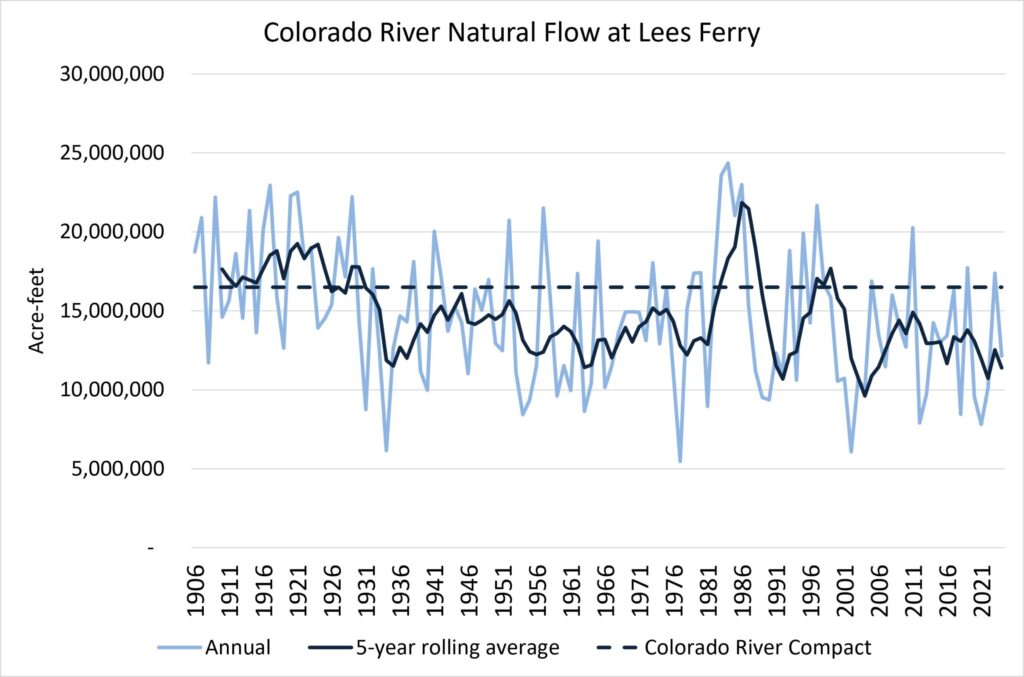
The US Department of the Interior’s 2027–2028 Operating Guidelines for the Colorado River system, issued on August 21, call for reducing water deliveries to the Lower Basin States by 1.25 million acre-feet, a 17 percent decrease. That’s a start, but it’s still more water than there’s been during the “megadrought” that the region’s been in for the past 25 years—which doesn’t show any sign of ending soon.
Colorado River–dependent agriculture has come under increasing scrutiny as water shortage looms. Fifty-two percent of the Colorado River’s water is used for agriculture, compared to 18 percent for cities. Two-thirds of that irrigation water is being used to grow water-intensive forage crops like alfalfa—most of which is exported. A smaller but still significant amount is used to grow lettuce, cabbage, and other vegetables.
Due to an anachronistic concept called “prior appropriation,” farmers in areas like California’s Imperial Valley legally have first dibs on the Colorado River’s water—even before big cities like Los Angeles or Phoenix. Forcing farmers to use less irrigation water would require overturning century-old water rights laws. But the laws are based on more water than there is in the river.
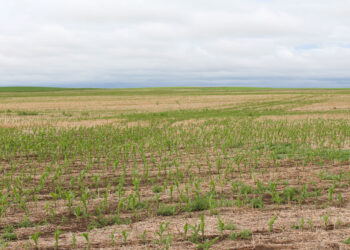
From an eco-ag perspective, it’s questionable whether irrigated agriculture on the scale currently being practiced in the Southwest is sustainable. Ideally, farmers wouldn’t use more water each year than falls as rain and snow. But that would mean retiring thousands of acres of desert land from agricultural production. There’s no easy answer—unless rainfall magically returns to early twentieth-century levels. But that’s probably not going to happen.