

Researchers found lactation in 14 to nearly 20 percent of finished steers. Is the cause extreme adiposity, hormonal implants, mammary stimulation—or an interaction agriculture hasn’t studied yet?
Dr. Ty Lawrence thinks I am looking in the wrong place.
I think hormonal growth implants are an obvious suspect when trying to explain why thousands of castrated male cattle were found producing milk at slaughter. Dr. Lawrence, a meat scientist at West Texas A&M University who oversees the research, doesn’t. His working hypothesis is that modern fed cattle have become so extraordinarily fat that their own adipose tissue is altering their endocrine environment enough to help trigger lactation.
We have spent hours talking and exchanging emails about it. I keep pushing him on implants. He keeps pushing me back toward fat. The interesting thing is that neither of us can yet prove our explanation.
Since I first began reporting this story, a third possibility has emerged. A large dairy producer told me he has watched open heifers—females that were not bred—begin producing milk after being repeatedly sucked by other cattle. That sent me into the literature on cross-sucking, calf management and mechanical mammary stimulation. It also led me into a part of the beef-on-dairy production system I hadn’t understood before, where I found a 2025 peer-reviewed study reporting that some commercial calf ranches were administering growth-promoting implants to calves during the pre-weaning period.
Suddenly I wasn’t asking whether it was fat or implants anymore. I was asking whether we are making the classic mistake of looking for a single cause in an animal that has experienced a lifetime of interacting biological interventions. That is a very different question from the one I was asking a few weeks ago.
How I Got Here
For readers who didn’t see my original Acres U.S.A. article, this investigation began almost accidentally in North Dakota. I had spoken at an event at the Theodore Roosevelt Presidential Library and was watching the sun set over the Badlands when a man approached me after my talk and mentioned that a surprising number of steers were lactating when they reached slaughter.
I raise cattle. I milk cows. I raise forage-finished beef. I had never seen a steer lactate, and I had never even heard producers around me discuss it. When the man told me the number was approaching 20 percent, I assumed he had misunderstood something. Then he showed me a photograph of a research poster.
The research was real. Researchers associated with West Texas A&M University and Cargill had evaluated 20,481 finished cattle originating from 33 feedlots. Of those animals, 6,078 were lactating. Among native heifers, 28.77 percent were lactating; among dairy-cross heifers, the figure was an astonishing 55.81 percent.
But the numbers that stopped me were the males. Among native beef steers, 14.55 percent were lactating. Among dairy-cross steers, 19.66 percent were lactating.
These were not researchers looking at an enlarged teat and guessing. Subsequent correspondence clarified that an animal was classified as lactating when manually stripping the teat produced a visible stream of mammary secretion. Samples were analyzed and contained components consistent with milk, including lactose and casein.
A castrated male producing milk is not normal cattle biology as I understand it. Finding one would have fascinated me. Finding lactation in roughly one out of every seven native steers and nearly one out of every five dairy-cross steers demanded an explanation.
My first suspicion was hormonal growth implants, in part because my own cattle don’t receive them and I had never seen the phenomenon. I began calling slaughterhouse workers and producers outside the conventional feedlot system. A.J. Richards of From the Farm, who formerly ran a slaughterhouse floor, couldn’t remember seeing it. People associated with smaller slaughter facilities processing cattle from family ranches, 4-H producers and regenerative farms couldn’t remember it. Will Harris of White Oak Pastures, whose operation processes substantial numbers of its own cattle, hadn’t seen it either.
Those observations aren’t science. The populations are different, the animals weren’t systematically examined, and people who weren’t looking for lactation could easily have missed it. In fact, the researchers themselves apparently did not anticipate what they would find.
In written correspondence with Oklahoma regenerative farmer Ann Bennett, Thomas Cole Petit, the graduate student and meat lab manager working with Dr. Lawrence, said the team had expected lactation in perhaps 1 to 2 percent of steers at most. Instead, they quickly discovered it at much higher rates. Petit said processing facilities and producers apparently hadn’t been aware it was occurring in steers at harvest and were as surprised as the researchers.
That may explain some of the disconnect. A lactating steer doesn’t necessarily walk into a processing facility carrying an udder that looks like a Jersey cow’s. The researchers reported that males did not develop the extensive mammary tissue seen in heifers. Unless someone deliberately examined the teat and attempted to express secretion, the condition could be missed.
But it didn’t answer the question that mattered: Why are these animals producing milk at all? That was the question that sent me toward hormonal implants. And it was the question that eventually put me on the phone with Dr. Lawrence.
We Already Know the Mammary Gland Responds to Hormones
Commercial cattle implants can contain compounds including estradiol, trenbolone acetate and zeranol, depending upon the product and production phase. These products work precisely because they alter physiology. They can improve gain, feed efficiency and economic return. Any fair discussion of implants should acknowledge those benefits.
But an economic benefit doesn’t tell us everything occurring biologically inside an animal. As I dug deeper, I discovered that inducing lactation without pregnancy isn’t some theoretical biological possibility. Scientists have intentionally induced lactation in nonpregnant cattle for decades using hormonal protocols involving estradiol and progesterone.
Those protocols are not equivalent to beef growth implants. The doses, timing, combinations and objectives differ substantially. But mammary tissue is hormonally responsive. Controlled cattle research has also examined mammary development following treatment with compounds including estradiol, trenbolone acetate and zeranol, with some estrogenic treatments producing measurable mammary changes.
There is an interesting human parallel. Estradiol is also part of some protocols that have successfully induced lactation in transgender women—biological males who have not experienced pregnancy or childbirth. Those protocols can involve multiple hormones, prolactin-promoting medication, repeated breast stimulation or pumping, and changes in hormone levels intended to mimic portions of pregnancy and the postpartum transition.
A cattle implant is obviously not a human induced-lactation protocol. The relevance is conceptual: Hormonal priming and mammary stimulation can interact to produce lactation without pregnancy. When endocrine-active compounds are deliberately administered to cattle and researchers subsequently document actual lactation in castrated males, asking whether those compounds contribute seems to me like an obvious scientific question.
Dr. Lawrence’s Adiposity Hypothesis
Yet Dr. Lawrence thinks I’m looking in the wrong place. He spent considerable time talking with me and subsequently answered detailed questions by email. He thinks the primary culprit is fat—more specifically, extreme adiposity.
His proposed pathway begins with adrenal androstenedione. Aromatase activity in adipose tissue converts it to estrone. Estrone then binds estrogen receptors in pituitary lactotrophs, stimulating prolactin synthesis; circulating prolactin, in turn, activates mammary epithelial milk production.
Adipose tissue isn’t simply a storage compartment. It is biologically and endocrinologically active. Dr. Lawrence also believes dairy and dairy-cross cattle may be especially susceptible because their fat distribution differs from conventional beef cattle. Dairy animals can look relatively lean externally while carrying considerable omental, mesenteric and perinephric fat internally.
His rough working threshold is around 30 to 35 percent empty-body fat. That is different from visually estimating body condition or simply measuring backfat, and it is important not to turn that number into an established threshold. It is part of the hypothesis he wants to test.
Dr. Lawrence has explicitly described his explanation as a hypothesis requiring experimental testing. That distinction matters because the initial audit did not directly measure the hormonal cascade he proposes. Petit separately confirmed in his correspondence with Bennett that the researchers did not measure circulating estradiol, prolactin, progesterone, testosterone, trenbolone metabolites, IGF-1 or the other biomarkers that might distinguish among competing endocrine explanations.
The research team submitted a grant proposal to investigate hormones in blood and fat tissues, but it was not funded. Dr. Lawrence separately told me that he had tried to obtain funding for further investigation and intends to try again.
His adiposity mechanism is therefore not a conclusion derived from measured estrone and prolactin levels in these lactating steers. It is a biologically plausible hypothesis supported in part by associations between lactation and carcass measurements consistent with greater fatness and by existing knowledge about adipose tissue and estrogen production.
I think his hypothesis deserves to be tested. I don’t think it deserves to become the answer before that testing occurs.
There Is Still a Giant Variable in the Room
I asked Dr. Lawrence about the implant histories of these animals. The researchers didn’t have them.
Petit later put the limitation especially clearly in his correspondence with Bennett: The team had no access to individual implant histories, including which products were used, how many times the animals were implanted or when those implants were administered. Instead, the researchers assume essentially 100 percent of the cattle represented in the commercial audit received one or more growth-promoting implants because that is standard industry practice. There was no verified never-implanted control population.
That creates an obvious scientific limitation. If virtually every animal in a population receives an endocrine-active treatment, observing a phenomenon throughout that population cannot tell us whether the treatment contributes to the phenomenon. It does not prove implants caused the lactation, but neither can that dataset exclude implants as a contributing factor.
Interestingly, Petit appears somewhat more open to experimentally addressing that question than Dr. Lawrence has been in my conversations. When Bennett asked whether comparing implanted steers with verified never-implanted steers under otherwise comparable conditions could help answer the question, Petit agreed that such a study was one of the next steps toward solving the issue. That is the experiment I want to see.
The Implant History Is More Complicated Than I Thought
Dr. Lawrence also gave me an argument against my implant suspicion that initially seemed quite persuasive. He pointed me toward FDA Guidance for Industry #191. His interpretation was that dairy cattle and dairy crossbreds such as Angus-Holstein or Limousin-Jersey animals, because they are commonly raised in confinement throughout their lives, would under the strictest interpretation receive only two growth-promoting implants during their lifetime. Conventional beef cattle moving through multiple production phases, he said, could potentially receive as many as five.
That was interesting because dairy-cross steers were lactating more, not less. If the population receiving fewer implants experienced more lactation, that would seem to cut against my hypothesis.
So I looked more deeply into GFI #191, and the regulatory picture turned out to be considerably more complicated. FDA’s system does not simply divide animals genetically into “dairy cattle” and “beef cattle.” For slaughter animals, certain growing-beef classes explicitly include both beef and dairy breeds. That distinction matters enormously for beef-on-dairy animals. A dairy replacement heifer destined to enter a milking herd is one thing; a dairy-genetic or beef-on-dairy animal destined exclusively for slaughter can travel through beef production classes.
Under the post-2023 framework, reimplantation within a defined production phase generally is not permitted unless a particular implant is specifically labeled for reimplantation. But legitimate movement into another production phase can create another approved implant opportunity, and some finishing programs specifically allow a second implant during that final confined-for-slaughter phase.
A plausible legally permitted lifetime implant history for a conventional beef animal might therefore include an approved implant while nursing its dam, another after moving into an eligible growing phase, and later exposure during confined finishing, potentially including a labeled reimplantation program. The exact history depends upon the animal, production pathway and products used; there is not a simple universal rule that every animal receives a particular number of implants.
This changes the biological question. “Implanted or unimplanted” may be too crude. We may need to know age at first exposure, compounds and doses, release duration, number of exposures, developmental stage, intervals between treatments and time between the final implant and slaughter. Exposure can also begin surprisingly early. Certain approved implants can be administered to qualifying nursing beef calves well before puberty.
Then I found the calf ranches.
The Missing Stage in Beef-on-Dairy Production
A 2025 peer-reviewed study, “Beef-on-dairy calf management practices in commercial calf ranches,” surveyed 15 operations in Kansas, Texas, New Mexico, Indiana, Ohio and California. Some had capacities exceeding 50,000 calves.
All participating ranches received beef-on-dairy calves when they were less than four days old. Nearly all fed milk replacer, all offered calf starter immediately, and weaning occurred between 42 and 72 days. After weaning, calves could remain in group pens for as long as another 180 days.
That filled in a production system I had not initially understood clearly. The calf can leave the dairy almost immediately after birth, move to a specialized commercial calf ranch for milk feeding and weaning, transition through growing systems, enter finishing and ultimately go to slaughter.
Then I reached the part of the study that caught my attention. The authors reported that some participating operations administered an implant during the pre-weaning period. Those operations were located in the Midwest and shared the same consulting veterinarian.
This does not tell us which implant they used, the exact age at implantation, the compounds or doses, the regulatory classification under which those animals were treated or whether the same protocol remains in use today. Those remain important reporting questions. But it establishes something important: Published peer-reviewed research documents at least some commercial beef-on-dairy calf ranches reporting implantation while calves were still in the pre-weaning, milk-fed period.
That complicates the assumption that dairy-cross cattle necessarily begin hormonal exposure later or experience only a couple of hormonal interventions during their lives. More importantly, it reinforces the fundamental limitation of the lactation dataset: We don’t know the actual lifetime implant histories of the cattle that lactated.
Then a Dairy Farmer Gave Me Another Hypothesis
I spent roughly 45 minutes talking with Derrick Josi, a large Pacific Northwest dairy producer. His experience raised a completely different possibility.
Josi told me he has seen open heifers—animals that were not bred—begin producing milk after other cattle repeatedly sucked on them. That observation is anecdotal, but it immediately caught my attention because artificially reared calves are well known for cross-sucking. Bottle-fed calves can direct sucking behavior toward other animals, including the inguinal, udder and scrotal regions.
Josi wondered whether beef-on-dairy cattle destined for slaughter might receive less intervention to stop cross-sucking than future dairy cows. In a dairy replacement animal, teat damage can have serious future economic consequences. In an animal destined for beef, preserving a perfect future udder has little economic value. His suspicion is that producers therefore may have less incentive to use nose rings or other interventions to prevent persistent suckling.
That remains a hypothesis. We need calf-ranch operators and veterinarians to tell us whether that management difference actually exists. My own cattle, however, make me unwilling to assume the behavior necessarily disappears after weaning. I currently have a 2½-year-old full-grown bull who still attempts to suck his mother. In my experience, bottle babies can retain suckling behavior particularly persistently.
Mechanical stimulation matters biologically because suckling participates in the neuroendocrine regulation of lactation, including prolactin and oxytocin pathways. That does not mean cross-sucking causes lactation in steers. But it raises a fascinating question: Could repeated mechanical stimulation act on mammary tissue that has already been hormonally or endocrinologically primed?
The human induced-lactation literature becomes interesting again here, not because humans and cattle are equivalent, but because those protocols demonstrate an important biological principle. Hormonal priming, prolactin signaling and repeated mechanical stimulation do not have to be competing explanations. They can work together.
And What About Castration?
There was another variable staring me in the face. We castrate male cattle so routinely that most of us barely think of castration itself as an experimental variable. I have castrated cattle. It has practical advantages and is deeply embedded in beef production. But I no longer routinely castrate. Neither does Will Harris, and other regenerative producers I know have made similar decisions. None of us use hormonal growth implants either, and we weren’t seeing lactation.
I began wondering whether maintaining an intact male reproductive endocrine system might reduce susceptibility to development of a female reproductive function like lactation. So I asked Dr. Lawrence.
His answer gave me something better than speculation. Of 10,221 males audited, Dr. Lawrence told me 98 had at least one testicle present at harvest. Among those animals, five dairy bulls and one beef bull had lacteal secretions.
Having an intact testicle therefore clearly does not make lactation impossible. But Dr. Lawrence’s explanation brought us straight back to fat. Testosterone promotes muscle growth, he explained, generally at the expense of fat deposition. Removing the testes reduces testosterone production and allows steers to fatten more rapidly and achieve desired quality grades at substantially lighter weights than would be necessary in intact males.
That makes castration interesting from two directions. Under Dr. Lawrence’s hypothesis, castration may matter indirectly because it facilitates the extreme adiposity he considers causal. I am interested in an additional possibility: whether fundamentally changing the animal’s reproductive endocrine environment also changes how it responds to subsequent endocrine stimuli.
We don’t know. But “we have always castrated cattle” isn’t an answer to the question.
My Cow Una Keeps Bothering Me
I also have a cow who makes me skeptical of any explanation that sounds as simple as “they’re fat.” Her name is Una. Years ago, we believed Una was pregnant. She is a dairy cow, so because we thought she was carrying a calf, we dried her off. But she wasn’t pregnant.

Without the enormous energetic demand of milk production, Una continued gaining weight. On primarily forage with some supplemental feed, she became what I can only describe as morbidly obese. Eventually we bred her, and the subsequent pregnancy nearly killed her. Her excessive body condition contributed to serious problems, and the veterinarian told me I probably should never breed her again.
Instead, we brought her weight down. That was roughly eight years ago, and she has successfully calved every year since.
What interests me for this story is what happened while Una was extremely fat and dry: She did not spontaneously begin lactating.
Una is obviously not an experiment. I didn’t measure her empty-body fat, and a mature cow differs biologically from a steer in countless ways. But she is a dairy animal genetically selected for milk production, she had previously lactated, and she has enormous mammary capacity. After calving, her udder can become so large that it hangs extraordinarily low. Yet extreme obesity did not simply turn her milk production back on.
Una doesn’t disprove Dr. Lawrence’s hypothesis, yet she makes me wonder whether extreme adiposity could be necessary in susceptible animals without necessarily being sufficient.
Maybe We Are Asking the Wrong Scientific Question
This investigation has forced me to think about something larger than lactating steers: how our own assumptions shape the questions we ask.
I am generally skeptical of pharmaceutical and technological interventions in agriculture. When I saw castrated males producing milk in a production system where endocrine-active implants are ubiquitous, I immediately looked toward the implants. That is my bias, and recognizing it matters.
Dr. Lawrence comes to the question from a different perspective. He has spent his career studying meat science and commercial cattle production. He looks at modern cattle and sees the extraordinary success of decades of genetic selection, nutrition and management. He believes excessive adiposity is the principal explanation for the lactation.
Derrick Josi looked at the same mystery through the eyes of a dairy producer and thought about mammary stimulation and cross-sucking. Petit, while presenting adiposity as the research team’s leading explanation, appears willing to test implanted against never-implanted animals.
Each of us notices the mechanism our experience has trained us to notice. We could design studies that appeared to “prove” any one of these ideas if we failed to control the others. Compare extremely fat feedlot cattle with lean pasture cattle and perhaps fat looks causal. Compare highly implanted conventional cattle with lean never-implanted regenerative cattle and perhaps implants look causal. Find cattle experiencing persistent cross-sucking and perhaps stimulation looks causal.
But cattle don’t experience variables one at a time. A modern commercial steer may be castrated early in life, exposed to growth-promoting hormones while young, exposed again during subsequent production phases, fed increasingly energy-dense diets, accumulate enormous quantities of internal and carcass fat, and perhaps experience repeated cross-sucking or mammary stimulation. The animal is also living within a larger environment, potentially exposed to agricultural chemicals and other environmental compounds that may have biological effects. Then he reaches slaughter producing milk and we ask which one thing caused it.
Maybe that is the wrong question. The hypothesis I now find most interesting is not that Dr. Lawrence is wrong and I am right, or that Josi has discovered the missing answer. Perhaps several conditions converge. Extreme adiposity could increase endogenous estrogenic activity through the pathway Dr. Lawrence proposes. Exogenous hormonal exposure could potentially alter or prime endocrine and mammary signaling. Castration could facilitate fat accumulation while fundamentally changing the animal’s endogenous hormonal environment. Persistent cross-sucking could provide mechanical stimulation to mammary tissue that has already been hormonally primed. Diet, genetics, agricultural chemicals or other environmental exposures could prove relevant, irrelevant or interactive.
Not every one of those possibilities has equal evidence behind it. Dr. Lawrence has told me he does not believe agricultural chemicals are a meaningful cause, for example. But the point is not to declare every imaginable variable equally likely. It is to distinguish what has actually been measured from what we have merely assumed away.
None of these interactions has been demonstrated. Implants have not been established as a contributing cause. Cross-sucking has not been established as a contributing cause. Castration has not been established as a contributing cause. Agricultural or environmental chemical exposures have not been established as a contributing cause. Even Dr. Lawrence’s proposed adiposity mechanism has not yet been experimentally demonstrated in these animals.
The existing research has not separated those variables either.
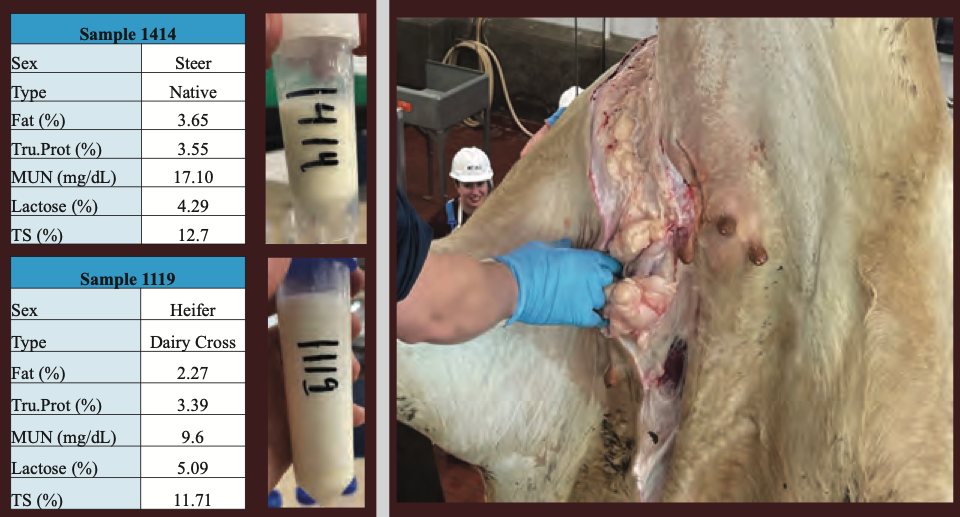
From the West Texas A&M / Cargill research poster — a comparison of a steer and a heifer, both of which were lactating.
The Experiment I Want to See
We already have cattle populations capable of helping us answer these questions. Compare native beef genetics with dairy and beef-on-dairy genetics. Include verified never-implanted animals and animals following precisely documented implant programs. Include castrated and intact males. Most importantly, stratify them by objectively measured adiposity rather than assuming pasture cattle are lean and feedlot cattle are fat.
Record lifetime implant history, age at first exposure, compounds and doses, release duration, reimplantation history, age at castration, age at slaughter and time between the final implant and harvest. Measure internal fat depots as well as carcass fat. Measure estrone, estradiol, testosterone, prolactin and other relevant endocrine markers. Examine mammary tissue and actual secretion. Observe cross-sucking behavior rather than assuming it occurs or doesn’t. If agricultural chemical or environmental exposures are going to be considered or excluded, characterize those exposures rather than relying solely on assumptions about them.
Then follow the data wherever they go. If verified never-implanted steers at 32 or 35 percent empty-body fat lactate at the same rate as implanted steers at equivalent adiposity, my implant suspicion takes a serious hit, and I will accept that result. If equally fat never-implanted cattle don’t lactate at comparable rates, the implant question becomes much harder to dismiss. If cross-sucking dramatically changes the probability within either population, we learn something else.
Perhaps the eventual answer won’t fit neatly into any of our camps. That would be science doing its job.
What If Dr. Lawrence Is Completely Right?
I keep returning to this question because even the answer that most undermines my original hypothesis doesn’t necessarily reassure me.
Suppose implants have nothing to do with it. Suppose Dr. Lawrence is entirely correct, and extreme adiposity explains the phenomenon. It would mean we have become so successful at manipulating genetics, nutrition, castration and finishing that we are producing cattle capable of reaching a degree of adiposity where their own fat alters their endocrine environment enough that castrated males begin producing milk and open females lactate without ever having a calf.
Lactation is a female reproductive function. Finding it in a castrated male, or in a female that has never experienced pregnancy or parturition, is precisely why this phenomenon is so striking.
Dr. Lawrence doesn’t regard the lactation as desirable. He sees it as an inefficiency. Once an animal begins producing milk, nutrients are being diverted into a biological function the producer isn’t trying to create, and eventually the animal can begin losing body condition. From a production standpoint, we have crossed the optimum: We kept pushing the animal for more finish and quality until some of the additional energy began going somewhere we never intended.
Even if adiposity turns out to be the entire explanation, that seems worth paying attention to.
What Does “Highest Quality” Mean?
This may be where conventional and regenerative producers are asking different questions. Dr. Lawrence points to the extraordinary consistency of modern American beef. From the standpoint of marbling, eating quality and consistency, he believes we are producing some of the highest-quality beef in American history. Prime cattle are far more common than they once were, while Select is now far less common relative to Choice and Prime.
For many consumers, that is exactly what quality means.
Other consumers are asking different questions, though. How was the animal raised? What did it eat? Was it raised on diverse pasture? Did it receive hormonal growth promotants? Was it continuously confined? How long did it live? What ecological function did it perform while alive?
Those aren’t imaginary distinctions — research has found nutritional differences between fully grass-fed and grass-finished beef and conventionally grain-finished beef, particularly in fatty-acid profiles and some micronutrients. Emerging research also suggests that the botanical diversity of an animal’s diet can influence phytochemicals and other compounds ultimately present in meat.
Nor does forage finishing necessarily mean cattle cannot become highly finished. On my own ranch, our cattle sometimes stand in cover crops filled with mature millet, sorghum-Sudan and other seed heads. Calling that simply “grass” misses what the animal is actually consuming. With the right genetics, nutrient-dense forage and enough time, cattle can develop significant marbling and adiposity without entering a conventional feedlot.
That makes these cattle scientifically useful too. If Dr. Lawrence believes 30 to 35 percent empty-body fat is the important threshold, I want to find extremely well-finished, verified never-implanted forage cattle and look at them. Adiposity and production system should not be treated as interchangeable variables.
Regenerative and organic producers also don’t need to claim that every steak we produce is nutritionally superior in every possible measurement. But neither should we pretend our production practices are merely a marketing story pasted onto an otherwise identical product.
Our differences need to mean something. If you don’t use steroidal growth implants, tell consumers and explain what that means. If your cattle harvest diverse living plants rather than spending their finishing period on a conventional high-energy ration, explain why you value that. If your animals take longer to finish, explain the tradeoff. If you choose not to castrate, explain that too.
Dr. Lawrence may be right that conventional agriculture is producing extraordinarily consistent, highly marbled beef. That is one definition of quality. Regenerative and organic producers are offering consumers additional definitions of quality, and consumers get to decide which attributes they value.
The Culture Looking Back at Us
There is one uncomfortable thought I haven’t been able to shake during this investigation.
We are having an enormous cultural battle in America over sex, hormones, bodies and identity. We argue about declining testosterone in men and increasing obesity. We live in a food environment capable of supplying enormous amounts of inexpensive calories while metabolic disease surrounds us. At the same time, we are fighting bitterly over whether children should be permitted to alter their sexual development through hormones or surgery before the frontal lobe is fully developed.
Meanwhile, in agriculture, we castrate male animals, administer endocrine-active compounds and feed energy-dense diets while deliberately manipulating physiology to produce the carcasses the market rewards. Then we eat those animals.
I am not claiming that eating implanted cattle causes transgender identity. I know of no evidence supporting that statement, and making it would cheapen the much more interesting question I am trying to ask.
What interests me is the mirror. We have constructed a human food environment that encourages enormous caloric consumption and metabolic dysfunction while constructing animal-production systems designed to maximize growth, feed efficiency and body composition. We manipulate hormones in ourselves and in our livestock, though for completely different purposes, and then become surprised when biology produces outcomes we didn’t anticipate.
We raise animals inside that system, and then those animals become us in the most literal nutritional sense: We eat them. I cannot prove that the biological abnormalities we see in livestock explain anything occurring in human culture, and I am not trying to. But I do wonder whether society is reflecting something back to us about the way we feed, manipulate and understand the biological world.
As farmers, I think we are allowed to ask the question.
Virality Isn’t Investigation
When this story began circulating online, it exploded. Millions of views accumulated across videos, memes and posts. People reacted with some version of “Of course — another insane thing they’re doing to our food. Nothing surprises me anymore.” I understand the reaction because I had essentially the same one when somebody first showed me the poster.
But virality isn’t investigation. If regenerative agriculture is going to offer something more meaningful than another tribe in the culture war, our job cannot end at “I knew conventional agriculture was bad.” We have to be willing to discover that our first explanation was wrong, partially wrong, or only one part of the answer.
Dr. Lawrence has been extraordinarily generous with his time even though I continue challenging his hypothesis. His research team has been willing to answer questions. They attempted to obtain funding to investigate the hormonal mechanism, and Dr. Lawrence told me he intends to continue trying to fund the work.
I respect that. I also intend to keep asking uncomfortable questions about implants, castration, cumulative hormonal exposure, calf-ranch practices, cross-sucking and environmental exposures. Those positions are not contradictory. They are what curiosity is supposed to look like.
The Animal Still Gets a Vote
Farmers were observers long before laboratories existed. We notice when conception rates change, when calves aren’t thriving, when an animal’s behavior changes and when pasture responds differently after rain. An observation isn’t proof; it is an invitation to investigate. Nearly 15 percent of native steers and almost 20 percent of dairy-cross steers lactating is an invitation I don’t think agriculture should ignore.
Maybe the ultimate answer vindicates conventional implant programs. Maybe it challenges them. Maybe Dr. Lawrence demonstrates that regenerative cattle would do exactly the same thing if we finished them to comparable levels of empty-body fat. Maybe Derrick Josi’s observation about cross-suckling leads somewhere none of us expected. Maybe a variable we haven’t adequately measured — diet, genetics, agricultural chemicals, environmental exposure or something else — changes the picture. Most likely, I suspect, biology will turn out to be messier than any single explanation.
What I am unwilling to do is redefine an unexpected biological outcome as normal simply because we discover it is common. A castrated male producing milk is a biological signal, and producers have a responsibility to understand what that signal means. Whether the lever is adiposity, hormonal implants, castration, mechanical stimulation, genetics, diet, agricultural chemicals and other environmental exposures, time — or some interaction among multiple factors — we should be curious enough to find out. Not every one of these possibilities has equal evidence behind it, and some may ultimately prove irrelevant. But the point of investigation is to measure the variables before we eliminate them.
There is a larger question underneath this investigation: What are we actually trying to optimize?
For most of modern agriculture, the answer has been efficiency: more pounds, less feed, faster gain, greater consistency and more predictable carcasses. Those things matter. A farming system that bankrupts the farmer cannot survive, no matter how beautiful its philosophy. But an agricultural system also cannot ultimately succeed if efficiency comes at the expense of the animal, or if the people eating the food increasingly distrust how it was produced.
I want agriculture to pursue a different equation: a win for the farmer, a win for the consumer and a win for the animal. The farmer should be able to make a living — not barely survive, not subsidize the food system with an off-farm job, but build a viable business producing food. The consumer should receive nutrient-dense, delicious food from a system they understand and can choose with honest information. And the animal should be allowed to express as much of its natural biology as is reasonably possible while living a life worth living.
Those interests do not have to be enemies. In fact, I believe the future of agriculture depends upon bringing them back into alignment.
That is why this strange story about lactating steers matters to me beyond the question of what caused the milk. It forces us to ask whether our measurements of agricultural success are complete. Perhaps an animal can achieve extraordinary feed efficiency, marble beautifully, grade Prime and produce an economically excellent carcass — and still be telling us biologically that we pushed something too far.
Perhaps the answer is not to reflexively reject every technology used in conventional agriculture. It is also not to defend every technology simply because it improves efficiency. The responsibility of farmers — and of scientists — is to keep asking whether an intervention produces a genuine net benefit once we count everything that matters.
Consumers have a role in that calculation too. Every dollar spent on food is ultimately a signal about the agriculture we want. But consumers can only make meaningful choices if farmers tell them honestly what distinguishes one production system from another and researchers are willing to investigate uncomfortable biological outcomes rather than dismissing them as curiosities.
The millions of people who reacted to this story have already demonstrated that they want to know. Now agriculture owes them something better than outrage, memes or reassurance. We owe them answers, and we owe the animals the same curiosity.
Efficiency and biological normalcy are not necessarily the same thing. The best agriculture should not require us to choose between the prosperity of the farmer, the health and trust of the consumer, and the biological integrity of the animal.
The goal should be a system in which all three can win: The farmer gets a vote. The consumer gets a vote. And the animal still gets a vote.