
A Note from Taylor Henry, Owner of Acres U.S.A.
The passing of Wendell Berry is a tremendous loss—not only to agriculture, but to anyone who believes that our relationships with land, food, community, and one another matter.
Acres U.S.A. was fortunate to have a long history with Wendell. Long before “regenerative agriculture” became a common phrase, he was challenging people to think about what happens when agriculture becomes merely an industry and a farm becomes merely a unit of production. When Acres interviewed him in 2002, we described him as a spokesman for “America’s heart, its culture, history and freedom.”
Reading this interview nearly 25 years later, what strikes me most is how little of it feels dated. Wendell talked about an agriculture built around exhaustion rather than renewal. He argued that a family farm isn’t simply a unit of production—it is a home, a family trust, a place to raise and educate children, and something that carries with it an obligation of maintenance and good care. He believed good farming had to be adapted to the land and practiced by people who knew that land intimately.
Perhaps most importantly, he understood stewardship as something much bigger than a farming practice. In the interview, he said that our moral obligation was to care for what we depend upon and will eventually pass to the generations that follow us—to “waste nothing and ruin nothing.”
That idea is as close to the heart of Acres U.S.A. as anything I could write. We have spent more than 50 years trying to preserve and share the ideas of people willing to challenge the industrialization of agriculture—people who remind us that soil, farms, and communities cannot simply be mined until there is nothing left. Wendell Berry was one of the clearest and most important voices ever to make that argument.
In appreciation of his life and work, we are opening our archives and republishing this 2002 Acres U.S.A. interview, along with his 2007 Acres talk.
There is no better tribute we can give him than to read his words again, share them with another generation, and—most importantly—put them into practice.
Thank you, Wendell. Your work will continue.
— Taylor Henry
Owner, Acres U.S.A.
Fitting Farms to the Land
Social Philosopher Confronts ‘Modern Superstition’
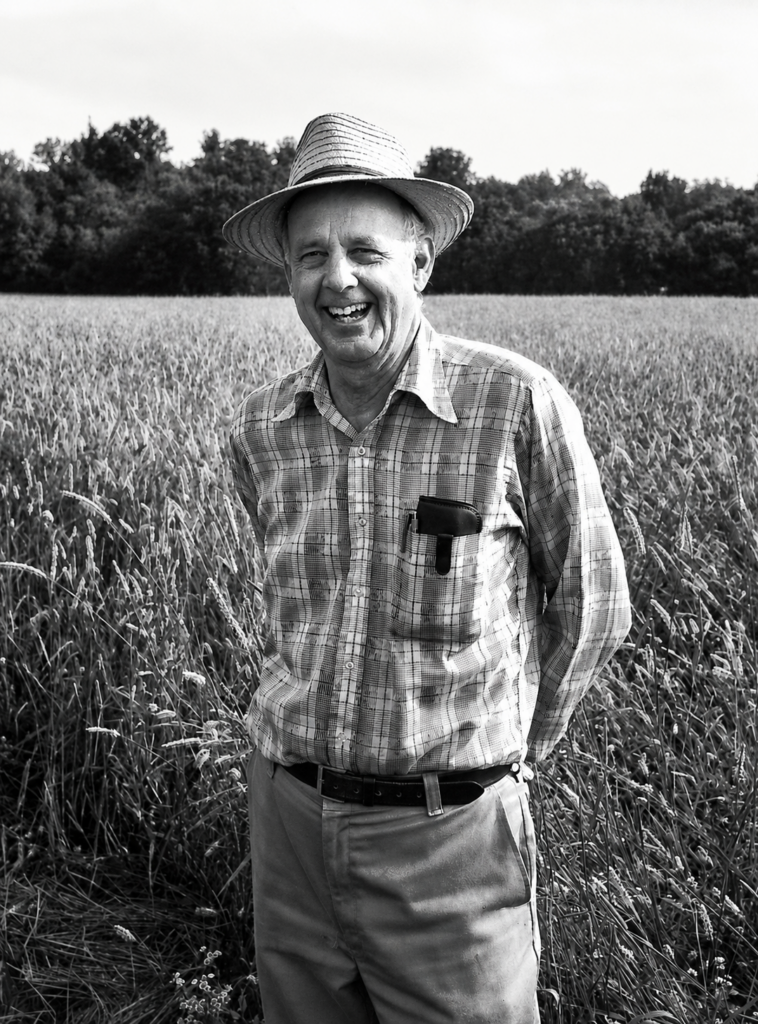
Wendell Berry
Wendell Berry is America’s star presenter of uncommon good sense. His commentaries are those of a social philosopher anointed with the refinements of poetry and literature. His Unsettling of America: Culture & Agriculture and dozens of other books, poems and platform presentations remind a small confederation of Cassandras that all is not dross, that there is thinking about that sounds the summons of a glass bell.
Wendell Berry is a gentle rebel with the uncanny ability it takes to unmask blunders, impale contradiction with the offender’s own petard, and explain to his fellow countrymen the long range consequences of the public policy sold by spin minsters with syrupy logic.
Berry is a poet, a much recognized word artist whose awards fill several pages of small type. Included in the above is a Guggenheim Fellowship and a Rockefeller Foundation Award, Vachel Lindsay Prize, Poetry Magazine’s Bess Hokin Prize, and the T. S. Eliot Award. Two of his books were mentioned in Acres U.S.A.’s Newsletter a few months ago.
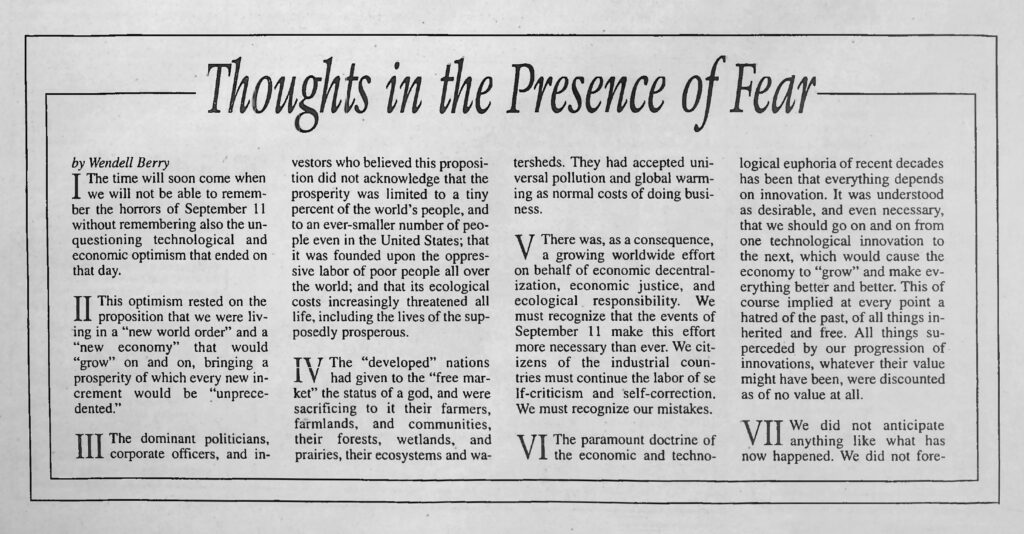
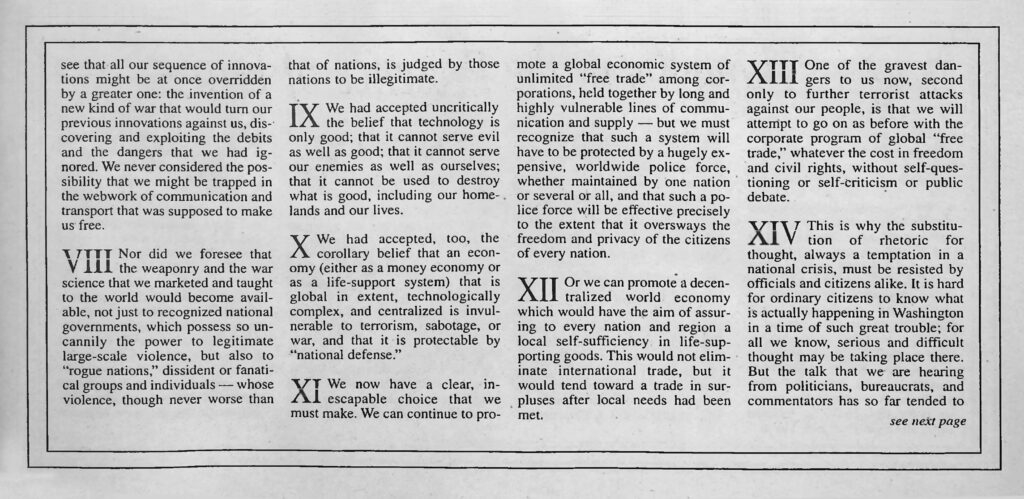
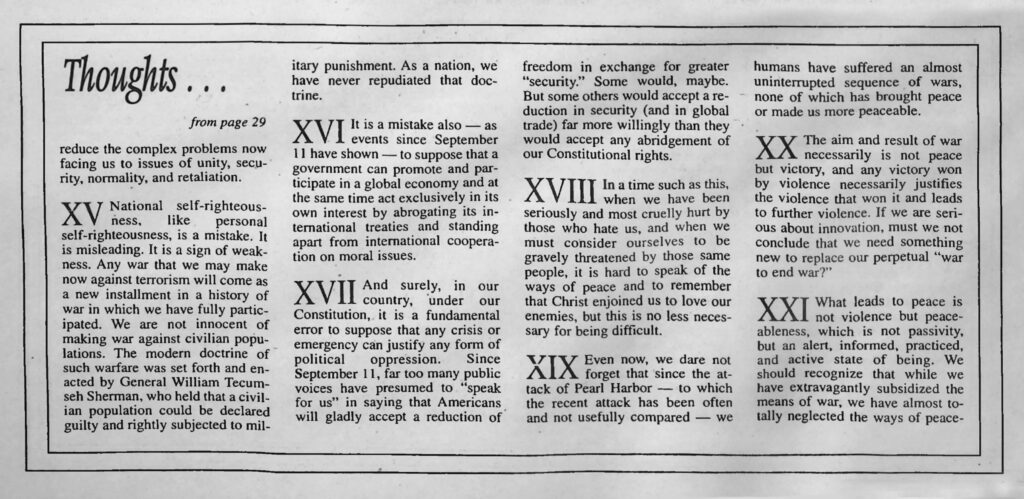
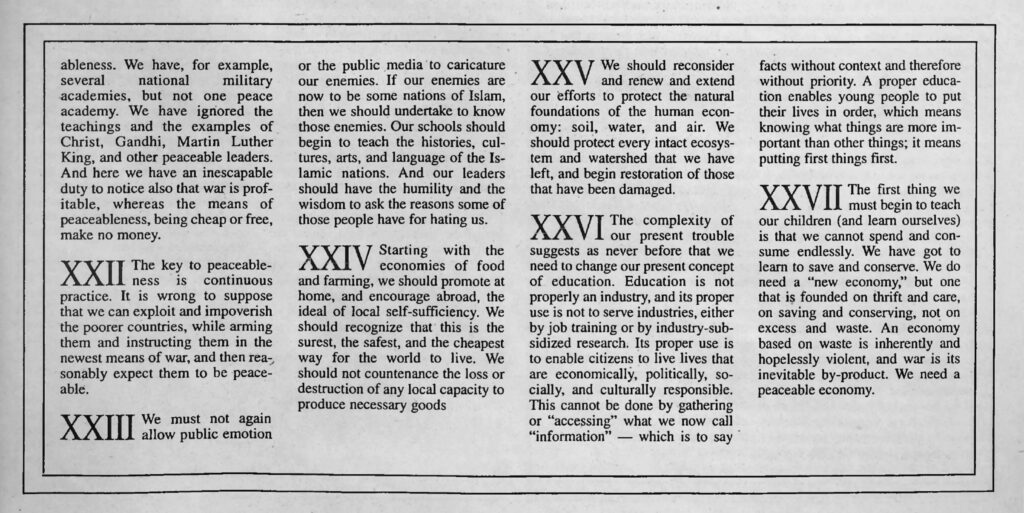
Reputation and credits are merely an aside. What is important today is the thinking of this much loved spokesman for America’s heart, its culture, history and freedom, both economic and political. His essay “Thoughts in the Presence of Fear” is reprinted here.
Interview
ACRES U.S.A. In the presence of a new world order industrial model for agriculture and the perception that there is an inexhaustible supply of raw materials, where are we headed?
WENDELL BERRY. We are heading toward exhaustion. The assumption of inexhaustible raw materials is false. It has been the reigning assumption for a long time, but we know that we are dealing with finite quantities all along the line.
ACRES U.S.A. And the industrial model is exhausting that finite quantity rather rapidly, is it not?
BERRY. That’s right. It is the economics of exhaustion.
ACRES U.S.A. How did we get into this lot? What happened to the United States that started out with such lofty ideals?
BERRY. I think we always had the illusion that there were inexhaustible quantities of raw materials. We stood on the edge of this huge land mass and we realized that it had been very little exploited by its original inhabitants. It was there for us to use as we saw fit and there was an enormous amount of it. We began with the illusion of inexhaustibility. Our estimates of how long it would take to settle the country were way off. We did it much faster than the predictors thought we would. Now it is no longer an illusion; it is a fantasy. The idea of inexhaustibility of resources is a consciously maintained fantasy, and it is not going to work.
ACRES U.S.A. We sort of made the transition from an agriculture based on husbandry and agronomy to one of mining, did we not?
BERRY. Yes we did. Wes Jackson has been very good on this subject. We are using agriculture, which is a potentially renewable economy, as another one of the economies of exhaustion. We are using it as a way of mining. In other words, we are using a renewable resource as an exhaustible one, and we are exhausting it as fast as we can.
ACRES U.S.A. In some of your writings you have mentioned the proxy at times. Can you explain what you mean by that?
BERRY. I am making an analogy to the idea of a political proxy. Modern consumers have given their proxies for production to all sorts of people, among them are the farmers. The modern food consumer typically does not produce any food. The proxy is given to somebody else to do it. Someone else must get down on hands and knees to deliver the calf; someone else must work in the weather. The rule about proxies is that you have to supervise them. We give our representatives in the government our proxies to represent us, and the rule, as people have been telling us since at least Thomas Jefferson, is that you have got to oversee the proxy holders or you ultimately lose your freedom. These agricultural proxies that have been given by modern consumers have not been overseen. The modern food consumer typically has been an ignorant consumer who has no idea where the food comes from or what is involved in its production or what is done to it.
ACRES U.S.A. Or even whether or not it is food!
BERRY. Even whether or not it is food. Yes, that’s right.
ACRES U.S.A. Let’s talk about romantic environmentalism, which is sort of the handmaiden or opposite side of the equal sign from romantic capitalism and romantic communism. That’s been one of your favorite themes.
BERRY. I don’t know whether it is a favorite or not, but it is one I have needed to go back to from time to time. The idea of romantic environmentalism begins with the idea that the world is an environment that is different from us and outside of us — our “surroundings.” This assumes that the world is away from us “out there,” and we experience it as scenery or a recreational place to “go to.” This is a radical separation of human beings from the world that sustains us and with which, in fact, we have a much more intimate relationship. We eat the environment and we excrete it. We breathe it in and out. We live in a world of which we are a part.
ACRES U.S.A. In other words, we are part of the organism.
BERRY. Yes, we are. We are little organisms who are parts of a great organism.
“We are little organisms who are parts of a great organism.”
ACRES U.S.A. It is a little easy to get carried away with the idea of that vision. In the ’20s and ’30s Lincoln Stephens and some of those people had this great vision of communism — the future now. In our own day, of course, we have this vision of capitalism that qualifies under your term of romantic capitalism.
BERRY. I think one part of it is the romanticism of progress — that things are inevitably getting better and better.
ACRES U.S.A. We act as if there is just not any system that could hold its own against this great capitalistic empire that delivers so much for so many people, when, in fact, a sizeable section of these people are being ushered into abject poverty. Isn’t that the point?
BERRY. Perhaps these romantic ideas are a mask for the fact that the big economy, what we now call the global economy, is a way of allowing a few people to plunder all the other people, and to plunder the world in the process.
ACRES U.S.A. But the leadership speaks of it as a moral imperative for the entire world.
BERRY. The moral imperative, it seems to me, is always to take care of the things that you use, that you are dependent on, and that you will pass on to generations still to come. The moral imperative is to waste nothing and ruin nothing, to keep the world as an inheritance given in trust to pass on to coming generations. There is no moral imperative to waste and ruin and plunder. That’s hogwash.
“The moral imperative is to waste nothing and ruin nothing, to keep the world as an inheritance given in trust to pass on to coming generations.”
ACRES U.S.A. Regardless of whether it is justified on the basis of false accounting or not.
BERRY. If you do plunder, waste, exploit and steal, that leads directly to false accounting. You do not get false accounting to begin with. I think you get false accounting after you have made the fundamental moral error, which is to assume that the earth is yours to do with as you please. I am deliberately avoiding religious language, but obviously there is a religious reference involved here.
ACRES U.S.A. It all comes back to this: you have six billion people on the planet and four billion of them are probably shared out completely. Would that be correct? If that is the case, this system of globalism can have consequences that will lead to the destruction of political and institutional arrangements across the board. It comes down to the Walmart approach to cheap regardless of what it does to the local situation is not to be ratified.
BERRY. The doctrine of cheapness at any price. This takes us back to bookkeeping because what the bookkeeping has done so far is externalize all of the costs except for the ones that the corporation in question wants to honor or thinks it can readily pay back. To permit Wal-Mart to destroy your community in the name of cheap commodities is insane, because we simply have no way of getting onto the books what the cost of a ruined community ultimately will be. We don’t have any way at present to account for the value of a functioning community. Wes Jackson says that the science of the new century will be bookkeeping, and he means learning to set the books up so that the real costs of things are accounted.
“To permit Wal-Mart to destroy your community in the name of cheap commodities is insane, because we simply have no way of getting onto the books what the cost of a ruined community ultimately will be.”
ACRES U.S.A. What this all boils down to is that we have to go back to that family farm unit that was squeezed into being bigger and bigger until now it is a relief client.
BERRY. This again is a failure of our way of accounting. We have lost those little farms because we insisted on classifying them only as units of production. We have got to learn to take a more complex view of it. A small farm belonging to a family is not just a unit of production. It’s a home, for one thing. It’s a family trust. It’s a place of entertainment. It’s a place of trouble and trial, too, there’s no question about that. It’s a place to raise children and a place to educate children — it’s a school. It has lots of functions besides just that of production. It’s a place of maintenance also, and we had better say that before we go any farther. The industrial idea of production involves no idea of return. We cause the thing to produce to the point of exhaustion. But always in a natural system, as in a religious system, there is this counter movement of return, of gratitude for the thing that has been gained or given, but also there is the obligation of maintenance, of good care. To return the waste to the soil, for instance, is an obligation that we have ignored on a big scale.
ACRES U.S.A. The farm managed on an individual basis takes more of these aspects into account than the one that gets bigger and bigger until it consumes its own capital, doesn’t it?
BERRY. Yes. The idea of a farm being the consumer of its own capital is a suicidal idea. A well-managed farm preserves itself, and it produces satisfaction along with an income. We always have to look for these multiple returns. When you are cleaning your barn, if you do it right, you are enriching the soil, and you are satisfying yourself, so you are not doing just one thing. I think on a good farm you rarely are doing just one thing.
“A well-managed farm preserves itself, and it produces satisfaction along with an income.”
ACRES U.S.A. We used to have an associate who was a farm editor on a paper in Oklahoma. He said, “The demise of the family farm also means the demise of one of the most successful institutions of learning the country has ever had.”
BERRY. There is no question about it. The English agrarian writer William Cobbett in Rural Rides of “a little hop-garden” where he worked and played as a small boy: “This was the spot where I was receiving my education.” It was this education, he said, that had kept him from becoming a milksop and a fool. I think all of us who grew up farming knew that we were going to school. These one-time farm boys who get into agricultural economics and on one hand acknowledge wistfully the benefits of growing up on a farm and on the other hand justify the destruction of the very childhood that they enjoyed are ridiculously at cross purposes.
ACRES U.S.A. Jimmy Carter’s book about growing up on a Georgia farm argues this educational aspect that we are talking about now. Let’s depart a little. In one of your books you talked about the Menominee Indians. Could you recast that for us now?
BERRY. We were going to have a forest conference here and a friend of mine, William Martin of Eastern Kentucky State University, asked me if I would speak. He said I should talk about the kind of forestry we ought to have. Our state of Kentucky has 12,700,000 acres of forest, mostly privately owned by people who do not know what their woodlands are worth, much less how to take care of them. I thought I needed an example. I had heard of the Menominee forest and I had seen some statistical reports on what those people had accomplished. The most significant thing, I suppose, is that they have been logging their forest for about 150 years, and it has more standing board feet in it now than it had when they started.
ACRES U.S.A. And this was through good forestry practices?
BERRY. The story is that when they were forced out of their ancestral lands into their reservation in Menominee County, Wisconsin, the tribal leaders instructed the young men that the tribe would now have to live from their forest. The young men were to start on one side and log their way across, but they had to do it in such a way that, when they reached the other side, they could go back to where they started and do it again. That is essentially the program that they have followed. It is a very sophisticated forestry program now, with computer models and all of that, but it is still essentially the same program. They go into each area of the forest every 15 years, and they mark the trees that are not likely to live for the next 15 years. Those are the only trees that they cut. The forest ecosystem in Menominee County is intact, with very old trees still standing. The foresters have left them standing because they are healthy, they are still making wood. To drive from the Menominee forest, which is still an intact and thriving forest ecosystem, northward to where the forest was clear-cut many years ago is an instructive experience, because you drive out of a healthy ecosystem into a degraded one. It is one that has been degraded for a long time and will continue to be degraded. It is readily apparent what the difference is.
ACRES U.S.A. And this same degradation goes on as we move into field agriculture using the toxic technology and so on, doesn’t it?
BERRY. Yes. I know you are acquainted with the work of Sir Albert Howard. He said a half century ago that if you want to know how to farm, you have got to look at the forest. Wes Jackson came along maybe 40 years later and said, since he was a Midwesterner, if you want to know how to farm, you have got to look at the native prairie. Both of them were saying that nature makes the rules for farming, and they both have recited the rules: Farming has to be diverse; you must farm with both plants and animals; you must keep the land covered; you must build and maintain great reserves of fertility; and so on. These are the principles, and they are absolutely contrary to the principles of industrial agriculture. This is biological agriculture that we are talking about, and it takes lots of forms, but essentially the biological program says that you have to keep intact on the farm, in the domestic or economic landscape, the processes that are at work in the natural landscape.
ACRES U.S.A. And do you think this requires broad spectrum distribution of land?
BERRY. Absolutely it does, because farms have to be fitted to the land. Another great writer, J. Russell Smith, said we should “fit the farming to the farm.” We all know that in even the most uniform looking landscapes, the land varies from one acre to another. In order to farm those landscapes well, we have to have enough people on them to know them intimately and use them well. They have to be people who understand the history and nature of the place, and how to preserve it at the same time as they use it. Good farming is inseparable from the idea of economic democracy. The land has to be divided among a lot of owners, as Thomas Jefferson said, and as other writers going all the way back to Virgil have said.
“Good farming is inseparable from the idea of economic democracy.”
ACRES U.S.A. Yet we are going in the opposite direction and the worst aspect of it is, and you’ve been highly critical of it as we have, is this World Trade Organization, especially NAFTA and this idea that this commission of corporations can trump the United States Supreme Court. Bill Moyers had a good program on it the other night and, as he pointed out, if you allow them, they will take Canadian Lakes and water the deserts in Sonora with them.
BERRY. There are people who would do that. The proper thing to do, however, would be to go to the Sonora Desert and see how the Papago and the Pima farmed, rather than try to transport the agriculture of Illinois to southern Arizona. The argument for the proper use of the arid West started a long time ago, with John Wesley Powell. Bernard DeVoto argued it; Wallace Stegner, who was my teacher, argued it. You have got to fit the farming to the farm. What we must have is a locally adapted agriculture.
“You have got to fit the farming to the farm. What we must have is a locally adapted agriculture.”
ACRES U.S.A. That was the same statement Walter Prescott Webb made. You can’t expect to transport Ohio to Arizona.
BERRY. It is a mistake that we have been making all along. We go to a new place and pretend that we can behave there in the same way that we did in the old place. We have to let the place prescribe the terms of settlement to the settler. The settler can’t prescribe terms to the landscape — that has never worked, and it cannot work.
ACRES U.S.A. What you have been saying meshes pretty thoroughly with what you say in your “Thoughts in the Presence of Fear” essay. What prompted you to write that?
BERRY. Wes Jackson and I were worrying about the calamity of September 11 and decided that maybe we ought to write something. My immediate thought in the face of terrorism was that we have now the most vulnerable food system imaginable. We have a national food system that is trying, and so far succeeding, to be a part of a global food system. This is a highly centralized system economically, but productively it is more and more extensive. This means we have long supply lines everywhere. These supply lines are highly vulnerable to disruption by sabotage or terrorism. Moreover, the supply lines, even without terrorism, work as conduits for diseases and exotic pests. Even before September 11 we knew that. The forests and fields of our country are being invaded by damaging organisms brought in from other places by the food transportation system. In my little essay I said that we now face a choice: we can either keep this extensive, highly centralized system with its long supply lines and undertake the very expensive and politically threatening task of defending them, or we can come to our senses and develop decentralized food systems based on the idea that localities, states and regions should be, as far as possible, self-sufficient in their economy.
“My immediate thought in the face of terrorism was that we have now the most vulnerable food system imaginable.”
ACRES U.S.A. As local as possible.
BERRY. Yes. The idea, as my brother and I have been saying back and forth to each other for years, is that we should go back to the principle of subsistence. The farm, the community, the region, the state, the nation, each should supply itself first and then export the surplus. Always take care of the local or immediate need and then the surplus is for export — for sale or for charity or however you want to use it.
ACRES U.S.A. This goes exactly opposite to what Stephen Blank says, that the big fish will swallow the little fish and eventually the foreign fish will swallow the American fish, meaning that we will end up importing all of our food.
BERRY. In the process, we will all be swallowed by a food dictatorship that will make us all the serfs of the agribusiness corporations. As I have argued elsewhere, the idea of competition doesn’t propose a lot of small entities competing with one another indefinitely. It proposes, finally, one corporation. Competition ultimately destroys competition. The law of competition is the same as the law of war: finally you have one victor. When you come to that, you have come to capitalist totalitarianism.
Wendell Berry’s books remain widely available through independent bookstores and booksellers. Many of his works are published by Counterpoint Press, with additional collections available from the Library of America.
Listen to our 2007 recording of Wendell Berry’s address at the Eco-Ag Conference in Louisville, Kentucky.