

Research scientist Frank Dean talks with John Kempf about chelation, glyphosate and the vast farming knowledge that has been lost
John Kempf: Frank, can you tell us a little bit about your journey as it relates to the agricultural space and some of the things you’ve been working on?
Frank Dean: Well, it started years ago. I worked for Stoller out of college; I put together all his chelates. Then I went to work for LidoChem, which is a chemical distributor. I developed some end-use products that have some value in the marketplace, and I’ve been doing that for over 20 years.
Kempf: I’ve been looking forward to having a conversation with you about chelation. Chelation is often promoted in a positive sense — that we need nutrients that are more chelated and therefore more readily bioavailable. And then, on the flip side, when we talk about the mode of action of various pesticides and herbicides, the mode of action is described as also being a chelation.
So, what is the difference between those two? How is it that on one hand we have chelation being a positive, on the other hand, chelation has the ability to kill plants or other organisms?
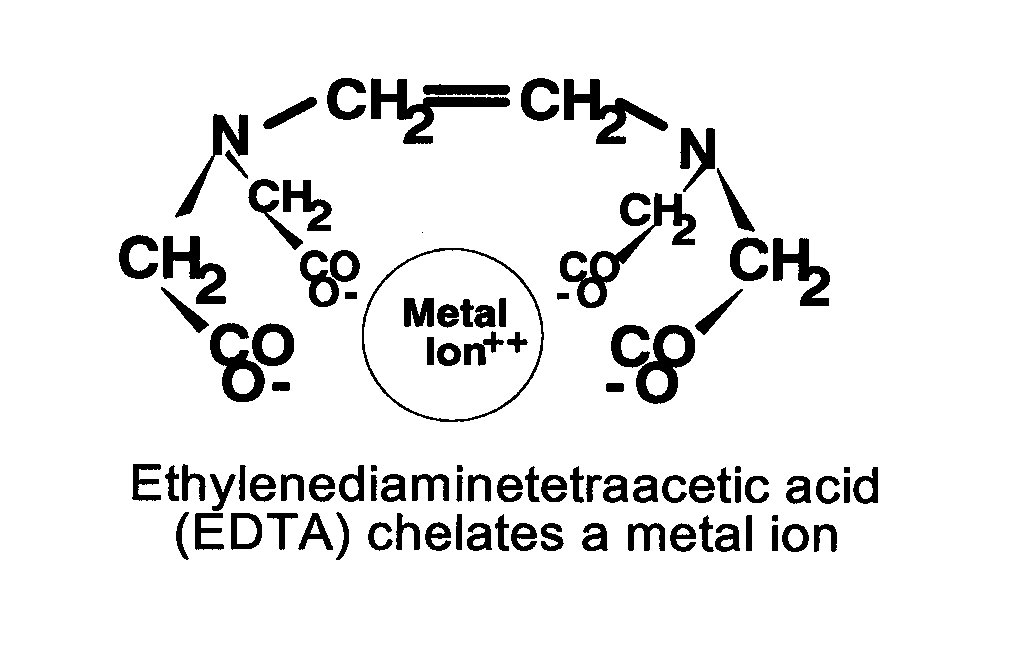
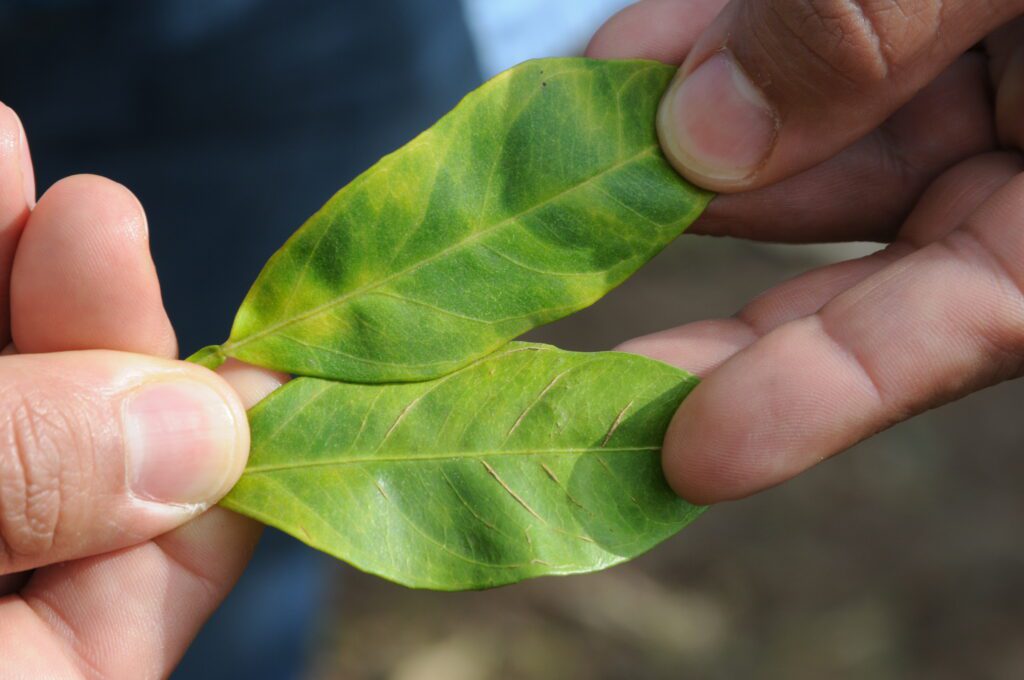
Dean: Well, herbicides are able to chelate certain metals. Now, they’re not being distributed on the ground; they’re being distributed on plant tissue, which means that the concentration of metals in the plant is much, much lower than it would be in the soil. So, you have this herbicide, say, going into a plant, collecting all the manganese or iron or copper, and eliminating the ability of the plant to have normal metabolism.
You need these metals — zinc, copper, manganese, iron — as enzyme catalysts inside the plant. If the metals are not there, then the metabolic reactions inside a plant either get slowed down or shut down. And then, as you know, if you have mineral deficiencies in plants, oftentimes the plant becomes very attractive to fungi, bacteria and insects; if the plant has a full load of micronutrients, along with adequate macronutrients, it becomes much more resistant.
There’s a couple of things we have to understand. The metal is an individual atom. You’ll see them as a little circle on a piece of paper with two little plus signs, which says that they’re positive. Now, a chelate is often a weak acid. As you put it in water or solution, only a little bit of the acid comes off the weak acid, and then that acid has a negative charge. So, if that weak acid can find the metal, then you go from a plus-two to a plus-one. But if there’s more than one weak acid on a molecule, the second arm of the chelating agent attaches much more easily, which means that your original plus-two cation now has no charge at all.
For instance, a metal is an individual atom; EDTA, a chelating acid, has 36 atoms. If you connect two of them, you get no charge at all in the new molecule. If you collect three, that iron or copper begins to take on a negative charge. Things like carbonates, sulfates, phosphates — EDTA can make certain metals insoluble at negative charges.
Now your metal has a negative charge; it becomes immune to attack. So, you have this little round ball of a metal and it’s now being covered by 32 other atoms. Even if the chelate was to fall apart somewhat, there’s still no room for the negatively charged anion to attack the metal. You’ve got this blanket, or web, around the metal, protecting it.
Then, when it’s taken in by the plant, the plant has a pH of, say, 5.5 or 6.0 in its sap. That’s enough to start to break the chelating agent apart and free up the metal. Whether the plant disposes of the chelating agent or metabolizes it, it doesn’t matter at that point. If it were in the soil, the roots would set out organic acids. Those are enough to release the chelating agent and make the metal available. In the plant, sap has to do this.
Now, some herbicides have the same properties. However, the herbicide is shutting down metabolic processes inside the plant.
Kempf: Shutting them down by removing the enzyme cofactors — the metals.
Dean: That’s right. And when it shuts them down, other parts of the plant get backed up in the precursors to the enzyme, which become toxic at some point, and that’s what kills the plant.
For instance, glyphosate — it’s a weak acid. And when you take a weak acid and you place it in a solution — water or sap — it may have a lot of acid potential, but it’s only going to release a very small amount of it. For instance, you could put 100 percent EDTA in water and you might end up with a pH of three — as opposed to hydrochloric acid, which would be a pH of zero or one. So, it only releases a little bit of hydrogen at a time. That is what’s called the “dissociation constant.” You’re going to hear this word when you talk about chelates.
If you take the number one and divide it by the dissociation constant, you get the stability constant. So, if you have a stability constant of six, that tells you that out of the hundreds of millions of acids available — hydrogens — only one million at a time are going to be available. You don’t get that very low pH. It stays in equilibrium. Now, once that hydrogen is dealt with, another hydrogen will come off to maintain equilibrium.
So, glyphosate stability constants are pretty strong. For manganese, for example, it’s a 12. That means only one atom in 1012 is going to be available in solution at any time. That’s a very tiny number.
Imagine you have 106 parts per million of, say, manganese or iron or copper in your plant tissue. How do you overcome that? Say the glyphosate grabs a manganese. It’s only going to release one in 1012 atoms. Even though the manganese might be available, there’s not enough in a plant to make that happen. There’s not 1012 atoms of manganese in a plant.
Different herbicides have different chelating abilities. Some of them go after copper, some go after iron, etc.
Kempf: As I’ve understood it historically — and I think what you’re describing — is that the relative difference between chelation as a source of nutrition and chelation as a binder of nutrients is a reflection of the stability constants. It’s a reflection of their chelation bonding strength.
Dean: That’s absolutely correct — and the concentration of the metal that’s available. Say you have 20 parts per million copper in your plant, and the herbicide comes in and collects all the copper. But it’s only going to release one for every 1012. That means you’re not going to get any release ever.
Kempf: Yeah. You are not going to get any released ever, relative to what the biological needs of that plant are. Functionally, the plant has a 100 percent copper deficiency. And when you have a functional complete copper deficiency, that’s enough to kill the plant.
Dean: It truly is. And the same with manganese on corn or beans, or alfalfa. That’s why people will apply manganese in the herbicide sprays — just to overcome that. To overcome the deficiency caused by the herbicide, you have to put on maybe a pound of manganese, or a tenth of a pound of chelated manganese. You have to overwhelm the amount of herbicide applied just to get adequate nutrition again. Essentially, you’re tying up the herbicide with the agent you’re applying, and then you have to overcome that with the excess.
Say you’re going to go out and spray beans with glyphosate, and you know they’re going to turn yellow, so you want to apply some manganese. And when you apply the manganese, you don’t apply it in parts per million. You’re going out there in parts per hundred, in order to overwhelming the ability of the agent to chelate what’s inside the plant.
Kempf: What is the chain of dominoes that results in plant death after metal chelation? You remove all the copper from a plant, or you remove all the manganese from a plant; what happens after that to result in plant death?
Dean: First of all, you tie up all the metabolism, and then you have a backup of precursors that become toxic inside the plant. Second, the plant loses its ability to defend itself against insects, bacteria and fungi. Whether the plant dies from excessive buildup of precursors in the metabolic chain, or from exposure to fungus, insects or bacteria, it all seems to happen at once.
When you get tied up, the enzymes fail to form. For glyphosate, you have the essential amino acids being blocked. So that means you cannot produce any phytoalexins, which are a plant’s natural antibiotic. You can’t produce any plant hormones like indole-3. If you can’t make that benzene ring, you end up not being able to protect yourself.
Normally — in an attack on a healthy plant — a fungus gets on a leaf, the plant produces lignin, the plant contains that fungus inside that cell, and that cell becomes a suicide cell. That blocks the fungus from spreading to other cells. That’s a good, healthy plant. If you cannot make lignin, though, the plant cannot contain the fungus. And so you don’t have a suicide cell — you have a suicide plant.
Kempf: It’s my understanding that when you apply glyphosate to a plant, you also affect the microbiome around the root system. And not only do you have a suppressant effect on the disease-oppressive organisms, but you actually enhance a group of various different pathogens, particularly fusarium, and that fusarium population just explodes within the plant.
And my understanding of glyphosate resistance in weeds has been that we’re not so much selecting weeds that are resistant to glyphosate as we are selecting weeds that are resistant to fusarium. But I’d love to get your perspective on that.
Dean: That’s 100 percent accurate. In 2002, Monsanto filed a patent on glyphosate as a biocide. Not an herbicide — a biocide — which means it has the ability to kill a lot of different lives.
Kempf: When you look at all the families that are listed on the patent and you recognize what they mean, it makes your head spin.
Dean: That’s right. Say you’ve got Bacillus subtilis protecting your plant from insects and disease in the roots. You apply glyphosate. The glyphosate comes down and kills that Bacillus subtilis, which then becomes food for the fusarium fungus.
When bacteria die, they’re full of the same nutrients we are — and as plants are. They just become food. So, they’re recycling, but this way they’re selecting such that only the bad guys can survive and the good guys can’t. That goes into the idea that consuming food with too much glyphosate could affect the microbiome of your own belly, and that will disrupt human metabolism.
So, I try to eat organic. For many years I grew my own food. I’m getting too old for that now. But when you’re aware of these things, you just have to be careful. I’m not saying that all herbicides are bad. I know they’re necessary. I know that insecticides and fungicides are necessary, but it’s usually because there’s something else wrong in the system.
Kempf: When you think about their mechanism and these various modes of action, what I find so intriguing about the herbicide story and the story of chelation is that within the story is the kernel of truth that provides the answer to a lot of other challenges. If you can make a plant sick by depriving it of trace mineral metals completely, then the counterpoint would be that you can make a plant healthy and resistant to diseases and insects by supplying an adequate balance of all those trace mineral metals that it needs as enzyme cofactors.
Dean: Exactly right. That takes me back to a book called Bread from Stones.
Kempf: Julius Hensel.
Dean: Oh, so you’ve read it.
Kempf: Oh yeah!
Dean: This happened in Germany, the idea being that if you give the plant enough nutrition, then, down the line, your livestock become more healthy and more productive, your plants don’t die prematurely, and disease becomes minimal. I always thought that was a really important piece of work, especially for the organic side, or the regenerative side — that we would think of something like that book and say, “That really makes sense.” And Hensel wrote it 150 years ago.
Kempf: If we come back to the comment that you made about the presence of glyphosate in our food impacting our microbiome, there’s now an abundance of literature and research on this. If anyone cares to go look, you can find the information. Depending on the soil microbiome and soil geology, glyphosate can remain on the soil profile for much longer than has sometimes been communicated; in many cases it can hang around for decades.
That has affected my own diet, and my family’s. We eat many organic foods. Not perfectly; we know a number of local farmers that we source things from that are not organically certified, because I’m not persuaded that organic certification is necessarily a correlation to a reduction of toxins, particularly in the case of glyphosate and some of these other herbicides, which hang around in the soil for a long period of time. I’ve seen glyphosate analysis from quite a number of different grains coming from different crops, and there’s a general correlation between the quantity of trace mineral metals that a crop packs into its seeds, given the opportunity, and the glyphosate load that could be in those crops. I still remember seeing some garbanzo beans that were over 4,000 parts per million on a lab analysis. My wife’s favorite food — hummus — is no longer a favorite food in our house!
Dean: Right. And it’s the same with oats. It’s a practice to take the oats down with an application of glyphosate to get them to dry down faster and more uniformly. And if you tie up the metals in the plant, how are they going to move to the seed?
I’ve worked with seed people before, and I always thought, “Well, taking tissue samples throughout the year, that gives you a snapshot of that afternoon.” But if you want to know what’s happening with your crop, you take the seed out of the bin, send that to the lab, get that checked for say, total nutrition, and you’ll find out what’s being blocked in your field.
You might have 4 percent potash in the soil and none in the seed. You might have lots of calcium in the field but none in your seed. I want to see the lab analysis of the mineral content of what you’re selling. If you’re working on a golf course, I want to see the turf cuttings. But if you’re working on apple trees, I want the apples to be sent in for mineral analysis just to make sure that what is in the leaf is actually transferred to the fruit or the seed or whatever you’re selling.
Kempf: What are the agronomic implications of historical herbicide residues in the soil? You discussed the significant stability constant that glyphosate has. To me, that means that relatively small amounts can have a significant impact on some trace mineral metals.
Dean: When you test your soil for metal content, you’re going to get the metal content, but you’re not going to be told what’s being tied up by the herbicide in the soil.
Think of it like this. If your herbicide is collecting metals in the soil and wrapping it up in a blanket, it almost becomes inert. Nobody’s going to eat it. It’s just free to build up over long periods of time. Then, in the spring, you want to plant soy but you’ve got X number of parts per million glyphosate in the field. Jim Wellman found that if you get over a hundred parts per million in the soil, there’s a lot of replant going on. He did studies for several years on that. He found that if you introduce enough biological activity to the soil, then you will be able to knock that back pretty quickly.
You’re looking at replanting, slow starts, uneven emergence — things like that.
Kempf: When you think about soils that have a hundred parts per million glyphosate residue that have accumulated in those soils, what does that translate to, roughly, in terms of quantity of trace mineral metals that are complexed and tied up?
Dean: When you have iron and manganese and zinc in the soil, and you have phosphate, you’re going to end up with zinc phosphate, manganese phosphate, etc. They become little rocks or stones. They’re really not available. They’re not in solution. They’re minerals.
Now, when you get the glyphosate out there at higher concentrations, you don’t have the adequate biological activity in the soil to loosen up those minerals. It is the bacteria, and the fungi, and the mycorrhizae that make those minerals available and water available. If you don’t have them in the field, you end up with issues.
I’ve seen studies where people try to overcome stuff like that. They would put out, say, a couple of tons of chicken manure. But then when you send the chicken manure in for analysis, you find that it has a labeled rate of glyphosate per ton. How do you get over that? And if the stuff is inert biologically in the soil because it’s killed everything that could take it apart, all you can do is add to it.
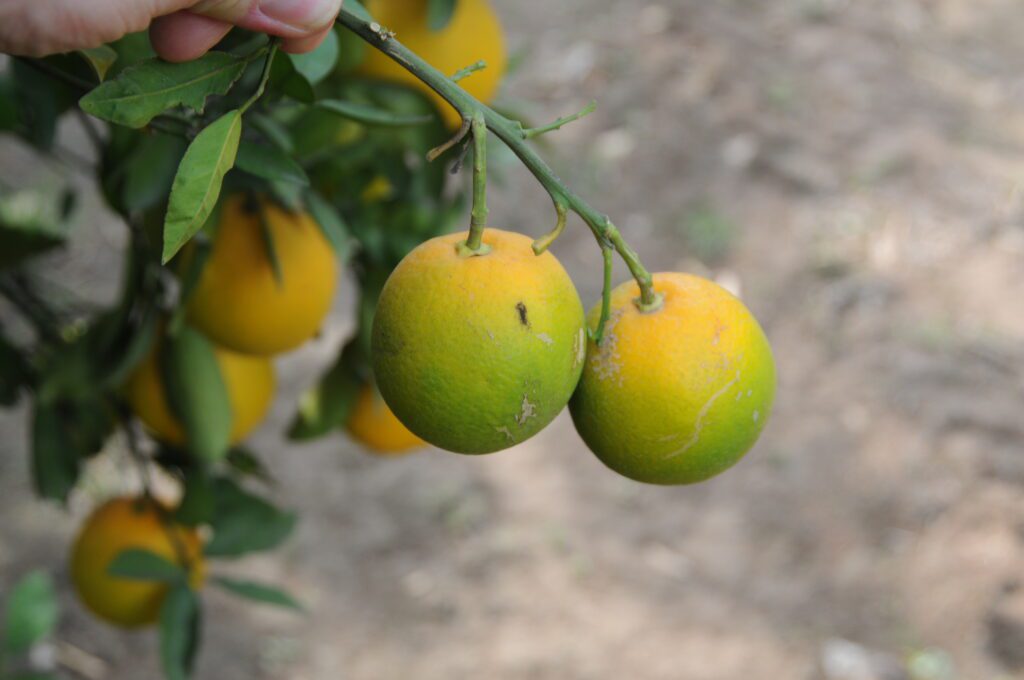
Now, I’ve been to Florida a couple of times, and citrus greening is a big problem. The name of the organism is Candidatus liberibacter. In English that means, “candidate for a disease, if it is ever found and characterized.” There’s no photographs of it. You can look under a microscope; you can’t see it. But think about their practices. They only spray glyphosate under the tree. A common rate is four quarts per acre under the drip line, five to seven times per year. That’s a battle you can’t win.
Kempf: We had a trial a decade ago with a farm in Florida where we applied our nutrient treatments, and we completely reversed citrus greening in 18 months. It was gone. Those trees were loaded up with fruit. They got 80 percent of a full harvest 18 months after we started our nutrient treatments.
The trial block was three acres, but they never progressed to the remaining 600 acres of the operation.
Dean: We did studies in Florida on 40-acre blocks — 20 treated, 20 untreated. We showed a huge difference. But they wouldn’t move forward with it, even though in the long run their fertilizer and other costs would go down. This was about 25 years ago, and the state of Florida realized it was losing too much of its groundwater to evaporation, so they eliminated overhead irrigation. It became outlawed. Everything became microjet on the soil, which meant that what they used to mow now had to have herbicide applied to it. When they did that, that’s when the changes in color in the plants started to show up, and mineral nutrition problems showed up. Over time they got short internodes; if you can’t make indole-3 acetic acid and you can’t make cytokinins, then you get short internodes — you get blooming all throughout the year because you have no regulation of your metabolism. They call that a death bloom.
Just using a different type of herbicide would help; don’t use the same type every single time.
Kempf: There’s an anecdote from an organic Florida citrus farmer who remembers as a young man when they applied the first glyphosate application on their farm. That year they experienced a historic fruit drop — levels significantly higher than they had ever observed before. And his father commented, “If we continue to use glyphosate in the long term, it will destroy our overall tree health and it will destroy our yields.” And his father went on to describe the exact scenario that exists with citrus greening today. This was in the seventies. And here we are. We’ve done this to ourselves.
Dean: Another thing that’s interesting is the use of irrigation water in some of these citrus farms. They irrigate and then they collect what they can, and every time they check their reclaimed water, the concentration of glyphosate goes up — which means on their next application of irrigation, they’re applying herbicide; maybe not at labeled rates, but if you’re doing that twice a week, you’re going to get there.
Kempf: And isn’t it true that they are irrigating with wastewater from the city of Orlando?
Dean: Yes.
Kempf: Yeah. So they’re actually getting glyphosate from Orlando City wastewater and applying that in their irrigation. Quite the dilemmas we create for ourselves.
Dean: Well, I always tell myself that the only people who cause me problems are myself and Uncle Sam. If I have problems in my life, I usually have a finger in creating it.
Kempf: I agree with that sentiment. I think each one of us has a tremendous responsibility. I prefer to use the phrase and the approach that I’m completely responsible for the things that happen in my life. Now some might argue that things happen that are outside of our control, but we control our response, and the way we respond then shapes what happens in the future. We have a much greater degree of responsibility and accountability than I think many of us would like to accept sometimes, because it feels very intimidating to take on that level of responsibility.
I want to go back to a couple of the topics from earlier. Let’s talk a little bit about crops that have been genetically modified to be resistant to glyphosate. When you have glyphosate that has such a high stability constant, and the ability to completely complex trace mineral metals that are inside a plant, how is it that we have corn and soybeans and cotton and other crops that are genetically engineered to be resistant to Roundup? How does that work?

Dean: There’s an enzyme called ESPS, which converts organic molecules into phenyl rings. That is what glyphosate blocks. However, they took Bacillus thuringiensis, which has that same ability to produce the benzene ring, and they took the genes responsible for that and put it inside the corn or soy or alfalfa DNA.
So, when the plant’s ability to produce these essential amino acids shuts down, over the course of time, the signal is sent to the bacteria DNA to produce the essential amino acids through a different pathway. And what happens is you always get that lag — you get the yellow flash — and then maybe a week or two later, it begins to recover on its own.
But you have to think of it like this, John: imagine you had an erector set to build a crane, and you got one-inch, two-inch and three-inch pieces, and you built the crane exactly like the picture that’s on the box. It works perfectly. Now I’m going to tell you to build the same crane, but I’m going to take all your one-inch pieces away. You can build a crane, and probably get it to operate, but it’s not going to have the same shape or size.
This is what happens when you limit the pool of amino acids. Amino acids are the building blocks of protein, and when you limit one of them, you get a fruit, but it’s going to be misshapen. You limit the ability of the plant to produce pigments; you’re going to end up with poor color. Long-chain fatty acids might get shut down, so you end up with no cuticles and leaves that look burnt. You don’t get leaf expansion. You don’t get cell elongation. Your rooting is suspect. And that’s just simply from inhibiting one amino acid. You build the crane, but it doesn’t look like it’s supposed to. It’s pretty simple, really.
Kempf: And it doesn’t operate the way that it’s supposed to, either. That’s a very good analogy.
Dean: There’s a rationale out there that says, “Well, it’s really parts per billion that’s showing up in the fruit, parts per billion that are showing up in the grain.” But if I go to the doctor and they say, “You’re getting older; you should take 30 milligrams of aspirin once in a while just to minimize your chance of having a stroke or a heart attack.” Well, I’m 100 kilos; if I take 30 milligrams of aspirin, that means in my body it is parts per billion. And look at all the metabolic changes that happen to me. My blood gets thinner. If I take too much aspirin, I bruise easy. But it does prevent you from having a heart attack or stroke.
So don’t tell me parts per billion doesn’t work, especially when you’re taking an antibiotic, for instance. You’re talking about taking 50 milligrams of, say, penicillin. It’s enough to wipe out a disease in your body, but that’s parts per billion; these are not big numbers.
Kempf: I’m going to offer the counterpoint here, which is that you’re describing consuming 30 milligrams, or 50 milligrams being injected into your body, but that still doesn’t correspond mathematically — if you consume grain that has, let’s say, 50 parts per billion, the food that you’re eating with 50 parts per billion still adds up to fractions of a milligram that you’re consuming versus the drugs that you’re describing.
Dean: Right. Fractions of a milligram that you consume three to four times a day, seven days a week, plus there’s a chance that there’s still some in your drinking water. We know it’s in fruit juices. The toxic load is everywhere, and you’re consuming it. Glyphosate is found in the rain.
Kempf: Yeah. There was a study that I read a number of years ago in which over 700 samples were collected across North America, and they found glyphosate in every single sample, including in the Rocky Mountains and north of the Arctic Circle.
Dean: Right. It’s everywhere. We have to try to limit our exposure. I live in Texas, but I don’t eat corn tortillas — tamales. It’s corn meal, and you don’t know where it came from.
Kempf: You described how, when we apply an herbicide, we sometimes see this yellow flash, and then over a period of a couple of weeks it somewhat recovers and continues to go on. And earlier in the conversation you spoke about combining herbicides with applications of minerals to offset their negative impacts. Let’s talk a little bit about that. How do you produce an effective tank mix that can improve plant health on the plants you desire without completely shutting down the herbicide’s effectiveness?
Dean: We’ve talked about how glyphosate is a chelating agent. So, if you have high calcium in your tank water, glyphosate will grab it; it becomes less effective. If you want to overcome a manganese deficiency with your herbicide spray, there’s only one way to do it. It has to be a chelated manganese, because if you put manganese sulfate in the tank and then add your glyphosate, the glyphosate is just going to grab your manganese. The manganese is not going to be available to the plant, and the glyphosate is not going to be as effective. The only way to do that is to chelate the manganese — to protect it from the glyphosate.
Another way of doing it, if you have calcium in your water, is you could add a little bit of phosphate to tie up the calcium.
Kempf: This is one of the reasons lots of people add ammonium sulfate to their spray tank as a standard application with Roundup.
Dean: Right. Calcium sulfate is gypsum. That is still slightly soluble, so some of your glyphosate will collect that calcium, lowering your efficacy of the herbicide application.
Kempf: So, you’re suggesting that it’s actually more effective to apply soluble phosphates than sulfates in the spray tank.
Dean: We like to use monopotassium phosphate, or a solution made from it. It could be as little as a quart — just enough to tie up the iron and the calcium in the spray tank. And then the glyphosate becomes efficacious at lower rates.
Kempf: When we think about adding chelated manganese to a tank — first we add monopotassium phosphate, then we add glyphosate, and I would suggest that we ideally want to have a very clean water source, and then lastly we add chelated manganese or chelated minerals to the spray tank.
What are the implications of using different types of chelates for those chelated nutrients — using EDTAs versus amino acid products like glycine or organic acids?
Dean: I would say EDTA would probably do the best job. Glycine will certainly chelate, say, copper and zinc in solution. But again, the molecule size of glycine is 10; the molecule size of EDTA is 36. So, you can protect better with EDTA.
Kempf: I don’t recall ever seeing the data for some of the organic amino acids, but my perception is that they would have a much smaller stability constant than EDTA would.
Dean: That’s certainly true. You might get away with it with enough amino acid, but the problem is that glyphosate is a much stronger chelating agent, so it would knock amino acids off.
Now, I’ll tell you about a study I did on corn and beans. If you do a glyphosate application, kill the grass, and plant corn and beans, and then you come back a couple of weeks later and do another application of glyphosate. But in half of that mix, when I get half of it done, I’ll come back and add some amino acids, but I’ll leave some of them out. So, you don’t have the full array of amino acids. You leave some of them out.
When you do that, the grass might take a year to recover, whereas the grass on glyphosate only is growing back in two weeks.
What that tells you is that the plant has the ability to take in these amino acids — and the soil does too. But if you limit the pool, or the array, of amino acids, you’re going to make your herbicide work much better.
Kempf: Is that because it’s taking in the herbicide and attempting to use that in conjunction with the amino acid pool?
Dean: Yes. But if you are limiting amino acids with the application of your herbicide, and then you apply more amino acids with the same amino acids that were blocked by the herbicide missing from your blend, you’re making the problem worse. You’re compounding it. You throw everything out of equilibrium. Now you’re applying amino acids with no essential amino acids — and an herbicide that blocks essential amino acids. When you do that, it shuts the whole thing down. It knocks the whole thing out of equilibrium. It can’t recover.
Kempf: Interesting. That’s the first time I’ve heard that. That has a lot of implications. If you apply this on scale, you could do one glyphosate application per year instead of five on orchards.
There’s one other thought on tank mixing that I don’t want to lose sight of. Is there any danger of tank mixing glyphosate and, let’s say, EDTA manganese and reducing the effectiveness of the herbicide on the target species — on the weeds that you’re trying to get rid of?
Dean: No. I don’t think so. If you have a good EDTA chelate and put it in the tank with glyphosate, then I think the glyphosate becomes more efficacious.
Kempf: We haven’t used a lot of EDTA chelates historically, preferring to use more of the organic and amino acids. One of the reasons for that is because, going back probably 20 years, I observed what I believed to be some negative effects from EDTA. My perception was that some of the EDTA products that we were using perhaps contained free EDTA — or perhaps the EDTA was trading ions — where one of them was being released and then was binding others, so we were supplying one nutrient, but at the expense of others inside the plant.
This is what was described to me; we certainly saw some very puzzling things where some of these EDTA chelates seemed to produce a negative overall crop effect. Can you tell me what it is that we might’ve been observing there?
Dean: The only way that would work is if you were applying EDTA manganese and there was copper in the tank. Copper has a higher stability constant than manganese, so there would be some transfer of EDTA to the copper. The manganese would then become free, so the glyphosate could chelate it, and so you would lower the efficacy.
Kempf: Just to clarify — in this context, I’m not talking about tank mixing it with glyphosate, but just using EDTA as a foliar source of nutrition.
Dean: Oh, well, then you have to remember that you really want to think about how much you’re applying. If it’s an EDTA powder, you might be applying at 12 percent, and then you’re putting out a pound per acre. That’s 120 grams of manganese. Then if you go out with a liquid that is 5 percent chelated, you’re putting out 50 grams.
There is such a thing as manganese toxicity, or iron toxicity. And it may not have been the EDTA — it may have been the overload of metals.
Years ago we understood this. If you were to take, say, iron, copper, zinc, manganese and boron, and put them all in the same blend, and make the application, you’re putting out smaller amounts of each metal, but you’re covering all your bases. Anytime you do that, your tissue test will always show a 2 percent manganese getting taken into the plant at higher concentrations than a 5 percent manganese. A lower dose and a lower load always gives you higher concentrations inside the plant.
Kempf: It’s certainly something we’ve observed. Is that just because of the combination — the combined effects?
Dean: I think it goes back to equilibrium. Remember, plants are very selective as to which minerals they’ll take up. Evidence of that is seaweed — if you send your seaweed in for analysis, it’ll have very low sodium in it, but the sodium in the sea is about 17 percent.
When you read Marschner’s Mineral Nutrition of Higher Plants, it tells you how selective plants are. If you overload manganese, you limit the ability of the plant to collect zinc, copper, iron, boron, because you tossed it out of equilibrium.
Kempf: There is this fascinating response that we’ve observed many times where a plant appears to be relatively well-balanced. It appears to have the trace mineral metals in proportion, in a well-balanced state, although the overall levels are not quite where you’d like them to be. But it’s completely missing cobalt, let’s say.
This is almost our expected response now with cobalt, because it’s so universally deficient. We put on a small amount of cobalt, and the plant concentrations of manganese and zinc and iron and copper and boron can increase by a factor of 200 percent in like 48 hours — and we didn’t apply a single one of them.
Dean: Right. Cobalt is a cofactor, primarily used in the roots for bacteria and mycorrhizae and fungi. So, you are feeding the bacteria that are feeding your plant. You’re feeding the mycorrhizae that are feeding your plant. The mycorrhizae are out there searching for minerals and water, and the plant is supplying it with sugar. If you feed that mycorrhizae, or fungi, what it is limited in, it’ll certainly do a better job.
Kempf: Frank, a moment ago, when you said this is something that we all used to know — referring to the implications of applying a balance of trace mineral metals and restoring equilibrium — it reminded me of an experience that I had probably a decade ago when I was describing fulvic acid chelation. There was a scientist in an audience who approached me and said, “There is no literature to support that fulvic acids chelate minerals.” And I got this funny look on my face. I didn’t know exactly how to respond, because I had learned that from some of my mentors and people that I was having conversations with. I didn’t recall having read that in the literature.
I did a fairly cursory literature review, and I wasn’t able to find it, either. So, I called one of my mentors, and I said, “Hey, I thought that fulvic acid was known to be an effective chelation agent, and yet I can’t find any documentation to support that.” And his response was, “Yeah. Well, we’ve known that since the ’20s and ’30s. It wasn’t even worth researching because everybody knows that.”
That made me start wondering what other knowledge is out there that very senior, experienced people believed was never worthy of being written down because everybody just knew it?
Dean: I went to a conference on plant hormones many years ago, and one of the papers was using fulvic acid as a plant growth regulator or plant hormone. And it can be done in parts per billion.
And then, years ago, I was working with a geologist who talked about fulvic acid having this unique ability, maybe not to chelate, but as a release agent in the soil. It takes what’s unavailable and makes it available. But one interesting thing was that he called it the “lithotrophic series” — that if you apply the fulvic acid, the only metal that reaches out is sodium.
I thought that was pretty weird — that the sodium would actually go into a lower profile, maybe even down to the hardpan or below with the use of fulvic acid. And I thought that was very interesting. So, you might be taking some of the salt stress off of the plant, and when you do that, it has the ability to acquire more minerals and more water.
Kempf: That’s fascinating. That makes me think of all the sodic soils that we are increasingly dealing with in different places.
Dean: We use fulvic acid on golf courses, and that’s the primary use. If they’re watering with high-chlorine water in Florida, we go ahead and put the fulvic acid in. All the minerals become available except sodium.
Kempf: Well, Frank, what’s the question that I’ve missed asking? What’s the topic that you would love to get into that we haven’t touched on yet?
Dean: Let’s go back to the idea of using the same herbicide year-after-year, two, three times a year, just as ordinary practice, and how you’re eventually going to get yourself in trouble. That could be with glyphosate or dicamba or 2,4-D or any other herbicide. We’re not going to stop people from using the herbicides, but what we can do is limit the load of a specific herbicide on soils.
Kempf: That’s a very important thought. I sprayed the last glyphosate on my father’s farm in 2005, and I did so as a part of an experiment. I wanted to see how low of a rate I could go to and still have an effective kill rate, if I stacked all these different technologies together. You start with very clean water and then acidify the spray solution, and then added carriers and adjuvants. I was stacking eight or nine technologies together in the same tank. With a four-ounce-per-acre rate, I got like an 80 or 85 percent effectiveness. At an eight-ounce-per-acre rate, I got complete 100 percent effectiveness.
What strikes me from our conversation, Frank, is that there is a lot of information that is already well known but that isn’t being broadly applied in agriculture. A small percentage of the farming community actually knows what technologies are out there and how to utilize them most productively.
Dean: That’s right. Everything was very labor intensive prior to the introduction of fertilizers and herbicides. Then they came out with herbicides and some insecticides after the second World War. That reduced the number of people needed on a farm.
There are one or two guys running 10,000 acres now. Things have progressed pretty far along in terms of efficiency, but you wonder what was lost in that exchange. That’s part of the problem, I think. I think we gave up efficacy in exchange for efficiency. And then, as a community, we started sending our kids to school to get master’s degrees in business, and we were more worried about trading our corn than growing our corn.
Those are the kinds of disruptions and changes that have happened over our lifetime. I think that in going for efficiency, we let go of the efficacy. And when we let go of the efficacy, then we had this great forgetting.
Kempf: That’s a somber note, Frank. But I think it is an important one. When I think of the great forgetting, what comes to mind is that we have many individuals, such as yourself, within the agricultural space who have remarkable and in-depth domain knowledge. The problem is not that we don’t have individuals who have good knowledge, because we still do. We still have many individuals who have remarkable knowledge, but we no longer have the same depth of agronomic knowledge generally and broadly. Instead, knowledge has become concentrated in fewer and fewer minds.
We have fewer generalists and more specialists, which is necessary to some degree from a scientific research and development perspective because one certainly can’t know everything about everything. But farmers, perhaps of all the various professions, are almost the ultimate generalists. They have to know a good deal about many different domains.
One of the things that I find intriguing is that farmers have largely seeded the domain of agronomy to expert advisors. And it has cost them significantly over the last seven or eight decades because, as it turns out, the agronomists, in many cases, are being rewarded from the interest of those people selling products rather than for the growers’ benefit. And that has not been a positive for growers generally.
Dean: And that goes all way to the universities, John. Who finances the research?
Kempf: The people selling the products.
Dean: Their funding at the university is coming from Monsanto and Bayer, and they don’t want solutions — they just want to continue to perpetuate the problem so that they can come in, make their application, and solve the problem for a couple of weeks. How can you compete with that?
Kempf: Well, you compete with that not by trying to compete with them, but by simply creating such a better reality that you completely change the game — by building something that makes their business model obsolete. So, that’s the work that we’re engaged in.