

Plants control voltage (Eh) and acidity (pH) to thwart pathogens and insect pressure
Electricity is ubiquitous, but it is often not discussed when evaluating living systems. Plants produce energy in the form of sugars during photosynthesis by splitting water into electrons (negative charges) and protons (positive charges related to acidity) while releasing oxygen into the atmosphere. These sugars are distributed throughout the plant and into the soil through the phloem sap pathway.
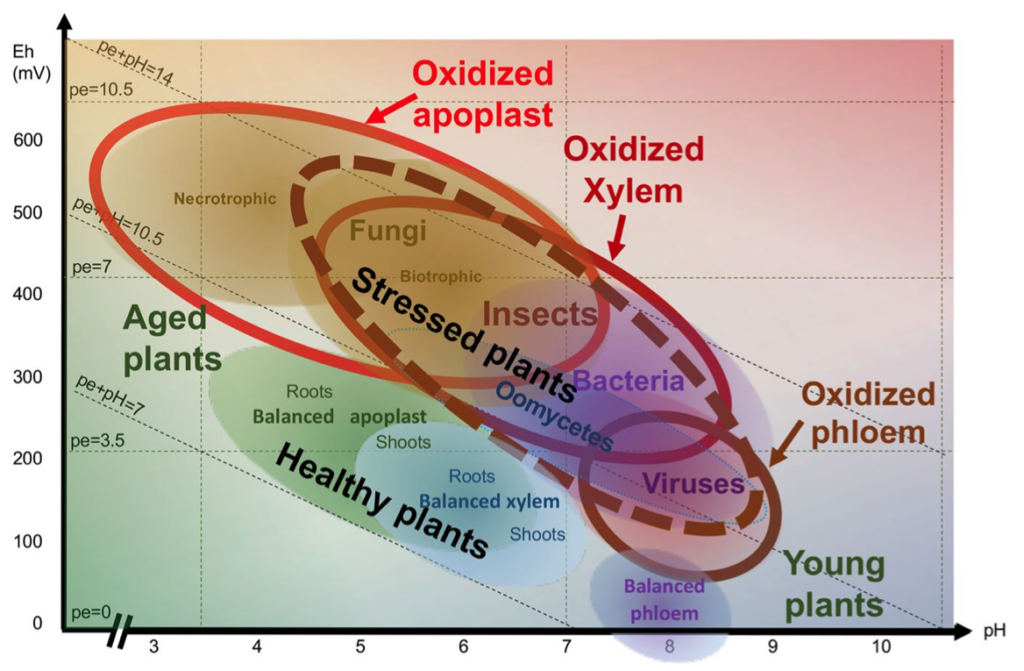
Olivier Husson et al. have shown that specific locations on plants, as well as within and around plant cells, have specific ranges of voltage and acidity. Remarkably, Husson has also measured specific ranges of voltage and acidity (Eh and pH) that bacteria, fungi and virus species, as well as insects, each require for their survival. See Figure 1.
Microorganisms and insects, as well as plants, release compounds that alter voltage and acidity, creating a battle of life and death to control these life-sustaining conditions. Husson has shown that plant pathogen and insect attacks occur at locations on plants with Eh and pH conditions optimized for that specific pathogen or insect. It is by controlling voltage and acidity conditions within and on its surfaces that healthy plants thwart unwanted pathogens and insect pressure.
The vertical axis of Figure 1 refers to Eh, a voltage. The horizontal axis, pH, is the familiar measure of acidity. Note that healthy plants have voltage and acidity ranges below those of pathogens and insects.
Many natural and human interventions move voltage and acidity toward conditions that favor pathogen and insect pressure. The chemical reaction associated with these changes is oxidation. For example, too little water, or drought conditions, exposes soils to air, allowing minerals and compounds to react with oxygen, or to oxidize, which raises both voltage and acidity conditions up and to the right in Figure 1 — away from values that support healthy plants and toward conditions supporting pathogens and insects.
We call this “plant stress”; it requires plant energy to bring these conditions back into balance. The correction process is called reduction, which removes oxygen from, or adds hydrogen to, a mineral or compound, reducing both voltage and acidity, moving conditions down and to the left in Figure 1 — toward areas that support healthy plants. If the plant does not have the energy to do this then those pathogens and insects will take hold and thrive.
Plant energy, in the form of sugars released from roots through the phloem flow, selectively feed microbes, ensuring that the solution absorbed into plant roots through the xylem flow will not disrupt voltage and acidity conditions within the plant. This energy is also stored like a battery within the soil’s stable organic matter structure. As much as 70 percent of plant photosynthetic energy may be directed to maintain homeostasis as a result of stress caused by human or natural interventions — energy that could otherwise be used to grow leaves to further increase the supply of energy through photosynthesis.
Actions taken in the field by growers — e.g., no-till initiative, building stable soil organic matter, etc. — can affect the amount of plant energy required to bring the system back into balance. When applying any product to plants or soils, the plant-energy cost associated with adjusting the product so that it may be safely absorbed by the plant must be considered. This introduces the concepts of applying products with balanced mineral proportions and evaluating the plant-energy cost of adding chemicals. The struggle to maintain voltage and acidity — specifically the amount of energy the plant must expend to do so —- significantly affects the health of the plant and the quality of the food that plant produces.
Plant photosynthesis energy is used to counter the effects of oxidation, maintaining voltage and acidity in ranges optimal for plants and unsuitable for insects, bacteria, fungi or viruses. Photosynthesis efficiency determines the amount of energy available for distribution to the different parts of the plant and into the soil. The more energy created in the leaves, the more energy available for leaf production and delivery to the soil, selectively promoting microorganisms that gather nutrients and adjust voltage and acidity conditions for the plant. This energy also increases the soil stable organic matter needed to buffer the effects of human and natural interventions, reducing plant energy needed to maintain homeostasis. Maximizing soil stable organic matter and improving photosynthesis efficiency are thus key strategies for growing healthy plants and eliminating the need for pesticides, insecticides and fungicides.
Any disturbance of the soil ecosystem will affect voltage and acidity. Natural interventions, like changing sunlight, rain, temperature and seasonal changes, all effect these parameters. The importance of water cannot be understated. When water is broken apart, both protons and electrons are made available — constituents needed for oxidation and reduction. The ability of the soil to hold water is a key parameter to limiting oxidative stress. While 2 percent soil organic matter absorbs 1 inch of rain/hour, 4.5 percent soil organic matter can absorb 5 inches of rain/hour. This implies that each additional 1 percent of soil organic matter will absorb an additional 1.6 inches of rain.
Human interventions that disturb the earth, exposing soil to air, cause oxidative stress and move soil voltage and acidity toward conditions that support insects, fungi, bacteria and viruses. Applying chemical fertilizers has a similar effect. It is stable soil organic matter and biological diversity that reduces or buffers the effects of natural and human interventions.
The existence of voltage gradients within plants and soils and the ease of measuring the soil’s electrical conductivity (EC) offers interesting contemplation. The electrical relationships between voltage, electrical conductivity and current may help explain some agricultural activities. Available ions — the familiar charged mineral nutrients Ca+2, Mg+2, NH+4, NO-3, SO4-2 and Cl– — are all affected by the voltage created by plants. Plant leaves are more negative than the soil solution, so positively charged nutrients are drawn up into plants through the xylem flow by the more negative leaves. Negatively charged nutrients require plant energy to be moved against this voltage gradient.
Using a conductivity meter to measure soil conductivity in various parts of my gardens reveals that the healthiest plants grow in soils with the highest electrical conductivity. Many soil reports list EC. It is interesting to contemplate how this simple measurement may be used, in conjunction with soil voltage, to improve our understanding of the movement of mineral ions within soils and plants.
Stable organic matter establishes soil structure, ecosystem housing, and water and mineral ion holding capacity. It acts as a voltage and acidic battery, creating conditions that support a diversity of biological activity. This may not be represented by the percent organic matter that is often provided with soil test results, which may include not-yet-digested materials and often only six inches of soil depth. Yet a large, stable organic matter volume is a key parameter that defines the robustness of the plant-soil ecosystem. The larger the volume, the more mineral ions held, satisfying needs of the system throughout the entire growing season.
Larger volumes also enable niches of specific voltage and acidity — locations that will support a diversity of microorganisms, creating redundant functions and an expansive toolbox plants can access to mine mineral nutrients and maintain homeostasis. Soils short of stable organic matter have a smaller battery, limited ecosystem housing, limited conditions to support a diverse and populous microorganism community, and limited storage capacity of mineral ions.
This is especially important at the end of the growing season, when many pathogens and insect pressure traditionally take hold. Oxidative stress degrades the volume of stable organic matter, reducing plants’ ability to control voltage and acidity conditions and maintain homeostasis, causing conditions that allow insects and pathogens to take hold. A large volume of stable organic matter increases redundant function, improves the soil’s buffering capability against natural and human interventions, and improves the robustness of the entire ecosystem.
The value of an electrical model of plant-soil interactions may not change the regenerative grower’s agricultural practices, but it helps him or her understand the relative importance of, and give appropriate priority to, the fundamental ideas of improving soil stable organic matter, improving biological diversity, improving photosynthesis efficiency and maintaining water availability.
Dig Deeper
This article is based on the work of French agroecologist Olivier Husson, particularly these two papers:
“Soil and plant health in relation to dynamic sustainment of Eh and pH homeostasis: A review,” Plant and Soil, July 2021.
“Redox potential (Eh) and pH as drivers of soil/plant/microorganism systems: A transdisciplinary overview pointing to integrative opportunities for agronomy,” Plant and Soil, September 2012.
Nigel Palmer is a former aerospace engineer and is an instructor at the Institute of Sustainable Nutrition in Connecticut. He is the author of The Regenerative Grower’s Guide to Garden Amendments. Learn more, including complete analysis of farm-made mineral amendments at nigel-palmer.com.
Come meet Nigel and learn from him and others at the 2024 Acres U.S.A. Eco Ag Conference, 2-5 December in Madison, Wisconsin. conference.eco-ag.com