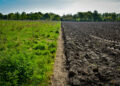


Three of the seven paradigms that need to change for regenerative agriculture to go mainstream — according to Jon Stika in his new book, Degradation to Regeneration: Why regenerative agriculture is not yet mainstream—and how we can make it so, published by Acres U.S.A.
Changing the Research Paradigm
Most scientific experiments are designed to vary only one factor of a system at a time. This approach assures that a clear cause-and-effect relationship can be described after experimentation is complete. Both agriculture and the soil are very complex, so a more complex view of them is essential when conducting research. This is especially true when evaluating agricultural systems for their effect on soil health. Soil health is the capacity of the soil to capture, store, and cycle water and nutrients that support plants while maintaining the soil itself. Soil health is dependent upon how good of a job we do to make the soil the best place for the soil microbiome to live. In a crop production system, this means doing things that benefit the soil microbiome and avoiding things that harm it.
Establishing exactly how and why a particular system will benefit the soil and return a certain profit from doing so is very difficult. When I discuss the potential cost savings of growing a crop on a healthy, functioning soil versus an unhealthy, dysfunctional soil, I can only speak in general terms based on the experience of a particular producer or group of producers. This level of confidence may get farmers to try something new, but it will not pass muster with research scientists. This scientific reductionism slows much of the economic research in the arena of soil health. Those who are looking for airtight economics in regenerative agricultural systems are going to have to be very patient.
But folks at universities are not the only ones who can conduct research that is useful to farmers who are working to improve soil health. In my experience, most of the big advances in our ability to promote soil health have been the result of farmers doing their own experimentation. Most farmers do this every year. Farmers are always tinkering with a new variety of seed, a different fertilizer or pesticide application rate, a new attachment on planting equipment, etc. Some of these experiments are conducted on large swaths of the farm, and some are carried out on only part of one field. If you really want to know how something will work on your farm, you will have to do the experimentation yourself. When producers become interested in restoring soil health, they need to know how any changes they make to their cropping system will work on their farm. I usually suggest that farmers pick a piece of land where they are comfortable taking the risk to try new methods. For some farmers this may only be one acre; for others, it might be a few hundred acres.
Some farmers will conduct their experiments to see how a new method works, and if it doesn’t work perfectly, they take what they learned and do it better until they find a reliable approach. Some farmers will also conduct experiments to prove that something will not work. If you set out to prove that something will not work, you will almost always be right. During my time working with many different innovative farmers as they developed effective soil health management systems for their land, I did not have all the answers when things didn’t go as expected, but I often knew of someone who did. This collective exploring and sharing ultimately helped everyone move forward in restoring soil health on a wide scale in western North Dakota.
Modern agronomy is beginning to acknowledge soil biology as a player in crop performance—but only at its convenience. University curriculum, textbooks, and extension models still largely reflect a physical-chemical-focused agronomy. The graduates of these programs become professionals that see what they have been trained to see—the symptoms of dysfunctional soil, not the dysfunctional soil itself.
Conventional agronomy’s viewpoint has reduced the soil to a physical and chemical medium to which things are added and subtracted according to models based on how dysfunctional soil behaves. Many producers have become comfortable with this reliability and consistency, even while it continues to degrade the soil. But we are now at the end of the Green Revolution paradigm. Recent soil-related research is looking more closely at the association between the soil microbiome and plants to determine more precisely how water and nutrient transfer occur between soil organisms and plant roots. One recent discovery that is challenging the old physical/chemical paradigm of crop nutrient management is called rhizophagy.
Rhizophagy is where soil bacteria are admitted into plant roots and stripped of all but their genetic material, then returned to the soil to restore themselves. This process provides plants with many compounds that they would otherwise have had to synthesize. This makes plant growth and development much more efficient. It allows them to manufacture larger molecules that help them protect against insects and diseases and become more nutritious food for higher animals, including us.
These types of research discoveries help us gain a better understanding of how to help soil and plants function and tailor management to improve soil health. We need to encourage researchers to explore soil biology and how the many different organisms relate to plants. This will give us insight into how we can fine-tune the details of soil health management systems for any agricultural setting.
Changing the Banking and Insurance Paradigm
It is an understatement to say that farming involves risk. Farmers assume much of the risk of producing crops, but that risk is sometimes also shared by the government and crop insurance companies. At present, nearly everyone assuming some risk in agriculture is hesitant to leave their comfort zone of the old physical and chemical model of managing the soil. However, it is time to realize that restoring the capacity of the soil to function will address the root cause of much of the risk faced in agriculture.
The actuarial assessments used in agriculture are based on models of dysfunctional soil. Without enough fertilizer, yields will suffer. When there is too much or not enough rain, yields will suffer. Dysfunctional soils are not very forgiving, but they are predictable. With our ever-increasing understanding of the soil as a biologically driven system, it is becoming clear that the actuarial risk of that old model is needlessly high. A biologically diverse and well-functioning soil microbiome is the most resilient and dependable system of crop production imaginable.
An agricultural risk-assessment system based on healthy, functioning soil should be rated as the lowest risk. Regenerative systems need to be recognized as being more profitable because they tap into the efficiencies of nature (Lacanne and Lundgren 2018; Pretty et al. 2018). Stable soil aggregates allow water to infiltrate the soil to avoid flooding and store that water for later use during periods of drought. The resiliency of the soil to capture, store, and release water to crops should serve as its own “crop insurance” and greatly reduce the risk to insurers of crops.
Changing the Agricultural Supplier and Consultant Paradigm
Continued supplementation of degraded, dysfunctional soil is a profitable status quo for most agricultural suppliers and consultants. One could argue whether this is being done out of ignorance or simply in pursuit of profits. I think it is a combination of the two. Without understanding how the soil can function as a biological system, many agricultural consultants are simply doing what they have been trained to do—treat the symptoms of dysfunctional soil with a wide array of inputs. The manufacturers of ag products must answer to their shareholders first and customers second. Like a shareholder of any company, investors in companies that manufacture and supply ag products expect a return on their investment. Crop consultants and agricultural suppliers are giving farmers what they ask for. Since most of those involved in agriculture don’t understand that the problem we face is that the soil has lost its capacity to properly function, everyone continues to do their best to treat the symptoms with a wide array of inputs.
One of the ironies I see from some of the current attention to regenerative agriculture is the emergence of soil biological products. The advent of these biologicals is a growing admission by those in conventional agronomy that crop nutrient cycling is indeed biologically mediated. Most currently available biologicals are just what the manufacturer claims them to be. These products often elicit positive responses for producers who are applying them to soil that currently has little biology of its own. The addition of organisms that should have been inhabiting the soil already gives plants some partners to work with, when before they probably had few or none. It is encouraging to see that these biological products are raising awareness of the importance of soil biology crop production systems (LaCanne and Lundgren 2018).
My concern is that soil biologicals will just become another annual input. If biologicals are used to jump-start soil biology as part of a change to a soil health management system, they can serve as part of an off-ramp from conventional crop production systems. Most biological products are currently being sold and used as annual inputs in the same way as in-furrow or side-dressed fertilizers. Biologicals could instead be used to prime soils to begin bringing the former soil microbiome back into action.
If soil management does not change to create suitable habitat for the organisms being added using biologicals, they are doomed to die in short order. The added organisms may provide a significant boost to a crop at a given growth stage, but so would the application of chemically based fertilizers. If not used to begin restoration of the soil microbiome, a biological product becomes just another purchased input without any lasting positive effect.
Where biological products can play an effective role is in adding biology to a soil that has little, while changing the management to set things on a path that restores soil health. In this case, a biological becomes a catalyst for positive change, rather than just a repeatedly applied input. The goal is to restore the soil microbiome as the primary engine of nutrient supply to crops (van der Heijden et al. 2008).
Herein lies the problem for those that make and sell biological products. If their product is used in a logical way, producers may only need to apply it a few times as part of jump-starting a soil health management system until the soil has built enough biological horsepower to run on its own. The more degraded (devoid of life) a soil has become, the greater the response from the application of a soil biological product. If a producer simply applies a biological product in lieu of some fertilizer, without implementing real change in how the soil is managed to build soil health, the biological will simply be another input to be purchased and applied continually to get a particular yield response. Farmers must understand how to use biologicals as a tool to help build soil health—not just to provide a different type of nutrient boost in place of fertilizer.