Acres U.S.A.® Magazine
  • Articles
    • News
    • Ecological farming
      • Climate
      • Environmental Issues
      • Farm management & planning
      • Human health
    • Livestock
    • Farm
    • Crop
      • Crop management practices
        • Ag technology
        • Cover crops
        • Crop nutrition
          • Crop protection
          • Diseases
        • Crops
        • Fruits
    • Soil
    • Opinion
  • Resources
    • Magazine
    • Online Learning
    • Newsletters
    • Free Articles
    • Blog
  • Magazine Issues
    • 2026
      • February 2026
      • January 2026
    • 2025
      • December 2025
      • November 2025
      • October 2025
      • September 2025
      • August 2025
      • July 2025
      • June 2025
      • May 2025
      • April 2025
      • March 2025
      • February 2025
      • January 2025
    • 2024
      • December 2024
      • November 2024
      • October 2024
      • September 2024
      • August 2024
      • July 2024
      • June 2024
      • May 2024
      • April 2024
      • March 2024
      • February 2024
      • January 2024
    • 2023
      • December 2023
      • November 2023
      • October 2023
      • August 2023
      • July 2023
      • June 2023
      • May 2023
      • April 2023
      • March 2023
      • February 2023
      • January 2023
    • 2022
      • December 2022
      • November 2022
      • October 2022
      • September 2022
      • August 2022
      • July 2022
      • June 2022
      • May 2022
      • April 2022
      • March 2022
      • February 2022
  • About Us
    • Our History
    • Our Staff
    • Contact Us
    • Community
      • Soil Health Primer Resources
  • Events
    • Eco-Ag Conference
    • Farm Weird Event
    • Viroqua On Farm Event
  • Subscribe
  • Login
  • Register
No Result
View All Result
  • Articles
    • News
    • Ecological farming
      • Climate
      • Environmental Issues
      • Farm management & planning
      • Human health
    • Livestock
    • Farm
    • Crop
      • Crop management practices
        • Ag technology
        • Cover crops
        • Crop nutrition
          • Crop protection
          • Diseases
        • Crops
        • Fruits
    • Soil
    • Opinion
  • Resources
    • Magazine
    • Online Learning
    • Newsletters
    • Free Articles
    • Blog
  • Magazine Issues
    • 2026
      • February 2026
      • January 2026
    • 2025
      • December 2025
      • November 2025
      • October 2025
      • September 2025
      • August 2025
      • July 2025
      • June 2025
      • May 2025
      • April 2025
      • March 2025
      • February 2025
      • January 2025
    • 2024
      • December 2024
      • November 2024
      • October 2024
      • September 2024
      • August 2024
      • July 2024
      • June 2024
      • May 2024
      • April 2024
      • March 2024
      • February 2024
      • January 2024
    • 2023
      • December 2023
      • November 2023
      • October 2023
      • August 2023
      • July 2023
      • June 2023
      • May 2023
      • April 2023
      • March 2023
      • February 2023
      • January 2023
    • 2022
      • December 2022
      • November 2022
      • October 2022
      • September 2022
      • August 2022
      • July 2022
      • June 2022
      • May 2022
      • April 2022
      • March 2022
      • February 2022
  • About Us
    • Our History
    • Our Staff
    • Contact Us
    • Community
      • Soil Health Primer Resources
  • Events
    • Eco-Ag Conference
    • Farm Weird Event
    • Viroqua On Farm Event
  • Subscribe
No Result
View All Result
Acres U.S.A.® Magazine
No Result
View All Result
Home Magazine issues February 2023

The Role of Phyllochrons in SRI Performance

Acres U.S.A. by Acres U.S.A.
August 28, 2024
in February 2023, Interviews
0
The Role of Phyllochrons in SRI Performance

Nepal rice plant (Credit: Dr. Norman Uphoff; can go anywhere in the article) — This rice plant with 98 fertile tillers, grown in the Nepal terai, was able to go through more than 12 phyllochrons of growth before its panicle initiation started.

0
SHARES
16
VIEWS
Share on FacebookShare on Twitter

Editor’s note: the following is an excerpt from Dr. Norman Uphoff’s System of Rice Intensification FAQ Guide, used by permission of the author and available online at http://sri.cals.cornell.edu/aboutsri/SRI_FAQs_Uphoff_2016.pdf.

The profuse tillering of SRI plants can be better understood by considering the effects of phyllochrons, a little-known periodicity in rice plants’ growth that regulates and determines their ultimate number of tillers and roots. When Fr. Laulanié learned practically by accident in the 1983-84 season that transplanting very young seedlings can lead to more robust and productive rice plants, this was hard to explain; it was just an empirical observation (Laulanié 1993). 

However, four years later, Laulanié learned about phyllochrons from reading a book on rice science that presented this concept (Moreau 1986). It derived from research that was done during the 1920s and 1930s by a crop scientist in Japan, T. Katayama. Unfortunately, his research findings were not published until after World War II (Katayama 1951), and they have never been translated into English, so they are not widely known outside Japan…. 

From his studies of rice, wheat and barley, Katayama discovered a regularity in the way tillers (and roots) emerge from the meristematic tissue at the plant base of these cereal crops. He documented a remarkable patterning in the way that grass-family species (gramineae/poaceae) grow, described below. 

Understanding phyllochrons helps explain why transplanting rice seedlings before they are about 15 days old can give a different and greater growth response to all the other practices of crop management than seen with seedlings that are transplanted at an older age, i.e., after the start of the 4th phyllochron. The timing and length of phyllochrons is determined by multiple factors, as discussed below. 

The term itself combines two Greek words phyllo + chron, which respectively mean leaf + time. Phyllochron refers to an interval of time during which a plant leaf, together with an associated root and tiller, emerges from the plant’s meristematic tissue, which produces new cells that create plant organs. This generative tissue derived from the rice plant’s seed is located at the base of the plant, at or near the soil surface, between the plant’s root system and its above-ground canopy. 

Beyond the 4th phyllochron, multiple units of leaf and associated root and tiller will emerge at the same time, i.e., within a period of time that is designated as a phyllochron. 

A synchronously emergent unit of a leaf, together with a tiller and a root, referred to collectively as a phytomer, grows both upward and downward from the plant’s meristem at the base of the visible plant. At the same time that a plant’s leaves and tillers grow upward into the air, its roots grow downward into the soil. Roots emanate from the same cell-division processes as do the leaves and the tillers. 

The length of a phyllochron for rice can vary considerably, from: 

• Perhaps 4 days if the conditions for growth are ideal, i.e., if the plant is encountering no stresses that will slow or impede its growth, to 

• 8 to 10 days if growing conditions for the plant are unfavorable because the plant is subject to many stresses (temperature, water, compacted soil, etc.). 

When growing conditions are good, with favorable temperatures, enough water and sunlight, adequate availability of nutrients in the soil, lots of space all around the roots and canopy, and friable soil for root growth, a phyllochron can be 5 or 6 days in length, and the plant can complete 10, 11 or 12 phyllochron periods of growth before it (a) comes to the end of its initial phase of vegetative growth and (b) switches into its reproductive phase, from panicle initiation to flowering and heading, and then (c) proceeds with grain forming and filling, ripening, and maturation, when the grains have become ready for harvesting….
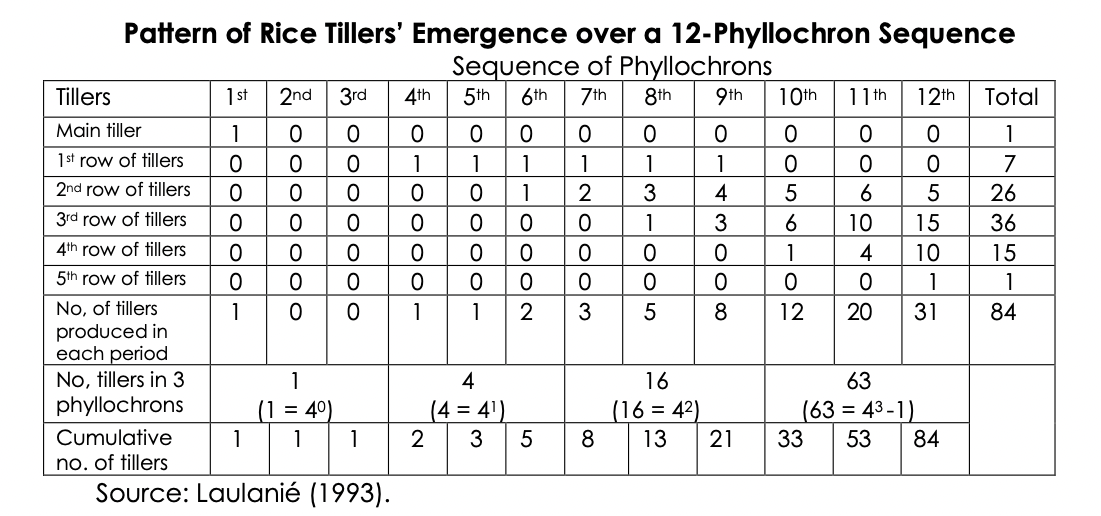
Phyllochron table

Readers may have noticed that the pattern of tillering indicated in the table corresponds to what is known in mathematics and biology as a Fibonacci series. In such a series, the number that emerges in each period is the sum of the previous two periods: 1+1=2, 1+2=3, 2+3=5, 3+5=8 … The number of tillers produced in each period is approximately 2/3 more than emerged in the preceding period. Such mathematical regularity in nature is noteworthy. 

A rice plant that can complete 12 phyllochrons of growth before the end of its vegetative phase and moves into its reproductive phase, starting with panicle initiation, can have as many as 84 tillers…. Such a plant would have a similarly profuse root system because its roots emanate from the same meristem cells that go through cell division and differentiation to create tillers and leaves, forming the plant’s canopy above-ground. 

If rice plants are transplanted during the 4th phyllochron or during even later phyllochrons, it is seen that their subsequent production of phytomers is both decelerated and diminished. Accordingly, such rice plants, when they begin their reproductive phase, have fewer tillers and fewer leaves, and also fewer roots. 

What is described here is a mechanistic presentation of a biological process. Specific plants do not necessarily grow as mathematically as the model above indicates. For one thing, the length of their phyllochrons is not always so uniform. Also, in practice, rice tillers increase according to a modified Fibonacci series, not a perfect one; 12 periods should hypothetically produce 89 tillers, rather than 84. This discrepancy is apparently due to physical congestion in the base of the rice plant, which keeps the emergence of tillers (and roots) from the meristematic tissue from reaching its hypothetical maximum. 

Transplanting rice seedlings during their 2nd or 3rd phyllochron of growth — roughly between the 5th and 15th days — represents a window of opportunity for the best management of rice plants. Their roots will be less traumatized if they are transplanted during this relatively dormant period, and these plants, when they resume their growth after transplanting, will produce more phytomers (units of tiller, leave and root) in an accelerated way…. 

The concept underlying this presentation is that the rice plants’ growth proceeds according to some kind of ‘biological clock.’ This runs faster or more slowly depending on the totality of favorable and/or unfavorable growth conditions. It is regulated operationally by the speed with which the plant’s cells are growing, elongating and dividing, in turn growing, elongating and dividing….

More research remains to be done on phyllochrons and on their implications for rice crop growth. There has been considerable research on phyllochrons in wheat (see, e.g., a special issue of Crop Science, 35:1, 1995), and on phyllochrons in forage grasses, especially in Australia. However, there has been little consideration of rice phyllochrons except by rice scientists in Japan and China, where they are well known. In the English-reading world, phyllochrons do not figure much in plant science considerations, presumably because the original research on phyllochrons has not been translated into English. 

Considerable research has been done along similar lines in terms of degree-days, but these are not linked to an understanding of plant physiology and morphology as closely as analysis done in terms of phyllochrons. For SRI, an understanding of phyllochrons helps to explain why the use of young seedlings has such a strong positive effect, validated empirically (Uphoff and Randriamiharisoa 2002). The rapid tillering and root growth which is possible when the full set of SRI practices are used together is not seen when older seedlings are used or when rice plants are grown under continuously flooded conditions with degenerating plant roots, which lengthens their phyllochrons. We hope that this area will become the focus of extensive research, such as that reported by Veeramani et al. (2012).

← Previous The Plant-ness of the Plant Next High on the Hog Farmer →
Tags: February 2023Interviews
Acres U.S.A.

Acres U.S.A.

North America’s oldest publisher on production-scale organic and regenerative farming. For more than 50 years, our mission has been to help farmers, ranchers and market gardeners grow food profitably, regeneratively, and with nature in mind.

Next Post
March 2023 • Issue #621

March 2023 • Issue #621

  • Trending
  • Comments
  • Latest
The Most Important Livestock in Our Fields

The Most Important Livestock in Our Fields

July 1, 2024
Glyphosate Does What It’s Designed to Do — Kill

Glyphosate Does What It’s Designed to Do — Kill

February 19, 2025
The Take-Half, Leave-Half Fallacy

The Take-Half, Leave-Half Fallacy

July 1, 2025
White snakeroot

Toxic Forages?

September 1, 2025
We Don’t Need Another Bridge — We Need an Off-Ramp

We Don’t Need Another Bridge — We Need an Off-Ramp

3
Under One Roof

Under One Roof

3
A Rose By Any Other Name

A Rose By Any Other Name

2
Terra Preta’s Biological Advantage

Terra Preta’s Biological Advantage

2
Don’t You Dare Disparage Sugar!

Don’t You Dare Disparage Sugar!

February 3, 2026
February 2026 • Issue #656

February 2026 • Issue #656

February 1, 2026
Fungal Exchange Capacity

Fungal Exchange Capacity

February 1, 2026
ECO-MEETINGS

ECO-MEETINGS

February 1, 2026

Recent News

Don’t You Dare Disparage Sugar!

Don’t You Dare Disparage Sugar!

February 3, 2026
February 2026 • Issue #656

February 2026 • Issue #656

February 1, 2026
Fungal Exchange Capacity

Fungal Exchange Capacity

February 1, 2026
ECO-MEETINGS

ECO-MEETINGS

February 1, 2026

About ACRES USA

Acres U.S.A.® Magazine

Acres U.S.A.® is North America’s oldest publisher on production-scale organic and regenerative farming. For more than 50 years, our mission has been to help farmers, ranchers and market gardeners grow food profitably and sustainably, with nature in mind.

Visit Our Advertisers

Magazine Issues

  • News
  • 2025
    • June 2025
    • May 2025
    • April 2025
    • March 2025
    • February 2025
    • January 2025
  • 2024 Articles
    • December 2024
    • November 2024
    • October 2024
    • September 2024
    • August 2024
    • July 2024
    • June 2024
    • May 2024
    • April 2024
    • March 2024
    • February 2024
    • January 2024
  • December 2023
    • December 2023
    • November 2023
    • October 2023
    • August 2023
    • July 2023
    • June 2023
    • May 2023
    • April 2023
    • March 2023
    • February 2023
    • January 2023
  • December 2022
    • November 2022
    • October 2022
    • September 2022
    • August 2022
    • July 2022
    • June 2022
    • May 2022
    • April 2022
    • March 2022

Contact Acres U.S.A

  • Contact Us
  • About Us
  • Advertise With Acres U.S.A.
  • My Subscription

Learn

  • Resources
  • Events
  • Magazine
  • Newsletters
  • Free Articles
  • Webinars
  • Online Courses
  • Bookstore

Our All Socials

Follow With Us...

  • My account
  • News
  • Ecological farming
  • Refund and Returns Policy
  • Privacy & Policy

© 2024 Acers USA Magazine

Welcome Back!

Login to your account below

Forgotten Password? Sign Up

Create New Account!

Fill the forms below to register

All fields are required. Log In

Retrieve your password

Please enter your username or email address to reset your password.

Log In
No Result
View All Result
  • HOME
  • ARTICLES
    • News
    • Farm
    • Ecological farming
    • Livestock
    • Crop
      • Crop management practices
      • Cover crops
      • Crop nutrition
      • Crop protection
      • Crops
      • Ag technology
    • Soil
    • Opinion
  • RESOURCES
    • Magazine
    • Online Learning
    • Newsletters
    • Blog
    • Free Articles
  • MAGAZINE ISSUES
    • 2025
      • June 2025
      • May 2025
      • April 2025
      • March 2025
      • February 2025
      • January 2025
    • 2024
      • December 2024
      • November 2024
      • October 2024
      • September 2024
      • August 2024
      • July 2024
      • June 2024
      • May 2024
      • April 2024
      • March 2024
      • February 2024
      • January 2024
    • 2023
      • December 2023
      • November 2023
      • October 2023
      • August 2023
      • July 2023
      • June 2023
      • May 2023
      • April 2023
      • March 2023
      • February 2023
      • January 2023
  • ABOUT US
    • Our History
    • Our Staff
    • Contact Us
    • Community
      • Soil Health Primer Resources
  • EVENTS
    • Eco-Ag Conference
    • On-Farm Viroqua Event
    • Farm Weird
  • SUBSCRIBE
  • Login
  • Sign Up
  • Cart

© 2024 Acers USA Magazine

Are you sure want to unlock this post?
Unlock left : 0
Are you sure want to cancel subscription?