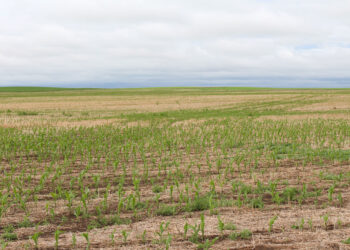


The System of Rice/Crop Intensification utilizes simple principles to provide plants an ideal growing environment
The System of Rice Intensification is an agronomic approach that was serendipitously discovered in Madagascar by a French priest and popularized by a university in New York, utilizing a discovery — made by Japanese scientists in the 1930s but, due to WWII, never translated into English — that follows the pattern in nature we now call the Fibonacci sequence.
This is the unlikely and fascinating story of SRI — a set of principles that has enable increased profitability and improved yields for growers of rice and other crops across the world since the 1990s. It is only now beginning to be picked up among growers in industrialized nations like the United States.
Dr. Erika Styger is one of the researchers at Cornell who has been working to promote SRI for the past several decades. She is beginning to work with growers here in the states as well to implement these principles, which offer much for farmers of all scales.
Acres U.S.A. How does a professor of tropical agronomy end up in New York State at Cornell?
Erika Styger. Good question! Cornell is a big agriculture school, so there are also tropical specialists here. There’s not really much local fieldwork. But I actually have been working with some farmers around here on SRI.
Acres U.S.A. Do you get to travel regularly to tropical places, though?
Styger. Oh, yes. With COVID it was very difficult — but before, yes, and I think it should be picking up again.
Acres U.S.A. Where do you have research projects right now?
Styger. I work in mostly in West Africa, and I also have a research project in Suriname on rice diversity. And I’ve also been working in the South in the U.S.
Acres U.S.A. Great. So, for those who’ve never heard of it, what is SRI, and why is it important?
Styger. SRI — system of rice intensification — is an agronomic approach. It’s a management approach to rice production, although it’s also applicable to many other crops. It’s about managing soil, plant nutrients and water. It’s really based on the farmer’s management of the crop.
The goal of the method is for the plant to be able to express its full genetic potential. I think that SRI shows us — it showed me, when I first learned about it — that no, most of the time we don’t actually listen to the plant or follow what the plant wants and needs.
Acres U.S.A. Why did SRI start with rice?
Styger. Rice is a very interesting crop because it has a high plasticity. You can plant it in some really horrible messes — you can produce a seedling, cut its roots, cut its leaves and stick it in the mud; any other crop might die, but rice will recover and regrow. Growers sometimes don’t pay that much attention to it because it’s so robust.
And so, when you start to follow the method of SRI, you realize that these rice plants have something to offer that we never realized. I’ve traveled to 30 countries and have met with SRI farmers in Asia, Africa and Latin America, and that’s what I hear. When farmers first see an SRI plant, they’re like, “Wow, I’ve been growing rice my whole life, but I have never seen a plant expressing itself like that.”
I would say that SRI is an agro-ecological approach because it has a lot to do with how we optimize the environment — the ecological processes — so that the plant really can express its potential. It’s not that SRI is a given, boxed-in method. It’s more like a quest of approaching agronomy and agriculture a little differently.
Acres U.S.A. In the regenerative livestock world, we talk about the “pigness of the pig” — giving the pig or the chicken or the cow the environment they want to be in. So SRI is kind of similar, but with plants.
Styger. Yes, exactly.
Acres U.S.A. Can you talk about the history of SRI — how it was developed?
Styger. SRI was developed in Madagascar by a French Jesuit priest named Father Henri de Laulanié. He was working with farmers, and his goal was to help people to have a better life — to get better crop production. They were experimenting with rice planting. At one point, the rainy season started and the plants in the nursery were still too young and too small to transplant, plus they didn’t have enough seedlings. They had to decide whether to plant or to wait — because if you wait, you may lose some productivity — you will have a yield decline.
So, they planted, and because they had fewer seedlings, they gave each one more space than they usually did. And that year the yield was actually higher than it had ever been. So, they continued experimenting and synthesizing different practices — although SRI is more than just the practices.

The usual practice with rice, in many countries, is for seedlings to be produced in nurseries for 30 to 45 to 60 days. This sometimes happens because the rainy season starts or the grower’s soil preparation gets delayed. The seedlings are just sitting in the nursery, and sometimes they’re 60 days old. Then they get transplanted, and farmers usually take a clump of seedlings — three or four or five, and I’ve even seen 10 or 15 — and they clump them together and plant them into the mud. Actually, it’s often just standing water. And because the plants are already old and weak, the growers space them close together — 15 centimeters or so apart. Then the rice is flooded from the beginning to the end. Maybe two weeks before harvest, the field is drained so it can be harvested. And, of course, growers today often use chemical fertilizer — urea, etc.
With SRI, though, the transplants are much younger. They are at the two-leaf stage, so they’re eight to 12 days old instead of 30 or 45 or 60. Single seedlings are planted — not clumps of seedlings — and there’s a wide spacing — 25 by 25 centimeters or more. That reduces seed use by 90 percent. Then, in the vegetative phase, irrigation is only done intermittently. Growers irrigate a bit, let the paddy dry, and then come in and irrigate a little more.
Acres U.S.A. And compost is typically used as fertilizer, correct?
Styger. Yes. Compost and organic matter, in the beginning. It doesn’t have to be organic, but SRI emphasizes building soil so that growers can reduce their chemical inputs. And I’ve seen farmers who, depending on their soil — if they’ve built up their soil — may not need fertilizer anymore. In some soils, farmers still may add a little bit of urea later on in the growing process. Father Laulanié didn’t say much about organic fertilization because growers were already doing that. He just said to continue using organic manure and there wouldn’t be any need to move toward chemical fertilizers.
Cornell actually had a project in Madagascar in the mid-90s, and they were working at the edge of a rainforest and were looking for good agricultural practices so farmers didn’t need to continue deforestation. They heard about SRI and were surprised that people said it was increasing yields by 50 or 100 percent. So the Cornell team, led by Dr. Norman Uphoff, began testing the method. After three years of testing had confirmed that the process worked and did increase yields, he knew that this method needed to be made known to other people. Dr. Uphoff had worked on rice production before, and he traveled a lot and had a huge international network, so he started to give talks about the method. Then people started to test SRI in different countries. I think the first reports came out in the year 2000, and today we have 55 to 60 countries where SRI has been validated and adopted, to different levels.
Acres U.S.A. We’ve touched on some of the key principles — transplanting of an eight- to 15-day-old seedling at wider spacings, less irrigation than normal, the addition of organic matter. Can you talk about cultivation as well — aeration with a tool as opposed to simple hand weeding? That’s a key aspect, too, isn’t it?
Styger. It is. And I’m making a difference between SRI principles and the practices. It’s important to know the principles, because when SRI started to spread all around the world, everybody began doing a slightly a little different version of it. People adapted it to their own environment, whether that was a desert or a rainforest or an uplands or the lowlands. Some can irrigate and some can’t, and some would use 12-day-old seedlings and others 15. And this great debate started. But people need to stop and think about the bigger picture and more about the principles. The principles are still very practical.
There are four principles that we think about. Principle one is to encourage early and healthy plant establishment. The second is to minimize competition among plants. The third is to build up soils so that they become richer in organic matter and beneficial soil biota. And one aspect of beneficial soil biota is that it needs aerated soil — to answer your question about cultivation. We could even call it regenerating soils, because we know we need to build back our soils, because we have degraded them so much. And the fourth principle is to manage water in a way that reduces flooding, so as to not induce water stress.
You can apply those four principles in any environment. Take, for example, early healthy plant establishment — one farmer would say, “I’m going to direct-seed my rice, but maybe I can inoculate it so that it gets a healthy start.” Another uses seedlings. Even seed selection influences plants and applies to this principle. So there are all these different practices that go with it. If you say, “I want to enrich my soil” — we’re talking about 60 countries — everybody has a different approach to that. Some have cows, some do compost, some do green manure. It’s a principle; you go ahead and adapt it to your environment.
If you can implement these four guiding principles, the plant can express itself much better.
Acres U.S.A. Can we go back to the second principle? How do you distinguish between trying to reduce competition with all that we know from ecology about the symbiotic benefits of growing different species together?
Styger. The SRI principle is to minimize competition between the plants. The conventional paradigm is to use more seed to produce more crops; we say to use fewer seeds to produce more crops.
That goes back to letting the plant express itself — to give it the room it needs to really grow. What we see in these plants is that they develop thicker tillers. The leaf gets wider and thicker — these plants are completely different beasts!
Acres U.S.A. And they’re tillering more, correct? You’re getting more production by planting fewer seeds because each plant is tillering more; can you talk about how that works? And what’s a phyllochron?
Styger. We can think of like a plant as having five tillers or 20 tillers, but SRI plants also get thicker and bigger and taller.
A phyllochron is basically a period of time — four to eight days — in which there’s a growth spurt where the plant produces a tiller — a leaf and a root and a tiller. It’s a growth period. When you plant the seedling young and give it a lot of space, the period of time is shorter. Every new shoot produces additional shoots until vegetative growth stops — so it can come become exponential.
Acres U.S.A. It’s fascinating that there’s this built-in mechanism within the plant to keep tillering — it’s like each step begets more success. And it’s incredible that it follows a Fibonacci sequence.
Styger. Some breeders actually don’t want too many tillers — they just want to have a few tillers that are very productive. But then you need more seed, and you have more expenses.
Also, SRI plants have much deeper roots. As the tiller develops, the roots develop. The roots can actually support tillering. They can extract more nutrients and can produce better grain filling. When the rice paddies are flooded and when you plant older seedlings, the roots don’t even grow that much anymore. They’re submerged in water, and roots also need to breathe — the plant has to pump oxygen into the root, and the root dies back much more regularly. So you have this tiny root system that uses a lot of energy. Then grain fill and shoot development are not strong. When there’s a storm, they fall over; when there’s an insect attack, they give in to it. And the plants are planted much more closely together, so disease spreads faster — and there’s high humidity in the tropics, especially when you irrigate a lot.
So the roots cannot really do their job to fill the grains. With SRI we have more grain filling — thicker, bigger grains and fewer empty ones.
Acres U.S.A. What is the bottom line in terms of yield improvement with SRI?
Styger. In the tropics, farming systems often have low yields, especially with farmers who grow in a traditional way. Some farmers still broadcast seed and might only yield one or two tonnes of rice per hectare, which is very low. With SRI it’s easy to produce six or seven tonnes. So growers can double their productivity — sometimes even more. But in very intensive productivity systems — let’s say the U.S.A. — a grower who gets eight or nine tonnes conventionally may not increase yield very much using SRI.
But overall, in the tropics, rice yields average about four tonnes per hectare, and with SRI you can easily get to six or seven — so a 50 percent increase.
Acres U.S.A. Can you talk about how rice is conventionally grown on a large scale here in the states, or in another developed country, and what kind of SRI principles could be adapted by a large-scale grower here?
Styger. Sure. I primarily work with smallholder farmers because 80 percent of the world’s rice farmers are smallholders. But rice in the U.S. is sometimes seeded from a biplane. The hybrids growers are using are extremely expensive. No one is transplanting single seedlings.
But the SRI principle is to give more space for each plant, even if you’re direct seeding. We’re doing that right now with a project called Jubilee Justice in Louisiana. We’re transplanting rice seedlings with a vegetable transplanter. That has limits — if you need 30-40,000 plants per acre, there are limits on the scale.
Growers like Adam Chappell in Arkansas are basically using the SRI principles with a precision seeder. He has really wide spacing, and I think he even adds molasses to the seed for early establishment and healthy soil. He gives the seed and the microbes a little kick so things can germinate and grow well.
Then the other thing that a large-scale grower can do is of course regenerate soil — Adam Chappell puts cover crops in every winter. He says he can already see the soil biology coming back. Although he terminates cover crops with herbicides, he only floods very lightly, so his plants are really big and bushy. He uses much less fertilizer, and he has much less disease.
He has reduced his costs — especially his seed cost — and his amount of fertilizer and pesticide, as well as water. He produces about the same yield, though.
Acres U.S.A. So he has better profitability.
Styger. Yes.
Acres U.S.A. SRI is specifically for rice, but SCI — system of crop intensification — would be for any other crop. Can you talk about doing this with other crops?
Styger. Yeah, I think that’s important to mention. I helped introduce SRI to Mali, and we worked in Timbuktu. And some rice farmers came to me and said, “We plant wheat in the winter — can we use SRI?” And I said, “I don’t know, but let’s try it.” And that’s how it started — with SRI farmers who were just innovating.
There has been a lot of innovation coming out of India on the SCI method. It started with wheat, but now they use it for other grain crops — barley, finger millet — all the plants that tiller. Sugar cane also has much more tillering when planted with SCI methods. And now farmers have started to use it for vegetables — eggplant in India and tomatoes and others.
It’s a farmer-led innovation, and it follows the same principles — you can use the same SRI principles and adapt them to optimize the resources available to the plant to minimize distress — to give each individual plant the room it wants and the environment it wants to thrive in. The principles for SRI and SCI are the same.
SRI is open-source. Nobody owns it. It’s not easy, but at the end of the day, if we continue innovating we can grow better crops.