
Austin Unruh of Trees for Graziers and John Kempf discuss how silvopasture — establishing trees in pasture for shade and feed for livestock — is the wisest and most scalable agroforestry practice
John Kempf. Austin, can you tell us a little bit about the work you’re doing and what got you here?
Austin Unruh. Absolutely. I run a company called Trees for Graziers. As the name suggests, our focus is indeed on silvopasture — integrating trees into pastures.
It’s been a very circuitous route in order to get here. If you told me 10 years ago that I was going to be leading a silvopasture-focused company, I would’ve asked you what silvopasture was. I did not grow up on a farm. My dad grew up on a farm — a jersey dairy in Minnesota — and I came out of college wanting to get my hands in the ground and wanting to do something that could have a lasting impact in the natural world, and I wanted to do something involved with agriculture.
I had read Restoration Agriculture by Mark Shepard, and that inspired me to the vision of landscape-scale agroforestry — wanting to see agriculture that was both economically and also ecologically viable — that led to thriving both ecologically and economically. That was my guiding star, as it were.
I started out doing work on riparian buffers. I’m located in Lancaster County, Pennsylvania. For better or worse, we send the most pollution of any area down to the Chesapeake Bay, so there’s a lot of water-quality-related funding available here. That was my entry into agroforestry — through riparian buffers from a conservation perspective.
Once I got into that, I had a number of clients who were also dairy graziers, and I was working with them to get trees established along their streams. And they said, “This is great, but how do we get trees established in a pasture? Our cattle need access to shade.” I had done some studies in agroforestry at that point and knew that there weren’t very many tried-and-true methods of getting trees established at any scale, for a budget that works for a farmer. You can get trees established if you fence out a big area and plant a big tree. But most farmers don’t have the kind of money to do that on a large scale.
So, we just started experimenting with different methods of protecting trees and integrating them into pasture in a way that was minimally intrusive to the way that the farm operates. We don’t want to take the land completely out of production in order to get those trees established. We don’t want to have to change the way the farm is managed in order to get trees established. Also, given that we’re in Lancaster County, land goes for anywhere from $30,000 to $50,000 an acre, so it does not pay in this area to take land out of production for five or 10 years until the trees are large enough to let the cattle back in.
That was our start in the silvopasture world, and over the past number of years we’ve refined our techniques for getting trees established. We’ve also started to work to improve tree genetics. We’re also trying to find more funding for farmers so they can reduce the cost of investing in trees for a silvopasture system.
Kempf. Can you tell us a little bit about the scale you’re operating on currently?
Unruh. So far we’ve planted trees on about 400 acres, on 25 different farms — all active farms, so not hobby farms, not homesteads, not rich-people farms where they don’t really care about the production costs; these are all active, working farms, most of them dairies. About 90 percent of our projects have been within an hour radius of Lancaster County. We don’t have really big farms around here; they mostly range from 40 acres to 200 acres. We are now doing second- and third-phase plantings on several of our farms. We have another 12 or 15 projects next spring, and the speed at which we’re doing plantings is only going up from there.
Kempf. Lancaster County, Pennsylvania, has the third-largest Amish community in the world, so this is reflected in the smaller farm size and very intensive management. With $30,000 to $50,000 an acre land cost, there is no margin for poor management.
Unruh. Exactly. We focus on planting trees in pastures because most of our area is open pastures. We don’t have woodlots that people have left, except on the least-accessible land, and we don’t have brush to thin to create silvopasture. No one lets their land grow up into brush around here.
Kempf. I believe that if the work you’re doing can be applicable and relevant and add value in that type of an economic environment, then it’s justifiable almost anywhere. But let’s talk about the establishment process — planting trees in pasture where you’re grazing livestock. Sounds like a challenge to me because livestock love young trees. What does the establishment process look like, and how do you get this to work on a working farm?
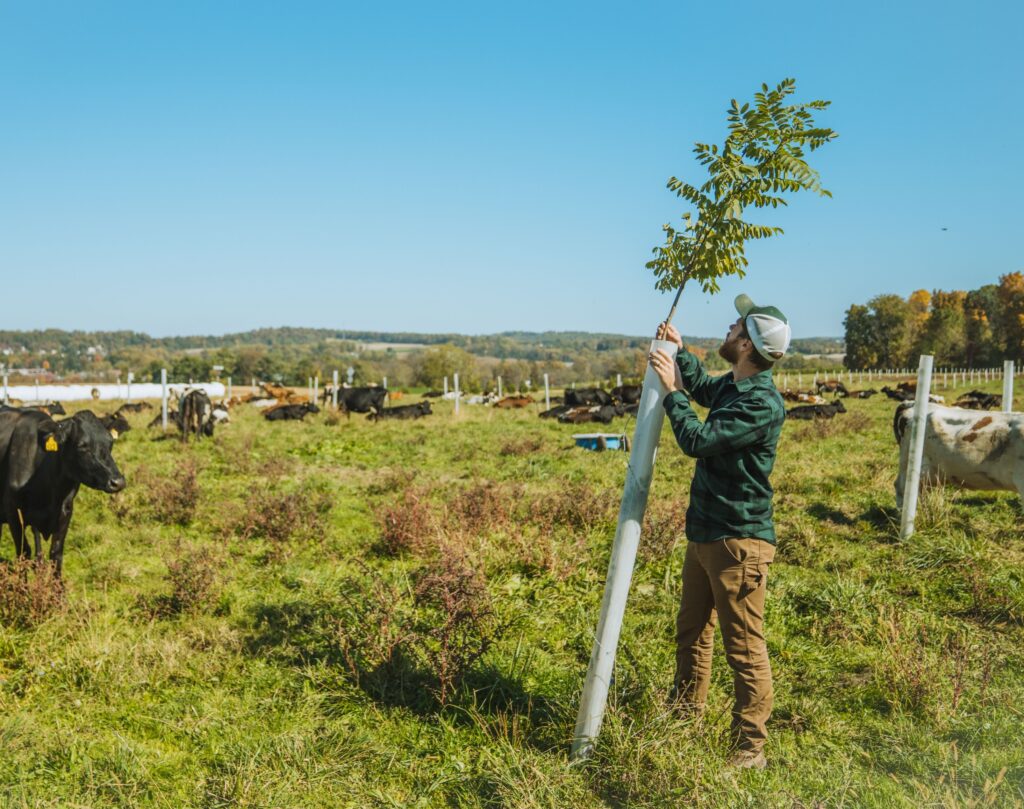
Unruh. Our system is fairly simple. We use a six-foot-tall tree shelter, and that shelter has a plastic tube and a fiberglass stake. The upside of a fiberglass stake is it does not rot. It is flexible, if cattle do rub up against it, and it’s an electrical insulator. The tube is what protects the tree from browsing. And then we run electric fencing along rows of trees. We usually establish trees in long rows, and we’re running electric fencing along those rows of trees.
There are different ways that we can configure the fencing. Sometimes we’ll run it at the height of a paddock division fence, and then we just use a single strand of fencing. Sometimes we will wrap a strand of polywire around that tube as well to protect the entire tube from being rubbed up against.
And then voles are something that we deal with — little rodents that like to girdle our trees. Orchards deal with this all the time, and we just need to manage it a little bit differently because we’re in organically managed farms and there’s a whole lot of forages, with a whole lot of places for those voles to hide. We can’t do clean culture, and there’s a whole lot of forages to work around. So to protect against vols, at least now, we use a 10-inch spiral guard — it’s a vinyl guard that protects the base of the tree from girdling. And then every fall we put a combination of castor oil and blood meal inside of the tree tube to try to repel voles inside of there. And then you layer on a really big thick layer of woodchip mulch right around the base to get them a good start — to get a more fungal environment going and to conserve the moisture right around the tree.
Kempf. You’re conserving moisture and you’re also avoiding moisture competition with the grasses and the forages that are around the trees, which are very effective at sucking all the moisture out of the soil. How effective has that vole management process been for you?
Unruh. Last winter was the first winter that we went through with those spiral guards on all of the new trees, and we had very little vole damage on those trees. Those spiral guards are providing protection from aboveground girdling, and the castor oil product is supposed to repel belowground rodents, gophers, moles, etc.
Kempf. I want to also speak about the establishment costs and population densities. But I think in order to have the context for that conversation, we first need to speak about the desired outcomes — the goals? When you think about farmers planting trees on land that’s worth $50,000 an acre — we’ve spent the last several hundred years removing every tree possible from land that has that type of economic value. So, what are the goals that these farmers are expecting to achieve from planting trees on pasture?
Unruh. Envision a savanna ecosystem with a combination of grasslands and trees interspersed widely throughout that system — that’s what we’re aiming for. We’re not looking to recreate a forest — all of our clients are grass farmers; they depend on forages. But we also don’t want a wide-open space without trees because trees can provide certain key benefits to these grazing operations.

The number one thing that brings most of our clients to us is shade. Livestock just perform better when they have access to shade. What we want to avoid is having shade distributed in too small of an area. Say you have one tree, or just a handful of trees, or maybe a row at the edge of a woodlot where the livestock can go for heat stress relief. They’re moving all of those nutrients underneath that one tree, or into that one area, and they’re overusing that one area.
What we want to do is to create a silvopasture system where the shade is well dispersed throughout the pasture, and we can do that by planting trees fairly evenly. We can do that by having trees with a fairly small canopy. So, we prune off those lower limbs and create a fairly small canopy that is high up on the tree — as high up as we can reasonably get.
Kempf. That would make the shade move around.
Unruh. Exactly. That’s the kind of system we want to create. Shade is what brings most people to us, but any tree can provide shade. So, we want to select for trees that are going to provide shade plus additional benefits. That can be honey locusts that are going to drop pods in November, December and January, that add additional feed energy during the wintertime. It can be persimmons that are going to do a similar thing, but with fruit.
I was talking yesterday with Alvin Peachy — a Pennsylvania dairy farmer — and he was very excited about being able to have apples and even mulberries and persimmons and things that are going to drop to bring in wildlife, particularly large deer. That’s very common — wanting to integrate trees both for the livestock and for wildlife, whether that’s deer for hunting or birds or whatever. Our clients want to see more biodiversity on their farms; shade and then feed during critical times of the year helps with that.
I should stress that we want these trees to help reduce input costs and increase output for the farm itself. We’re not really focused on tree crops for human consumption. On a homestead scale, yes, I think every farm should have some trees for homestead use — for homestead resiliency. But our focus is on reducing the cost of doing business on that farm and increasing the economic output on that farm.
Take honey locust. A good pasture of honey locust can produce hundreds, if not thousands, of pounds of additional feed, depending on how many trees you’re planting per acre. That is a high-energy food source during those months when our forages are low in energy and livestock need more energy in order to keep condition during the winter months.
The same thing would apply to others, like persimmons. If someone is feeding hogs or poultry, then we can add in mulberries or acorns or chestnuts — especially when it comes to hogs, because they can eat just about anything. Again, our goal is to reduce the feed cost and be able to have a stronger bottom line for the farm operation.
Kempf. The line that really catches my attention is increasing profitability. When you think about planting trees close to crops, or into pasture, there is this inherent assumption that the presence of trees is going to reduce yields. What do you see happening to the yields and the overall crop performance of the underlying forage base?
Unruh. We as a business have not been doing this long enough to see a lot of effect on our projects. But from the research that I’ve looked at, Virginia Tech in particular has done quite a bit of research on forage production in silvopasture systems. They have found that if you get 30 to 50 percent canopy cover, you get about the same forage production, and you should see stronger growth during the summer months. Most of our clients are grazing cool-season perennial forages, and as the name suggests, those forages want to be cool. They don’t want to be overheated, so they experience heat stress during the summer months, just like livestock.
By having a moderate level of shade, we’re able to reduce the heat stress on those cool-season perennial forages and allow them to grow better during those summer months, which is the most critical growing season. Most farmers don’t need additional forages during the spring —there’s so much forage that you can’t even keep up with it then. It’s during those summer months that you experienced the slump, and having some shade, especially during periods of drought, is particularly valuable.
One of our consultants has his own farm that he established silvopasture on a number of years ago. Last year he had pretty significant drought in his area, and he noted that the forages grew the best in the morning shade of his tallest trees because the dew was able to settle there and be more effectively used than the rest of the forages.
Kempf. The experience you’re describing matches what I am learning about how plants respond to excessive light. When we think about the simple phenomena of our yards and how grass grows around trees in landscaped areas, it can depend on the tree species — that certainly has an impact — and also on how the grass is managed and maintained — but if you have grass with a well-developed, robust root system, and you have trees that aren’t providing excessive shade, then the grass actually grows more luxuriously and better underneath the trees than it does anywhere else in the lawn.
There’s also this interesting phenomenon related to the summer heat period. I’m beginning to realize that it’s not just the heat stress — that there is in fact such a thing as excess of light. When you have too much light coming in, plants are not able to utilize all of it, and it actually induces a stress on the crop. This is why nurseries and greenhouses commonly put shade on during the summer months. It’s in the exact same range you’re describing — 30 to 40 percent shade on a shade cloth has a dramatic yield-increasing effect and a positive effect on tomato production, or on flower production, in greenhouses. I think that many of our field crops would actually benefit from some shade during the summer months.
But let’s talk a bit about the tree species that you perceive as having the greatest opportunity, from a forage potential. Over a decade ago, we started working with apple producers who were producing apples for processing instead of for the fresh market. And that was a fascinating perspective because the fruit doesn’t have to be absolutely blemish free. The pesticide applications reduce dramatically. The pruning could also be different because you didn’t require perfect light penetration to the canopy and perfect fruit coloration. You can allow the fruit to drop to the ground, and it can be smaller.
And the yield numbers were very different. We’re talking about yields that range anywhere from 1,200 to 1,500 bushels per acre, and as high as 1,800 to 2,000 in some exceptional instances. I started doing the math about the calorie production from a field of trees like that, and then from chestnuts and from mulberries, and I started wondering, “Wait a minute, why are we growing grass?”
I know you’re very passionate about honey locusts because of the seasonality and the synergies that they offer. What are the species with the greatest forage yield potential and the greatest opportunity from your perspective?
Unruh. I’ll break this up into a couple of different categories. First are trees that are there primarily for quick shade. These would be hybrid poplars, hybrid willows, black locusts. Those are our three main trees that we use in our area, and they’re applicable across a large portion of the United States. They’re cheap trees, and they’re hardy and resilient.
With our willows and poplars, we use a live stake — a branch from a tree that is 10, 12, 14 feet tall — and we put it two or three feet in the ground. It’s going to make its own roots and it’s going to get established that way. It’s able to produce actual shade that is usable by the livestock in the second growing season. Don’t start with a $40 grafted honey locust; start with one of these $2 hybrid poplars or willows.
Our second category is long-term trees for feed for ruminants. That’s mostly honey locust and persimmon. Honey locust is the tree that I think has the highest potential upside for ruminant silvopasture in a large chunk of the United States. It’s a nitrogen fixer. It has a very nice, dappled canopy, so it allows a lot of light to come through and still hit the forages beneath. And then it drops high-energy pods. Wild pods are 17 to 20 percent energy, or sugar; on selected varieties, you’re looking at 30, 35, 38 percent sugar in those pods.
Kempf. I remember in the book Tree Crops, by J. Russell Smith, which was written about a hundred years ago, he described the potential of honey locust to be grown as a sugar crop.
Unruh. The easiest thing would be for livestock to harvest whatever is dropped. That’s the beauty of it — livestock pick the pods or persimmons off the ground themselves.
I will note for those people who are right now raising the question of honey locust — they’re familiar with the wild honey locust that has amazing and impressive and dangerous thorns on it. They’re pretty nasty — they can get to a foot or even longer. You don’t want to have it in your pastures. Even the most zealous tree hugger would not hug these trees.
Thankfully, there is a way to get those thorns out of the trees via genetics. If you go to most farms that have honey locust natively, you’ll also see thornless honey locust on that same farm. There’s been very little work done to improve honey locust over the past hundred years, except for ornamental street trees. And so we are selecting for known thornless trees and clonally propagating those trees so that what we are planting out on pastures is completely thornless.
The other tree in this second category is persimmons. Persimmons are going to drop their fruit, which is about the size of a golf ball, anywhere from as early as August to as late as January or February, and some will even hold on to their fruit a little bit longer. So, with persimmon, we have the opportunity to really stretch our drop season over a long period of time. Persimmons don’t have thorns, but they also don’t grow very fast, which is a challenge.
Kempf. What’s the forage potential of persimmons and honey locusts? How much feed value can they generate?
Unruh. There’s very limited data on how much livestock feed can be offset, or how much feed these trees can produce — largely because it takes a long time to set up a study like this, and most universities are not in the place where they can plant trees and then 10, 15, 20 years later run a study on the production of those trees, especially trees that are not for human consumption, like peaches or apples or plums.
Kempf. They’re not perceived as being as economically impactful for the economy as a whole.
Unruh. Exactly. Livestock-focused trees do not get a whole lot of attention.
So, with that caveat, J. Russell Smith in Tree Crops talks about persimmon trees in Kansas being able to get four to five bushels in a year. If you plant trees on a 30-by-30 spacing and you have 48 trees, you could be looking at 200 to 240 bushels of persimmons per year. Now, if we compare that to corn, adjusting for moisture — which is going to be higher in persimmons than in corn — that’s roughly equivalent to a hundred bushels of corn per acre. And this would be a very low-input system.
Kempf. Practically none, really. But also there’s the key aspect that the livestock can pick them up off the ground at a time of the year when they really need the energy and can benefit from that.
Unruh. Exactly. Labor and financial inputs into this system are minimal, and you’re able to produce a full crop of forages underneath the trees.
Kempf. How about for honey locust?
Unruh. On honey locust there is probably even less research. But there was a study in the early ’40s that was unfortunately cut off because of World War II. But at the age of seven to 10 years old, these grafted honey locust trees were averaging about 95 pounds of pods, and this is dry matter. These were young trees, and they were well taken care of. If you have a density 36 trees per acre, you’re looking at 3,400 pounds of pods annually coming off of that acre of honey locust.
Kempf. Wow. And given the energy content, if you’re talking 30 to 40 percent sugar content, that is a lot of calories per acre — that’s a significant energy yield.
Unruh. Yes, indeed. This is why I’m optimistic about the upside of silvopasture and its broad applicability.
Our final category is trees grown for hogs or poultry. While for pastured pigs, most of their diet is still going to come from grain that’s grown on farm or brought there, we still have a real opportunity to reduce feed costs. Given that pigs are monogastrics, not ruminants, they’re not meant to have their full feed coming off of forages, but they can supplement with forages. But in the wild, wild boar are not grazing on grasslands. Our chickens are not domesticated from prairie chickens; they’re domesticated from jungle fowl. This is the habitat that they want to be in — this is what creates a low-stress environment for them. Hogs and poultry do much better when they are not heat stressed. So, there are a lot of reasons to integrate trees for them.
And then we might as well integrate trees that are going to provide additional feed. So, mulberry is one that we look to for both hogs and poultry. It’s easy to propagate. It’s inexpensive, it grows really fast, it transplants well, and it’ll start to yield immediately. Once you graft a mulberry, it wants to set fruit that very first year. In terms of a quick return on investment for tree planting, mulberry is really hard to beat. Also, not only does it drop high-quality, high-energy fruit, but the leaves of a mulberry plant are very digestible and very high in protein — a similar protein content as clovers, and similar digestibility. It’s so digestible that humans can even eat it. In certain cultures, mulberry leaves are used similar to a grape leaves.

Hogs can eat just about anything. Acorns, chestnuts, beech nuts, apples, pears, plums, the whole gamut — they can consume it and make good use of it.
Kempf. Why not apples and chestnuts for ruminants? Why did you exclude those from the list?
Unruh. We might integrate more of those in the years to come. The challenge with apples is that they’re more perishable and drop during the warmer seasons of the year. If you’re in a system where you’re rotationally grazing and you’re not coming back through for 30, 40, 50 days, if a fruit falls and your livestock aren’t through in the next five days, you lose a large chunk of that feed value. That’s the complexity of integrating some of those trees into a ruminant system with long rotational grazing cycles.
The nice thing about honey locusts is that once they drop their pods, in November or December, those pods are going to be there until livestock come back around.
Kempf. Wouldn’t the same be true for chestnuts — that they would drop and remain stable on the ground for an extended period?
Unruh. I’m sure that they would stay better than apples, but less than honey locusts. What I’ve seen so far would suggest that chestnut yields are going to be lower than honey locusts. I’ve heard from various growers to expect anywhere from 1,000 to 4,000 pounds per acre, depending on the site conditions. That would be a fresh weight, and I think chestnuts are about 40 or 50 percent moisture.
Kempf. Let’s talk about apples, because there is something that many people don’t know about apples. First of all, as I’m sure you’re aware, apples have this tremendous genetic variability and genetic diversity. You can actually select apples to be held onto the tree and to drop at different times of the year, just as with persimmons. There are folks who’ve done some very innovative selection and breeding work who have apples that are being held on the tree all the way into the middle of the winter — January and February — before they drop. This is going to require some careful selection, working with a breeding pool that isn’t that extensive right now, but there’s the possibility to really extend the drop window of apples, just as you do with persimmons.
Unruh. That makes sense. We’re almost into December and there’s still plenty of crabapples on the trees.
Kempf. What does your tree density look like per acre for these various species? And what are the establishment costs?
Unruh. Tree density ranges anywhere from about 20 trees per acre to 60 or 70. We like to integrate both fast-growing shade trees and slower-growing trees that are going to be there for the long term. If you’re in a context where you can plant at a lower density, maybe plant some taller trees that are already six, seven, eight feet tall — say, a honey locust and a persimmon that are going to be there long term — and then you can plant fewer trees per acre, maybe 20 to 30, and have a lower cost per acre that way.
About $10 is a rough number for a tree shelter. Trees can be anywhere from a $2 seedling to a $50 grafted tree. Our goal with Trees for Graziers is to develop a nursery where we are able to sell to the general public. At this point, we’re only using our trees on our own projects, but our goal is to be able to sell silvopasture-specific trees with the right genetics and the right size of tree to match each context.
On our projects, we’re typically planting anywhere from two to three trees per hour, per person. Our trees are far apart. We’re digging a hole, planting the tree, putting the shelter on, stringing up the poly wire, and putting the mulch on. That’s the labor component.
Kempf. What programs are available to offset these costs? You mentioned you got into this through riparian buffers, and I’m guessing there’s probably some similar programs available for silvopasture, though perhaps to a much smaller degree.
Unruh. It’s been somewhat frustrating to find the right cost share for this. In our area, we have a lot of water-quality problems, so there’s a lot of water-quality-related funding available in our area. That’s been our saving grace because at this point, in Pennsylvania, there’s no NRCS support for silvopasture. In some of the Midwestern states there’s about $30 or $35 per tree that can be used for cost share, and that’s going to cover a good chunk of the costs with establishing silvopasture. Some of the other states in the eastern United States have some cost share, but not as much as you would need to get a pine silvopasture established — which for most of our graziers is not something that’s at all interesting.
I firmly believe that the amount of cost share that’s available will increase in the years to come, and largely that’s going to be driven through public policy to support what they call “climate-smart” agricultural practices. When you look at the practices that can sequester the most carbon, silvopasture is usually ranked as the number one practice on agricultural lands. Because of that, I anticipate a lot more funding coming to support the practice in the years to come.
Kempf. So often as we go through life, we can look back and we can reflect on pivotal moments, experiences, observations or stories that really stand out in our mind. What are some of those experiences that you’ve had over the past 10 years of your journey that have inspired you and have given you some idea of the potential and the implications for these silvopasture systems?
Unruh. One that comes to mind is talking with one of our farmers who said that ever since he took control of the farm, he’d wanted to get trees established. And that was about 20 years ago. I think this is the case for a lot of farmers, especially graziers. They recognize the benefit of trees; they see that their livestock prefer being in the shade. But for a variety of reasons, most farmers do not get trees established.
There’s always a whole laundry list of things to do on a farm. It’s usually 10 pages long, and half of those things should have been done a year ago, or even five years ago. Planting trees never gets to the top of that list. And for those who do, oftentimes it is met with frustration because, like we said earlier, livestock want to eat trees and smother them up. So, most farmers, even if it’s in their ethics, and in their economic interest to establish trees, they just don’t; it never happens.
That was one of the pivotal things for us to decide to grow the business — to grow our reach of services so that we can help those farmers actually make this practice happen. It’s not just providing more information. The information is out there; it’s spotty, but there is enough information out there for a lot of farmers to be able to do this on their own. But what we find is that it just doesn’t happen unless there’s the support that’s needed.
And that’s why our goal is to make it as simple as possible for farmers to say yes to silvopasture. We take care of the planning and consulting. We write a plan, step-by-step and farm specific. We help farmers apply for funding, because no one likes to go and wade through all that funding mess and all that paperwork by themselves. We have a silvopasture-specific nursery. We do the planting, and we do the aftercare, taking care of those trees for the first number of years that they’re planted out in the field to make sure that they have the best chance of succeeding.
I relate it to the solar business. Twenty or 30 years ago, there weren’t very many solar installers around. But today, I could call any number of contractors and they would come and would install solar panels on my house, and they would probably be able to put me up with a package where I don’t have to pay any money upfront — I just pay a little bit every month for the duration of the lifespan of that solar panel.
That’s what I see for silvopasture. Most farmers are too busy to do this themselves and don’t have the right skill set or insight into this very specific thing that we’re trying to do. If they can have services that are tailored to them, it makes a world of a difference.
Kempf. I think your observations are very astute. It’s true — there are many things that we would like to do that we lack the bandwidth for, and it just never makes it to the top of the priority list.
Austin, you’ve developed a very unique perspective on pasture and tree management. What is the point of view that you’ve developed that is very different from the mainstream view?
Unruh. Compared to agroforestry in general, we think differently about what we do. Our focus is specifically on integrating trees that are there to serve livestock. We don’t really focus much on trees for human consumption. We’re not looking at having chestnut orchards or apple cider orchards or currants or hazelnuts or the other tree species that are used in agroforestry for human consumption. We’re focused on what I see as the most scalable practice: silvopasture to support livestock.
If you look at American agriculture in general right now, most of the land that’s in production is not for human food. Much of our land is being used for livestock feed. If you had a million acres of chestnuts, you’re going to have a glut in the chestnut market; you’re going to have way too many chestnuts than can be sold. If you have 10 million acres of honey locusts that are dropping feed for cattle, that’s just offsetting feed that would’ve otherwise been grown and consumed by those cattle. If you have 10 million acres of mulberries that are there dropping fruit for your hogs — and I should say, I don’t advocate for monocultures, but to use a simple example — you’re going to reduce the amount of corn that’s going into feeding hogs. So, silvopasture for livestock production is by far the most scalable agroforestry practice. And that’s what we want to be involved in and leading.
And then, even within the realm of silvopasture, we approach things differently. I think most silvopasture has been approached by foresters, and a forester comes to an open piece of land and just dreams about how many trees they could grow for timber — because that’s a forester’s mindset. Whereas our clients are graziers. They look at a forest and get scared because they’ve lost all their forages; timber is typically not a main concern for them.
Planting trees so that you can get a timber harvest in 50 years is not a primary thing that we’re going after. Our primary thing is supporting the grazing operation and supporting livestock through shade and through feed. We do integrate timber trees on a fairly small scale, but it’s more of a tertiary thing that we’re looking for as a means of bringing ecological diversity and also income diversity way down the road. But the first purpose those trees have on the farm is to benefit the livestock and the ecosystem on that farm.
One other thing that I want to make sure I communicate to people is that I highly recommend starting small with silvopasture. What I don’t want to see is people moving forward too fast and then getting discouraged about failures — about trees dying or trees not taking off the way that they anticipate. We’re in a very early phase of this movement of silvopasture. We’re relearning how to use this practice — silvopasture is a really old practice, but we’ve lost how to use it, and specifically how to integrate it into a 21st-century grazing system.
Start with just planting 10 trees. See how those work on your farm. See how you can protect those, what works, what does not, how your livestock interact with them, how your trees interact with the soils. Then, over time, build in those more expensive trees, once you have the knowledge and the confidence that you can indeed protect those trees.
When we do a project, if a farmer wants, say, a thousand trees, we won’t do all thousand trees on their farm all at once. Typically, we’ll start with 10 trees right now so that they get some hands-on experience between now and the first real planting date. And then maybe we’ll do 10 or 20 percent of those trees, and then we’ll wait a year or two before we do our next phase so that we have the time to sit back and reflect on what worked, what did not work, how the livestock interact with the trees, etc.
There’s a whole bunch of benefits, too, of starting early. You can grow your own genetic stock that’s adapted to your site; that can reduce your costs. You can reuse tree shelters. There’s most likely going to be better funding available in the future. There’s going to be better tree stock available in the future. There’s going to be better support systems available in the future.
I don’t want silvopasture to be a fad. I think there’s a really strong value that silvopasture can bring, and I want people to have a good experience with it right out of the gate. And the best way to do that is to start small, be conservative, and have a long-term view. That is a recipe for success.