

Before investing in a new venture, be sure to set expectations based on the market conditions that will exist at harvest
I believe that if we want to see agroforestry adopted at scale — meaning tens of millions of acres — it’s going to be through silvopasture with trees that are primarily in place to serve livestock and reduce input costs for grazing operations.
While they get a lot of interest and hype, I’m skeptical of the long-term scalability and profitability of tree crops for human consumption. I’d like to inject a note of caution on the most highly touted agroforestry tree crop: chestnuts.
Chestnuts are currently the go-to species when looking to build a profitable tree crops enterprise. This is because demand currently outstrips supply, leading to solid profitability. The U.S. imports 7.5 million pounds right now. This sounds like a lot until you do the math and realize that’s equivalent to the production from roughly 4,000 acres. That’s not much; that many acres will certainly be planted in the next few years, if it hasn’t already been. One project alone was slated to plant a full 2,000 acres by the end of 2023.

(Courtesy of Russell Wallack)
Now, I’m confident that folks can find new uses (and revitalize old uses) for chestnuts. Demand right now is very low relative to European countries, and chestnut roasts, festivals and fresher supplies can increase demand. Chestnuts can be processed and turned into a sweet, gluten-free flour for inclusion in all kinds of recipes and shelf-stable products, thus further expanding demand. But how much demand is there going to be? Even if we 10x the current imported amount, we’re still only at 40,000 acres. I highly doubt that we’ll ever hit per-capita demand like there is in Europe. We just don’t have the traditional cultural ties to chestnuts that Europe does.
It’s exciting to see farmers make good money on a product, and the math looks great. Two thousand pounds per acre multiplied by $4 or even $6 a pound makes a lot more money per acre than just about anything else you can (legally) grow on broad acreage. It sure beats the socks off of growing corn. But the real question is, will prices stay anything close to that high once many others get in the game?
Here’s the sequence I can see starting to unfold:
- Folks see an opportunity to make money. At current retail prices, there’s good money to be made. There’s gold in them thar hills!
- Lots of folks decide they want in on the action, and they plant orchards, believing they’ll be making bank in 10-15 years once the orchard is in full production.
- Except that a lot of people get in, and because of the significant lag time between planting and harvesting, there’s a big feedback delay in the market. The price stays high for the next several years, because hardly any new production has come on board yet. Heck, prices go higher because the profile of chestnuts is going up, and everyone wants to try this hot new delicacy. Farmers might be getting even more for their product, causing even more growers to get in on the action.
- And then those orchards start coming online. At first prices stabilize, because there’s more supply, and those with supply are boosting demand by marketing their product. Everything is great for a few more years as the early movers make really good money. But as more and more acres keep coming online, the demand can’t keep up. Prices start to go down, and down some more.
I’m not going to turn this into a doomsday piece, because I don’t know how much prices would drop. These things tend to level out eventually. But they’ll likely level out at a place where folks are making just a bit of money, if they are creative and resourceful and have good buyers. Folks who aren’t in that position will likely lose money on their harvests. Such is so often the case in agriculture.

There will be a chestnut industry, but it likely won’t make too many people rich, and not for very long. My guess is there will be two main groups who will do well. One, those who are fairly small and can sell directly to their customers, especially through local channels, u-pick, farmers markets, etc.; also small wholesale, to local grocery stores that emphasize fresh, local produce. The second group will be those that figure this out on a large scale, who are well organized and vertically integrated to manage, harvest, process and market efficiently. Those will also likely be the ones who can purchase from other growers who are not so vertically integrated, hence putting them in position to set the price. Those large, vertically integrated producers will have the leg up when it comes to selling chestnuts as an ingredient, like chestnut flour to a gluten-free foods brand. If a food company has the option to source from one big chestnut producer or from five different small farms or co-ops with varying quality standards, prices and sales managers to deal with, I can tell you who will have the upper hand.
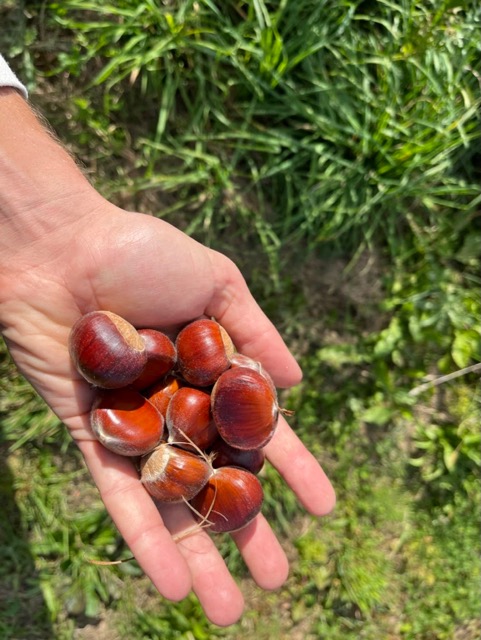
(Courtesy of Russell Wallack)
Take the story of walnuts as a cautionary tale, or almonds or pistachios. Delayed gluts can be very dangerous, because they give you a long time to get into the game while the going looks good, and you can put years of investment into a crop that, depending on when it starts producing, may never earn much money. There are young walnut orchards being ripped out right now — while others are only starting to come online.
Chestnuts have an upside over walnuts and almonds in that they can be eaten with minimal processing and hence don’t need the processing middlemen in order to get them to customers. That opens up the direct-to-consumer market for small producers. The downside for chestnuts is that they are a carb-rich food, whereas walnuts, almonds and pistachios are all high in fats and protein. Fat- and protein-rich foods are generally valued and priced higher than carbohydrates because carbs are so readily available. So, although chestnuts are currently fetching a lot more than walnuts, is a chestnut really worth more than a walnut in the long run once markets stabilize? Chestnuts are gluten free, but so is corn, and at even $12/bushel (56 pounds) for organic, food-grade corn, the farmer is earning less than $0.22/pound.
So what should you do if you want to grow chestnuts or some other tree crops?
- Don’t build your budgets and expectations around being able to earn $6/pound long term. I would build expectations at prices below $2/pound if selling bulk — maybe higher if selling retail.
- Have a strategy for what you’ll do when prices eventually come down. How can you carve out a premium, differentiated niche? If it fits in your context, how can you sell directly to consumers?
- Think about efficiencies. If this is going to scale, it’ll be an actual industry, where the larger players will have custom machinery for harvesting and processing. Especially if you can’t develop a retail niche, think about how — or whether — you want to compete on wholesale pricing.
- What are your backup options if it simply becomes unprofitable to harvest and process chestnuts, as it has become for many producing walnuts? Do you integrate livestock to eat the chestnuts? Sell hunting leases? Thankfully there are options beyond putting in a lot of work to still sell at a loss — all too common in much of agriculture. Even if you never sell a pound of chestnuts, and pigs aren’t the right fit for you, cows will gladly eat the nuts and will appreciate the shade, so the trees can still be a net gain.
J. Russell Smith, author of Tree Crops: A Permanent Agriculture, said it well:
Now the nuts that people eat are fine and worthy of much improvement, but a few hundred thousand acres of them would glut the market. Not so with stock food. Once we get a cow-feed tree crop established we have a guaranteed outlet, and twenty or thirty million acres will not glut the market. We would simply convert thirty or forty million acres of our hundred million acres of corn to a more profitable and soil-saving crop… [S]tock foods start on an honest-to-goodness basis. They don’t begin five prices high like a human food novelty and then come down bumpety-bump as soon as a few carloads are produced.
While this article may not get anyone excited, or make chestnut growers all that happy, I hope that this word of caution, at a time when tree-crop planting is hot and exciting, will prevent some real pain and losses for even just a few farmers who come to beware the dangers of a slow glut.
Austin Unruh is the founder of Trees for Graziers, a business that helps farmers establish silvopastures (treesforgraziers.com). He is the author of The Grazier’s Guide to Trees, available at bookstore.acresusa.com.
| Interested in this subject? Check out Mark Shepard’s response piece at our member site: https://members.acresusa.com. |