

Longtime farmer and researcher Helen Atthowe discusses the possibilities and challenges of taking the established principles of eco-agriculture and making them work in commercial vegetable and fruit production
Acres U.S.A. You mentioned in an email that you had an experience recently at a conference where some extension agents were talking about organic research, and you realized that they were about 20 years behind in the type of information they were presenting growers. We feel that way a little bit too here at Acres U.S.A. — Charles Walters started talking about ecological methods of farming 50 years ago, and for a long time very few other publications were talking about it, and now all of a sudden everyone’s talking about regenerative. This is of course great — but then also it feels like people don’t quite understand the whole-systems aspect of it, and there’s a lot of fluff out there.
Helen Atthowe. Yes! I was an extension horticulture agent myself for 17 years, ending in 2009. It’s wonderful that there is more interest in organic methods now, where before we had to fight to use the “O” word! However, now we’re using the same words, but it’s not a deep dive into ecological or, let’s face it, organic. Now we have a big umbrella over which we have the term “organic,” and some of it is barely organic — while some of it is moving well into ecological farming, I think.
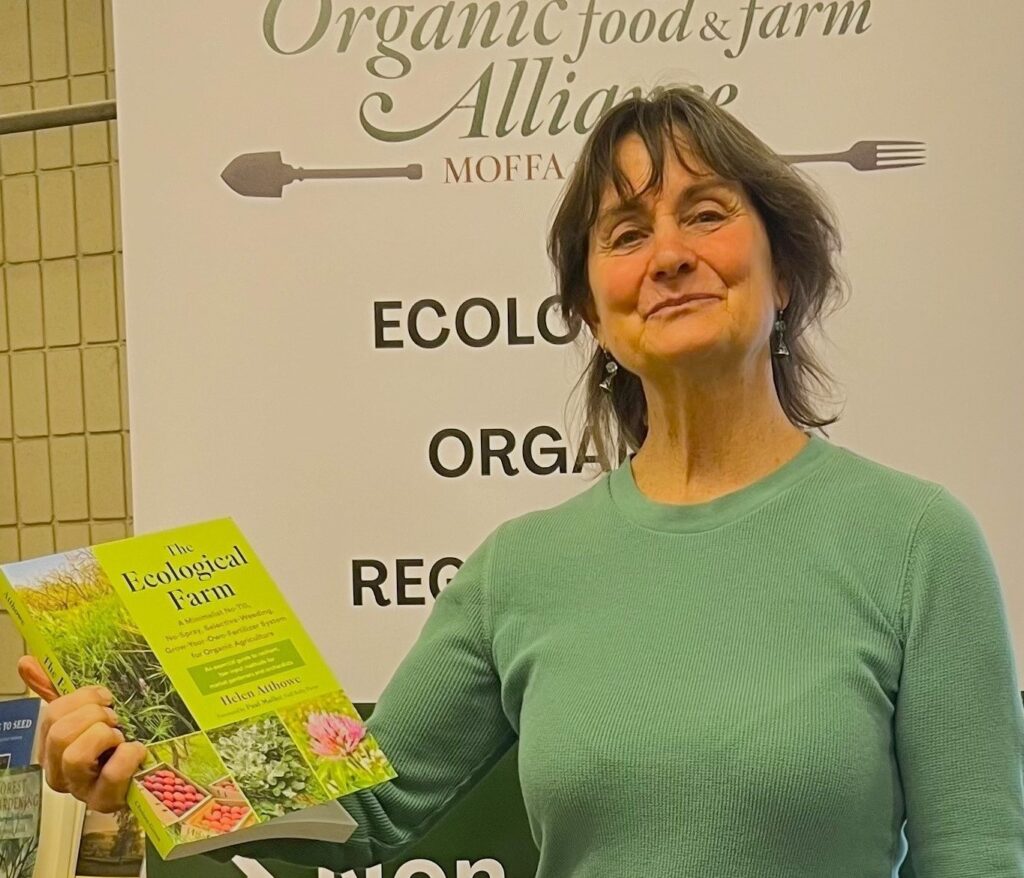
Acres U.S.A. Right. You don’t want to be persnickety, and you want to welcome people openly into the fold, but you want to encourage them to keep moving more in the ecological direction. How do you do that — how do you help folks like these researchers move from level A to level D or E or F — whatever level you and other Acres U.S.A.-type farmers are at?
Atthowe. I think talking about soil health and microbial communities is a point of common ground because I think the science has caught up with what we thought 50 years ago. I think that’s exciting.
But I don’t think we’ve figured out how to practically go from where the science is to what our methods are. We talk about reduced tillage, we talk about keeping a living root in the ground, and I think those are key and are a place of common ground. But I don’t think we understand how to make that happen — how to manage plant competition when you leave a growing root in the ground, how to deal with high residues as a big part, if not the total, of your soil fertility system. I think we haven’t addressed that, and we certainly don’t have as much of a research agenda around it as I would like to see.
Acres U.S.A. I think that’s true. Could we go back and describe your background? You worked with Masanobu Fukoaka and Wes Jackson — you’ve got this unique history in agroecology.
Atthowe. I’ve been really lucky. I started out before I even knew better. I grew up in Montana around conventional farming. Actually, it was mostly organic, because people didn’t have money to use the chemicals.
And then I managed to drop out of college for the first time, and I discovered Masanobu Fukoaka, who focused on all the things we’re talking about — a living root in the soil all the time, reduced tillage or no tillage, and growing your own fertilizers. I spent a lot of the next 40 years trying to figure out how to make it happen on commercial vegetable and fruit farms in the United States.
I knew it was something important. It certainly wasn’t the way we grew grain in Montana. It inspired me to go back to college, finish up, and go to graduate school, and then I got a year’s internship at the Land Institute. Wes Jackson just opened my whole focus there. It was a deep dive into ecological components of an agricultural system that would mimic nature. I’ve been trying to do that in my commercial horticulture pursuits for the past 40 years.
Wes was a great thinker who inspired me and gave me readings — every morning we would argue about the readings with him and the other students who were there. And then in the afternoon we all had our experiments in the field. I can’t emphasize how important those readings were in opening me up to thinking differently. I had a different paradigm, and I was asking questions differently.
Acres U.S.A. What were some of those readings? Aldo Leopold, Sir Albert Howard…?
Atthowe. Yes, those and articles by soil ecologists and geneticists, and John Harper’s book, Population Biology of Plants. The idea of applying plant population biology theory to agriculture was revolutionary to me. Harper’s book helped me to see plants as part of a series of interactions within an ecological community that also comprises microbes, insects, birds and animals.
Acres U.S.A. And then what did you argue about?
Atthowe. Oh, all the details about what an ecological system would look like and its most important components, and definitely understanding root systems and how important the root-soil microbial interactions were. At the time, Wes was focused on perennial polycultures and the model of agriculture being the prairie. Being from western Montana, I of course wanted meadows and forest to be part of the model too. I think that was the first time I realized how much was going on underground, in terms of different ways of thinking about organic matter — how we measure it and all of the microbial root exudate interactions that then caused all the interconnections — all the ecological relationships.
Acres U.S.A. Have you followed many of the new rhizophagy findings?
Atthowe. Yes. It’s so exciting to me that all these things that we understood — certainly that Fukoaka understood intuitively, and he had a microbiology background — these things that have come out in the past five to 10 years confirm our understanding of these ecological connections between plant and microbial communities. These understandings help us move away from conventional toward “conventional organic,” and from there toward “ecological organic.”
“Conventional organic” is a terrible term, but I’m using it now to describe what I was doing 15, 20 years ago. We had raised beds with black plastic mulch, and we were using high tunnels. It’s changed the food system to have high tunnels in cold climates. I’m not against them, but I think we are still going with that mindset of having zero tolerance for weeds, zero tolerance for particular pests, and not understanding the ecological interactions so that we can suppress rather than kill everything.
Acres U.S.A. Right. Going back to the Land Institute for a second, have you followed their kernza research recently? Are yields continuing to improve?
Atthowe. There are Montanans experimenting with kernza, and I’m very excited by that. I do think that we’re actually coming to commercialization sooner than I would’ve anticipated. We’ll see. It can certainly be a part of a system. But yes, yield is always going to be the issue. How do we have these ecological systems and maintain the kinds of yields that we seem to think we need?
Acres U.S.A. Well, that’s just it — it’s expectations, right? We’ve become used to 250-, 300-bushel corn, but that wasn’t the case until recent decades.

Atthowe. And what I think we haven’t asked, and what I’d like to know more about, are the ghost acres required to maintain those high yields. Fertility is still relatively cheap. In fact, at the recent organic conference at Montana State University, I ran into one of my old students, and he’s doing everything that I was doing 20 years ago, with the raised bed and the plastic, but not putting the living mulches in between the rows. And his partner said that the more 13-5-5 she added — organic fertilizer — the higher the yields, and that fertilizer is very cheap compared to the increase in yield. And she’s right.
Acres U.S.A. Yeah, in one sense it’s hard to argue with that.
Atthowe. Yes, but she’s getting a bagged fertilizer from out of state hauled in here. And then how is that fertilizer made?
Acres U.S.A. Right. It should all be incorporated in the cost. That’s what the price system is for — it’s supposed to measure all those things — but where are subsidies involved that are making that price unrealistic, and where are the long-term ecosystem costs not accounted for?
So, are you still farming today?
Atthowe. I would call myself a gentleperson farmer. I’m doing enough that I can continue to experiment and research and grow all my own food. I grow food for myself and my friends and my neighbors, but I am not selling much at this point. I have put in a hundred-tree orchard, so eventually that’s going to be way more than me, my friends and family and neighbors can utilize. At that point there will probably have to be sales, but I did that because a diversity of fruit is a little less available at the local farmers markets here, and the stone fruit that I’ve put in is unheard of at the farmers markets. So, there’s a need for it.
I have a high tunnel, a beautiful five-acre field that has these hundred fruit trees in it, and plenty of room for vegetable production too. I’m kind of in transition, trying to figure out what an old lady can actually do — so that I can continue to experiment both with growing my own fertilizers and the economic sustainability and the practicality of that. I’m looking at the crop nutrition effects of higher-nitrogen fertilizers, such as manure compost, compared to fertilizers with a lower carbon-to-nitrogen ratio, such as the fertilizer I grow myself. I want to look at vitamin and antioxidant content in tree fruit, but also in red peppers; I’m really excited about that research too.
I think we really have not seen definitive nutritional quality results looking at organic versus conventional. I think that’s again because of the big umbrella over all these different operations we call organic. I think there is more and more compelling data in the literature to say that maybe we don’t want these quick-release, higher-nitrogen organic fertilizers — much less conventional, chemical, high-nitrogen fertilizers.
We’re starting to see higher levels of nitrates in our vegetable crops, and we’re seeing different microbial community dynamics associated with higher-nitrogen soil fertility systems. I’d like to look at that more. I’ve set up my orchard in a way that we have good replication, so I can do those experiments.
Acres U.S.A. One of the biggest things we’ve been hearing about lately is the role that synthetic, and even organic, high-nitrogen fertilizers play in shutting down microbial life.
Atthowe. Exactly — and in moving us into a particular microbial community. If you put on those high-nitrogen fertilizers, you get a blast of mineralizing bacteria, but you can lose a whole component of your other microbial life, particularly specific fungi. You may still have microbial abundance, but you may sacrifice microbial diversity.
Acres U.S.A. Right. But the fertilizer only works for maybe six weeks, and then when that fertilizer is gone, the plant still needs that resource, but it doesn’t have the microbial community anymore to deliver it via rhizophagy.
Atthowe. Yes. I think we need more of that type of research.
Acres U.S.A. Could you describe your vegetable system a bit more? It’s essentially a strip-till system, correct?
Atthowe. Yes. My late husband and I came up with these 10 principles for managing ecological relationships rather than simply crops, and so I’m focusing on those both in the orchard and the vegetable production.
I’m utilizing reduced tillage or no tillage, depending on the crop. The crop rotation is part of this system, and within the rotation I also rotate the amount of tillage. Some crops, like seeded crops, of course require more tillage passes. Other crops, like transplants — particularly brassica transplants — require less and possibly even no tillage. If you’re flipping a bed from, say, a spring lettuce to fall brassicas, you can perhaps just mow the lettuce, cover it with mowed living mulch, and then transplant directly into that. The tillage amount will vary within the crop rotation.
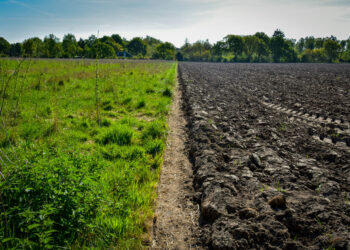
Generally, I’ve moved from annual living walkways or living mulches in between the crop rows to perennials walkways. They’re perennial for a certain amount of time, at least, because I’ve learned that after about five years there will be a natural ecological cycling and succession. I once had this wonderful six-acre field, for example, and I seeded it to red clover and triticale, and it came up with about 1 percent triticale and 99 percent red clover, and it was just gorgeous. So, I went to perennial walkways in between my strip-tilled beds, and after about five years we had natural ecological cycling and succession, with more grasses moving back into the plant community and less clover.
In Oregon, my late husband and I set up a 15-year rotation where we would move the perennial living mulch every five years. We would have the perennial living mulch for five years and the strip-tilled crop bed next to it, with the mowed living mulch being blown into the crop bed for both fertility and for pest suppression. After five years, we would either seed the crop bed — probably with more legumes — or let things move in, and then we would strip-till what had been living mulch

Acres U.S.A. I think I remember reading that you have four-foot beds; do you use four-foot living pathways? Is it 50 percent of each?
Atthowe. It was 50 percent on my Montana farm. In Oregon we had 211 acres and were trying to think about this long term. What if we never brought in any off-farm fertilizer? So, we did five-foot beds and 10-foot living pathways. That way we could leave some unmown at all times as habitat for ground-dwelling predators like spiders and beetles, and we could leave some sequential season-long blooming habitat right next to the crop for our predators and parasites that need pollen and nectar. We had enough room to just use the living walkways as our grow-your-own fertilizer.
We did an interesting experiment that was supposed to last five years, but we only made three years. My husband had a farm accident, and I couldn’t continue it. But the idea was to compare living mulch alone, from within that same field, with adding another six inches of hay mulch from another field. And indeed, in some of the heavy-feeding crops, we did find that added living hay mulch was important and significantly improved yield for things like red peppers and onions — but not so much for cabbage and dry beans, for example. I’m still trying to figure out how you can do that completely closed fertility system.
Acres U.S.A. When you talk about perennials in the pathways, do you mean plowing it and putting it into clover and other cover crops, or do you mean just leaving turf?
Atthowe. I mean both. In Oregon, we simply took a 50-year-old pasture and strip-tilled. Well, first we mowed, and we blew the living mulch onto what would be the beds. Then we strip-tilled that in, but we left the 50-year-old pasture as the walkways between strip-tilled crop beds. We were definitely experimenting — we were not basing our livelihood on this — but instead of a lovely, easy-to-deal-with legume, we had several species of grasses, red and white clover and alfalfa, and weeds. We got the weeds for free from that pasture! But we had extraordinary results with the orchard and good to very good — and sometimes questionable — results with the vegetables.
Acres U.S.A. What type of implement were you using for strip tilling? Just a rototiller?
Atthowe. I’m so glad you asked because, again, the ecological details matter.
We had a little tiller, and we would do a very shallow tillage about two inches. We would bring up the annual weed seeds that would be in that top two inches, but we would not go deep and bring up the buried weed seed. The weed seed bank would be disturbed only on that top two inches where you have most of the annual weed seeds. And then we would till again a second time. For seeded crops, we would go through and strip-till a third time.
The caveat is that every time we tilled, we added organic residue. We would mow the living mulch, blow it in, then till it in each time. We would disturb the weed seed bank at the same time we were adding residue and feeding the soil microbial community — or at least some of the microbes that like those rapidly decomposing residues.
Then I would use what I like to call my single-shank chisel plow, which is kind of a ripper. I would go down and back on certain beds periodically for deep-rooted crops. There’s pretty compelling evidence that you disturb the buried weed seed bank much less with a chisel plow than with a rototiller or plow.

Courtesy of Helen Atthowe
So, that was the plan. As you can imagine, particularly in Oregon, with the 50-year-old perennial pasture, we had lots of grasses, and we had things like smooth brome and quackgrass. The nice thing about the timing of the strip tillage and periodically using the ripper is that that would help me suppress some of the rhizomatous things that might move into the bed, and it would at least give me a chance to let my crop have the advantage for the early part of its root establishment.
Acres U.S.A. Did you do the ripping right along the edge, or all through the bed?
Atthowe. All through the bed. I basically go up and down and possibly up again.
Acres U.S.A. And how deep is that going?
Atthowe. Well, the soil got to be so lovely and fluffy. We could go down about a foot.
Acres U.S.A. But when you’re started from turf, did you need to go a little bit deeper with the initial tillage, or still only two inches? It seems like you wouldn’t even get to the bottom of all the grass at that point.
Atthowe. Right. Yes, we went a little deeper at first in that 50-year-old sod, but then we tried to keep it at two inches. And, of course, we used the ripper quite a bit; every bed got the ripper that first year.
Acres U.S.A. When you had the 10-foot living pathway in between the beds, were you mowing three feet and three feet and leaving four feet in the middle in every bed for beneficial insects? I assume a lot of this would depend on what kind of mowing equipment you have. Or were you alternating pathways between mowing and not mowing?
Atthowe. When I had the smaller walkways, I definitely would alternate. When we were doing this 50-year-old pasture, we would mow very close, right next to the crop rows — like a golf course. We were mowing every time we did the strip-tillage. As we put the crop in, we kept the living mulch next to the crop row very, very short. We would then leave the centers of the living walkways to grow. Later on, we would mow those. We would alternate every other row in terms of habitat as we went through the season.
In the spring, we would mow and blow on the young, green, lower-carbon-to-nitrogen-ratio residues. Later, as the pathways got taller and became a higher-carbon residue, we would blow that into the larger crops as part of our continuing nutrient cycling system, and as part of our weed suppression.
Acres U.S.A. And then before winter, would you mow everything?
Atthowe. Yes, everything was mown down to a golf course. We hopefully had plenty of residue on the beds. And then, for the crops that would be the heavy feeders the next year — like the peppers and the onions, maybe tomatoes — we would apply extra mulch for the winter.
The beautiful thing about having the 50-year-old pasture is that roots would move in from the side. Hence, I didn’t have to seed a cover crop unless I really felt I needed something or if there was a particular issue that I wanted to deal with in that bed. Of course, the bad news was that while we had very few annual weeds after several years, we learned to deal with rhizomatous creeping perennials. It’s not for the faint of heart.
Acres U.S.A. I assume the grass management in the orchard was pretty similar in terms of mowing — you’re mowing around the trees early in the season, keeping it open around the base, but letting it grow in the middle?
Atthowe. Yes, and then the same thing in the fall — we mowed everything till it looked like a golf course. For vole management, for rodent management, the last mow of the year, when the leaves would finally fall on the crops, we would mow everything away from the tree.
Acres U.S.A. Did this system keep everything in balance in terms of pests and diseases?
Atthowe. Yes, but we accepted up to 10 percent damage on crops. We often had less than 5 percent on apples, but sometimes had more than 10 percent if it was a bad coddling moth year. With stone fruit, it was things like oriental fruit moth or direct fruit pests. We no longer had things like aphids or mites — the things I consider the easier-to-suppress pests.
In terms of vegetables, we had lower damage from aboveground pests in Oregon. Squash bugs were quite problematic in the area, but most years we had less than 5 percent damage. Cabbage worms were problematic on kale, but not on cabbage and broccoli — and by problematic I mean sometimes we got up to 10 percent holes in kale. We had a couple of very dry and hot years, but as long as we maintained irrigation, we didn’t have problems. When we didn’t, though, we had some flea beetles on arugula, and we had some root crop issues on things like salad turnips. But on our main crops — peppers and tomatoes, eggplants, onions, dry beans, cabbage — we had less than 5 percent injury to any crop.
When I did my conventional-organic approach, with lots and lots of high-nitrogen composts and raised beds, I had pretty high levels of blossom end rot and sunscald, particularly sunscald on peppers. I assumed these were acceptable levels because that’s how it had always been. But as we changed to this higher-carbon, lower-nitrogen fertility system and provided a more balanced cycling throughout the season — as opposed to putting compost in, tilling it, and having everything in there all at once every spring — this significantly reduced these physiological disorders.
As I said, we accepted up to 10 percent damage, but on some crops, like peppers, we probably came out as well or better than if we sprayed for pests because we so reduced the sunscald issue.
Acres U.S.A. Did you do any spraying of compost teas or foliar nutrition?
Atthowe. Not on the vegetable crops, but my brilliant late husband was a mineral balancer, and he had developed what he called his mineral mix-blossom spray. He had done research, and we continued to do research with this, to suppress brown rot, and we found that it also helped us suppress fire blight on pears and apples. The whole orchard would get a blossom mineral-mix spray with micronutrients, such as manganese, boron, seaweed, azomite and other nutrients, like potassium.
Acres U.S.A. Did you ever do any sap testing?
Atthowe. We did some of that at the orchard in California. We didn’t do any of that in Oregon. We did a little Brix testing and were kind of shocked at how high the Brix was.
But we did quite a bit of mineral testing and comparison of our final products. One year we took six of our O’Henry peaches and then six from two other long-term organic farmers that were at that same San Francisco market, and we sent them off to be analyzed for mineral nutrients. And sure enough, perhaps not surprisingly, with the mineral mix bloom spray and the fact that Carl was a mineral balancer, our farm had the highest manganese, boron and zinc in the fruit compared to fruit from the other organic farms. That wasn’t surprising, but what did surprise us was that even with our low-nitrogen fertility, we were comparable in nitrogen, phosphorus and potassium.

One of the things that was so exciting about Carl was that he was farming the way I do, except he also did mineral balancing. He opened my thought processes to mineral balancing more. He had studied with Neil Kinsey. We farmed the same way, and we read the same things.
Acres U.S.A. Well, your book is one of the very best on incorporating ecological thinking into a practical farming system. I was looking for my copy of it, but I loaned it out to somebody.
Atthowe. Good, thank you! As I mentioned earlier, that practical implementation is what we need more of.
A few years ago there was a wonderful young person who took a week-long class from me and wanted to come and learn on the Oregon farm, and I gave him maybe three quarters of an acre of the field to do what he wanted with it. I continued my own, and then he would help me with the orchard. I split the profits of the orchard with him, but he did not do so well with his vegetables. He did some of the same crops I did — tomatoes and peppers and brassicas — but he also did a salad mix, the salanova, and was trying to do the approach where you have very heavily seeded, quick-turnover beds of radishes, arugula, salad, etc.
But he didn’t focus on what I call “managing the ecological relationships” — what he called “managing Helen’s fiddly details!” He didn’t focus on the needs of the crop as much. He also didn’t want to till as much. He was really all no-till, so instead of doing three passes on seeded crops, he wanted to get away with one or two, and he didn’t mow the living mulch walkway edges near his crop beds enough, and he didn’t irrigate as well. He had far more pest problems. We’d never seen flea beetles so heavy. They had been present, but not as a pest. They were a serious pest on his arugula. And he didn’t cover his crops. In Oregon it gets cold in the spring, but he didn’t cover the early kale, and it had more cabbage worm damage than my kale, which was literally a couple hundred feet away but that had been covered. And I had mowed short close to it, to avoid early competition from my living mulch. All of those little ecological details matter!
I guess what I want to say is that ecological farming takes less labor in terms of weeding labor. You can’t get away with not having harvest help, but you do limit the weeding and fertilizing. But even with all of the benefits of the agroecosystem, you still have to shift the ecological community balance toward your crop. You still want to think about the soil preferences, the temperature preferences, and the water preferences of that particular crop, and you have to think about the root development early on and suppressing other root competition until the crop establishes strong roots. All of those things are still really vital in an ecological system. You can diminish your inputs of fertility and of pest materials, but it requires even more brain activity, if that makes sense.
Acres U.S.A. It does. Does that make you optimistic or a little bit more cautious about the ability of farmers to implement an ecological farming system? This guy was literally right there with you to tell you to him what to do, and he still failed.
Atthowe. It really is a lot more challenging to farm this way. After going to this most recent conference here in Montana — which is a hard place to grow, by the way — much harder than where we were in eastern Oregon and in California — I realize that over-applying nitrogen and going with bare soil is a kind of insurance. You may not need it, and, in fact, I think there are negative ecological consequences to it. But you always know that you’re going to be able to control things better with it in the short term.
Whereas with my system, you’re constantly having to reassess what the weather’s doing, what insects might be moving in, or voles or mice. You’re constantly reassessing. Some years I may mow much more heavily, and some years I may let the living mulches grow really tall because we’re having a really windy year, and I want them to be a climate modification for my crops. You’re constantly rethinking and rearranging.
Acres U.S.A. You’re a master craftsman.
Atthowe. Yes, you have to be a master craftsman. You use less of the world’s resources and more of your brain. The good news is, as an old lady, I don’t have to do as much physical work. I have a little Husqvarna mower. I also have a 10-foot mower on a tractor, but mostly I use the little Husqvarna mower. With it, I can stack ecological function, and my one mowing task can multitask as fertility management, pest management and weed suppression.
Acres U.S.A. Did you ever use anything like an edger, like they would do on a lawn to go right along the edge of the row to keep the rhizomes from coming into the bed?
Atthowe. I didn’t, but in the early season, after the strip tillage, I have a hand wheel hoe, and I have a furrow that I put on the wheel hoe. I have often taken that down where I was going to do the seeded crops as well. But I think that would be a great innovation to do some edging as well. You’re not going to stop the rhizomatous growth, but the longer you postpone it, the better it is for the crop you’re trying to give the advantage to in that agroecosystem.
I don’t think people should entirely mimic my system. I think they should look at the ecological principles that I suggest and think about suppression rather than zero tolerance, and managing all of the organisms within the system rather than limiting your system to mostly just crops and the bad insects and the bad pathogens. Every agroecosystem is going to look different, but if we can think in those terms, I think we’ll be moving in an ecological direction.