

Oregon hazelnut grower Dan Brown and John Kempf discuss how nutrition and crop management practices — including some that may seem crazy — have helped reduce inputs while maintaining yield
John Kempf. Dan, tell us a little bit about your context. What are the crops that you’re growing, and in what type of environment? What does your operation look like?
Dan Brown. We primarily farm hazelnuts in the Pacific Northwest, in the Willamette Valley of Oregon. The trees are of varying ages. I’m fifth generation on the family farm. We have lots of different varieties of hazelnuts, and this is the primary hazelnut growing region in the country — 99 percent of hazelnuts are grown within about 60 miles of me. It’s a very small microclimate.

Kempf. From a food security perspective, what’s going to happen when you get a deep freeze some winter and then a hot summer that summer?
Brown. We hope that doesn’t happen. In 1989, I believe, there was almost a crop failure. But hazels are not hugely consumed domestically either — they’re relatively unknown.
Kempf. That’s true. In which parts of the world are hazelnuts consumed? Does that mean that the majority of your crop goes to an export market?
Brown. It does, although a lot of it is exported and then re-imported as Nutella. That’s the primary mode of hazelnut consumption of Americans. But as far as direct consumption, it’s mostly Europe — Germany is a huge consumer, as well as other parts of Europe. China was a big market as well for a while, but they’ve kind of pulled back.
Kempf. Given the recent change in administration, do you foresee any possibilities of some of that exported processing and manufacturing being brought domestically into the country?
Brown. I don’t know if that will necessarily benefit us directly. It’s hard to say. It’s very fluid at this point.
Kempf. Yeah, it’s premature to speculate at this point.
Tell us a little bit about your operation. You said that you’re the fifth generation still farming with your family; what is the scale of production, and what other crops are you growing in addition to the hazelnuts?
Brown. Yes, I farm with my family. Dad’s still heavily involved, and my brother as well. We also have some walnuts; we used to farm quite a few walnuts, but that market has collapsed. And then we also farm some corn, wheat, and clover for seed. We experimented with peas this year. That was a bit of a failure, but we’ll try again. Some oats for grain. In the Willamette Valley, there are about 200 different crops grown — you can grow anything you can imagine here.
Kempf. Pretty awesome microclimate, isn’t it? Can you give us some perspective on your rainfall environment and what your growing conditions look like?
Brown. It’s a Mediterranean climate, so we get most of our moisture and precipitation in the fall, winter and early spring. Then the summer is almost desert-like in some years. The rain turns off early May, and we don’t see a drop of rain until September. But we can also get upwards of 30 to 50 inches of rain in the off-season.
Kempf. Does that mean then that you’re generally irrigating during the summer months?

Brown. We have both types. Hazelnuts are traditionally dryland, but irrigation has been adopted in recent years on a lot of the newer plantings. The industry had an influx boom 10 years ago when the price basically tripled overnight, and the acreage also tripled in about five years. Pricing fell but has since recovered to a much better level.
But a lot of crops in our area are cool-season grasses, which grow primarily in the fall, winter and spring, so irrigation is not required. Winter wheat in our area can be 150 bushel dryland.
Kempf. So how has your farming operation evolved over the last five to 10 years? What are the things that you’re working to improve?
Brown. We were having some significant struggles and challenges in our orchards related to compaction, soil loss via erosion, etc. We just went down the rabbit hole of how we could address this and try to fix and mitigate these issues. We tried some really crazy things to see what happens.
A tree is supposed to have roots out to its dripline. So, I took a subsoiler down a row — it was a very small test because didn’t want to totally kill everything — and I found very minimal rooting. That was more confirmation that the roots really weren’t there because of extreme compaction. I took a soil penetrometer and was able to peg 1,000 psi at the surface.
Kempf. Wow.
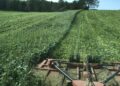
Brown. That was about three or four years ago. Since then we’ve done some cover cropping. We’ve tried to stay out of the orchards when it’s too wet, as much as possible. We’ve changed from a traditional bare orchard floor to a covered one — even if it’s just the native weed cover, letting a lot of that grow at least in the drive rows — to both mitigate compaction and to help with erosion.
Kempf. How thorough is the shade cover on the orchard floor in hazelnut production? Of course it varies with how mature the trees are, but for a mature orchard, what proportion of the orchard floor is covered in shade during the day?
Brown. In the summertime, a mature orchard can be basically fully shaded.
Kempf. And what does that translate to in terms of cover crop growth underneath the orchard canopy?
Brown. That was actually a little surprising. I planted a mix of oats and peas one year, and we had some four-foot-tall oats in the orchard, even through the full canopy, with no direct sunlight. A lot of people were really surprised. I was too!
Kempf. In almonds, the reason for the bare orchard floor is to facilitate harvest. I assume that’s the same purpose in hazelnut production — so how have you been managing that cover crop residue for harvest?

Brown. That is correct. We flail mow quite a few times through the year, and if we don’t get behind on it, that generally takes care of it and does a good job. If we do get behind — we’ve had some challenges with grass residue this year — we can bail a little bit just to get rid of it. It’s all a learning process.
Kempf. In addition to the cover crops, have you also been doing any subsoiling for compaction?
Brown. We haven’t, after that first experiment. I’d like to try an in-line ripper just to minimize the surface blowout — to try to not cause so many problems. It was a full reset, and so harvest that year was virtually impossible. I ripped it in August, which is about a month and a half prior to harvest, and in doing so I brought up basketball-size boulders of soil that I then had to break back down. Then it got a little bit wet, and it was just a muddy mess.
In terms of other things we’ve been doing, though, we also have some subsurface drip irrigation that we’re big fans of. It’s much easier to manage than surface drip. And then with that we do some fertigation. We like foliar feeding. It’s direct, it’s quick, it’s efficient with volumes of product, and it doesn’t necessarily have the microbial degradation associated with some of the salty fertilizer products that you would soil-apply.
Kempf. I’m assuming that with the hazelnut production, like with other higher-value crops, you’ve been foliar feeding over the years. It’s not a particularly new innovation for you. But how has your nutrition management evolved over the last couple of years?
Brown. Correct. Dad was actually an early adopter of foliar feeding, probably close to 20 years ago. We’ve since continued and refined over the years, and sap analysis has really targeted it even more. We’ve brought nutrients into the picture that we never thought of in the past.
Kempf. I find it intriguing that still, to this day, people reach out and say, “Foliar applications are invalid; they have no scientific basis; foliar applications don’t work. Plants only absorb nutrients through the roots.” And I’m like, where have you been for the past 40 years, and where are you getting your information? We have the International Plant Nutrient Institute publishing articles and some outstanding reference materials and resources on how to design effective foliar applications. This is not a new idea. But for you, what did the sap analysis results reveal, and how did that change your nutrition management?
Brown. We’ve seen lots of different things. We found low molybdenum and cobalt and have since added those into our programs. We’ve been able to pull back on potassium some different times of the year. We’ve always struggled trying to get calcium levels up; we’re still trying to dial that one in.

We’ve pulled back on nitrogen levels, and that’s also timing based. We would traditionally pull soil tests in August, and I’d get the results back and there’d be 150 units of nitrogen left in the soil at the end of the year. This seems silly — we put it on, but the tree never took it up, and then it gets flushed in the wintertime, and it’s gone. So, we’ve since really pulled back on soil-applied nitrogen. Traditional application rates are as high as 160 units — that’s the recommendation from the college; we’ve pulled that way down to sub-50.
Kempf. So, you’ve cut it down to about 30, 35 percent of where you were.
Brown. Yes.
Kempf. There’s an important question that I missed asking when we were talking about your use of cover crops: how did the soil compaction change as a result of that? Do you have less compaction now?
Brown. It’s improved some, but we’re still fighting that and trying to alleviate that. We’re still looking for — I wouldn’t say the magic bullet, but we’re open to trying anything and everything to try to help with that. Cover cropping certainly has helped, but it’s challenging still.
Kempf. My reason for asking about soil compaction was that you mentioned that you had as much as 150 units of nitrogen left in the soil at the end of the season, and you were applying 150 to 160 units. Do you think you had very limited absorption because of soil compaction?
Brown. That’s possible. Also, they’ve done uptake tests on hazelnuts and found that they only need about half of that total anyways. And a lot of hazelnut orchards are 3 to 5 percent organic matter, and if you get 20 to 25 units per percentage point through microbial processing — I think it was just basically wasted.
Kempf. With where you are right now, with 50 units of nitrogen application, how are the trees responding?
Brown. We’ve had some very good yields. We’ve had our challenges as well, but not necessarily related to that. We’re still dialing it in. We foliar feed with urea and some amino nitrogen products throughout the year, and next year we’ll probably step that up some. We were labor challenged the last couple of years due to very low crop pricing. That’s one downside to foliar feeding — the acres-per-day cost is much higher than dry bulk spread.
Kempf. In addition to nitrogen management, what other nutrient changes did you see taking place?
Brown. We’re always trying to address boron. Hazelnuts like boron, and we have low soil boron levels, even in the parent rock material, so we’ll put on as much as three actual pounds of boron in a band. If you took it as a broadcast rate, it’s almost six pounds in the tree row, which most people think is crazy. But we’re yet to see any boron toxicity symptoms. And again, you pull soil a test at the end of the season and it’s back down to 0.5 ppm in boron. So, the tree had to absorb some of it.

Kempf. That’s intriguing. Yes, the tree absorbed some of it, and who knows — some of it may have gotten sequestered, or it may not be showing up on the test. It’s not there anymore. With the changes in boron management and nitrogen management and the various things that you’ve done, how has crop performance shifted? Are you getting yields equivalent to what you got in the past?
Brown. We’ve had yields equal to others in our area, and some even higher. We have shallower soils here; 20 miles south of us always gets a higher yield than we do because they have 30 feet of topsoil versus our six to 12 inches. But we’ve been pleased. We’ve had yield increases through changing management last year. We’re still waiting on final numbers for this year, but we’ve been very pleased.
Kempf. What have been some of the highlights or the memorable moments in these management changes? What are some of the things that really stand out to you that were perhaps a surprise or were unexpected?
Brown. We pulled a total nutrient digestion test on some fields last spring, and it was very eye-opening to see the amount of potassium and organic nitrogen — all these minerals that I was always taught to keep adding. Well, no, we need to unlock what’s there and use that. We don’t need to pour on hundreds and hundreds of dollars an acre every year just because somebody said it’s a good idea — even though we’ve shown and seen that there’s really no economic benefit to us. There’s only benefit to the fertilizer retailer. The trick is to find high-ROI inputs and unlock the native cycling of nutrients via soil biology.
Kempf. What are some experiences that you believe other farmers would benefit from knowing about? What have you learned that you wish you knew several years ago?
Brown. Don’t be afraid to try something new. That’s a big one. Even if it’s on a small amount of your acreage, try some crazy ideas and see what happens. That’s how we learn. Do I mess up and fail? Absolutely. I look at that as learning. We learn more from our failures than our successes.

Kempf. There’s this interesting pattern that occurs when you look at the trajectory of people’s lives early in life. We encourage failure — we encourage toddlers to figure out how to walk, and when they fall down we celebrate it: “Hey, that was awesome! You did great!” It’s the same with learning how to ride a bike and all kinds of athletic endeavors through your childhood years and formative years. But the older you get — and particularly once you go to school — rather than celebrating failures, by the time we’re adults, we want to avoid making mistakes. The reality is that we should consider mistakes as a part of training — we want to make as many of them as rapidly as possible —unintentionally, of course.
What were some of the mistakes you’ve made, or areas where you encourage people to take risks? What have been some of the risks that you have taken that you would encourage other people to experiment with?
Brown. Cover cropping. We’ve had successes with that and some struggles. One definite struggle was that we planted a radish that was very aggressive, both in top growth and the tuber. Come harvest season, we had three-foot-tall radishes, and that was an epic problem. The harvest equipment would pull the whole tuber out of the ground and was trying to run a three-pound radish through the nut harvester. It’s not made for that!
But our success through cover cropping has been a significant reduction in soil erosion. We used to manage our orchard floors with bare soil. We would spray pre-emergent herbicide in the spring and would then mow and drag to create basically a tabletop, bare-dirt surface. We’ve really gone away from that. We still keep the tree rows pretty clean because it’s hard to get the nuts out of the tree row if there’s too much vegetation there. But we manage a mowed center via either native weed cover or planted cover crops. We’re hoping next spring to put in some creeping red fescue as a nice grass cover that we’ll mow four, five, six times a year. We can flail mow that as fast as eight miles an hour and cover a lot of acres in a hurry. It’s really not the huge cost I used to think it was — mowing versus chemicals.
Kempf. You mentioned the various cover crops you’ve tried — the radishes and the oats. What time of year are those going in the ground? During the dormant season post-harvest, or are they going in during the summer months?
Brown. We typically plant post-harvest, or early spring if it gets too wet before we’ve gotten a chance to plant or too cold to germinate.
Kempf. So, if you’re planting cover crops in the post-harvest period, that’s the period when you have abundant rainfall and you also don’t have a tree canopy. Is there some level of growth that continues all the way during the winter months?
Brown. Yes. It’s slow, but even in the winter we’re not super cold. There are a lot of 50-degree days. Cool-season grasses will grow and tiller, and other things will grow as well, just slowly. And then in the spring, when we get more heat units, stuff really takes off, as long as we get them in before temperatures get too cold to germinate.
Kempf. I’m curious about how your experience is different from that of other hazelnut growers, or from the hazelnut industry as a whole. What are some of the challenges that the industry is dealing with?
Brown. The biggest thing the past couple years has been low prices. As good as corn was two years ago, hazelnuts were that bad, and worse. There were record low prices by I don’t even know how many orders of magnitude. But that’s now recovering, and that will help a lot of industry issues.
Soil erosion’s a big problem. I was just chatting with a grower the other day who was asking me if I’d ever tried subsoiling in an orchard, and I said I had, but there’s definitely challenges that can come with that. I’d like to try an in-line ripper in an orchard. It’s a minimum-disturbance implement to try to shatter some deeper compaction layers while not obliterating the soil surface.
Kempf. Several years ago I was visiting with a group of hazelnut growers, and they were having major concerns around Eastern filbert blight. Is that still a challenge to the same degree that it has been historically?
Brown. It is. It’s interesting that you bring that up; the college has bred new varieties that were highly resistant to the Eastern filbert blight. And then just this spring, the spring of 2024, it’s been found to have mutated into a new blight strain that affects hazelnuts again. So, what we thought was no longer an issue has come full circle — not surprisingly, honestly.
Kempf. Not surprisingly at all.
Brown. Yeah, that’s the way nature works. The college is recommending four fungicide treatments in the spring, but we have taken a different approach. We’re going after it through our nutrition management practices — trying to keep trees healthier. You and I have an immune system, and so does a plant and a tree. They can fight it off if they’re healthy. That’s our philosophy, anyway.
Kempf. And how’s that been working out for you? How long have you been trying that?
Brown. We’ve been managing this way for about three years now. It’s hard to know for sure the success on the blight directly because the blight has an 18- to 20-month latency period. What you do this year, you really don’t know for a couple of years if it worked. Plus, the spread of blight is on the new varieties, and it’s kind of localized. We haven’t seen it in our exact area.
But we figure that if the trees are healthier, we’ll have higher yields anyways, so it’s an economic benefit. If we do start to see it, we’ll just monitor that and try other intensive nutrient approaches. The blight was already in the orchards we’ve been managing with nutrition — very significantly; if we were to prune it out entirely, the tree would be completely gone. We had to pick a level that was acceptable, but we’re excited about this process of managing disease through nutrition versus synthetic chemistry.
We have had success in insect pressure via nutrition management. We have orchards that we traditionally treated with one to two insecticide sprays in the summer for filbertworm moth that we haven’t sprayed insecticide on in three, four years, and we haven’t had insect problems at all.
Kempf. We have a lot of experience working with nutrition management for disease and insect control, and I have this subconscious expectation that if you balance nutrition, then diseases should be easier to control than insects — because insects are mobile. But it’s been a common experience that insects are faster to respond to nutrition management than diseases. You get more immediate results.
Brown. Yeah, we’ve had the same experience.
Kempf. You mentioned that you are working with foliar feeding, and you want to change some of your nitrogen to do more amino acid and urea foliar applications. How common is foliar feeding in hazelnut production?

Brown. It’s definitely not used by everyone, but it is fairly common. We’re probably on a higher intensity level. Some people figure they’re already making a pass for an insecticide or fungicide treatment, so they’ll throw something else in the tank. Whereas our primary objective is foliar nutrition that’s directed by sap analysis, and we have some crazy tank mixes. We’ll have 15 different products in the tank at one time. Most people think I’m nuts.
Kempf. That’s quite a combination. What are the things that you would like to try in the future? Where do you think the opportunities are?
Brown. I think the opportunities are endless, honestly. If you look at the yield potential of a hazelnut, we’re at probably 10 percent. There’s a lot of room to grow. If you go out in the winter or spring when they’re in bloom and you count all the blossoms and the number of nuts that could be there, versus what we harvest, it’s very limited.
Kempf. Where does most of that loss happen? Is it a lack of pollination? Is it nut drop?
Brown. I believe it’s abortions throughout the season. A lot of it is earlier on — there are nutrient deficiencies or stressors from environmental things. And then also the tree can only support so much weight. If you try to get too much, you could break the tree in half. But there’s a lot of room for yield improvement.
Kempf. That’s exciting, because when you have a plant that expresses itself in that way genetically, then producing nice yield responses is usually not difficult. With good nutrition management, you can get some nice yield responses.
Brown. Yeah, that’s exciting for us.
Kempf. How do you see the hazelnut industry evolving generally? What does the future look like?
Brown. I hope to encourage other growers to try the regenerative ag approach. Some are receptive and some are reticent, but I believe this is the future of agriculture. It’s encouraging to be asked. That means they have a problem or a question; something makes them scratch their head about why something’s happening or not. I like to encourage trying new ideas.
Kempf. What other crops have you had memorable experiences on, or things that you’ve been trying?
Brown. We’re very new to growing grain corn. This is only our second year, but we have grown some high-200 to probably 300-bushel corn on sub-100-unit nitrogen.
Kempf. That sounds fun. Now, if I were a cynic from the Midwest, I would say, “But you’re doing that on 3 to 5 percent organic matter soil!” And is that irrigated?
Brown. It is irrigated, although this year we only irrigated one time. We got a couple summer rains, which was very helpful. But we’re actually thinking we can grow some dryland corn. There’s much lower yield potential, but even still there is opportunity there.
Kempf. How did you manage nitrogen to produce that much yield? Was there nitrogen coming from any other sources? From cover crops, manure, or any other types of applications?
Brown. It was a hay field that was very tired from about 10 years. We turned it under and planted it to corn and put down very limited nitrogen, and it put out a very nice corn crop.
Kempf. Did you run any soil analysis — how much nitrogen was in the soil and from the hay residue?
Brown. There was some organic nitrogen. Nitrate levels were very low. It was five or 10 units of nitrate nitrogen.
Kempf. And what form of nitrogen did you apply?
Brown. We used both dry urea as well as an amino product. That first year we did not do any foliar nitrogen; it was just there with the planter.
Kempf. So, you’re running roughly a third of a pound of nitrogen per bushel of corn, which is some of the most efficient that I’ve heard of. It’d be interesting to know the total contribution from the soil — not just of nitrate, but of the total organic nitrogen.
Brown. We ran a Haney test, and it was pretty microbially active. It had a good score. So that was certainly a contributor, but I’d rather have it fix its own versus buying it.
Kempf. You said earlier that you tried peas this last year and that did not turn out as you had hoped.
Brown. No. Peas were an experiment for us this year — dry peas for seed. They’re traditionally swathed and then combined with a pickup header. We didn’t have a swather at the time, so we were going to direct combine them, but it had rained, so the biomass was just flat on the ground — less than an inch high. We tried crop lifters on the combine, but never having grown these before, didn’t know how firm and smooth a seed bed is required to do that. We were putting as much dirt into the combine as seed, so we decided to just flail them all off and disc them under. And now it’s a volunteer pea crop, and we’re going to try and overwinter those, and hopefully they don’t freeze kill. We’ll see. But right now it’s a very lush field of peas.
Kempf. Give them a good dose of boron — that’ll help them to not freeze kill.
Brown. That’s good to know.
Kempf. We had an interesting experience this fall — it’s been a couple of weeks since I looked at it, but about four miles from here, we planted a diverse mixture of cover crop seed — for the first time after coming out of mainstream corn-soybean production for the last 20 years. The intent is to spend a couple years in cover crops to try to regenerate the soil and then go into an orchard system. So, we planted these cover crops, and the seed emerged in mid- to late-August because of how dry it was here. At planting, we had broadcast some gypsum and some poultry litter and a very hefty dose of boron — three pounds per acre of actual boron, or what would be considered a high dose here in this part of the world.
It was originally intended to be planted at the beginning of June, but we didn’t get it into the ground because there was no moisture. As a result of that, the mix included summer annuals like buckwheat and sunflower and phacelia and similar types of cover crops. When I looked at recently, after we had experienced three hard, killing frosts — low- to mid-twenties — the buckwheat was still blooming, and the phacelia was still just as green and vibrant as can be. It’s only maybe eight to 10 inches tall, but it had been completely unfazed by the hard freeze.
My understanding is that boron contributes to creating a gel-like state in the cell and preventing cellular damage from freezing temperatures. It also contributes to a high sugar content. I’m giving boron the credit for that. We’ve done lots of gypsum applications over the years and lots of pelletized liter applications, but I’ve never seen a response quite like that, and it’s the first time I had put on such a high dose of boron at that particular stage. I’m going to be trying to replicate it, that’s for sure.
Brown. Excellent. Excited to hear what happens with that.