
Third-generation sequencers will soon enable growers to gain a much deeper understanding of their farm’s microbial health
Ready access to microbial DNA sequencing data will provide a leap forward for farmers, given the vital role that microbes play in plant and animal health. Human health research has revealed that billions of microbes live inside the human body and cover every surface of the skin. Microbes support nutrient uptake and perform other essential functions that the human body cannot perform on its own. They also help to fight off pathogens and have even been shown to influence moods and mental health. They play such an important role in human health that they are sometimes referred to as an invisible organ.
Microbes play an equally important role in plant health. They are inside plants and coat all root and aboveground surfaces. They exchange nutrients and water with plants in a win-win, symbiotic relationship. They respond rapidly to changing plant nutrient needs as the plant transitions through its many phases of vegetative and reproductive growth. This exchange results in more nutrient-dense foods. Microbes fix nitrogen, help manage pH near the plant root, and play a vital role in the plant’s ability to fight off diseases and pests.
In addition to directly impacting plant health, microbes provide many ancillary services that improve overall soil structure. They produce humic and fulvic acids that create soil aggregates, which improve soil water-holding capacity and oxygen penetration and that minimize soil erosion. Microbes also hold and circulate nutrients in the soil, keeping them from leaching away.
It is vital for farmers to support these hardworking and highly efficient farming partners. Microbes provide the responsiveness and resilience needed to produce crops in the presence of environmental fluctuations.
Third-Generation Sequencing
Until now, farmers have been trying to manage their operations without visibility and sometimes even awareness of the invisible microbial partners that play such an important role in their success. The advancing DNA sequencing technologies will reveal this microscopic ecosystem and fill in the missing gaps in understanding of what is affecting plant performance. Integrating DNA sequencing data with traditional soil and plant health data will provide a more complete picture of what is happening in the field and how to manage it.
New DNA sequencing technologies have emerged that will soon allow farmers to regularly measure the microbial universe in their soils. Referred to as a “third-generation” sequencers, they work by passing strands of DNA through tiny pores, or nanopores. As the DNA moves through the pore, an electrical current is generated, which is then decoded into the specific DNA sequence.
This is a fundamentally different approach than the previous “second-generation,” or “next-generation,” sequencers. They relied on making a copy of the DNA strand, and this placed severe limitations on the length of the DNA strand that could be measured. Third-generation sequencers do not have this limitation and so can sequence much longer strands of DNA.
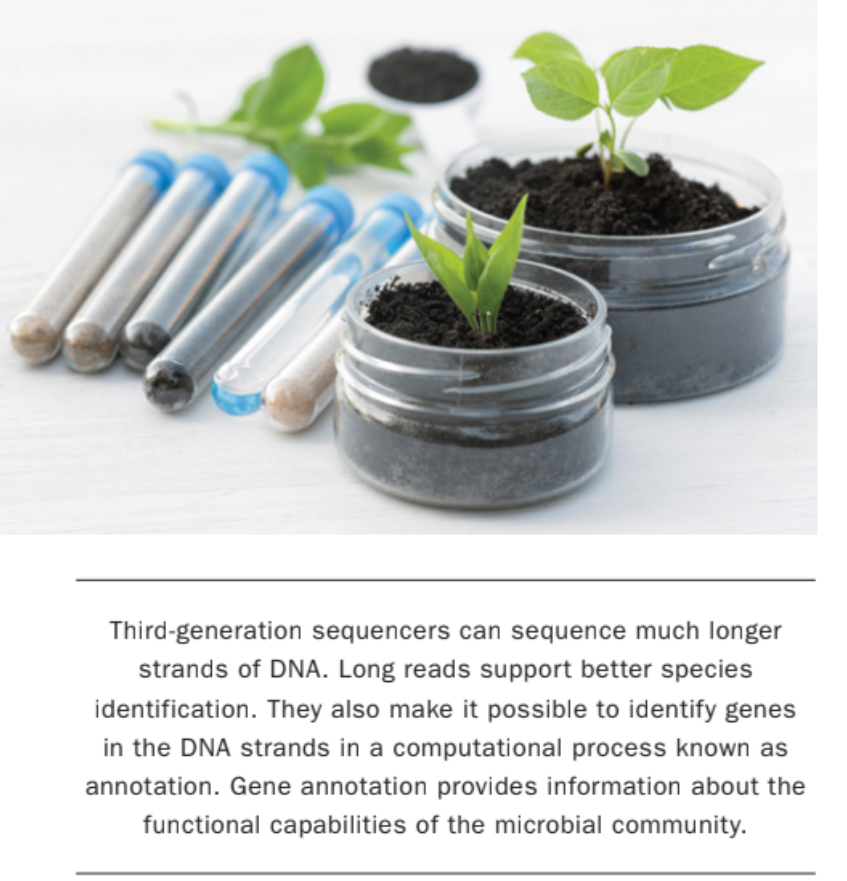
Both types of sequencing have their own benefits, depending on the user’s goals, but for the study of soil microbes, long reads are the superior option. Long reads support better species identification. They also make it possible to identify genes in the DNA strands in a computational process known as annotation. Gene annotation provides information about the functional capabilities of the microbial community. A farmer might, for example, want to know if there are microbial species in their soil that have nitrogen-fixing capabilities. This can be determined through gene annotation, even if the exact microbial species that possesses this ability remains unidentified.
Nanopore sequencers can also identify all kingdoms of life simultaneously (bacteria, archaea, protozoa, plantae, fungi and animalia). If these organisms are present in the sample, they will produce DNA strands that can pass through the nanopores and be sequenced. This means that the nanopore sequencer can reveal the presence of organisms across the entire soil food web. Second-generation sequencers, with their short read limitations, are typically used to sequence only bacteria and fungi; species in other kingdoms are almost always ignored.
Nanopore sequencers can be manufactured to be held in one hand and operated using a laptop computer, making the entire system mobile. Such mobile sequencing laboratories have already been employed to address several disease outbreaks in remote areas of the world. They are also potentially much more affordable than second-generation machines, and costs of materials and consumables are expected to continue to drop as the technology becomes more refined and optimized.

Third-generation sequencers also allow small sequencing runs to be performed at a low cost. Most other sequencing technologies have focused on making the cost per base very low if a large volume of sequence data is needed. This is valuable for large sequencing projects like the Human Genomes Project, but farmers only need a small amount of sequence data to get powerful insight into the richness of the microbial life in their soils.
It takes about a quarter of a gram of sample to perform the sequencing. The sample can come from soil, plant tissue, compost, liquid or any material of interest. The sample is subjected to physical and chemical treatments that break open the living cells and extract the DNA. The resulting pool of DNA is then prepared and sequenced on the machine. The sequencing of many genomes simultaneously is referred to as metagenomics. The extraction and preparation of the DNA for sequencing takes about three to four hours, depending on the methods used.
Once the DNA is prepared, it is placed in the sequencing machine and the sequencing begins. Data is produced immediately, and the progress of the run can be monitored in real time as data flows out of the machine. It typically takes about 24 hours to complete, but this varies depending on the amount of data desired.
The final step in the sequencing process is the computational analysis. The DNA strands that are sequenced are compared to databases of all known microbial species. This produces a taxonomic listing of the species in the sample. Gene annotation can also be performed. Data analysis typically requires several hours or days depending on the volume of data generated and the type of analysis performed.
Applications for On-Farm Sequencing
There are many applications for DNA sequencing on the farm. Some examples include:
- Assessing how different farming practices impact the biology in the soil over time.
- Identifying the community of microbes in composts and liquid biological amendments, produced on-farm or purchased, that are applied to the field.
- Determining if microbial amendments that have been added to the soil, or as seed treatments, have successfully established themselves in the field.
- Providing a qualitative idea of the overall quantity of microbes living in the soil.
- Evaluating the relative importance of microbial diversity vs. the impact of a specific microbial species of interest.
- Sequencing pathogens that appear in the field for quick diagnosis.
- Identifying plants growing especially well in a field and sequencing the soil on the roots (rhizosphere), in the plant (endophytes), and in the neighboring bulk soil to see if it is possible to identify the microbial companions that are supporting plant health.
Obstacles to On-Farm DNA Sequencing
Despite the great promise that DNA sequencing holds for improving farming productivity, there are several obstacles to overcome before sequencing systems become commonplace. The DNA extraction and sequencing protocols are complex and require specialized equipment and skills. They are also still developing rapidly. This results in regular protocol updates that make it difficult to stay current. The development of automated systems is underway and will undoubtedly overcome these challenges in the next few years, but in the meantime, sample processing will likely be limited to laboratories with trained technicians.
Another area that requires enhancement is computational analysis of DNA sequencing data. The data must be processed and presented to farmers in a way that is meaningful and actionable. Work has already been done in this area and will continue to evolve and improve.
A final challenge is presented by the richness and complexity of nature itself. Human understanding of life in the soil is in its infancy. Much of the soil DNA that is sequenced cannot be assigned to an exact species because the organism’s genome has not yet been captured in computational databases. It is estimated that only about 1-5 percent of soil organisms are currently sequenced. In these cases, the sequenced DNA is placed at a higher level on the taxonomic tree, or it remains unclassified. As DNA sequencing becomes more commonplace, this situation will rapidly improve. It will be an exciting journey of discovery as the true scope and capability of soil organisms is revealed.
It is an exciting time for farmers, as the technology of DNA sequencing transforms human understanding of the complex and beautiful symbiotic relationships between microbes and plants. This new understanding will enable farmers to implement practices that support these relationships. Growers will come to recognize that they are first and foremost microbe farmers — the health of the plants, animals, humans and environment will follow. With this enhanced understanding, farmers can transition to practices that minimize inputs and let the microbes do the bulk of the work.
Third-generation sequencing is an excellent fit-for-purpose sequencing tool for farmers. Its ongoing development opens the possibility for routine on-farm DNA microbial analysis in the not-too-distant future.
Dr. Laura Kavanaugh is the new Chief Science Officer at Advancing Eco Agriculture. She is the founder of Genome Insights, LLC, and served as a soil health expert at Union Grove Farm in Hillsborough, North Carolina