Acres U.S.A.® Magazine
  • Articles
    • News
    • Ecological farming
      • Climate
      • Environmental Issues
      • Farm management & planning
      • Human health
    • Livestock
    • Farm
    • Crop
      • Crop management practices
        • Ag technology
        • Cover crops
        • Crop nutrition
          • Crop protection
          • Diseases
        • Crops
        • Fruits
    • Soil
    • Opinion
  • Resources
    • Magazine
    • Online Learning
    • Newsletters
    • Free Articles
    • Blog
  • Magazine Issues
    • 2026
      • February 2026
      • January 2026
    • 2025
      • December 2025
      • November 2025
      • October 2025
      • September 2025
      • August 2025
      • July 2025
      • June 2025
      • May 2025
      • April 2025
      • March 2025
      • February 2025
      • January 2025
    • 2024
      • December 2024
      • November 2024
      • October 2024
      • September 2024
      • August 2024
      • July 2024
      • June 2024
      • May 2024
      • April 2024
      • March 2024
      • February 2024
      • January 2024
    • 2023
      • December 2023
      • November 2023
      • October 2023
      • August 2023
      • July 2023
      • June 2023
      • May 2023
      • April 2023
      • March 2023
      • February 2023
      • January 2023
    • 2022
      • December 2022
      • November 2022
      • October 2022
      • September 2022
      • August 2022
      • July 2022
      • June 2022
      • May 2022
      • April 2022
      • March 2022
      • February 2022
  • About Us
    • Our History
    • Our Staff
    • Contact Us
    • Community
      • Soil Health Primer Resources
  • Events
    • Eco-Ag Conference
    • Farm Weird Event
    • Viroqua On Farm Event
  • Subscribe
  • Login
  • Register
No Result
View All Result
  • Articles
    • News
    • Ecological farming
      • Climate
      • Environmental Issues
      • Farm management & planning
      • Human health
    • Livestock
    • Farm
    • Crop
      • Crop management practices
        • Ag technology
        • Cover crops
        • Crop nutrition
          • Crop protection
          • Diseases
        • Crops
        • Fruits
    • Soil
    • Opinion
  • Resources
    • Magazine
    • Online Learning
    • Newsletters
    • Free Articles
    • Blog
  • Magazine Issues
    • 2026
      • February 2026
      • January 2026
    • 2025
      • December 2025
      • November 2025
      • October 2025
      • September 2025
      • August 2025
      • July 2025
      • June 2025
      • May 2025
      • April 2025
      • March 2025
      • February 2025
      • January 2025
    • 2024
      • December 2024
      • November 2024
      • October 2024
      • September 2024
      • August 2024
      • July 2024
      • June 2024
      • May 2024
      • April 2024
      • March 2024
      • February 2024
      • January 2024
    • 2023
      • December 2023
      • November 2023
      • October 2023
      • August 2023
      • July 2023
      • June 2023
      • May 2023
      • April 2023
      • March 2023
      • February 2023
      • January 2023
    • 2022
      • December 2022
      • November 2022
      • October 2022
      • September 2022
      • August 2022
      • July 2022
      • June 2022
      • May 2022
      • April 2022
      • March 2022
      • February 2022
  • About Us
    • Our History
    • Our Staff
    • Contact Us
    • Community
      • Soil Health Primer Resources
  • Events
    • Eco-Ag Conference
    • Farm Weird Event
    • Viroqua On Farm Event
  • Subscribe
No Result
View All Result
Acres U.S.A.® Magazine
No Result
View All Result
Home Crop management practices Crops Row crops

Intercropping Corn with Soy

Chris Dietrich by Chris Dietrich
July 1, 2024
in Row crops
0
Intercropping Corn with Soy

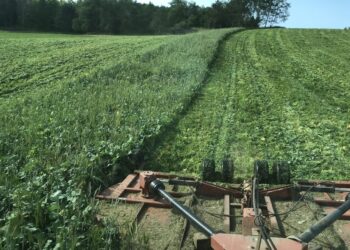
Corn and soy (Courtesy of Oregon State University)

0
SHARES
211
VIEWS
Share on FacebookShare on Twitter

A historical perspective on what’s possible when we question monocropping

Chris Dietrich

On July 6, 1976, I was cultivating my soybeans and saw a stalk of corn growing directly in the row of soybeans. I accidentally pulled out the center of the stalk and attempted to kill the rest of it. On July 15, I was cultivating my Harasoy 63 soybeans and saw the same stalk of corn. It was 3 feet high (it grew four inches per day for nine days). This was incredible for northwest Ohio for that time of year. The next year I grew 28 acres of corn (Reid) intercropped with soybeans (Harasoy 63).

Fifty-three days after planting the soybeans, the soybeans started to decompose, which provided the corn with plenty of nitrogen. The corn grew about four feet in six days. It was seven feet tall on July 8 and grew to approximately 13 feet 6 inches tall. I believe that this was the tallest corn in northwest Ohio. The width between the rows of corn was 36 inches. I think the width between the rows of beans was about 7 inches. I planted beans 2.8 to 3 seeds per foot of row. On the test plot over three tenths of an acre, the soybeans grew to 36 inches tall. The other beans grew to 40 inches tall. (I think this was from 56 to 60 days after planting). 

While the soybeans grew, they competed well with the weeds. I had two or three spots where the weeds overtook the beans and had to hoe them out. I decided to hand-pull weeds that were a half-inch or taller. It took eight days. The soybeans completely decomposed within two weeks, leaving a clean cornfield. The soil structure was completely changed, from a clay to a much bigger particle, almost to the point of the one picture in the old Encyclopedia of Organic Gardening. The ground opened up to at least six inches deep.

The local vo-ag class came out and did a yield analysis, and I ended up with 126 bushels per acre on the test plot. The corn in the test plot was grown on Dietrich’s Organic Farm in 1977 at Genoa, Ohio, with my mother, Veronica, as farm manager. I became a bed patient in 1978 and wasn’t able to keep developing this method (corn with soybeans — now called intercropping) even though it cost less than $50 per acre to do it, not counting land rent or labor. The local farmers were spending about $80 per acre and getting 77 bushels of corn per acre. I beat their yield by 49 bushels with less cost.

I got two tons (dry weight) of residue per acre from the soybeans. At 50 percent carbon, that is a ton of biologically active carbon per acre. Remember that biologically active carbon holds water. There was plenty of water in the fields where this was done, and the soil was easy to dig up. The field next to it was so dry and hard that I could stand on the top of a shovel, and it would not go down more than about 3/8 of an inch. I estimated my nitrogen on the test plot was 120 pounds per acre with a carbon-to-nitrogen ratio of 16.7 to 1.

On acreage, I estimated my nitrogen at 100 pounds per acre. That figures the C:N at 20 to 1. I also figured that in the 1970s, under best conditions, soybeans had the capacity of 240 pounds of nitrogen per acre in the Genoa area. In other areas of the United States it might be as high as 768 pounds of nitrogen (from soybeans) per acre.

I think that the Harasoy 63 soybeans worked because they started releasing excess nitrogen. The corn picked it up, grew really well, and wiped out the soybeans. We tried to use three other varieties of soybeans, but none of them worked with first-year corn crops. If you try planting corn with soybeans, be sure to plant the soybeans thick so they can compete well with the weeds. I would not recommend using another variety of soybeans for first year corn, but if you can still harvest corn without getting soybeans in the corn, you should try it. You would get up to 4.8 times your present yield of soybeans per acre in nitrogen the very first year. For a yield of 50 bushels soybeans, you would get 240 pounds of nitrogen per acre.

You should put nutrients on the soybeans so you can get the same yield of corn (or more) and the same quality or better. I think that the soybeans will tie up 10-15 pounds of available P2O5 per ton of residue. For the first year of corn, I would figure on 60 percent of present yield of soybeans, times 4.8, equals nitrogen content. Remember that if the nitrogen doesn’t get the corn the first year, it should get to the next crop.

Chris Dietrich is a long-time Acres U.S.A. reader and supporter.

← Previous Eco-graphic Next Photosynthesis and Atoms →
Tags: CornIntercroppingSoy
Chris Dietrich

Chris Dietrich

Chris Dietrich is a long-time Acres U.S.A. reader and supporter.

Next Post
Eco-Farm: An Acres U.S.A. Primer — Lesson 3: The Light Factor, Part 1

Eco-Farm: An Acres U.S.A. Primer — Lesson 3: The Light Factor, Part 1

  • Trending
  • Comments
  • Latest
The Most Important Livestock in Our Fields

The Most Important Livestock in Our Fields

July 1, 2024
Glyphosate Does What It’s Designed to Do — Kill

Glyphosate Does What It’s Designed to Do — Kill

February 19, 2025
The Take-Half, Leave-Half Fallacy

The Take-Half, Leave-Half Fallacy

July 1, 2025
USDA organic seal over American farm land

Losing Organic Farms

January 27, 2026
We Don’t Need Another Bridge — We Need an Off-Ramp

We Don’t Need Another Bridge — We Need an Off-Ramp

3
Under One Roof

Under One Roof

3
A Rose By Any Other Name

A Rose By Any Other Name

2
Terra Preta’s Biological Advantage

Terra Preta’s Biological Advantage

2
Roundup glyphosate herbicide referenced in debate over national security executive order

ROUNDUP PIE

March 5, 2026
What Does “Cutting Red Tape” Mean for Eco-Ag?

What Does “Cutting Red Tape” Mean for Eco-Ag?

March 4, 2026
March 2026 • Issue #657

March 2026 • Issue #657

March 1, 2026
Fungicides and Tillage and Bare Soil, Oh My!

Fungicides and Tillage and Bare Soil, Oh My!

March 1, 2026

Recent News

Roundup glyphosate herbicide referenced in debate over national security executive order

ROUNDUP PIE

March 5, 2026
What Does “Cutting Red Tape” Mean for Eco-Ag?

What Does “Cutting Red Tape” Mean for Eco-Ag?

March 4, 2026
March 2026 • Issue #657

March 2026 • Issue #657

March 1, 2026
Fungicides and Tillage and Bare Soil, Oh My!

Fungicides and Tillage and Bare Soil, Oh My!

March 1, 2026

About ACRES USA

Acres U.S.A.® Magazine

Acres U.S.A.® is North America’s oldest publisher on production-scale organic and regenerative farming. For more than 50 years, our mission has been to help farmers, ranchers and market gardeners grow food profitably and sustainably, with nature in mind.

Magazine Issues

  • News
  • 2025
    • June 2025
    • May 2025
    • April 2025
    • March 2025
    • February 2025
    • January 2025
  • 2024 Articles
    • December 2024
    • November 2024
    • October 2024
    • September 2024
    • August 2024
    • July 2024
    • June 2024
    • May 2024
    • April 2024
    • March 2024
    • February 2024
    • January 2024
  • December 2023
    • December 2023
    • November 2023
    • October 2023
    • August 2023
    • July 2023
    • June 2023
    • May 2023
    • April 2023
    • March 2023
    • February 2023
    • January 2023
  • December 2022
    • November 2022
    • October 2022
    • September 2022
    • August 2022
    • July 2022
    • June 2022
    • May 2022
    • April 2022
    • March 2022

Contact Acres U.S.A

  • Contact Us
  • About Us
  • Advertise With Acres U.S.A.
  • My Subscription

Learn

  • Resources
  • Events
  • Magazine
  • Newsletters
  • Free Articles
  • Webinars
  • Online Courses
  • Bookstore

Our All Socials

Follow With Us...

  • My account
  • News
  • Ecological farming
  • Refund and Returns Policy
  • Privacy & Policy

© 2024 Acers USA Magazine

Welcome Back!

Login to your account below

Forgotten Password? Sign Up

Create New Account!

Fill the forms below to register

All fields are required. Log In

Retrieve your password

Please enter your username or email address to reset your password.

Log In
No Result
View All Result
  • HOME
  • ARTICLES
    • News
    • Farm
    • Ecological farming
    • Livestock
    • Crop
      • Crop management practices
      • Cover crops
      • Crop nutrition
      • Crop protection
      • Crops
      • Ag technology
    • Soil
    • Opinion
  • RESOURCES
    • Magazine
    • Online Learning
    • Newsletters
    • Blog
    • Free Articles
  • MAGAZINE ISSUES
    • 2025
      • June 2025
      • May 2025
      • April 2025
      • March 2025
      • February 2025
      • January 2025
    • 2024
      • December 2024
      • November 2024
      • October 2024
      • September 2024
      • August 2024
      • July 2024
      • June 2024
      • May 2024
      • April 2024
      • March 2024
      • February 2024
      • January 2024
    • 2023
      • December 2023
      • November 2023
      • October 2023
      • August 2023
      • July 2023
      • June 2023
      • May 2023
      • April 2023
      • March 2023
      • February 2023
      • January 2023
  • ABOUT US
    • Our History
    • Our Staff
    • Contact Us
    • Community
      • Soil Health Primer Resources
  • EVENTS
    • Eco-Ag Conference
    • On-Farm Viroqua Event
    • Farm Weird
  • SUBSCRIBE
  • Login
  • Sign Up
  • Cart

© 2024 Acers USA Magazine

Are you sure want to unlock this post?
Unlock left : 0
Are you sure want to cancel subscription?