It’s not about soil carbon — it’s about keeping cool-season pastures healthy and productive
In a recent Acres U.S.A. article, “The Take-Half, Leave-Half Fallacy” (July, 2025), John Kempf promoted a mob-grazing approach as a means of improving pasture productivity and increasing soil carbon. Before we discard the long-held take-half, leave-half rule of thumb, though, let’s sort out what it does and doesn’t do. While take-half, leave-half is often misunderstood and sometimes misused, it’s definitely not a fallacy. For cool-season pastures, it is the one rule of thumb that most consistently delivers the greatest forage yields and the best overall managed grazing results.
In our combined 40+ years of managed grazing experience, we’ve seen a lot of grazing trends come and go and tried a few on our own pasture-based farms. Each of these new grazing styles adds another tool or two to the toolbox. When we’re managing a dynamic ecosystem like a grassland across many seasons, we need to be adaptive. We need all the tools at our disposal — including take-half leave-half.
The best graziers we know to focus on the most important tool: their own management. They monitor their system daily and make real-time, place-based decisions based on current conditions. The key is to identify the right tool or practice to use at the right time, for the right reason.
Defining Take-half, Leave-half
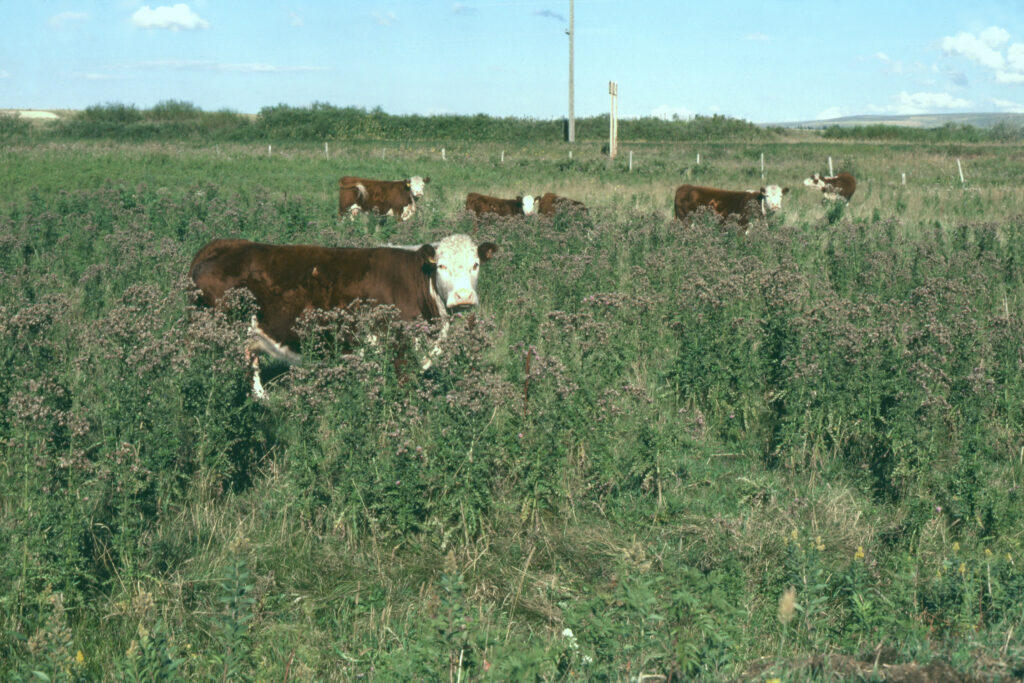
The take-half, leave-half rule of thumb seems to date to the 1950s, and since then it has taken on many interpretations. What does it really mean? Does it have to be half? And half of what? Is it about plant height or photosynthetic leaf area? Or total biomass? Does it matter whether the pasture sward is 8 inches or 20 inches?
Early grazing research indicates that take-half, leave-half is really about leaving adequate residual to maintain pasture plant growth, regardless of the pre-grazing height of the sward. This cannot be emphasized enough: the primary goal of take-half leave-half is to ensure that aboveground forage growth never stops at any point in the growing season.
Unlike many other grazing practices, take-half, leave-half is uniquely suited to cool-season pastures. French researcher Andre Voisin summarized decades of research in his book Grass Productivity, published in 1959. His research contributed to the take-half, leave-half rule-of-thumb for cool-season pastures. He demonstrated that no matter what height the pasture sward is when grazing starts, leaving adequate residual (4 to 6 inches) and rotating through paddocks on an approximately 30-day cycle kept mixed cool-season grass/legume pastures vigorous and healthy. The tool/practice of take-half, leave-half remains the best tool for maximizing capture of the sun’s energy and providing optimal forage yield and quality over the longest possible grazing season.
Take-half, leave-half is not about soil carbon. It is about managing cool-season pastures to optimize yield, quality and intake. Pasture plants have two sources of energy for growth during the grazing season: photosynthesis and stored energy reserves. We can think of them as a checking account and a savings account. Just as it would not be financially wise to routinely dip into our savings account for groceries, it’s wasteful and inefficient for the plant to draw on energy reserves for daily growth when there’s abundant sunshine. We want our day-to-day energy needs to be covered by our “disposable cash” — the sun! If we leave little or no residual, growth halts entirely for at least one to three weeks while the plant draws out of those reserves just to get started photosynthesizing again. And while it’s doing that, the sun’s energy is going to waste — just warming the soil — and you’re decreasing annual forage yield by delaying regrowth.
The plant’s “savings account” — its energy reserve — is for infrequent, special expenses: keeping itself alive over the winter, allowing it to restart growth in the spring, and exchanging its energy for mineral resources with its partners in the soil microbiome. In temperate zones, we have only 6 to 8 months to capture as much of the sun’s energy as we can. In the most efficient scenario, the plant should never have to draw on its “savings account” during the growing season. As much growth as possible should be generated through photosynthesis.
So, if our goal is to optimize cool-season pasture yield, quality and intake, leaving adequate residual (take-half, leave-half) works best most of the time. An occasional mob grazing can be a very effective tool for managing weeds, trampling stalks, or reducing refuse. There are even rare times when overgrazing (totally grazing all forage material to the soil surface) is appropriate, such as when prepping a pasture in the fall for frost seeding or interseeding the following spring. But each of those scenarios has a very specific aboveground goal in mind, and there is little or no evidence that overgrazing leads to increased soil organic matter once the pasture is well established. Overgrazing or mob grazing can serve a purpose for certain goals, but under normal conditions, why would we want to make our pasture plants work so hard?
Take-half, Leave-half Is Good for Soil Health
When we manage our pastures to maximize pasture health and productivity, we are by default, managing for soil health. By leaving residual, we’ve created a perfect, consistently warm and moist environment under the pasture sward to maintain a fully functioning soil microbial community. Does that automatically translate to increasing organic matter? No, that ecosystem will optimize carbon storage based on what it needs to maintain a healthy plant and microbial community. If allowed, it will bring itself to a relatively stable state, sometimes known as equilibrium.
Most grasslands evolved with ruminant grazing and other disturbances like fire. Grazing management does influence the composition and functioning of the soil microbiome, but other factors like climate and soil type have a far greater impact on the accumulation of soil carbon.
It is in the nature of all ecosystems to move toward a steady state where there is a net balance among the inputs and outputs. If ecosystems could be said to have goals, equilibrium is the desired steady state that balances functionality and resources for the ecosystem with the minimum use of energy. This important ecological principle is currently absent from the soil carbon discussion in agriculture.
We assume that we can manage our system to forever increase soil organic matter, but that’s not how it works in most ecosystems. Using soil health principles, we can create an environment for the soil microbiome to function efficiently, but we can’t force it to store more soil carbon than it needs. By its nature, it can only shape itself to move toward a balanced, steady state that is heavily influenced by soil type and climate and, to a lesser extent, plant community. Although we can manipulate the productivity of the plant community with our management, there’s no evidence (so far) that we can effectively harness the soil microbiome to work for us.
Not All Organic Matter Is Created Equal
Soil scientists currently talk about three pools of soil carbon, which vary in their stability in the soil and are characterized by their size. These include 1) the least stable dead plant material, which is >2 millimeters (mm) on average, 2) more stable particulate organic matter (POM) made up mostly of dead plant tissues <2 mm and >53 micrometers (μm), and 3) what is believed to be the most stable soil carbon pool — mineral-associated organic matter (MAOM), which is <53 μm and is mostly dead microbial bodies and their byproducts that are chemically bound to clay particles and/or trapped inside soil aggregates.
Potential inputs to soil organic matter such as reproductive biomass, aboveground biomass and belowground biomass may all contribute to the first two categories, but only indirectly to the third, most stable form of soil organic carbon. In a standard farm soil test, these three pools typically are included in the organic matter assessment but are not separated out.
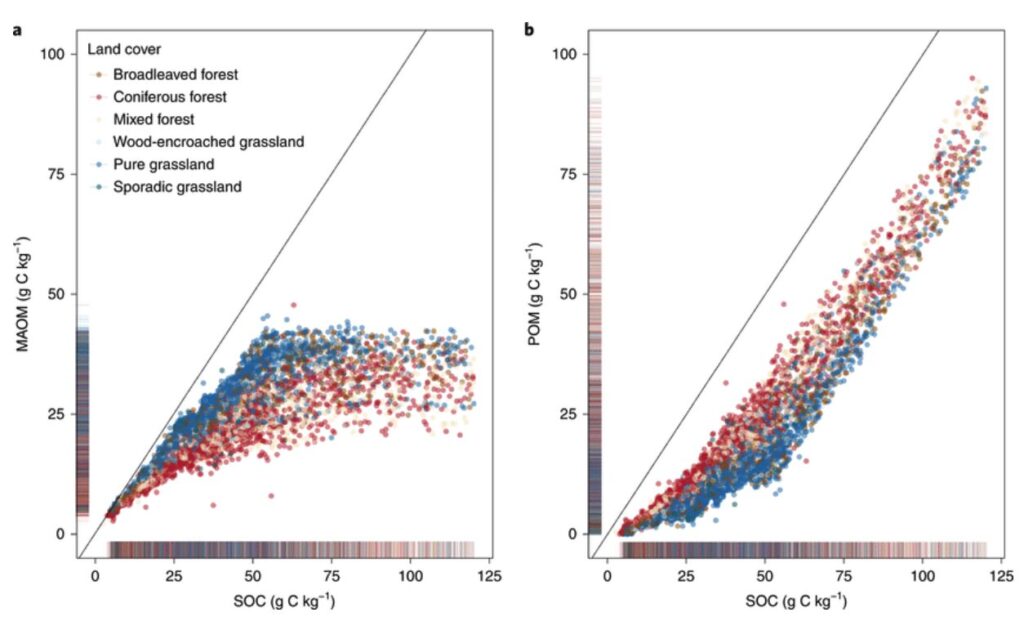
All forms of soil organic matter contribute to healthy soil and pastures because they all increase soil water- and nutrient-holding capacity, but MAOM is key to long-term carbon storage. All other forms of organic matter can be broken down and recycled through plants and animals. Researchers have found that MAOM seems to adhere to the principle of saturation. Work by Cotrufo and coauthors (see Figure 2) demonstrates that across forest and grassland ecosystems, POM levels seem to be able to accumulate indefinitely (righthand graph), while MAOM levels tend to increase to a point and then level off, reaching some sort of equilibrium (lefthand graph).
Soil Type Has an Outsized Effect on Carbon Storage
Because MAOM is mineral associated, its accumulation is constrained by soil type. Sandy soil, with large particle sizes, have less mineral surface area for MAOM to connect with, in addition to providing a more moisture-limited environment for the soil microbiome. On the clay end of the spectrum, particle size is small, which means more surface area but also soils that are often oxygen-limited due to smaller air spaces and waterlogging. Silt-loam soils have moderate-sized particles that can maintain a good balance of oxygen and water as well as significant surface area for associated organic matter. It is these soils that have the best potential for accumulating MAOM.
This progression toward saturation is probably what we’re seeing in many mature, well-managed cool season pastures. The biggest change in soil carbon storage occurs when we convert annually cropped fields to perennial pasture. Over time, these pasture ecosystems restore soil health and reach a stable state where the soil microbial community is happy and plant root and aboveground biomass production is optimized. The soil type, climate and existing plant community of your farm dictate what this level is.
But can we push the system beyond that stage of saturation? For farms with a primary goal of increasing soil organic matter, are there practices that can make a difference?
Neither reproductive biomass, aboveground biomass nor belowground biomass have a direct pathway to becoming MAOM, but all can contribute to it indirectly. Root exudates are especially ephemeral in the soil — they are put there by the plants to be used by soil microbes and generally cycle quickly in the soil. They are the currency plants use to barter with the soil biological community for nutrients, water and other resources. They contain compounds that can influence soil pH and suppress diseases, and they probably perform many other functions that aid in creating a positive environment for plant growth. There is a lot we don’t know about root exudates, but we do know that their direct contribution to stable soil organic matter is probably minimal. Root exudates may be used by soil microbes to create more stable kinds of soil organic matter, but they are, by nature and function, readily available sources of energy.
Pasture Species Diversity Is Good!
And although root exudates may not be the key to increasing soil organic matter, the underlying premise of plant community diversity may be! We can definitely say that a diverse plant community that includes plants that produce root exudates creates conditions for soil organic matter to increase, but we shouldn’t bet on a dandelion-heavy pasture mix being the key to higher organic matter.
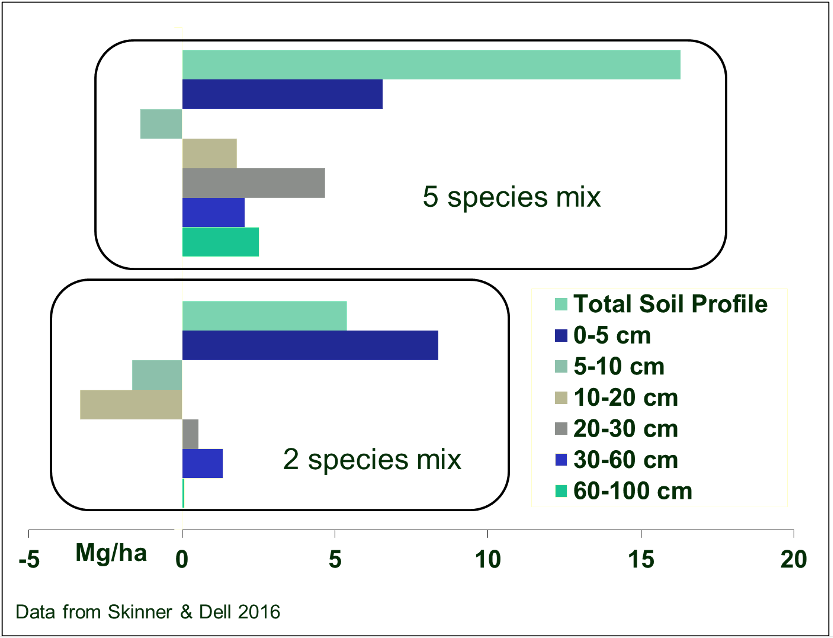
Research by Skinner and Dell (2016) demonstrated that pasture species diversity resulted in deeper rooting depths in cool-season pasture, and that deeper rooting depths increased soil organic carbon at lower levels in the soil profile. The study compared rotationally grazed pastures: a two-species mixture of orchardgrass and white clover and a five-species mix of orchardgrass, improved tall fescue, white clover, alfalfa and chicory. After nine years, both pastures gained carbon, but total soil organic carbon accumulation was more than three times higher under the complex mix compared to the simple mix. As Figure 1 shows, the two-species mix gained more soil carbon in the top 2 inches but lost significantly more than the five-species mix at lower depths. Soil organic carbon accumulation averaged 0.8 tons/acre/year for the five-species mix
Encouraging pasture species diversity has many benefits. A dense, diverse mix has been shown to have higher photosynthesis levels and greater yields (Skinner et al. 2006). Obtaining pasture diversity through planting — seeding down a pasture with a complex mix or occasionally interseeding to introduce additional species — is the best way of achieving a diverse pasture of desirable species.
Overgrazing with the goal of increasing diversity comes with significant risks. In many cases, overgrazing does create conditions that allow germination of seeds in the seedbank or release of existing forbs stunted by competition, but it is a gamble as to what species this practice will yield. While forbs have a role to play in pasture diversity, many forbs in cool-season pastures are weedy species like dandelions, thistles and burdocks. Whether or not forbs make a contribution to soil carbon stocks, many of them often do not contribute positively to pasture forage yield, quality, palatability or intake and can cause overall productivity to decline over time if they become prominent in the plant community.
It’s an exciting time to be involved in managed grazing. Ongoing research on the pasture ecosystem is constantly providing new insights that not only show the immense benefits of well-managed grazing, but that also can improve our management. Experimentation by graziers across the globe is adding new tools to the toolbox. Understanding what’s going on in your own pasture ecosystem should always guide the choice of tools. Adopting new tools should be undertaken with caution — try it out on a few acres and monitor the results so you know with certainty whether you’re achieving the results you desire.
Laura Paine is a grazing program coordinator and resource conservationist with the University of Wisconsin and NRCS.
Jason Cavadini is an extension grazing specialist with the University of Wisconsin.