How fungi reawakened plant chemistry in a sterile system
Controlled-environment agriculture offers a level of precision few soil systems can match. Feed schedules can be tuned by the milliliter, temperature and humidity by the tenth of a degree.
Yet with all that control comes a trade-off: sterility. In a system stripped of life, plants lose the microbial partners that help them reach their genetic potential — those invisible allies that drive plant resilience, flavor and the secondary metabolites that define nutrient density.
For decades, hydroponics and controlled-environment agriculture were built on one foundational belief: that sterility equals success. Early greenhouse and nursery operations in the mid-20th century relied on giant steam sterilizers — massive boilers that blasted soil, pots and even benches with superheated vapor to kill every living thing in sight. The smell of sterilized soil was once the hallmark of progress. In those days, “clean” didn’t just mean disease-free — it meant devoid of biology altogether.
That mindset carried forward into hydroponic culture, where growers chased predictability through exclusion. Reservoirs were disinfected with peroxide or chlorine, nutrient films ran through UV filters, and any trace of fungi was treated as a contamination event. The idea was simple: remove life, and you remove variability. For yield, it worked — but for plant vitality, something essential was lost.
As an organic grower stepping into that world, I found it almost paradoxical. While soil farmers were rediscovering the power of compost teas, mycorrhizal networks and living mulches, hydro systems were doubling down on sterility. It struck me that the industry had inherited a century-old fear of microbes, even as soil science was proving that those same microbes are what make plants thrive. My goal became to test whether that divide was necessary — or whether a touch of life could coexist with control.
As a plant scientist with experience in both organic regenerative and controlled-environment hydroponic systems, that paradox fascinated me. Could I borrow some biology from the forest floor and reintroduce it into a mostly lifeless hydroponic substrate? Could a living fungus — specifically the wine cap mushroom (Stropharia rugosoannulata) — spark the same kind of immune response and flavor chemistry that soil growers see in rich humus beds? The wine cap is an aggressive secondary decomposer and a reliable partner in woodchip systems, but it isn’t known to form direct relationships with plants — at least, not yet.
That question became the core of a small but revealing experiment I conducted through Texas Tech University.
The Trial
I grew CBD hemp (Cannabis sativa L.) in a coco-coir hydroponic setup under fully controlled lighting and ionic fertigation. Four treatments were compared:
- Control — sterile coco with no inoculant
- Bokashi (BO) — a fermented microbial mix dominated by lactic-acid bacteria
- Wine cap (SR) — substrate colonized by wine cap mycelium
- Combination (SB) — a 50/50 mix of both inoculants
The coco started clean — completely sterilized so nothing living was carried over. Everything else stayed the same: nutrients, pH, irrigation, temperature and light. When the plants finished, I measured cannabinoids, terpenes and yield, and I ran DNA sequencing on the substrate to see what, if any, long-term microbial community shifts had taken place.
What the DNA Revealed
Each inoculant reshaped the microbial life inside the coco substrate. Bokashi created a narrow, fermentation-driven community dominated by Lactobacillus plantarum and L. brevis — organisms known for rapid organic acid production but little long-term stability. In contrast — and to my surprise — the wine cap treatment fostered a more balanced bacterial community enriched with Pseudomonas, Devosia, and Chitinophaga, microbes commonly associated with Induced Systemic Resistance (ISR) and enhanced secondary metabolism.
The combination treatment was the most diverse overall, but not the most effective. Diversity alone, it turned out, didn’t guarantee functional synergy. Perhaps too many voices in the choir blur the melody.
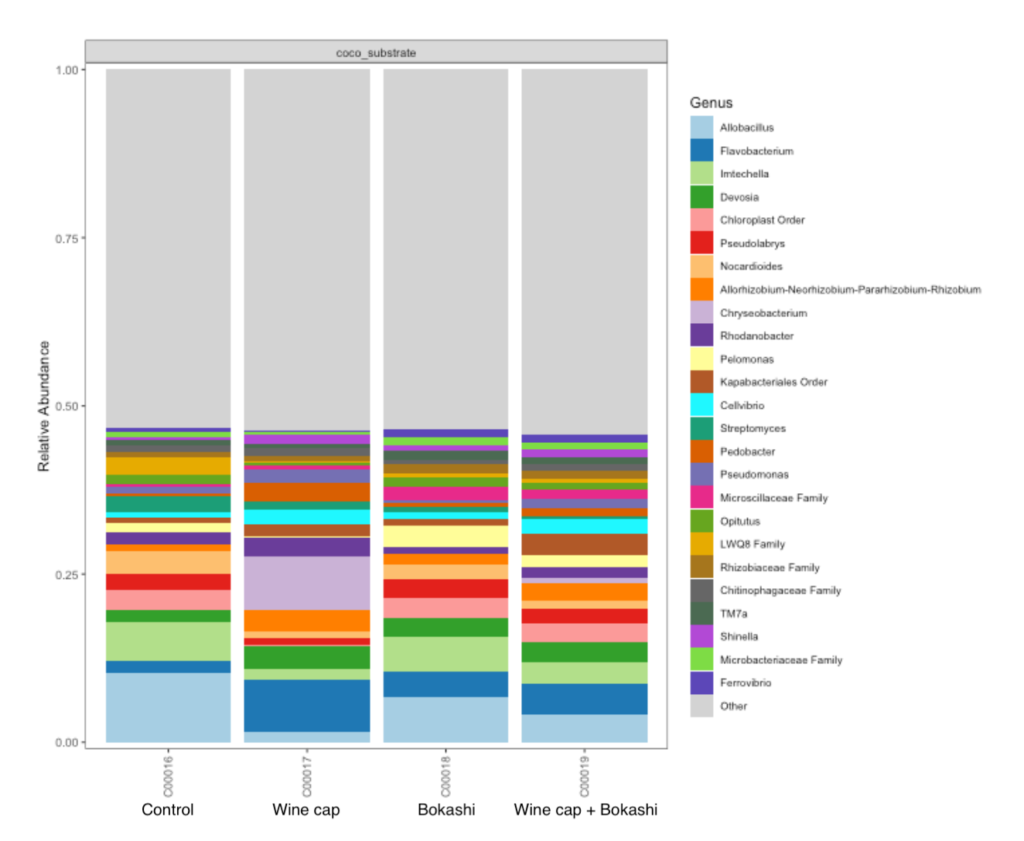
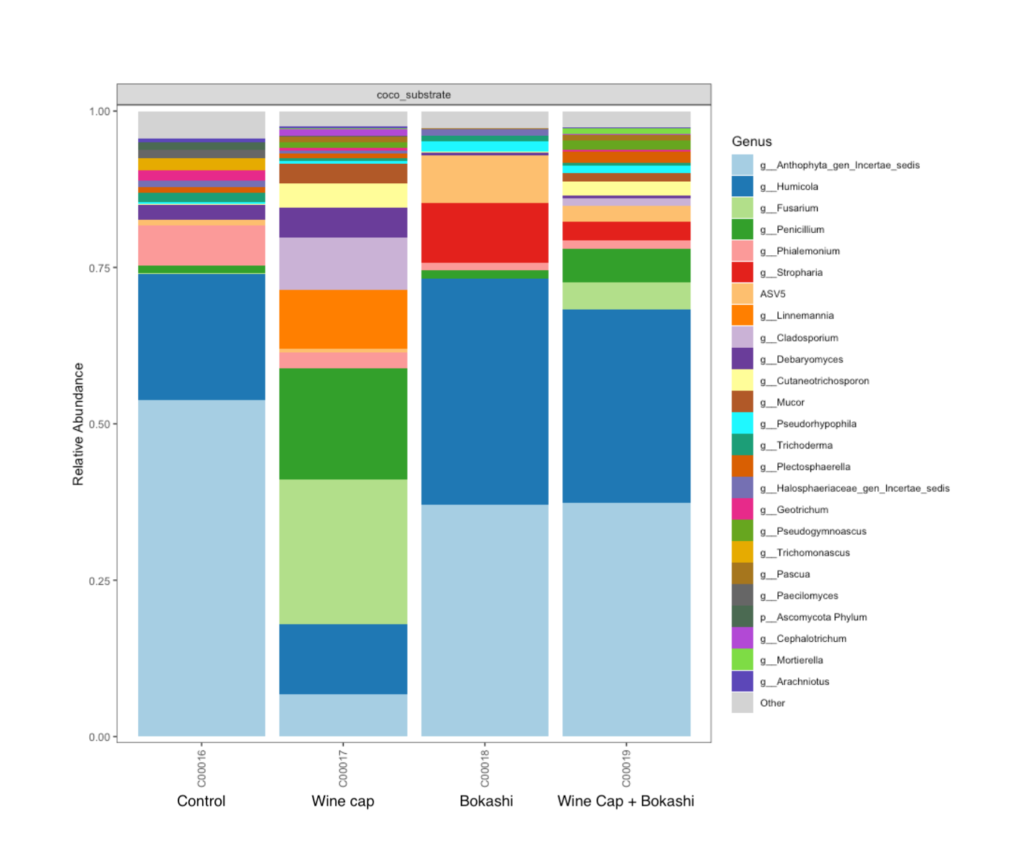
DNA sequencing revealed clear shifts in fungal populations across treatments. The control (C00016) showed limited diversity, dominated by Humicola and plant-associated sequences (Anthophyta). The wine cap inoculant (C00017) introduced its own mycelium and fostered beneficial associates, including Pseudomonas and Devosia, linked to Induced Systemic Resistance. Bokashi (C00018) developed a fermentation-driven community rich in Penicillium, Phialemonium and Fusarium. The combined treatment (C00019) exhibited the most taxonomically diverse community, integrating both fungal and bacterial partners from the individual inputs.
These shifts demonstrate that even in sterile hydroponic media, carefully chosen microbes can restore biological function, activating the same plant-microbe pathways that soil growers rely on for resilience and flavor expression. These microbial fingerprints set the stage for what mattered most: how that invisible life translated into plant chemistry — and ultimately into measurable quality.
Yield vs. Quality
When it came to biomass, nothing changed. Yields were statistically identical across all treatments — proof that these microbes weren’t about growth for growth’s sake. But the chemistry told a different story, one written not in grams of dry weight but in the plant’s own language of oils, aromas and secondary metabolites.

All microbial treatments increased total potency compared to the sterile control, reflecting the influence of biology on plant chemistry, even in hydroponic systems. The wine cap treatment delivered the highest average total potency (229.8 mg/g), including a 4 percent increase in terpene concentration over the control. Bokashi and the combined treatment also raised overall phytochemical output, though to a lesser degree.
Average terpene levels climbed from 9.38 mg/g in the control to 13.72 mg/g in the wine cap group — the most pronounced improvement of any treatment. Total cannabinoids followed the same upward trend, rising from 175 mg/g to 194 mg/g. The combination and bokashi groups fell in between, suggesting that functional synergy matters more than sheer microbial diversity.
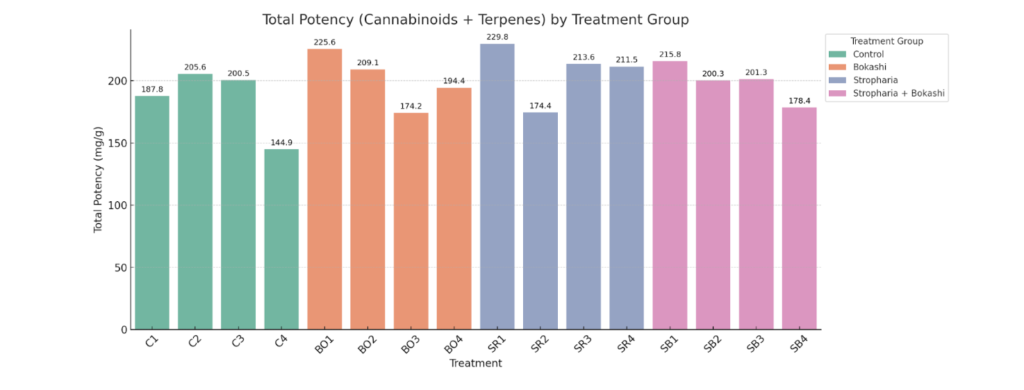
With only four replicates, these results stopped short of statistical significance — but the direction was unmistakable. Microbial inoculation, especially from a soil fungus like wine cap, consistently pushed plant chemistry in the right direction.
In the sterile world of hydroponics, where fungi are usually seen as contaminants, this is striking. It shows that the right kind of biology can reawaken a plant’s own defense and flavor pathways, enhancing quality without changing yield — a quiet revolution in how controlled environments can host life rather than exclude it.
Why a Mushroom Matters
Wine cap mushrooms are saprophytic decomposers that thread their mycelium through wood chips and soil, knitting organic matter into structure. In outdoor systems, they’re praised for suppressing pathogens and improving soil tilth. Inside coco coir, their role shifts: the mycelial network acts as a biological scaffold that anchors beneficial bacteria and stabilizes moisture and oxygen gradients.
In essence, the fungus re-creates the rhizosphere architecture that hydroponics lacks. Those bacterial partners — Pseudomonas and Chitinophaga in particular — are known to trigger ISR pathways, pushing plants to produce more protective secondary metabolites such as terpenes and flavonoids. The result isn’t bigger plants, but smarter ones: metabolically alert, chemically expressive, and more resilient.
On a side note, when I emptied the pots at the end of the trial, I noticed something I didn’t expect: the wine cap had already begun colonizing the coco itself. Fine white threads of mycelium were running through the medium, binding the particles together just as they would in wood chips or compost.
In a hydroponic setting, that’s unheard of. It meant the fungus wasn’t just influencing the plant — it was changing the substrate, laying the groundwork for decomposition and nutrient cycling right inside what’s normally an inert medium. In a way, it was closing the loop, turning hydroponics — traditionally a linear, input-to-output system — into something a little more circular and alive.
Lessons for Growers
- Hydroponics doesn’t have to mean lifeless. A controlled environment can still host a designed ecology. Inoculating coco or rockwool with the right microbes can restore biological signaling without sacrificing cleanliness.
- Function beats diversity. The richest microbial mix (bokashi + wine cap) didn’t yield the highest quality. Balanced, cooperative networks outperformed chaotic ones.
- Fungal frameworks endure. Bacteria come and go; mycelium stays. A stable fungal backbone may be key to maintaining consistent microbial benefits over time.
- Quality gains can outweigh yield plateaus. For markets that reward aroma, resin and terpene profile, small chemical shifts translate directly into value. And the same principle holds true across crops: when plants live in biologically active environments, they express more of what makes them unique — richer colors, stronger flavors and higher nutrient density. Microbial partnerships don’t just enhance chemistry; they strengthen the plant’s immune system, improve mineral uptake and build resilience from the ground up. Quality, in this sense, becomes a measure of vitality rather than volume.
Biology Is the Bridge
Organic farmers have long known that soil health drives flavor and nutrient density. What this experiment shows is that the same principle applies in hydroponics. Whether in coco, compost or clay loam, it’s the microbial relationships — not the medium itself — that ignite plant chemistry.
Wine cap mushrooms already have a home in regenerative orchards and wood-chip pathways. Translating that ecology into hydroponics suggests a broader principle: if you give plants the biological cues they evolved with, they respond, regardless of environment.
This was a pilot study — four plants per treatment, one season, one cultivar — but its consistency warrants a closer look. My next phase will scale the work into a vineyard setting in northern California, testing how fungal inoculants shape grapevine microbiomes, disease resistance and flavor chemistry over multiple years.
The larger question remains the same: How can we design living systems — in all crop production systems—that rebuild plant intelligence rather than replacing it with control?
The 4 percent terpene lift from a single fungal inoculant may sound modest, but for cultivators chasing premium quality, that’s real. More importantly, it points to a paradigm shift: microbes as management tools, not contaminants. By weaving life back into sterile systems, we can move beyond yield metrics and start measuring vitality itself.
Every time we bring life back into the system — even one pot of coco — we’re proving that regeneration scales upward. If hydroponics can host a living cycle, so can agriculture at large.
Craig Hartsough manages a vineyard for De La Montanya Vineyard and Winery in Sonoma County, California. He is working on his Ph.D., focusing on beneficial microbes and DNA testing in the vineyard context.