

An interview with long-time Michigan farmer and consultant Joe Scrimger about conservation tillage, transitioning from conventional practices, and his Acres U.S.A. mentors
Acres U.S.A. You grew up on a farm, right? What was your journey of developing an ecological mindset toward farming?
Joe Scrimger. Yes. My dad was a small dairy farmer in the thumb of Michigan. He had probably 30 cows and 200-300 acres, depending on the year. We used to raise navy beans. Back then there was atrazine for corn; there were very few herbicides for navy beans early on. They came more in the late ’60s and ’70s, and they didn’t work that well.
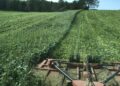
So, we just cultivated. There was more to weed control than just the cultivator, but my dad had a front-mount four-row cultivator. A front mount is a lot easier; everything is rear mount today, although there’s quite a few farmers that will buy a front-mount cultivator and adapt it because it’s easier for hired help to run.
Today, with GPS, we can set up any cultivator. Actually, the main argument for conventional agriculture having to use herbicides is because of hired help and cultivators. There was too much cultivator blight where the cultivator takes out the corn. Well, GPS and auto steer and cameras and hydraulic hitches — they can really hone the cultivator in. So there’s no reason conventional agriculture can’t cultivate.
Acres U.S.A. And that’s just today. They’re coming up cultivators that use AI to recognize what’s a weed and what’s the actual crop.
Scrimger. There’s a lot of good technology. The thought back in the day was that an organic farmer just seeds the field and doesn’t do anything. That’s obviously not true.
I was blessed that my dad didn’t want to get that big. It was a small, diversified dairy. We had chickens and hogs. We did a little custom combining, but not much.
But my father-in-law was a little different. He milked a few more cows, like 50 to 60, and he was one of the first organic dairy farms in the Midwest back in the ’60s. It’s just that there wasn’t really a market. But my father-in-law made money shipping in the conventional market and watching his costs, farming organically.
Acres U.S.A. So there was a certification agency even back then?
Scrimger. There really wasn’t. Organic Growers of Michigan was really just getting going, so we could get the farm certified, and he worked with that initially, but when he couldn’t get a market for the milk, he just farmed organically. So, my dad taught me field crops, and my father-in-law got me up to understand animal health.
And then my dad come down with colon cancer, and that really got my attention. So, we got into organics first because I was economically trying to come up with a better market. And then there was the health issue.
Acres U.S.A. How and when did you first hear about Acres U.S.A.?

Scrimger. My wife, Kay, and I borrowed a camper for the pickup and drove out to Kansas City and went to an Acres conference to hear Dr. Harold Manor, who had a cancer treatment center in Mexico. I liked what he was saying on the nutritional side. Coming out of the ’50s and ’60s, there was a lot of canned food. They were producing more volume because of extra nitrogen, and actually green beans lost their taste and flavor; but they put a lot of salt with it and got people to eat them out of the can. Peaches got harder, but they would truck well, and they’d can them and put a lot of sugar with them and get you to eat them. One time when I came home from college, my mother was a little concerned about me reading food labels.
I studied mechanical engineering. My dad suggested I should get something off the farm. I could farm if I wanted to, but he said, “You better get something to back you up.” But before I finished, I decided I wasn’t going to spend 40 years inside a building at a drafting table. So, I went home, got married, and bought a farm.
I thought that made more sense. Did I have all the economics figured out? Not necessarily. But I figured if you worked hard enough, you could make this work. I didn’t buy a really big farm. It was 160 acres. Then we bought another 40 and rented another 250 or so and did custom harvesting and worked outside jobs.
One of the first Acres U.S.A. people I really learned from was Don Schriefer. He worked for a tillage equipment company and built this chisel-disc combination that could make one pass in the spring on your cornstalks and would slice them up and mix them and ridge it. And then he had a spring tillage unit that one passed in the spring, then he’d plant. So, he was trying to conserve tillage and energy. And that system worked fairly well.
My outside job was selling farm equipment. I did that the first five, six, seven years when I was farming, at a couple different dealerships. I sold combines, four-wheel drive tractors, tillage equipment, and all the manure handling stuff — all the liquid pit agitators.
So, I got to learn about manure, and I got to know big farmers because I was selling combines. In the thumb of Michigan back in the ’70s, there were more four-wheel drive tractors per square mile than any place else in the world. It was a pretty big market. I learned a lot about all types of agriculture, while we were an organic farm. We didn’t mention that a lot — it’s just what we did.
But Don Schriefer talked about tillage in relation to soil air, soil water and soil decay. So, when I went to the Acres conferences to hear Dr. Manor, I’d run into Schriefer and I’d run into C. J. Fenzau. And of course you run into Chuck Walters.
My mother-in-law was pretty involved in health. She was a lay practitioner of homeopathy. And luckily, we had one of the most well-known homeopathic doctors there in the thumb, and we’d go down to see her. And she shared Acres U.S.A. magazine with me initially, and then she shared with me a book called Plowman’s Folly by Edward Faulkner. And that just sort of clicked. I didn’t really have the money, but I went out and bought a chisel plow. I had a two-way, four-bottom rollover plow — the most expensive piece of equipment on my farm — but I parked that and started to practice conservation tillage.
Acres U.S.A. Was that a crisis of conscience — that you were selling farmers these moldboard plows, and then you don’t really believe in that anymore?

Scrimger. Well, I do believe in surface tillage. But over the years, I’ve had a of Amish customers; some chisel plow and use an offset disc, but most of them will moldboard plow. But they plow shallow, and they don’t plow too often because they have sod in their rotation. Gene Logsdon used to say, “All you guys are talking about conservation tillage, but all I have is a WD45 Allis-Chalmers with 50 horsepower, and I can’t pull a chisel plow. But I don’t plow very often, I don’t plow very deep, and I watch how I manage the residue.” As near as I can tell by all his measurements, he was still building soil.
What really happened was that we got more horsepower — more of those four-wheel drive tractors — and we started plowing deeper to take out the compaction. And we created more compaction — just deeper. We were plowing the residue down there seven, eight, nine inches deep, and the residue could not decay properly.
We were out of the Saginaw Valley, and it is pretty farmland — although it’s not pretty to me anymore because it doesn’t have many woods or wind breaks. It’s just black ground that was all swamp land that was drained with big drainage ditches and then tiled. It was abused. As you raise more sugar beets, it got so that the soil blew away in the spring. Because they were growing sugar beets, very few of people would do any conservation tillage.
I got to see and measure the difference in the different types of tillage when I first focused on conservation tillage. I also got to measure the difference between big farms and the Amish farms, and there was a measurable difference as soon as you looked at the biology.
Acres U.S.A. What type of tillage are farmers up in the thumb doing these days? Is it any better?
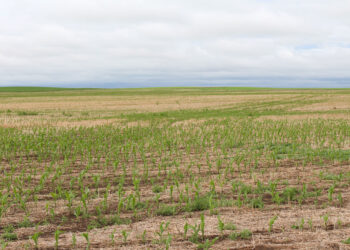
Scrimger. Most of them are still doing conservation tillage, and some are doing no-till, but no-till is harder to do in the heavy ground. Where I live now, in Battle Creek — southern Michigan — it’s lighter ground, and there’s still a fair amount of tillage being done here. But in the thumb, with the heavy ground, it just warms up slow in the spring, especially if it’s no-till. There are some very successful no-till growers up there, but there’s still a fair amount of moldboard plowing done. It bothers me a little bit because a lot of the organic guys I worked with there were doing conservation tillage, but some of the big guys were growing sugar beets. They switched to organic, but they did not get rid of the moldboard plow.
I like the tine weeder — there’s a European brand called Lely for tractors, but each tine has a hook on the end of it, so it wouldn’t handle residue. It’d just plug — it’d become what we’d call a duck rake, like something old-timers raked hay with. So, people started moldboard plowing to make their weeder work.
What we would do is just shift to a straight-tine weeder for high-residue conditions. Some farmers would use the straight tine first, and then they might finish with the hook one after the residue got decayed a little bit.

Acres U.S.A. How exactly would you define conservation tillage? Is it just not using the moldboard plow?
Scrimger. I think conservation tillage means using the disc-chisel plow field cultivator. Now it’s vertical tillage, which is a high-speed disc that’s set at less angle and less dish in the disc. It has less dish, so you can run it faster. I experimented with that design back in the ’70s, and it works.
High-speed discs have become very popular, but the big farmers are starting to use rollover plows with seven, eight, nine bottoms again. Rollover just means you go across the field one way and you don’t plow around and around. You turn around, flip the plow over and come right back. You have right-hand and left-hand bottoms. That’s what I had when I started farming.
If you have a long rotation, I wouldn’t be against that. As long as you don’t plow too often and you don’t plow too deep. But these guys are doing them on corn, soybeans and wheat, and they’re plowing two out of three years, and that’s too much plowing. If they’ve got a long rotation — like for Amish farmers, or for dairy farms — it can work. I’d run my moldboard plow once every four or five years maybe, and it was still a good shape after 40 years, and never needed new bottoms. I sold it and for more money than I paid for it.
I worked with dairy farmers in Canada, and dairy functions totally different over there because they have a quota system for milk and eggs; it doesn’t cost the consumer any tax dollars. They pay a stable price for milk and a stable price for eggs. And a farmer gets a set price, so a 50-cow dairy is very viable over there. They may have a two-way plow, but they’ll likely also have an offset disc and a chisel plow, or a disc-chisel combination. And they’ll have a cultivator that will take residue; some of the row-crop cultivators aren’t designed for residue.

So, conservation tillage is getting that organic matter to decay. The organic guys that are going back to moldboard plowing, I just ask them, “Explain to me how your decay goes on.” Most of them can’t. They’re not worried about it; they’re into short-term profits and what the price of organic soybeans is.
Acres U.S.A. And this is all what Don Schriefer and C. J. Fenzau were talking about back in the ’70s and ’80s, right?
Scrimger. Yes, they were some of the first. Don knew conventional growers and he knew how to talk to them. He could just get through to them. He didn’t talk about organic; he just talked about managing the residue. Initially he wasn’t organic. He’d recommend 10-34-0 liquid, monoammonium phosphate, ammonium sulfate, and 28 percent. He wouldn’t necessarily recommend anhydrous ammonia — but he’d talk to the guys about different forms of potash.
Don’s first book was From the Soil Up, and I got a lot out of that. I’d take a group to an Acres program just to see Don Schriefer. Back then you could get $100 plane ticket to the Acres conference!
Acres U.S.A. Is there anything that Don Schriefer wrote that would need to be substantially updated, or are those practices still what you would advocate today?
Scrimger. Well, I think we know a lot more about herbicides now than we did back then. He was advocating ways to use less, and to band fertilizer, and how to set a cultivator up properly, and how to get air back in the system. He knew about soil biology, but Elaine Ingham and many others have gotten more into that. Elaine visited us here in Michigan in the fruit region, up in Traverse City, and people understood what she was saying. She expressed it well and made headway.
Acres U.S.A. I know you were influenced by Carey Reams as well; what did you learn from him?
Scrimger. Well, the first time you ran into him, he could be a bit much — his biological theory of ionization was a little bit complicated. And then he had a human health program, and he would intermix the two. He started around human health, but he felt he had to work with the farmers to get better quality food to make the human health system work.
Carey Reams explained degenerative disease, and I had a focus on cancer, because of my father. He said that all degenerative disease basically starts with mineral deficiency. I didn’t necessarily buy into that at the start, but the further I went, the more I found that to be true. And then when you figured out that it also relates to pest and disease pressure in plants, it really started to get fun. It became dynamic.
I really have to give Dr. Albrecht credit, through Chuck Walters. I never met him, but I read the book. The old Acres primer, Eco-Farm, was the most used book on my shelf. The cover was broke. Particularly the weed section, and the fertility section. I got other fertility stuff from Reams, but I referenced the weed section all the time and started to see how that related to other things. I could change the soil balance and affect the weeds, and it made the cultivator work better.
It’s all tied together. You have to manage the residue, and you have to make sure that that chaff coming out of the combine doesn’t dump all in one spot. It’ll create spots of weed pressure, and you don’t want that. You want to manage decay from the combine on. And you have to keep it green. Don Schriefer said that next year’s planting starts at this year’s harvest.
As soon as you harvest, figure out what that field is going to, and get it covered. And that became easy to do. I found out that the wheat buyers would pay me more if I just put more air on the combine and blew all the light kernels out; they’re going to screen them out anyway, and doing this put some back in the field for a cover crop and spread them and turn the field green right away. I did that with wheat or oats or spelt, and it worked really well, and you didn’t have to seed it. It only takes a couple bushel to seed the cover crop. It’s very economical, and you get a better sample in the bin.

Dr. Reams also answered some questions I had about organic matter that I couldn’t understand. I couldn’t understand all the problems we had with muck soil when it was 50 or 60 percent organic matter. He initially explained the difference between anaerobic and aerobic organisms and how muck will get compacted too, and it changes to anaerobic and it functions like compacted soil. It happened because of the chemical and fertilizer use.
Acres U.S.A. You mentioned Elaine Ingham. Was she the entryway into more biological thinking for you, or were there others?
Scrimger. In the 1980s, I had a slide program where I showed 20 head of cattle in a field, and I’d say, “Well, we have the same amount of biology under the soil too, and we have to manage them just like those cattle.” But Elaine really helped explain that biology under the soil.
Acres U.S.A. What do you see as some of the big issues today? Are they the same things from the ’70s and ’80s, or are they changing much?
Scrimger. Well, the conventional world is using a lot more fungicide now. I understood the nitrogen cycles, and weed control, and that’s what I based a business on. But later on I started to understand phosphorus and how it works. It’s the hardest nutrient to make work in an organic system because the main source is rock phosphate, which is slow to digest. We have the clay-based phosphates too, which are better. But if you understand how the phosphate system works, it’s a factor of your organic matter and the quality of your organic matter. And the beneficial fungal organisms, including the mycorrhiza, have to be there in adequate numbers.
But if you’re applying fungicide by airplanes, after you applied it on your seed, you probably have a phosphorus problem. If there’s any nutrient that’s really able to put quality into a crop, it’s phosphorus. Nitrogen provides growth. Potassium provides volume. They’re all important. You have to have the traces. But if you don’t have phosphorus, you don’t have taste and flavor, and you won’t have pest and disease resistance, either. And once you put that fungicide on you, you’re going to have more fungal disease, guaranteed. That’s a mathematical equation that you can’t change.
That was easier to talk about in the ’80s. Some of the farms have consolidated and gotten so big, and I understand how they got there. They make decisions on buying combines and tractors, but a lot of their farm decisions they don’t control. Chemical companies controls them.
Acres U.S.A. They’re not becoming the experts themselves in the agronomy. They’re letting others do that for them.
Scrimger. They may hire an agronomist, but usually it’s the agronomist that the co-op or the fertilizer company is sending out. Or, if they’re large, the chemical company will provide them free agronomy. BASF, Bayer — they supply their own agronomists to all the large farms for free.
Acres U.S.A. People like free.
Scrimger. Yes, people like a free lunch. But we’re saying there’s a reason you want to pay for a good lunch — because you want better food! But you also want good information. Again, I do understand how these farmers got in this situation. I went to some free lunch programs too. I still go to one now and then just to see what the guys are doing.
Today, the farms are large, and they’re going faster, and it’s harder for them to miss a beat. If you’re going to consult with them in a transitional phase, this is pretty serious. You can’t let them miss a beat. You have to keep their yield on track, while you’re decreasing cost, to the point that you get it where they could take a little less yield and your yields will come back. Whatever potential yield they have, they’ll still have it on a biological or an organic program.
At one time, my goal was to get them to become certified organic. That’s not really a goal anymore; the goal is to get them farming biologically and to help them use fewer chemicals, and they can take that as far as they want to.
I also work on local/regional food, trying to get farmers to understand the reason for that. Even though some of them are so big that they may not be able to participate, I try to get them to visualize that if we do more local/regional food, that’s going to change the percentage of surplus production going into the commodity market, and it’s going to raise the price. So, if you can’t do local/regional food, you can still afford to invest in it because you’ll get a return on your investment at the local processing plant.
This local food thing is fun. My dad’s or my father-in-law’s farm would have worked really well on a local food basis. It took me a while to figure that out. But those farms could’ve been very financially viable today. Like your new owner has said, this is a good time to start in agriculture — I 100 percent agree. I say that much stronger than I did in the ’80s or early ’90s.
Acres U.S.A. Why is it a good time to get into farming now?
Scrimger. Because more people are realizing the importance of quality food. More people understand nutrient density. You’ve got groups like the Weston A. Price Foundation talking about nutrient density and making headway. Carey Reams understood that true nutrient density applies to all crops — grain, vegetables, meat, everything.
We do volume well in the United States. But we’ve lost nutrient density. We may be cash flowed, but our soil was getting worse in the process. We were losing organic matter. The Saginaw Valley is not out of organic matter, but the soil blows away, and it’s because the state of the organic matter is degrading and not building. The excess use of nitrogen is burning up organic matter. That affects phosphorus. It makes it so you can’t hold the soil.
If a new young farmer can understand basic beneficial bacterial/fungal soil relationships and how they relate to soil, plant, animal and human health, they will be ahead of most of the commodity-based agriculture of today. But there are a couple of other huge factors to local food that I bank on, which really are not discussed much. We all should have got an update on the first factor — in respect to our immune system — during COVID. Local feed or food is better for building animal and human immune systems, respectively, and that factor has been left out of the cheap-food, commodity-based system that our government and institutions have supported. This is because antibiotics were cheap and we thought they were good 50 years ago, which has proven not to be true. In our rush to consolidate agriculture, we have created potential viral problems that are getting worse, and it is explainable for those who really want answers.
The second big factor is that farmers care differently when they know and can see the customer — that the food that they produce has a lot of implications. Don Schriefer said “From the Soil Up,” where Carey Reams and Dan Skow said, “The Farmer Wants to Know.” I believe that the consumer/eater needs and wants to know also and will buy into a system that has a majority focus on local/regional food. That has the potential to bring physical, environmental and financial health back to our communities. That is the opportunity for this next generation.