
Understanding leaves better can inform your farming practices
As this issue goes to press, it is the peak of the northern hemisphere’s photosynthetic season, and the sun (whether obscured by cloud cover or not) is above the horizon longer than it is below the horizon. This is more pronounced in the northern regions than in the south, with some of our Acres U.S.A. growers in northern Alberta having over 17 hours of daylight and growers in Mexico receiving around 13.
It is this radiant energy that our crop plants use to drive the process of photosynthesis, which is the foundation of the entire planetary economy. The chlorophyll in plants combines carbon dioxide (CO2) from the atmosphere with water, using the energy of the sun, to create glucose, a simple sugar. During the process, water is split into its component parts, and oxygen from the water is released into the atmosphere. The basic chemistry equation is as follows:
6CO2 + 6H20 + energy ???????? C6H12O6 + 6O2
Using some of the energy stored in the carbon bonds of the glucose, plants then rearrange the elements into different shapes and forms, adding a number of nitrogen atoms to it to create amino acids. Amino acids are then used as the building blocks for enzymes, proteins, oils and more.
Most of this incredible chemistry takes place in the leaf.
As farmers and ranchers, we deal with leaves all the time. Grain farmers and grass farmers deal mostly with monocots — plants that emerge from seed with a single leaf. Produce, potato and sugar beet farmers work with dicots — plants that emerge with two “seed leaves” that don’t look like the plant’s eventual leaves.
The leaves of monocots are generally long and slender, with internal, mostly parallel veins that transport water and dissolved nutrients up and down along the length of the plant. Dicot leaves, on the other hand, have main internal veins that either resemble the pattern of a herringbone spine and ribs (pinnate) or your wrist and hand (palmate). The veins (vascular bundles) of a leaf form a network throughout the entire leaf and are the primary transport structures for water, sugars, mineral salts and other plant metabolites.
Whether a leaf is a parallel-veined monocot such as corn, or is a palmate-veined grape leaf, the veins are the scaffolding of the leaf that determine its shape and give the leaf structure. The leaf veins are like a hand that holds the leaf sandwich! The leaves of most temperate-zone agricultural crops, from pasture grass to cannabis grass, appear flat to us, but they are literally sandwiches of functional tissues. The outermost layer of the leaf surface, both upper and lower, is covered with a relatively tough single layer of cells called the epidermis. The leaf epidermis forms a continuous surface with the leaf, the leaf stem (the petiole in dicots, the sheath in monocots) and the surface of the stem, to which the leaf is attached. Embedded into the epidermis are several different kinds of cells that perform specialized functions. These are ordinary epidermal cells, glandular cells, hair cells and guard cells, which we’ll return to shortly.

Continuing with the sandwich metaphor, the epidermis is the toasted sourdough rye, and body of the leaf itself is the corned beef, sauerkraut and thousand island dressing — the “stuff” that makes a Reuben what it is. As a general category, the “stuff” in a leaf sandwich is called mesophyll (from the Greek meso, “middle”). All of the “phylling” is between the upper and lower epidermis. The mesophyll is the primary photosynthetic powerhouse of the leaf, where most of the chlorophyl is located. Products manufactured within the chloroplasts are transported to the leaf veins, where they are then shuttled to where they are needed. Some of these materials are allocated toward reproduction, some are allocated to stem elongation, and some are sent to inner stems and roots for longer-term storage.
Now back to the leaf surface. Glandular cells and hair cells are specialized cells that secrete different compounds that have been manufactured in the mesophyll of a leaf. Anyone who has rubbed their hands on a geranium or a tomato leaf has felt the furriness of the leaf and smelled the unmistakable scent on their hand. The flavors and aromas of our culinary herbs are concentrated in these cells, as are many essential and medicinal oils. Some leaves have very few hair cells and don’t excrete many oils, and others are completely fur-covered, like the ornamental dusty miller (silver ragwort). Some hair cells, such as those found on stinging nettle and poison ivy, can cause skin irritation.
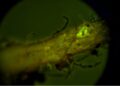
Although all cells in a plant leaf are important and serve a useful function, guard cells are powerfully significant and provide farmers and ranchers with tremendous opportunity to influence plant growth and crop yield. Guard cells occur in pairs, and each is somewhat crescent or semi-circular shaped. The side where each guard cell touches its compliment is less flexible than the side facing away from its compliment. Between the paired guard cell is a small opening called a stomata. The stomata opens to the inside of the leaf, into the various spaces between mesophyll cells. Since a leaf requires carbon dioxide for photosynthesis to occur, the stomata open and close to allow carbon dioxide in and to allow the other two products of photosynthesis, oxygen and water, out. Plant leaves literally breathe. This is the powerful significance of guard cells and stomata. Whenever the leaf stomata is open, molecules can pass into and out of the plant leaf.
It is the passing of nutrients into the plant via the stomata that makes foliar fertilization of crops so effective. I’ve read research that shows that foliar application of fertilizers is anywhere from 300 to 800 times more effective at boosting crop yield than the same quantity of fertilizer added to the soil. Potentially, this means that soil-applied fertilizer can be reduced by a factor of 300 with no reduction in yield, provided that such fine-tuned fertility can be delivered by sprayer at the right place on the plant at the right time of day, when the stomata are open. Many are working in this direction with specific applications of foliar sprays applied with drones.
How does one get the stomata to open? There are numerous ways that aren’t quite entirely figured out yet. Stomata open naturally after a period of rainfall or irrigation when internal plant moisture is high. Stomata open in the morning in order to off-gas from the previous night’s metabolism, and certain sounds — namely birdsong — have been shown to open leaf stomata. Yes, there are scientific studies showing that the “morning chorus” of birdsong can stimulate the opening of stomata; this is one of the entire premises of “Sonic Bloom” technology that was wildly popular not too many years ago. One would play a certain soundtrack that closely mimicked birdsong, then after a period of time, foliar nutrients would be sprayed.
Understanding how to “hack” plant stomata, in order to open them up and then to jack our crops with maximum quantities of “Red Bull” plant nutrients, should in no way be used as a substitute for sound, ecological farming practices. Balance your soil minerals. Establish cover crops, especially perennials. Include the right balance of animals. Manage your decay cycle.
And, know when to nudge your crops along with the right foliar feed at the right time for the desired effect. In the beauty of a July sunrise, when the birds are singing their hearts out, sounds like a good time to me!
Mark Shepard is a land designer and consultant and is the author of Restoration Agriculture, Water for Any Farm and the Water for Any Farm Technical Manual.