

Agronomist and farmer grower Joe Ailts shares his unique cover crop-pumpkin-sweet corn rotation, the benefits of early soybeans, and his secrets for growing competitive giant pumpkins
Acres U.S.A. Did you grow up on the farm? And can you describe your current farm context?
Joe Ailts. Sure. My grandpa owned a 65-cow dairy and about 220 acres of farmland here in northwest Wisconsin. We’re right on the northern boundary of what you could consider the corn belt. Interest rates in the eighties squeezed him out, and none of his four children, one of whom was my dad, wanted to continue the farming operation. So, they sold the cows, sold the equipment, kept the land, and kept the barns and such.
I like to say that I was born with a green thumb, a competitive spirit, and an insatiable thirst for knowledge, and when you put all that into a blender, what comes out is competitive giant pumpkins. I’ve been growing competitive giant pumpkins since I graduated college back in 2000. This will be my 25th growing season. I absolutely love the hobby. It’s a lot of fun, with great comradery. When you’re trying to grow the largest fruit on the planet, there’s a lot of excitement and a lot of heartbreak.
The one thing that’s unique about giant pumpkin growers is that we’re always trying to push the boundaries in the pursuit of 3,000 pounds. We’re looking under every rock to find more ways to push these pumpkins even bigger. A lot of the practices have now evolved to using things like biologicals. We use a lot of mycorrhizal fungi as an inoculant.
The unique thing about a pumpkin plant is that as the vine starts to grow across the ground surface, it puts out laterals, and at each lateral it puts out even more laterals, and out of all these laterals comes adventitious root systems, which grow into the ground and significantly increase the footprint of the plant root system. Every one of these adventitious roots is an opportunity for a endeavoring gardener to go out there and do things — to apply a biological, for example, or spoon-feed it nutrition — things like seaweed and kelp and other natural biostimulants.
I believe both as a hobbyist gardener as well as an agronomist that these types of stimulant interventions at these adventitious roots are what have driven this hobby to be able to produce nearly 3,000-pound pumpkins. You can’t find this growth trajectory anywhere else in nature; we’ve taken the size of the fruit and essentially doubled it in less than a decade.
I graduated from the University of Wisconsin River Falls with a degree in biotech and an emphasis in plant physiology. I wanted to go work for a seed company and help develop the next big corn hybrid, but as fate would have, it didn’t exactly work out that way. But about 15 years ago, I decided to answer the call back into agriculture. I started working for a large seed company, Pioneer Seed, as an agronomist for eight years, and then decided to break out and do my own independent consulting about four years ago.
It’s been awesome because there just aren’t a whole lot of agronomy specialists that understand soil health, cover cropping, minimal tillage practices, the biological side of things, working with nature, etc. — working with biology to help produce bigger, better crops. There are so many other farmers out there who are hungry and thirsty for this type of knowledge.
Acres U.S.A. What types of clients do you have? Mostly corn and soy, or other crops too?
Ailts. The demographic is really unique up here. Growers in northern Wisconsin actually grow a lot of different crops, including a number of specialty vegetables. Obviously corn and soybeans dominate most of the acres, but there’s a lot of other neat things that we grow to. We’re seeing an increase in small-grain production, which I think is awesome because of what that rotation does for row crops as well as for soil health. There’s a robust snapbean harvest up here as well. There are a lot of non-GMO soybeans, which present its own challenges. Potatoes are a pretty significant portion of the crops up here, too.
Interestingly, northwest Wisconsin has the second-highest density of CSA farms in all the nation. Northern California is the most dense, but northwest Wisconsin is right behind them.
Acres U.S.A. Why is that? Organic Valley was founded in Wisconsin, and there were a lot of dairy farms and people who were interested in organic, but what is it about northern Wisconsin culture that draws people to CSAs?
Ailts. That is a darn good question. I’m not sure I’ve ever found an answer for that. I think it’s one of those things where if you get a small cluster of farms that start doing it, that attracts more farms. It’s kind of like auto dealerships — all the auto dealers are always clustered in the same part of town. A couple CSAs got established and all of a sudden more popped up. It creates a nice community and a culture where consumers have so many options. There’s a lot of collaboration between these CSAs too. Some will specialize in certain crops, and they complement one another.
Acres U.S.A. Let’s talk about one of those specialty crops — pumpkins. You grow giant pumpkins competitively, as a hobby, but you also grow “regular” ones for sale, correct? Is northern Wisconsin just a good location for pumpkins?
Ailts. It absolutely is. Wisconsin ranks fairly high in pumpkin production nationally. The 45th parallel, where we’re located, is fantastic for growing pumpkin crops — both competitive and otherwise. If you can build resilience into your soil, the way we’ve very intently focused on doing, there’s no reason you can’t grow great pumpkin crops in this part of the world.
Acres U.S.A. So, you have the agronomy business, and you’ve got your competitive pumpkin hobby, but you grow some things for sale as well, like pumpkins. Can you describe your growing system?
Ailts. Sure. We have a three-acre regenerative hobby farm here for sweet corn and pumpkin production. We break our land into three separate acres: one every year for sweet corn, one for pumpkins, and then one for just a cover crop to build biomass and organic matter.
Just yesterday, coincidentally, I planted sorghum sudangrass on the one acre of ground that we typically don’t take a cash crop off of. It is more important to me to build soil health and soil resilience on that one acre than it is to try and monetize it with something else. And because we do this, we’ve had incredibly productive years in both the pumpkins and sweet corn.
We live on a relatively busy highway that’s full of weekend traffic from those coming out of the metro area in Minneapolis up to their lake cabins, and they’re happy to stop by and drop some money in our money box for our sweet corn and pumpkins.
Acres U.S.A. That’s great. And it’s just an unmonitored roadside stand.
Ailts. Yep — 24/7 on the honor system. It can still exist in America. It’s encouraging.
Acres U.S.A. So, let’s talk more about the one year in cover crops. Is it just sorghum sudan, or is it a mix? And then, do you mow it down and till it in and do a different cover crop in the fall?
Ailts. It’s a sorghum sudan monocrop. That tees up a great discussion. I think there could be an argument adding something else into the mix. It’s something I spend a lot of time thinking about — how to optimize this system even further. But sorghum sudan is a C4 grass, and C4 grasses are wired somewhat differently than other types of crops that can be grown, especially cover crops. The C4 grasses are nature’s carbon pumps into the soil. There’s nothing more efficient to pump carbon into the soil than a C4 grass.
Now, someone could argue, “Well, you’re growing sweet corn, which is a C4 grass, so aren’t you really doubling things up and creating more problems?” Sure, that’s a fair argument, but sorghum sudan is its own plant in the family. We plant it thicker than the hair on a dog’s back. It’s all inoculated with mycorrhizal fungi beforehand, so it sets a really nice mycorrhizal network. They’re great partners.
My goal is to pump as much carbon into the soil as I possibly can in the shortest timeframe. I’m open to any species that would ramp that system up even further, but I just haven’t stumbled across what that species is.
Acres U.S.A. Sorghum sudan is so tall too that nothing else would get any sun after a couple weeks.
Ailts. Exactly right. But I actually mow my cover crop. One of the unique aspects of managing a sorghum sudan cover crop for the purpose of growing as much root and carbon as you possibly can is that if you mow it at knee height, you force and stimulate the plant to robustly set out much more adventitious rooting. When the plant is knee height, if you go out there and you give it a haircut, it will put out more roots even more aggressively. Mowing is a stimulatory action.

So, that’s what we do. We let it get to knee height. Then we mow it down to about four or six inches. We let it regrow, and then I’ll come back every few weeks and mow it, just to keep whatever weed escapes from going to seed. I’m returning that biomass back to the soil surface so that it can decompose and mineralize and cycle nutrients and microbes even faster.
This has been a real important linchpin in our system. I don’t know how else I can replicate that outcome with other crops.
Acres U.S.A. So, you’re never letting it get above knee height?
Ailts. No, I usually don’t. A couple of reasons for that. Number one is I have a flail mower on a three-point hitch and a small-horsepower tractor. Once it gets beyond knee height, sorghum sudan becomes very woody. It can be very difficult to manage. I don’t ever want to plow it down — that’s just not part of our practice. So, in order to keep the crop in a manageable state without getting too lignified, I like to keep it mowed. Plus it’s also faster in cycling in the biomass.
Acres U.S.A. That makes sense. What’s the entire rotation look like, then?
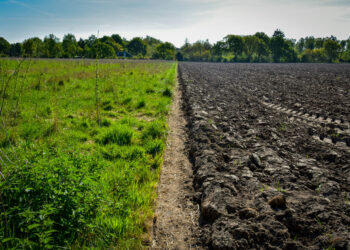
Ailts. Let’s start with the sorghum sudan. I planted it on June 1 or so, and I allow it to grow until about September 1. Then I’ll terminate it — I use the flail mower and take it down to the ground surface, to get as much residue recycled as possible. Then I’ll come back and plant winter rye. This field will become next year’s pumpkin patch. The rye becomes my weed barrier for the pumpkin patch the next year.
Acres U.S.A. Do you ever include vetch, or is it just the rye?
Ailts. I’ve steered away from including vetch. I like the idea of vetch — having a nitrogen-fixing legume in with the grass is a perfect complement. But I’ve found that it’s really hard to terminate vetch in those rye stands in my system. In the spring I knock the rye down by running over it with my flail mower on the ground, without the blades rotating. I do terminate it with some glyphosate because I don’t have a better way to kill it — I don’t have a true roller-crimper. But even with that termination process, I found that vetch would persist, and it would turn into a weed that would choke out the pumpkin plants.
So, I have since pulled the vetch out of that rotation — begrudgingly. I’d like to have the legume in there.
Acres U.S.A. Are you transplanting pumpkin seedlings into that?
Ailts. We were, but we’ve just recently figured out how to make our 7000 three-row sweet corn planter plant pumpkin seeds. I was exuberant about this because it’s going to save us so much labor. Historically we didn’t have enough weight on the planter to punch through that rye mat and get good seed-to-soil contact. But I shifted some of the weight to a single-row unit, lifting up the other row units, and was able then to punch through the rye mat.
Acres U.S.A. For “normal” pumpkin production — not giants — what’s your spacing?
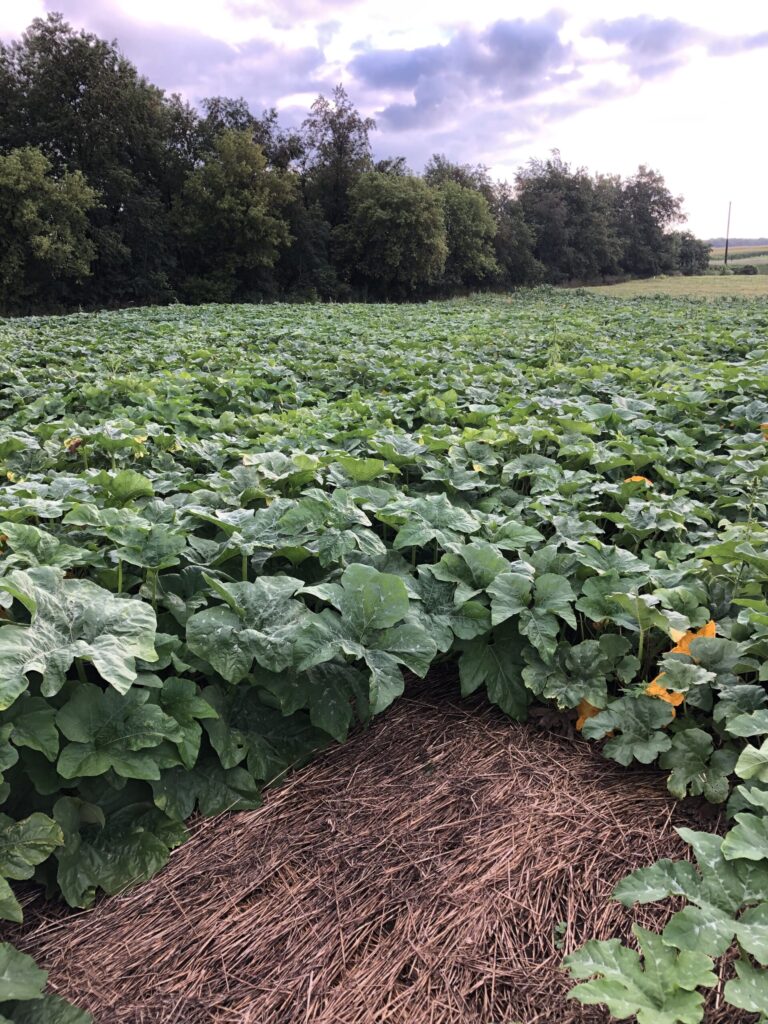
Ailts. We grow a lot of “stacker” pumpkins. These are the very colorful flat, round-shaped ones that you can stack — hence the name. About half of our total production is those stackers, and they take about 32 square feet per plant. So, with eight-foot row spacing, we’re spacing plants out every four feet within the row
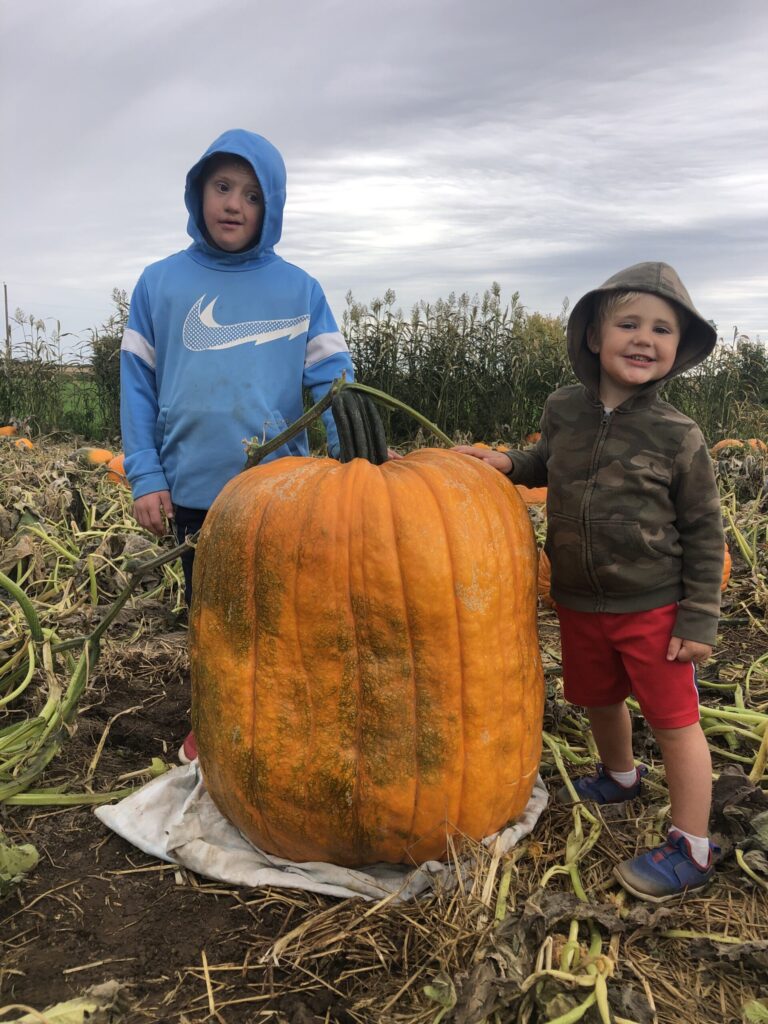
Another big part of our pumpkin business is extra-large jack-o’-lanterns. These are 100- to 150-pound pumpkins with a big thick stem. These are the ones kids really want for Halloween. They take a little more space — 72 square feet.
Acres U.S.A. How do people even lift those and get them into their cars?
Ailts. As a pumpkin grower, I have a lot of back pain! It’s a lot of physical labor to move these things, but thankfully we have a bunch of equipment to help. There are actually tarps made specifically for this purpose; they have handles sewn into the tarp edges. At our pumpkin stand, we offer all kinds of equipment to help people out — tarps and carts and wagons. And we also make ourselves available to help. But yeah, it’s a challenge.
Acres U.S.A. Do you mind talking about the economics of this a little bit? How much can you sell a hundred-pound jack-o’-lantern for?
Ailts. Sure. We price one of these large jack-o’-lanterns at anywhere between $25 and $35, based on shape, color and quality. We typically sell out of these before October 1 most years. There’s quite a demand for them. It’s a unique niche. I think we’ve carved out a little bit of a sweet spot in the market.
We’re not looking to rob people. These are hard-earned dollars. We just want to provide a quality product at a fair price. We think that $25 to $35 for a hundred-pound jack-o’-lantern is actually pretty reasonable.
Acres U.S.A. I think so, definitely.
So then, at the end of pumpkin season, how much rye thatch is still around, and what do you do to convert that field into corn the next year?
Ailts. Typically, most of the rye mat will still be intact post-harvest. Last year, 2024, we had extremely dry weather for the months of September and October, and there was little degradation of the rye residue. A lot has since gone down because we’ve had ample moisture and temperatures this spring for microbes and worms and all the other critters on the soil surface that decompose the residue.
Acres U.S.A. Then you just have to spray a little bit, I imagine, to keep that relatively weed free during the sweet corn year?
Ailts. That’s right. The rye mat probably kept the ground a little cooler than what I would have liked, but I’m okay with that. We punched in our sweet corn relatively early. The last week in April is what we always target. We get that nice weed-suppressing benefit of the rye mat, and in the first two weeks in May we touched 85 degrees for an extended period with no rain; having all that rye residue certainly helped with moisture retention.
Acres U.S.A. When is sweet corn harvest over, and what do you do then?
Ailts. We grow a short-day sweet corn; it’s a 68-day variety hybrid called Sweetness. The earliest we’ve ever harvested sweet corn here in northwest Wisconsin is July 20, which is fantastic. If we could ever hit the Fourth of July, we’d really be in the money, but that’s a bit of a stretch. But late July is when the flood gates open and everyone gets their first bite of fresh sweet corn. Our sweet corn season has extended all the way into October — it’s a long stretch. Usually by then, though, people have had their fill and it starts to taper off. The bulk of our business happens throughout the month of August and into the first couple of weeks of September, before we switch over to selling pumpkins.
Acres U.S.A. Do you plant any kind of cover crop over the winter going into the sorghum sudan year?
Ailts. This has been a really fun part of the rotation, where I get to tinker and experiment a little bit. After that first harvest of sweet corn comes off — let’s call it August 1 — we have what turns into a really long runway to grow something interesting.
For the past couple of seasons I’ve thrown together what I call a zoo mix. I go into the shed and find whatever cover crop seed or crop seed I have laying around that needs to get planted. I’ll fill up my drill with everything I can find on the shelf. In many years it’s oats and a clover or two, plus leftover soybean seed and maybe even some corn seed. I like to throw some brassicas in — a little bit of turnip, a little bit of radish — and then I’ve really enjoyed throwing sunflower in there as well. I’ve found that even in northern Wisconsin, if you plant sunflower on August 1, you can get it to bloom before it freezes. They’ll start to bloom in early October if we haven’t hit a frost yet. This year we’re going to try throwing zinnias into the zoo cover crop mix and seeing if we can get a bloom before it freezes.
Acres U.S.A. That’d be great. So, a lot of those species die over the winter; do you just do some light tillage before you put the sorghum sudan in?
Ailts. Yes, typically. I would love to find a way to fill that gap too — in the spring before we plant sorghum sudan on June 1 — because it’s a mess of the weeds then. Out of season, weeds really take over. We’ve got lamb’s quarter up the wazoo, we’ve got pigweed, we’ve got waterhemp, we’ve got white cockle — you name it, we’ve got it. That gap is a time that should be filled with something. I just don’t know what that is quite yet.
Acres U.S.A. Buckwheat probably wouldn’t germinate for you in March or April.
Ailts. Right. But interestingly, I did try some buckwheat in my competitive giant pumpkin patch this year because I wanted something that would grow fast to suppress the weeds. I seeded buckwheat in the third or fourth week in April, and it’s now just starting to bloom here in early June. I got a great crop of buckwheat in the competitive giant pumpkin patch, and it did suffer a frost that set it way back. I thought it was going to die, but somehow it popped back to life. Apparently, buckwheat can take a light frost — which is cool, because we need that type of flexibility here. But it would be a nice to have a gap crop to grow in between the winter thaw and the sorghum sudan.
Acres U.S.A. Is the competitive giant pumpkin patch separate from this rotation?
Ailts. It is separate, but somewhat inclusive, because of our space considerations. I carve out a couple thousand square feet of the sorghum sudan, and I reserve that for the giant pumpkins, and then it gets thrown back into the regular rotation. Once the giant pumpkins come out, I’ll put cover crop rye in, and it will catch up with the rest of the field, and then that just moves on through the rotation.
Acres U.S.A. And then you’re inoculating everything before planting, correct? And have you experimented at all with applying nutritional products on seeds?
Ailts. I have not. Not because I don’t believe that they’d work, but just because of lack of bandwidth to try new things. I love the idea, though.
And yes — every time I plant a seed, whether it’s for a cash crop or a cover crop, it is being inoculated with mycorrhizae. That’s something that I believe in so deeply — I don’t let a seed go into the ground without it.
I’ve been able to test our ground using a bunch of different testing platforms to measure various aspects of our soil biology and how robust it is, and I’m really happy with where we’ve come. Our organic matter is touching 4.5 percent. We started at 2.5. We have incredible biological activity as measured by respiration, as well as the microbiome and organic carbon. Overall, I’m really happy with the way our system is humming. I’ve done water infiltration tests, and how fast our ground can gulp up six inches of rain is just astounding. I don’t lose any soil because of runoff, mostly because it’s always covered with something; but even if it’s not covered, the ability of our soil to absorb and move water is really quite incredible.
Acres U.S.A. Going back to the sweet corn part of the rotation — have you experimented with different geometries like keeping wider rows or interplanting, like what Jason Mauck is doing?
Ailts. My mind is always spinning about new ways of doing things, and I don’t think there’s any better inspiration for that than what Jason does. I’m always scrolling his X posts to see what he’s trying lately. That inspires me to think outside the box even more — to consider what can I do with this system that I haven’t tried yet that would allow me to take it to the next level. I haven’t really figured out yet what to try to emulate from him, but I’m certainly open to whatever we can do here to maximize our processes.
Acres U.S.A. Can you discuss when, what and why you’re adding fertilizer at different points in this cover crop-sweet corn-pumpkin rotation?
Ailts. Very little fertilizer gets added to our system, mostly because our soils are topped up with P and K and some of the other micros. Every few years I’ll bring manure into the system, whether it’s turkey litter or dairy manure. But my phosphorus levels are too high, so I try to limit that as much as possible.
And our system is not all that extractive. We take off sweet corn and we take off pumpkins. Other than that, we don’t export a whole lot of nutrients off the farm. Pumpkins are 95 percent water, and sweet corn is probably 85 percent water, so not many nutrients leave the farm that way.
Other than a little bit of nitrogen, sulfur and boron in season, I don’t need a whole lot of additional fertilizer inputs. But as far as P and K go, we’re set. Our nutrients cycle pretty darn well.
Acres U.S.A. And what is the nutrient management program for the competitive pumpkins?
Ailts. Again, I don’t feel like I need to use any synthetics in order to get them to hum, with the exception of some nitrogen. I do throw some supplemental 28 percent at them just to get them moving in the front end of the season. However, we use copious amounts of biologicals and biostimulants throughout the season in order to help keep the biology belowground humming. We do foliars and drenches of various types with biostimulants that really drive the growth connectivity. We’re big fans of fish and seaweed products — we use fish emulsions and seaweed extracts to provide all the micronutrients and PGRs and everything else that comes with those complex blends.

Acres U.S.A. And then in your consulting work — what kind of successes have you had with helping growers move to a more regenerative direction? Is there one approach that is more helpful than others? Are people more willing to try a cover crop first or an inoculant first? What has worked best in your experience?
Ailts. I really consider myself quite blessed. I get to work with farmers on every aspect of that soil health spectrum. My book of business includes farmers that will probably never incorporate any aspect of soil health to those that are fully entrenched in all the things, and everybody in between. I see it as my job is to figure out where they’re at, figure out where they want to go, and then help them along that path.
So, I do have a couple clients who just do straight NPK recs and not a whole lot else because they just don’t have an interest or the ability to move along that spectrum. But I would say that is the minority. The vast majority of the folks I work with have some degree of open-mindedness to incorporate various aspects of the soil health principles and regenerative practices.
Getting cover crops on the fields, for those that haven’t before, is a pretty easy thing to do. I’ve got tools in my toolbox that can help show the benefits of what those things provide. Specifically, for someone who’s willing to dabble with a rye cover crop after soybeans going into next year’s corn crop — I’ve enjoyed finding ways to help that person take the next step. Instead of a basic cover crop of rye, why not a multi-species cover crop? That’s been the most satisfying and successful thing. Once you’ve got your head wrapped around how to manage a cover crop, it’s an easy step to either incorporate more species or to find other fields and rotations to try to squeeze them into.
So, for those who were convinced to try to grow their own rye, they now have a small grain in the rotation, which then opens up the really fun part: when it’s August 1 and you’ve got half a summer yet to do something, how creative can you get? Let’s figure out what to do next. That’s been probably the most fulfilling aspect of the soil health piece as it relates to my consulting business — opening guys’ eyes up to what you can do after a small grain.
Acres U.S.A. Do you think it could make sense for any of your corn and soy growers to replicate what you’re doing and have an entire year in sorghum sudan or another cover crop? Is that a bridge too far economically?
Ailts. That one’s a tough one — not many guys are not going to pull a chunk of acreage out of production with as tight as the farm economy is. However, every farmer I’ve ever encountered has at least a small number of acres that are their most marginal, toughest ground — where they would normally throw the small grain anyways. There is an opportunity, I think, to very delicately to have a conversation — “Hey, give me your worst few acres, and let’s just try to multi-species this thing for an entire season and see if we can’t turn it around.” I was able to do that on a couple of farms. That’s still a work in progress, but we’ve taken some really tough ground that has struggled to produce reasonable corn and bean, and we’ve gone through the process of incorporating a year of rye. We’re going to harvest the rye, and we’re going to come back and do something crazy and see if we can’t trick the ground into doing something other than what it’s done historically.
Acres U.S.A. And are any of your clients integrating livestock?

Ailts. Yeah, there’s still plenty of dairy going on here, and anybody who got out of dairy because it wasn’t profitable has kept a bunch of steers around for beef production. So, livestock is absolutely part of the equations.
Very few, however, have gotten to the point where they’ve integrated livestock into their cropping acres. The rotational grazing piece is just so hard. A lot of the operations I work with are at a thousand acres or more. There’s just no practical or logical way to put a herd of animals across that much acreage in a way that makes sense economically. It’s a good idea, but unless you’re 150 or 200 acres, I don’t know if there’s a practical way to manage animals across every acre.
Acres U.S.A. Can you talk about what you’ve observed with soybeans — being able to push the boundaries of early planting and frost resistance?
Ailts. This is one of my favorite things to talk about. One of the most significant things I’ve stumbled across in my agronomy career is trying to break down this preconceived notion that soybeans act like corn as it relates to maturity and yield potential.
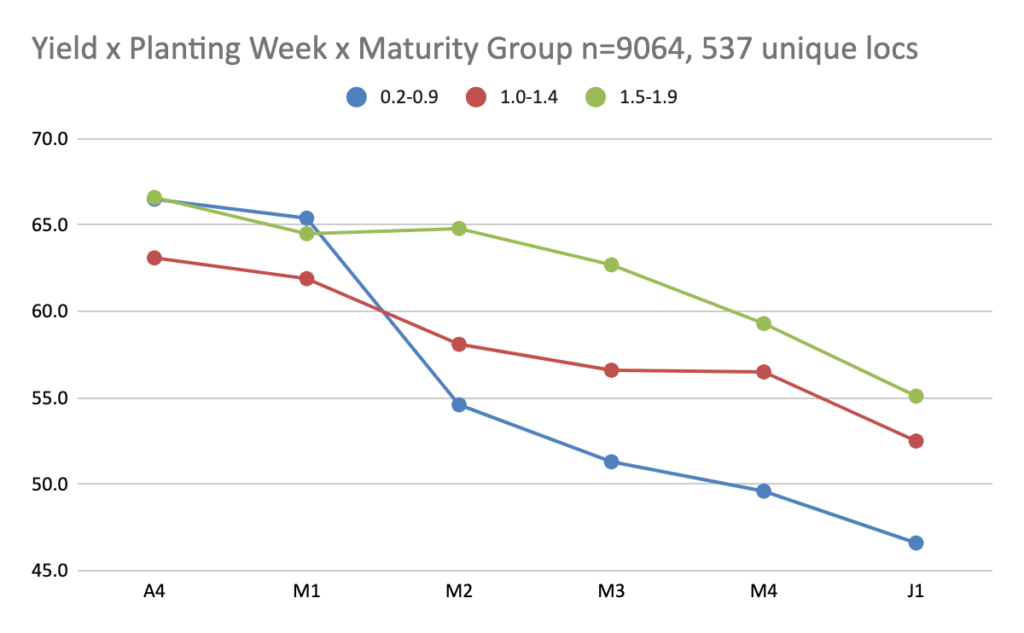
I have collected thousands of data points over the years to try to study this phenomenon of the relationship between soybean maturity, soybean planting date and yield potential. My research has shown that in northwest Wisconsin, if you can get an early maturing bean in the ground early — in the last week of April or the first week in May — it will yield as much as the later maturing soybean varieties planted at the same time.
The obvious benefits for cover croppers stand out like a sore thumb. If there are 10 days of harvest availability there, that means everything in the cover crop world. Having done this now for the last couple of years on the farms that I work with, we’ve collected a big dataset. I’ve worked with a couple of farmers up in Barron County, which is right up on the northern edge of what we’d consider the corn belt, where an 0.4 maturity soybean planted in the first week of May is yielding 60 to 65 bushels. These are yields that would be respectable as far south as Iowa. Given the right growing season, there’s no reason to believe that an 0.4 maturity soybean, which is done in a blink of an eye, can’t yield with some of these big boys if it’s managed properly and you get a decent pitch from Mother Nature.
I love the system. I love the way it works. I think it’s a huge insight that more farmers should be adopting. Who would not like to get out there and start harvesting soybeans on September 20 in northern Wisconsin? A lot of soybeans come off on November 20 here. So, to have soybeans off by September 20, what you do with that extra 10 days, before you switch over to corn the next year, is totally up to you. For me, as a cover crop guy, I’m punching my rye in — you can have a beautiful stand of rye before it hits winter.
There are a lot of reasons why this system makes a whole lot of sense, but it’s really hard to get guys to shift that mindset because they’re so ingrained to believe that you can’t grow good beans on a short maturity. Well, we can. The data shows we can.
Acres U.S.A. That’s great. Anything else you’d like to share?
Ailts. Maybe just a word on the Haney test, because that’s been a big success here. There’s a lot of scrutiny — maybe even scorn — in regard to the Haney test. I think that their criticism is a function of not knowing how to use it. I realize that sounds kind of spicy. I’m not trying to throw stones at anybody, but I will say that if you’re going to criticize a soil test, you better have run it a whole bunch of times and found it not useful — not just because you don’t understand what the numbers mean. I get a little soapboxy about this because I think it touches on some nerves. But with any new technology, its utility is a function of your ability to use it and put it to use wisely. I think that’s where a lot of the criticism about the Haney test comes from — not a lot of people put it to use wisely.
I’ve found that if we take this test two weeks prior to side-dress nitrogen applications, we can use it to fine-tune the dials. The last two growing seasons here have been essentially the bookends of the extremes of weather — and of what this test can show us about how to manage nitrogen. 2023 was the driest growing season on record since 1988 for us. 2024 was the wettest growing season we’ve ever had in the first two months — May and June. It just never stopped raining. In those two years, then, we saw the extremes when it comes to all the things that can cause nitrogen to leave or not leave the soil profile.
Having now done more than 200 Haney tests during that timeframe, I feel like I’ve been able to draw some interesting insights. The average nitrogen level in the top six inches during the dry season was over 120 pounds per acre. One hundred twenty pounds of nitrogen is going to get you a 150-bushel corn crop. And that’s just what’s in the soil — that’s not what’s applied as fertilizer. Last year, during the wet growing season, when you leach a lot of nitrogen, there were 60 pounds in the ground — literally half of 2023 because of all the rain.
Those numbers are useful — 120 pounds vs. 60 pounds — you can do something with that data. It’s going to get you a little closer to what the “right answer” for nitrogen is. I think the Haney test offers me a piece of insight that I would not otherwise have when it comes to nitrogen rates on corn.
Acres U.S.A. Everybody who wasn’t using this test was just putting the same amount of nitrogen on each year, because that’s what they always did.
Ailts. Yes. Here we are in 2025 — we have robots that can do back flips, but in the farming world, we’re going to come up with a nitrogen rate in February that we stick with all the way to the following October, with no adjustment in between. Are you kidding me? Why aren’t we figuring out a way to measure nitrogen? The Haney test can at least get you into the ballpark — it gives you a signal to help you adjust on the fly, based on what Mother Nature is doing, which always changes.
I realize measuring nitrogen is hard. But I also believe we now have tools that can help us get a little bit closer to the right answer, if not to perfection.
Acres U.S.A. Last questions: tell us some more about your giant pumpkins. What’s your personal record?
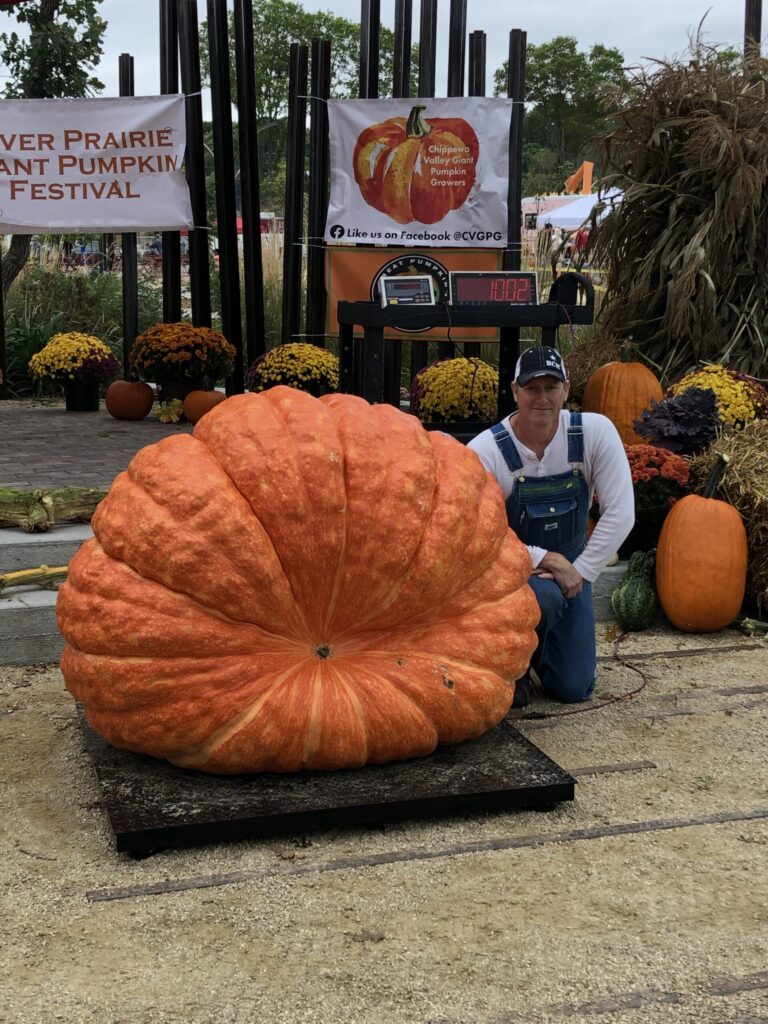
Ailts. The biggest pumpkin I’ve grown was 1,422 pounds. I did that back in 2010. We had a spectacular growing season up here. In fact, my old high school buddy, who lives about 10 miles away, grew the world record pumpkin that year — 1,810 pounds. At the time, that was the biggest pumpkin ever grown. You can grow some big pumpkins on the 45th parallel.
The current world record is 2,743 pounds — people are getting close to 3,000 pounds. That was grown in Anoka, Minnesota — another 45th-parallel town.
Acres U.S.A. What are you doing special this year?
Ailts. Success in the patch is a function of time, just like any hobby. The more time you put toward it, the better your outcomes are. That’s been my limiting factor these last couple of years. Running my own business, and we’ve got four boys, so it’s busy, busy, busy. The guys who are doing this at a competitive level are spending upwards of four to five hours a day in the patch. They’re out there first thing in the morning, they go to work — or if they’re retired, they don’t go to work — and they come back and do it again in the afternoon and the evening. It’s watering, it’s weeding, it’s fertilizer mixing, it’s pruning. It’s time dedication that drives outcomes.
Acres U.S.A. And can you talk a bit about how you prune these pumpkins?
Ailts. Sure. For the large jack-o’-lanterns and everything else that we grow to sell, I do not prune. I just let nature take its course. However, with a little bit of pruning effort, you can drastically change the outcomes.
Visualize a pumpkin plant growing like an inverted Christmas tree. You have a main runner that’s equivalent to the trunk, growing away from where it’s planted in the ground, and then at every leaf node it throws out a lateral branch. We call those laterals secondary vines. And, at each leaf node of a lateral, the plant will continue to produce even more laterals. So that’s what we prune. We pinch off what are called the tertiary vines — the laterals that come off the secondary vines. If you prune those, that prevents the plant from becoming a vegetative salad mix.
The plants will continue growing ad infinitum — they would take over an entire yard if you allowed them to. I give them a very specific allotted square footage: every competitive giant gets about 800 square feet. It’s a lot of space, but that’s what they get. Once they fill that 800-square-foot boundary, I chop the entire vine tip right off with pruning shears, so it’s done growing. You’re trying to force what would be vegetative growth into the fruit itself. And in the competitive patch we only allow one fruit per plant. So, 800 square feet of vine and leaves is all feeding a single fruit on that main runner.
Acres U.S.A. And then everywhere it’s going down into the ground, you’re feeding it, right?
Ailts. That’s right. As the vine grows, it’ll put out leaf nodes where a leaf goes up and a root goes down, and it keeps doing this over and over again. We take soil and compost, and we bury the vines. That prevents the wind from rolling the vines across the landscape, and it also encourages adventitious root growth. And it protects the vine from being exposed to things like critters and humans and bugs and all the things aboveground. Vine burying and vine pruning — that’s what gets you the big ones.