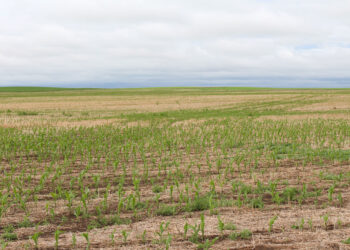
A young man’s journey from Guatemala to regenerative farming in the U.S. shows that the next generation is ready to begin stewarding the land

Roosters crowing at dawn, the rhythm of milking cows with my grandpa, daring my brother and friends to ride bull calves — these are my earliest memories from growing up in rural Santa Rosa, Guatemala.
One summer when I was about seven, I planted corn near the pig pens, where manure-enriched soil teemed with earthworms. I sowed seeds by hand and watched them germinate, grow, and thrive. My corn wasn’t as tall as Grandpa’s, but harvesting it for my family felt very fulfilling — it connected me to the land in a way I’d never forget. Experiencing nature’s processes sowed the seeds of my passion for farming.
At the end of 2017, though, I left that world behind and immigrated to the U.S. to build a new life. The move disconnected me from the land, but those childhood lessons would later guide me back to farming. I’m grateful God helped me turn adversity into strength and led me to discover my calling: regenerative farming and radical health.
American Food: What the Heck?
I was very excited to be in the U.S., but I spoke no English. I claimed asylum, lived with family, attended high school, and worked evenings as a dishwasher in a sushi restaurant. I indulged in fast food — McDonald’s, Burger King, Domino’s, you name it — until my health crashed. I was overweight and had high cholesterol; depression and anxiety made me feel meaningless, trapped, and helpless. I was a far from the vibrant kid who had herded cows in Guatemala.
One day I providentially discovered Dr. Mark Hyman’s book, Food: What the Heck Should I Eat? This renewed a spark in me: regenerative farming was the path I needed to follow — both for my own sake and for others’.
Classmates and teachers questioned my choice to skip college to farm. But I saw farming as a calling, not a fallback — a way to care for the earth and our food supply and to improve the land for future generations. As I began volunteering at a farm and practicing English with native speakers, my fluency improved. Today I dream of being able to publicly share my story and inspire youth to get back to farming. The challenges I encountered pushed me to rediscover my purpose: stewarding the land holistically with love and care.
Back on the Farm
Dr. Hyman posted articles on Kiss the Ground’s website, and through their network I found Sow a Heart Farm in California, owned by Mollie Engelhart and Elias Sosa. Volunteering there, I was welcomed into their family and community, balancing farm work with my final year of high school. The farm felt like home — everything I had imagined while living in the city. I dove into regenerative practices, learning hands-on what I’d read in Gabe Brown’s Dirt to Soil. The experience humbled me; school taught equations, but the farm taught life — the importance of soil, animals and resilience.
Spring was magical: cows, goats and sheep birthed their young. It was great to see lots of new life on the farm. But I also got to witness one of nature’s harshest realities. I watched lambs and baby goats die despite our efforts. A mountain lion once killed a goat and injured a few sheep. These moments echoed Marcus Aurelius’ philosophy: “You could leave life right now. Let that determine what you do, say, and think.” Death reminded me to live fully, to farm as nature intended, and to honor the animals that feed us.
The farm showed me nature’s principles in action — cover crops rebuilding soil, animals cycling nutrients, and humans harvesting and eating the most nutrient-dense food. I learned to appreciate the whole cycle of food. This was a lesson no classroom could match. Sow a Heart Farm was a family and a life school.
A Living Classroom
In late 2023, I moved to Bandera, Texas, to work at Sovereignty Ranch, a 200-acre regenerative operation with Mollie and Elias. My excitement surged as we began adaptive multi-paddock grazing, moving goats, sheep, and cows daily with portable electric fences. Goats and sheep browsed wild areas while cows grazed cover crops — cool-season rye and peas in the spring, and sorghum sudangrass, brown top millet, and mung beans in the summer. Adjusting paddock sizes based on the land’s and animals’ needs was fun.
One of my favorite tasks was milking cows and drinking their nutrient-dense milk every morning. I’m a big fan of raw milk; it’s a superfood packed with bioavailable nutrients, healthy fats, enzymes, and beneficial bacteria. Guests often joined me to experience milking a cow for their first time, connecting them to food in a new way.
Books and videos on holistic grazing prepared me, but hands-on practice taught me to read the land — when to move animals, how to balance grazing, etc. The cows’ butterfat-rich milk and the ecosystem’s revival showed me the power of cover crops and regenerative grazing. As soon as we put the cows out in the fields, the dung beetles showed up to do their magic. They play a vital role in resilient ecosystems, rolling manure into the soil, cycling nutrients, and disrupting parasite cycles. Their activity also attracts birds, which feed on worm and fly larvae, reducing parasite loads for the livestock. Sovereignty Ranch wasn’t just a workplace; it was a living classroom for nature’s stewardship.
Future at Tierra Soul Village

In the spring of 2025 I married a beautiful young woman named Fia Arias who, like me, is committed to stewarding the land. I moved with her and her family to Tierra Soul Village Farm in New Mexico, where we raise dairy goats, cows, horses, pigs and chickens. Our permaculture garden bursts with tomatoes, peppers, zucchini, lettuce, corn and herbs. Each harvest feels like a gift, echoing my childhood in Guatemala.
We run a herdshare for raw, grassfed goat milk and are planning to start a CSA to share nutrient-dense produce with our community. Using electric fence, we move the goats daily, mimicking the grazing patterns of herbivores to regenerate soil and raise healthy animals.
Fia and I dream of raising kids on this farm and teaching them to love and care for the land as we do. I’m eager to expand my skills through workshops and experiments, like testing new cover crops or grazing techniques. Tierra Soul Village is more than a farm; it’s a legacy of healing, blending my Guatemalan roots with regenerative practices to nurture the Earth for generations.
The average age of a U.S. farmer is 58; we need young minds on the land. If I can move from Guatemala, overcome health struggles, and find purpose in regenerative farming, so can you.