Acres U.S.A.® Magazine
  • Articles
    • News
    • Ecological farming
      • Climate
      • Environmental Issues
      • Farm management & planning
      • Human health
    • Livestock
    • Farm
    • Crop
      • Crop management practices
        • Ag technology
        • Cover crops
        • Crop nutrition
          • Crop protection
          • Diseases
        • Crops
        • Fruits
    • Soil
    • Opinion
  • Resources
    • Magazine
    • Online Learning
    • Newsletters
    • Free Articles
    • Blog
  • Magazine Issues
    • 2026
      • June 2026
      • May 2026
      • April 2026
      • March 2026
      • February 2026
      • January 2026
    • 2025
      • December 2025
      • November 2025
      • October 2025
      • September 2025
      • August 2025
      • July 2025
      • June 2025
      • May 2025
      • April 2025
      • March 2025
      • February 2025
      • January 2025
    • 2024
      • December 2024
      • November 2024
      • October 2024
      • September 2024
      • August 2024
      • July 2024
      • June 2024
      • May 2024
      • April 2024
      • March 2024
      • February 2024
      • January 2024
    • 2023
      • December 2023
      • November 2023
      • October 2023
      • August 2023
      • July 2023
      • June 2023
      • May 2023
      • April 2023
      • March 2023
      • February 2023
      • January 2023
    • 2022
      • December 2022
      • November 2022
      • October 2022
      • September 2022
      • August 2022
      • July 2022
      • June 2022
      • May 2022
      • April 2022
      • March 2022
      • February 2022
  • About Us
    • Our History
    • Our Staff
    • Contact Us
    • Community
      • Soil Health Primer Resources
  • Events
    • Eco-Ag Conference
    • Farm Weird Event
  • Subscribe
  • Login
  • Register
No Result
View All Result
  • Articles
    • News
    • Ecological farming
      • Climate
      • Environmental Issues
      • Farm management & planning
      • Human health
    • Livestock
    • Farm
    • Crop
      • Crop management practices
        • Ag technology
        • Cover crops
        • Crop nutrition
          • Crop protection
          • Diseases
        • Crops
        • Fruits
    • Soil
    • Opinion
  • Resources
    • Magazine
    • Online Learning
    • Newsletters
    • Free Articles
    • Blog
  • Magazine Issues
    • 2026
      • June 2026
      • May 2026
      • April 2026
      • March 2026
      • February 2026
      • January 2026
    • 2025
      • December 2025
      • November 2025
      • October 2025
      • September 2025
      • August 2025
      • July 2025
      • June 2025
      • May 2025
      • April 2025
      • March 2025
      • February 2025
      • January 2025
    • 2024
      • December 2024
      • November 2024
      • October 2024
      • September 2024
      • August 2024
      • July 2024
      • June 2024
      • May 2024
      • April 2024
      • March 2024
      • February 2024
      • January 2024
    • 2023
      • December 2023
      • November 2023
      • October 2023
      • August 2023
      • July 2023
      • June 2023
      • May 2023
      • April 2023
      • March 2023
      • February 2023
      • January 2023
    • 2022
      • December 2022
      • November 2022
      • October 2022
      • September 2022
      • August 2022
      • July 2022
      • June 2022
      • May 2022
      • April 2022
      • March 2022
      • February 2022
  • About Us
    • Our History
    • Our Staff
    • Contact Us
    • Community
      • Soil Health Primer Resources
  • Events
    • Eco-Ag Conference
    • Farm Weird Event
  • Subscribe
No Result
View All Result
Acres U.S.A.® Magazine
No Result
View All Result
Home Magazine issues February 2026

Armor Up!

Jay Fuhrer by Jay Fuhrer
February 1, 2026
0
Menoken Farm manager Seth Boechler

Menoken Farm manager Seth Boechler

0
SHARES
63
VIEWS
Share on FacebookShare on Twitter

Soil Health Principle 1: Soil Armor

Jay Fuhrer

Editor’s note: This is the first in a series of five explanations of the principles of soil health, as described by Jay Fuhrer, who was one of the first to define these principles as a whole. Each article will include a description of the principle along with a profile of a farm that is successfully implementing it.

Agriculture has a long history of bare soils. Lack of ground cover has likely even contributed to the downfall of past civilizations. 

Bare soils come with several challenges, such as being prone to wind and water erosion, temperature extremes, moisture extremes, rainfall compaction and salinity. They often reflect the losing end of the carbon cycle. 

The soils we enjoy today were not built by this management type. Instead, our soils were primarily built over geological time by perennial grasslands and forests, along with microbes, ruminant animals and predators, with the occasional glacier and volcano thrown in. Soils are the interface of the atmosphere (soil air), biosphere (organic matter and biomass), lithosphere (soil particles), and hydrosphere (soil water). The importance of soil cannot be overstated.

Brown and Green Armor

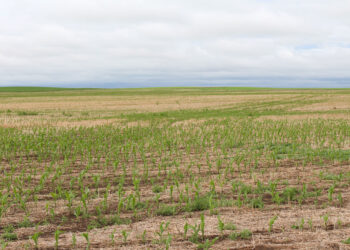
Farms that have moved into no-till systems start leaving crop residue, or brown litter, on the soil surface, usually from a recently completed harvest. This management change moderated erosion, temperature, moisture loss, compaction, and even salinity. Soil microbes can adjust back to something they were used to: residue on the soil surface. 

After a few years in a no-till system, the microbes have usually adjusted. This means they are no longer tying up nutrients for residue decomposition. For many farms, soil cover, or armor, means the soil can hydrate again and support more life.

Farms that provide green armor find that as young green plants evolve, they emit carbon into the soil. This now reflects the gaining end of the carbon cycle. Green cover crops can grow in the spring or fall and are sometimes used as companion plantings. The same bare-soil challenges addressed by brown armor can also be addressed by green armor. 

When we combine brown and green armor, we get the best of both worlds. For instance, brown is giving off carbon dioxide, and green is taking in carbon dioxide. Brown feeds saprophytic fungi, and green feeds mycorrhizal fungi. Combining a no-till system with green armor allows us to limit the release of carbon dioxide from our soils while simultaneously maximizing carbon inputs into our soils.

Dressing the Soil

Soil Venn diagram (The Nature and Properties of Soils, 14th Edition, page 11) — Soils are the interface of the atmosphere (soil air), biosphere (organic matter and biomass), lithosphere (soil particles), and hydrosphere (soil water).

If our goal truly is soil health, we need to manage the challenges of bare. This is the reason soil armor is the first soil health principle. With cover on the soil as a foundation, we have now set the stage for additional soil health principles. 

How to achieve cover on our soil varies across the U.S. A good starting point is to write a description of what soil health principle 1 — soil armor — looks like on your landscape. Arid regions tend to use more brown armor, especially at the start of a new no-till system. Higher-rainfall regions tend to use more brown and green armor. Both regions start to benefit from an increased ability to hold more soil water — a benefit of increased soil aggregates and carbon levels.

Farmers, ranchers and gardeners continually manage soil cover using both brown and green armor. Soil armor is not an easy process. Soil biology consumes more residue as it improves, creating the need for still more cover. 

Soil armor should be evaluated by looking straight down at the soil surface and asking yourself, “What percent of the soil is protected by cover?” The goal should be 100 percent soil cover with brown and/or green armor. 

Let’s armor up!

Featured Farm: Menoken Farm

Menoken, North Dakota
Farm manager: Seth Boechler

The Menoken Farm is an educational site consisting of 150 acres of cropland owned and operated by the Burleigh County Soil Conservation District, just east of Bismarck, North Dakota. The indigenous language interprets Menoken as “you reap what you sow,” a very fitting name for a conservation demonstration farm. 

The Burleigh County Soil Health Team identified several resource concerns across the Northern Plains landscape after the initial startup in 2009. These included a lack of soil surface armor, minimal biological diversity, poor nutrient cycling, slow infiltration, collapsed soil aggregates, carbon-deficient soils, and little beneficial insect habitat and food. The five soil health principles were then set into motion to address these resource concerns.

According to Menoken Farm Manager Seth Boechler, “Armor is an important first step. You really can’t set the system into motion until this principle is applied. When I walk a cropland field, the armor usually isn’t perfect; occasionally there are still some areas with little or even no cover.” 

Providing armor is a continual process. Menoken Farm surface residue amounts vary from field to field and, when managed properly, have not hindered successful seed-to-soil contact. The armor benefits are obvious during spring planting. The fields are well protected and stable, even during strong windstorms.

The Menoken Farm uses all five soil health principles in a systems approach, with soil armor as the first principle applied. A diverse plant community is established to cover the soil — both green plants and brown dead litter. Initial observations included the reduction and eventual elimination of erosion, followed by improved soil hydration. 

Cropland fields across the world struggle with forming enough armor to create an O (organic) horizon, which covers the soil surface and consists of decomposing dark plant material. O horizons contain high amounts of organic matter and are nutrient rich. Bare soils have little to no O horizon. Consequently, crops are missing the soil fertility, temperature and moisture management benefits provided by the various layers of decomposing organic material. 

“Wherever the armor is adequate, you can physically see the life under the residue,” Boechler says. “The diversity of life varies within the residue decomposition stage, eventually creating a fertile, dark, well-aggregated soil.” While the O horizon is more prevalent in prairies and forests, providing cropland armor helps mimic the original O horizon benefits.

The Menoken Farm has used various systems to cover the soil, using green covers and/or brown dead litter during the spring window, summer companion window, and fall window. A few recent Menoken Farm examples include winter wheat/clover, buckwheat/alfalfa, sunflower/multispecies, corn/multispecies, and soybean planted green/mowed. These are used before, during, and after a cash crop whenever a window presents itself. The farm incorporates annual, biennial, and perennial plants and always moves toward the elusive goal of no tillage and no pesticide use.
← Previous Bean There, Covered That Next Discovering My Calling →
Jay Fuhrer

Jay Fuhrer

Jay Fuhrer is a conservationist with the Burleigh County Soil Conservation District in North Dakota.

Next Post
Discovering My Calling

Discovering My Calling

  • Trending
  • Comments
  • Latest
The Most Important Livestock in Our Fields

The Most Important Livestock in Our Fields

July 1, 2024
Glyphosate Does What It’s Designed to Do — Kill

Glyphosate Does What It’s Designed to Do — Kill

February 19, 2025
USDA organic seal over American farm land

Losing Organic Farms

January 27, 2026
The Take-Half, Leave-Half Fallacy

The Take-Half, Leave-Half Fallacy

July 1, 2025
We Don’t Need Another Bridge — We Need an Off-Ramp

We Don’t Need Another Bridge — We Need an Off-Ramp

3
Under One Roof

Under One Roof

3
A Rose By Any Other Name

A Rose By Any Other Name

2
Terra Preta’s Biological Advantage

Terra Preta’s Biological Advantage

2
When a Steer Produces Milk, Farmers Should Pay Attention

When a Steer Produces Milk, Farmers Should Pay Attention

August 10, 2026
Groundbreaking Education

Groundbreaking Education

August 6, 2026
ECO-MEETINGS

ECO-MEETINGS

August 3, 2026
Shifting Gears

Shifting Gears

August 3, 2026

Recent News

When a Steer Produces Milk, Farmers Should Pay Attention

When a Steer Produces Milk, Farmers Should Pay Attention

August 10, 2026
Groundbreaking Education

Groundbreaking Education

August 6, 2026
ECO-MEETINGS

ECO-MEETINGS

August 3, 2026
Shifting Gears

Shifting Gears

August 3, 2026

About ACRES USA

Acres U.S.A.® Magazine

Acres U.S.A.® is North America’s oldest publisher on production-scale organic and regenerative farming. For more than 50 years, our mission has been to help farmers, ranchers and market gardeners grow food profitably and sustainably, with nature in mind.

Visit Our Advertisers

Magazine Issues

  • News
  • 2025
    • June 2025
    • May 2025
    • April 2025
    • March 2025
    • February 2025
    • January 2025
  • 2024 Articles
    • December 2024
    • November 2024
    • October 2024
    • September 2024
    • August 2024
    • July 2024
    • June 2024
    • May 2024
    • April 2024
    • March 2024
    • February 2024
    • January 2024
  • December 2023
    • December 2023
    • November 2023
    • October 2023
    • August 2023
    • July 2023
    • June 2023
    • May 2023
    • April 2023
    • March 2023
    • February 2023
    • January 2023
  • December 2022
    • November 2022
    • October 2022
    • September 2022
    • August 2022
    • July 2022
    • June 2022
    • May 2022
    • April 2022
    • March 2022

Contact Acres U.S.A

  • Contact Us
  • About Us
  • Advertise With Acres U.S.A.
  • My Subscription

Learn

  • Resources
  • Events
  • Magazine
  • Newsletters
  • Free Articles
  • Webinars
  • Online Courses
  • Bookstore

Our All Socials

Follow With Us...

  • My account
  • News
  • Ecological farming
  • Refund and Returns Policy
  • Privacy & Policy

© 2024 Acers USA Magazine

Welcome Back!

Login to your account below

Forgotten Password? Sign Up

Create New Account!

Fill the forms below to register

All fields are required. Log In

Retrieve your password

Please enter your username or email address to reset your password.

Log In
No Result
View All Result
  • HOME
  • ARTICLES
    • News
    • Farm
    • Ecological farming
    • Livestock
    • Crop
      • Crop management practices
      • Cover crops
      • Crop nutrition
      • Crop protection
      • Crops
      • Ag technology
    • Soil
    • Opinion
  • RESOURCES
    • Magazine
    • Online Learning
    • Newsletters
    • Blog
    • Free Articles
  • MAGAZINE ISSUES
    • 2026
      • June 2026
      • May 2026
      • April 2026
      • March 2026
      • February 2026
      • January 2026
    • 2025
      • December 2025
      • November 2025
      • October 2025
      • September 2025
      • August 2025
      • July 2025
      • June 2025
      • May 2025
      • April 2025
      • March 2025
      • February 2025
      • January 2025
    • 2024
      • December 2024
      • November 2024
      • October 2024
      • September 2024
      • August 2024
      • July 2024
      • June 2024
      • May 2024
      • April 2024
      • March 2024
      • February 2024
      • January 2024
    • 2023
      • December 2023
      • November 2023
      • October 2023
      • August 2023
      • July 2023
      • June 2023
      • May 2023
      • April 2023
      • March 2023
      • February 2023
      • January 2023
  • ABOUT US
    • Our History
    • Our Staff
    • Contact Us
    • Community
      • Soil Health Primer Resources
  • EVENTS
    • Eco-Ag Conference
    • Farm Weird
  • SUBSCRIBE
  • Login
  • Sign Up
  • Cart

© 2024 Acers USA Magazine

Lost Password?

Welcome Back!

Log in to your account below.

Lost Password?