
Acres U.S.A.® Magazine
  • Articles
    • News
    • Ecological farming
      • Climate
      • Environmental Issues
      • Farm management & planning
      • Human health
    • Livestock
    • Farm
    • Crop
      • Crop management practices
        • Ag technology
        • Cover crops
        • Crop nutrition
          • Crop protection
          • Diseases
        • Crops
        • Fruits
    • Soil
    • Opinion
  • Resources
    • Magazine
    • Online Learning
    • Newsletters
    • Free Articles
    • Blog
  • Magazine Issues
    • 2026
      • February 2026
      • January 2026
    • 2025
      • December 2025
      • November 2025
      • October 2025
      • September 2025
      • August 2025
      • July 2025
      • June 2025
      • May 2025
      • April 2025
      • March 2025
      • February 2025
      • January 2025
    • 2024
      • December 2024
      • November 2024
      • October 2024
      • September 2024
      • August 2024
      • July 2024
      • June 2024
      • May 2024
      • April 2024
      • March 2024
      • February 2024
      • January 2024
    • 2023
      • December 2023
      • November 2023
      • October 2023
      • August 2023
      • July 2023
      • June 2023
      • May 2023
      • April 2023
      • March 2023
      • February 2023
      • January 2023
    • 2022
      • December 2022
      • November 2022
      • October 2022
      • September 2022
      • August 2022
      • July 2022
      • June 2022
      • May 2022
      • April 2022
      • March 2022
      • February 2022
  • About Us
    • Our History
    • Our Staff
    • Contact Us
    • Community
      • Soil Health Primer Resources
  • Events
    • Eco-Ag Conference
    • Farm Weird Event
    • Viroqua On Farm Event
  • Subscribe
  • Login
  • Register
No Result
View All Result
  • Articles
    • News
    • Ecological farming
      • Climate
      • Environmental Issues
      • Farm management & planning
      • Human health
    • Livestock
    • Farm
    • Crop
      • Crop management practices
        • Ag technology
        • Cover crops
        • Crop nutrition
          • Crop protection
          • Diseases
        • Crops
        • Fruits
    • Soil
    • Opinion
  • Resources
    • Magazine
    • Online Learning
    • Newsletters
    • Free Articles
    • Blog
  • Magazine Issues
    • 2026
      • February 2026
      • January 2026
    • 2025
      • December 2025
      • November 2025
      • October 2025
      • September 2025
      • August 2025
      • July 2025
      • June 2025
      • May 2025
      • April 2025
      • March 2025
      • February 2025
      • January 2025
    • 2024
      • December 2024
      • November 2024
      • October 2024
      • September 2024
      • August 2024
      • July 2024
      • June 2024
      • May 2024
      • April 2024
      • March 2024
      • February 2024
      • January 2024
    • 2023
      • December 2023
      • November 2023
      • October 2023
      • August 2023
      • July 2023
      • June 2023
      • May 2023
      • April 2023
      • March 2023
      • February 2023
      • January 2023
    • 2022
      • December 2022
      • November 2022
      • October 2022
      • September 2022
      • August 2022
      • July 2022
      • June 2022
      • May 2022
      • April 2022
      • March 2022
      • February 2022
  • About Us
    • Our History
    • Our Staff
    • Contact Us
    • Community
      • Soil Health Primer Resources
  • Events
    • Eco-Ag Conference
    • Farm Weird Event
    • Viroqua On Farm Event
  • Subscribe
No Result
View All Result
Acres U.S.A.® Magazine
No Result
View All Result
Home Crop management practices Crops Fruits

Cracking the Regenerative Hazelnut — Part 1

Acres U.S.A. by Acres U.S.A.
June 26, 2024
in Fruits, Soil & plant health
0
Cracking the Regenerative Hazelnut — Part 1
0
SHARES
133
VIEWS
Share on FacebookShare on Twitter

An interview with Willamette Valley hazelnut grower Dan Brown

Acres U.S.A. It’s the end of March; where are you in terms of your season?

Brown. Stuff’s just getting started. Trees are at bud break now and a little past, depending on variety. We’re starting to work on grass control, tree fertilization, etc.

Acres U.S.A. How many acres is your operation, and how many acres are hazelnuts?

Brown. We’re doing about 350 acres of hazelnuts. We have a few walnuts, and then some grain and seed crops. We have some corn, wheat, some clover for seed, some oats.

Acres U.S.A. And you’re in the Willamette Valley, correct?
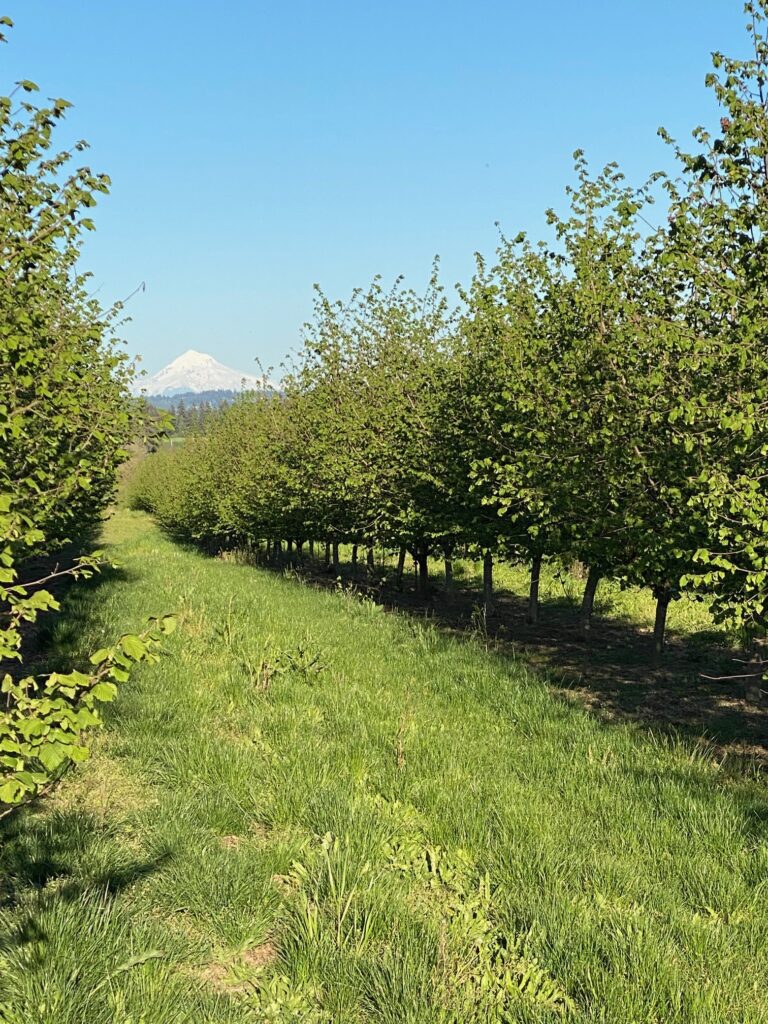
Brown. We are, yes.

Acres U.S.A. That’s the seed capitol; is it unusual to have an orchard there as well?

Brown. No — 99 percent of the hazelnuts grown in the U.S. are in the Willamette Valley. Just about any crop you can think of is grown here. There’s over 200 crops growing in the Willamette Valley. Grain corn is actually very rare here. The last few years with the high corn price, it’s been pretty good. But there’s quite a bit of silage corn grown for dairies. If you tell people here you grow corn, they think you’re growing silage or sweet corn.

Acres U.S.A. How old is your orchard?

Brown. We have orchards that are in their first year and some that were probably planted in the forties or fifties. The ones that are planted that long ago are definitely toward their end of their life. Actually, just outside my window, there’s a 40-year-old orchard and we’ve taken a block of a third of it out this year.

Acres U.S.A. How tall do these hazelnuts get, and how shaded is the ground?

Brown. This particular orchard is a Barcelona orchard, and they’re 30 to 35 feet tall and they can be full canopy. Yeah, you go through there in the middle of the afternoon and it’s shade.

Acres U.S.A. Here in the Midwest they’re more of a bush. Is it like that for you as well?

Brown. We train them to be more of a tree, even though they want to be a bush. It’s a management headache to try to keep them being a tree for management reasons. Harvest being probably the biggest one.

Acres U.S.A. You just prune every sucker that comes up and keep a single stem?

Brown. Pruning and spraying suckers is an endless task of a Willamette Valley hazelnut farmer. It’s four or five times a year. We don’t use glyphosate. We use 2,4-D, glufosinate, paraquat. I talked to a guy in California that sprays straight 32 for walnut suckers. I want to try experimenting with that this summer. Because the fertilizer is so hot, you’re essentially burning them with fertilizer versus the chemical.

Acres U.S.A. What do you do for cleaning up your rows in the winter?
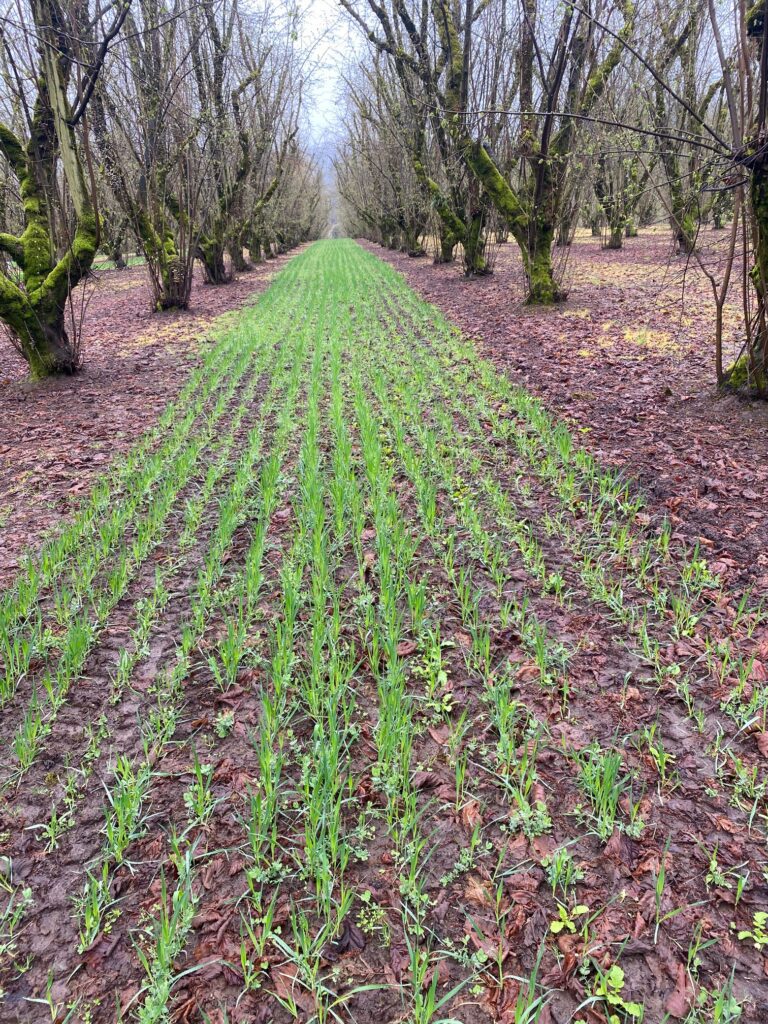
Brown. If we get some dry weather in winter or early spring, we like to flail mow. We try to get most all the nuts, but we at least chew up on the leaves. 

Acres U.S.A. What’s your journey with this? This was started by grandparents or great-grandparents, I assume, if you have trees that old.

Brown. Great-great, actually. I’m fifth generation. We haven’t always been a hazelnut farm. We started in hazelnuts, I believe, in the sixties. The reason we have some older trees is those are leased orchards that were established prior.

We’ve been a dairy farm before. They sold the cows in the early seventies.

Acres U.S.A. And more recently, what drove your movement toward a more regenerative direction?

Brown. Just noticing tree health declining significantly, so trying to figure out why. A very normal kind of observation among a lot of farms — not just hazelnut farms, but farms in general — is continuously having to put more inputs on to get a similar or lower yield, and trying to figure out why.

One key moment was an NRCS rain runoff infiltration demonstration I saw. That was very eye-opening. They took a surface cutout sample of different soil coverage — from bare soil to grass to native weed population. Then they apply a simulated rainfall at a reasonably high, but not crazy high, rate. Then they do infiltration and runoff testing into clear mason jars, so it’s very easy to see results. 

With bare soil, the runoff is super dirty — lots of erosion, and infiltration is almost zero. On ground with some sort of growing ground cover there’ll be almost no runoff, and full saturated soil, and mostly clear infiltrated water. 

Acres U.S.A. This is a test that they did on your farm, or at a different place?

Brown. This was done at a hazelnut growers meeting in the summer of 2018. They took actual samples from various hazelnut orchards in the Willamette Valley to try to be representative of different ground care methods. Seeing it was very eye-opening. It put proof to the theory that covered ground infiltrates more.

We had erosion problems before — some significant ones. We were trying to figure out ways to do better with that and to not lose our limited topsoil. Traditionally, hazelnuts were planted on hills, so rain is naturally going to be erosive. They were planted on hills because, traditionally, when older orchards were planted, it was hand harvest labor.

Acres U.S.A. What was your fertilization, herbicide, pesticide use in the past compared to now?

Brown. We would spray up to four fungicide passes, two insecticides, three or four herbicides. On the orchard floor, we use to have completely bare soil. People think it looks pretty; that’s still the standard practice. Leaving a grass center — or more of a weed center — is becoming a little more common, but the two insecticides is still very standard.
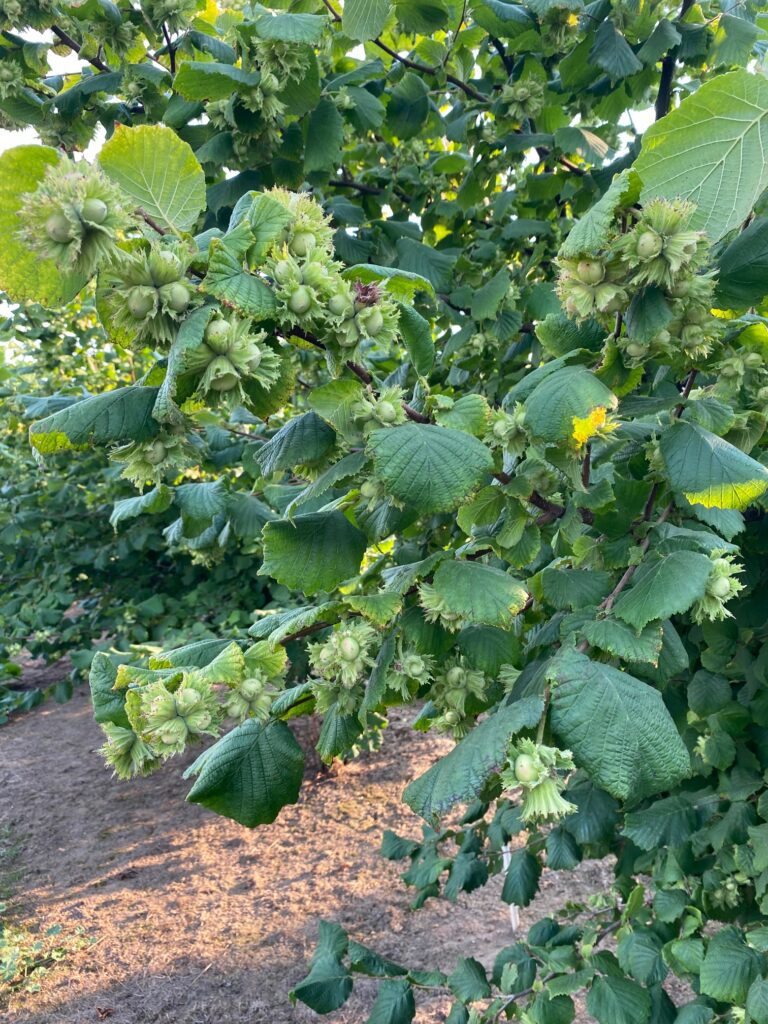
Acres U.S.A. In terms of passes, what are you down to?Brown. It’s not so much that we’ve reduced that many, it’s more just switching from chemistry to fertilizer. We’ve definitely pulled some back. Probably pulled back a third, I would say — a third of the passes. Our herbicide use is probably a third, and fungicides are way down. We still have a few orchards we’ll put a little bit on. That’s the Eastern Filbert blight, which came in the late eighties/early nineties and was an industry shift 30 years ago. That’s mutated and is now infecting all of the new varieties as well. The recommendation by the college is to spray the new varieties that are resistant to the blight — to spray them four times a season as a preventative measure in the springtime. We’re not taking that path at this time. That’s like taking preventative penicillin.

← Previous Plant Propagation Next Capturing Solar Energy →
Tags: HazelnutsWillamette Valley
Acres U.S.A.

Acres U.S.A.

North America’s oldest publisher on production-scale organic and regenerative farming. For more than 50 years, our mission has been to help farmers, ranchers and market gardeners grow food profitably, regeneratively, and with nature in mind.

Next Post
Capturing Solar Energy

Capturing Solar Energy

  • Trending
  • Comments
  • Latest
The Most Important Livestock in Our Fields

The Most Important Livestock in Our Fields

July 1, 2024
Glyphosate Does What It’s Designed to Do — Kill

Glyphosate Does What It’s Designed to Do — Kill

February 19, 2025
The Take-Half, Leave-Half Fallacy

The Take-Half, Leave-Half Fallacy

July 1, 2025
USDA organic seal over American farm land

Losing Organic Farms

January 27, 2026
We Don’t Need Another Bridge — We Need an Off-Ramp

We Don’t Need Another Bridge — We Need an Off-Ramp

3
Under One Roof

Under One Roof

3
A Rose By Any Other Name

A Rose By Any Other Name

2
Terra Preta’s Biological Advantage

Terra Preta’s Biological Advantage

2
Destroying Farmland for AI

Destroying Farmland for AI

March 12, 2026
Roundup glyphosate herbicide referenced in debate over national security executive order

ROUNDUP PIE

March 5, 2026
What Does “Cutting Red Tape” Mean for Eco-Ag?

What Does “Cutting Red Tape” Mean for Eco-Ag?

March 4, 2026
March 2026 • Issue #657

March 2026 • Issue #657

March 1, 2026

Recent News

Destroying Farmland for AI

Destroying Farmland for AI

March 12, 2026
Roundup glyphosate herbicide referenced in debate over national security executive order

ROUNDUP PIE

March 5, 2026
What Does “Cutting Red Tape” Mean for Eco-Ag?

What Does “Cutting Red Tape” Mean for Eco-Ag?

March 4, 2026
March 2026 • Issue #657

March 2026 • Issue #657

March 1, 2026

About ACRES USA

Acres U.S.A.® Magazine

Acres U.S.A.® is North America’s oldest publisher on production-scale organic and regenerative farming. For more than 50 years, our mission has been to help farmers, ranchers and market gardeners grow food profitably and sustainably, with nature in mind.

Magazine Issues

  • News
  • 2025
    • June 2025
    • May 2025
    • April 2025
    • March 2025
    • February 2025
    • January 2025
  • 2024 Articles
    • December 2024
    • November 2024
    • October 2024
    • September 2024
    • August 2024
    • July 2024
    • June 2024
    • May 2024
    • April 2024
    • March 2024
    • February 2024
    • January 2024
  • December 2023
    • December 2023
    • November 2023
    • October 2023
    • August 2023
    • July 2023
    • June 2023
    • May 2023
    • April 2023
    • March 2023
    • February 2023
    • January 2023
  • December 2022
    • November 2022
    • October 2022
    • September 2022
    • August 2022
    • July 2022
    • June 2022
    • May 2022
    • April 2022
    • March 2022

Contact Acres U.S.A

  • Contact Us
  • About Us
  • Advertise With Acres U.S.A.
  • My Subscription

Learn

  • Resources
  • Events
  • Magazine
  • Newsletters
  • Free Articles
  • Webinars
  • Online Courses
  • Bookstore

Our All Socials

Follow With Us...

  • My account
  • News
  • Ecological farming
  • Refund and Returns Policy
  • Privacy & Policy

© 2024 Acers USA Magazine

Welcome Back!

Login to your account below

Forgotten Password? Sign Up

Create New Account!

Fill the forms below to register

All fields are required. Log In

Retrieve your password

Please enter your username or email address to reset your password.

Log In
No Result
View All Result
  • HOME
  • ARTICLES
    • News
    • Farm
    • Ecological farming
    • Livestock
    • Crop
      • Crop management practices
      • Cover crops
      • Crop nutrition
      • Crop protection
      • Crops
      • Ag technology
    • Soil
    • Opinion
  • RESOURCES
    • Magazine
    • Online Learning
    • Newsletters
    • Blog
    • Free Articles
  • MAGAZINE ISSUES
    • 2025
      • June 2025
      • May 2025
      • April 2025
      • March 2025
      • February 2025
      • January 2025
    • 2024
      • December 2024
      • November 2024
      • October 2024
      • September 2024
      • August 2024
      • July 2024
      • June 2024
      • May 2024
      • April 2024
      • March 2024
      • February 2024
      • January 2024
    • 2023
      • December 2023
      • November 2023
      • October 2023
      • August 2023
      • July 2023
      • June 2023
      • May 2023
      • April 2023
      • March 2023
      • February 2023
      • January 2023
  • ABOUT US
    • Our History
    • Our Staff
    • Contact Us
    • Community
      • Soil Health Primer Resources
  • EVENTS
    • Eco-Ag Conference
    • On-Farm Viroqua Event
    • Farm Weird
  • SUBSCRIBE
  • Login
  • Sign Up
  • Cart

© 2024 Acers USA Magazine

Are you sure want to unlock this post?
Unlock left : 0
Are you sure want to cancel subscription?