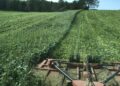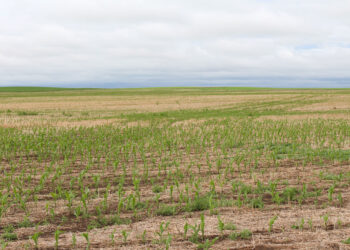


Rick Clark explains why an occasional deliberate disturbance to reset the soil-microbial balance can be a good thing
Acres U.S.A. It’s been a while since we’ve talked — how has this year gone, and what have you changed on your farm?
Rick Clark. Well, I’ll tell you — I have pounded very hard on this organic, no-till thing, and I’m backing off of that. We’re never going to get the masses to move that way. I understand that. I’m not saying I’m going to start using synthetic chemistry, but I think we need to do a little bit of everything — a little bit of chemistry, a little bit of tillage, a little bit of manure — and we need to build a system that we can take to millions of acres. So, I did do some tillage this year.
Acres U.S.A. I don’t think you’ll face any judgment from Acres U.S.A. folks for that. Like you said, if you want to help change things on a larger scale, you have to do what other people are going to be able to implement. And there are sometimes benefits to tillage, depending on the context.
Clark. Yeah, there’ll be some negativity, and that’s fine, but I think there’ll be a lot more positive than there will be negative.
Acres U.S.A. Yes. So, does that mean dropping the organic certification or just doing some tillage?
Clark. No, I think it just means doing some tillage. We’re headed into year eleven of no synthetic inputs and year sixteen or so of no tillage. We do occasionally use some manure — we have some alfalfa, and I don’t know any other way to bring the nutrients back that are leaving the field — in an organic environment, anyway.

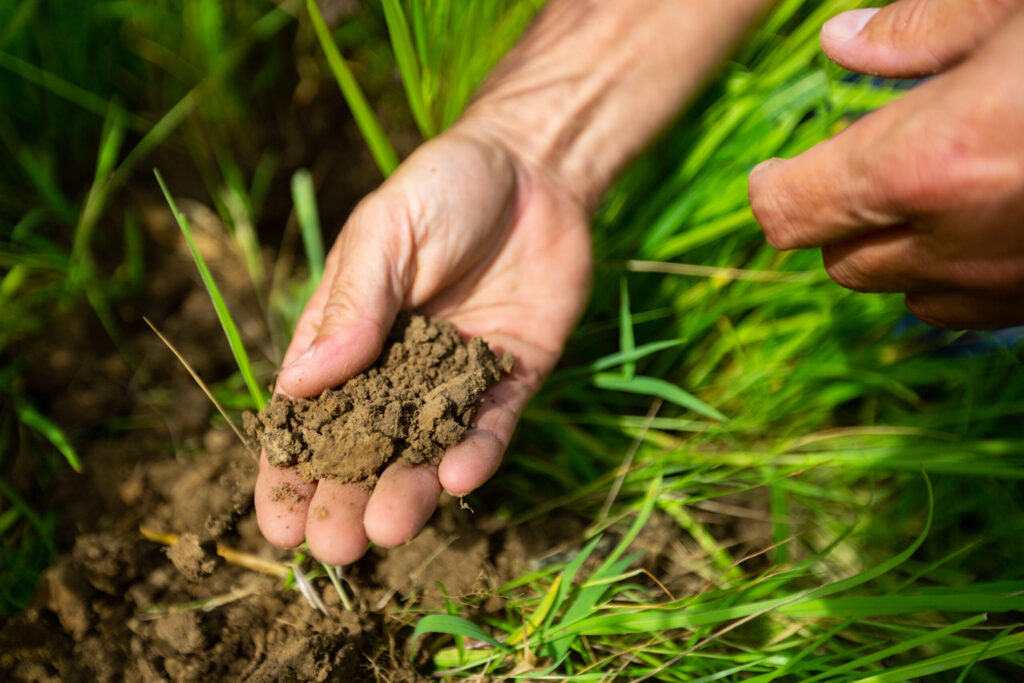
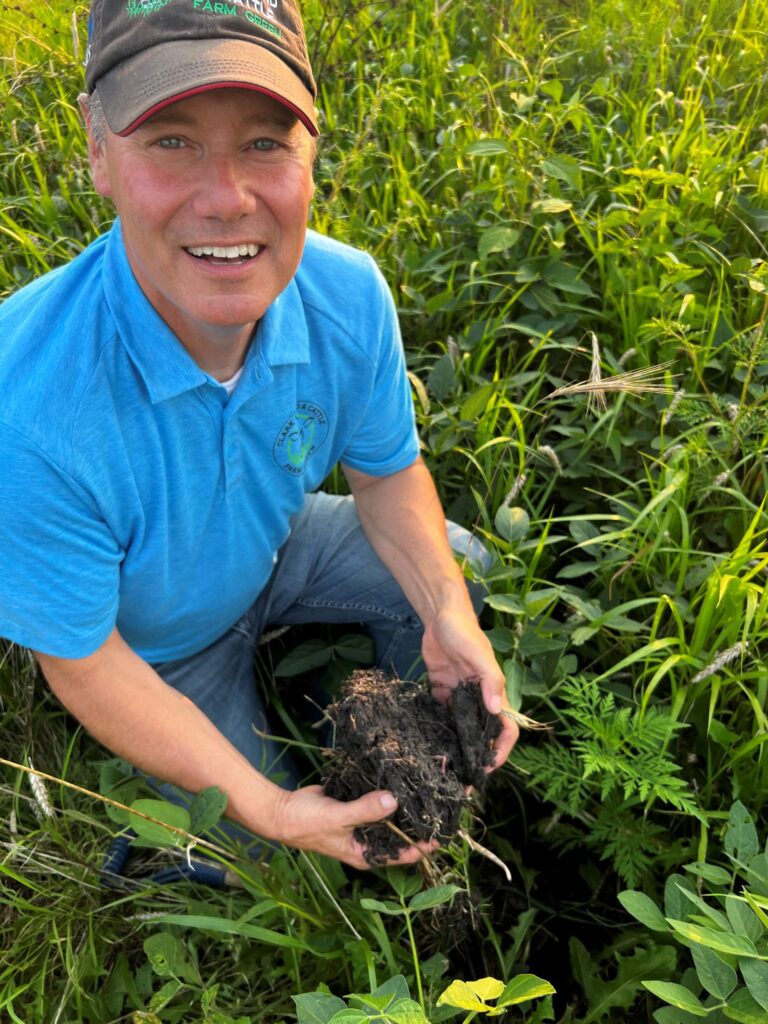
We’ve done some great things here over the years, I think. One of the ways that I’ve baselined our farm is through the Haney test. And one of the aspects of the Haney test is the fungal-to-bacterial relationship. When we started our journey, our soil was 90-something percent bacterial — like the majority of farm ground in the United States. As we started implementing regenerative principles and eliminating the inputs, taking this thing as far as we could, our soils are now 22 percent bacterial. We’re extremely high in fungi.
So, we have done exactly what Mother Nature wants to do. She wants you to resort to a fungal-based environment. But my biggest problem now — it’s a combination of many things, but the end result is native species that I can’t stop. Because we have such a fungal-dominated soil, we’ve got trees growing in our fields now. I’ve gone too far. And that’s fine — we’ve learned a lot on this journey. But now, instead of being way over on the fungal edge of the spectrum, we have to get closer to the middle. And I feel like the best way for me to do this is with a tillage event.
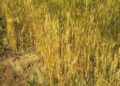
The perennial weeds that we’re really wrestling with right now are Canada thistle, goldenrod, bluegrass, aster and chicory. Those five have really bogged the system down for me. If you plant corn into a very heavily infested area of chicory, there won’t be a stalk of corn that survives. Same thing with Canada thistle.
So, I don’t know if tillage is the right answer, but we’re tracking what’s happening with and without tillage through a bunch of different tests. We’ve taken biology tests on the no-till and on the tilled fields, and we’re comparing the two. We’re doing PLFA, Solvita, CO2 burst, Biome Makers, Microbiometer, etc. We’re collecting all of this data to evaluate not only what’s happening in the system with the tillage event, but how quickly the system rebounds. I think we’re going to have some pretty good data.
Acres U.S.A. With that bacteria-to-fungi ratio, you’ve probably built some soil that would be really good for grazing.
Clark. That’s true, and we do have some cattle, but is it logical to think that we can move every acre in the U.S. to grazing? No, that’s not going to happen. So, let the graziers do their thing. They’re building great soil health.
Let’s work on systems that meet the farmer where they are. What’s their context? How far do they want to take it? I think the model to follow is like some of the certifications that do tiers. You come in at an entry level, and then you try to get better and better over time, with the goal of eventually, one day, being off of all inputs. But it’s a journey. It’s going to take you 10, 12 years to get there. That’s what I think is more realistic.
Acres U.S.A. What percent organic matter did you start with, and how much did it go up over those 11 years?
Clark. When we started the journey, our organic matter was 3.5 percent, and now we’re in the sixes. I really don’t look at that as a wow factor, though, because there’s not a cheap, accurate, repeatable way to measure soil organic matter. I’m okay with what I’m getting back, but once we can truly identify organic matter content easily, quickly and cheaply, then I’ll really start to zero in on that.
But there’s other things I look at. I look at aggregate stability. I look at infiltration rates. You’ve got to look at the Haney test. I don’t look at any of these tests by themselves. You cannot do that. Each test is a snapshot in time, and you plot all the data on an Excel spreadsheet, and you look at the trend. What is the trend of inorganic nitrogen? That to me is a beautiful way to determine if you’re building soil health or not, because if you are coming out of a full-tillage, full-fertility program, this is going to be like the bacteria-to-fungal relationship — you’re going to have hardly any fungi — it’s all going to be bacterial. The same thing with nitrogen — you’re going to have all inorganic nitrogen and hardly any organic. But once you start decreasing those synthetic inputs, you’re going to see organic nitrogen shoot up. That is a quick indicator that yes, what we’re doing is accurate.
And the Haney test is wonderful. It’s an awesome test. I don’t like to call it a Haney soil test — I like to call it a Haney soil health test. What it’s measuring is your soil health.
Acres U.S.A. Can you talk a little bit more about these fields that you’ve plowed? What kinds of cover crops have you been using, what type of tillage did you do, and did you have to do it a couple times to get a good seed bed?
Clark. First of all, Keith Berns and I have been working hard on how many families of plants can we get into a cocktail. Not how many species — how many families. But the number one thing you have to determine is how you’re going to terminate the cover crop next spring. Let’s say you’re full chemistry or full tillage. Throw the kitchen sink at it — get 20 families represented.
We are up to nine families, each of which works on our operation with either a) no termination at all, unless it’s with a roller crimper, or b) a light tillage pass in the spring to green manure, about two inches deep. That’s it. So, right now we have three species that will survive the winter, and we will deal with that next spring.
On the fields that we did this to last year, we took a John Deere speed disc — it’s a very shallow-running tool, but it’s high speed, like 12 miles an hour, and we simply churned up that top two inches. Then, right behind that — I mean in the same hour — we drilled a seven-family cocktail last fall. And I have never seen a cover crop take off and grow like it did last fall.
Now, why was that? Was that because of this one tillage event after 11 years or whatever? Was it the seven families? Was it something else about the year we had? I don’t know. All I know is that the amount of growth we had, and the amount of forage we grew from the time we planted till the time it winter–killed, was absolutely outrageous. On a scale of one to 10, if that tillage event was a four — because we did probably release some carbon — but behind that tillage event, with this massive cocktail that we grew in about 60 days, let’s say that was an eight. Then aren’t we a plus-four for the tillage event? That’s how I look at it. That may be a little too simplistic, but that’s what I’m looking at.
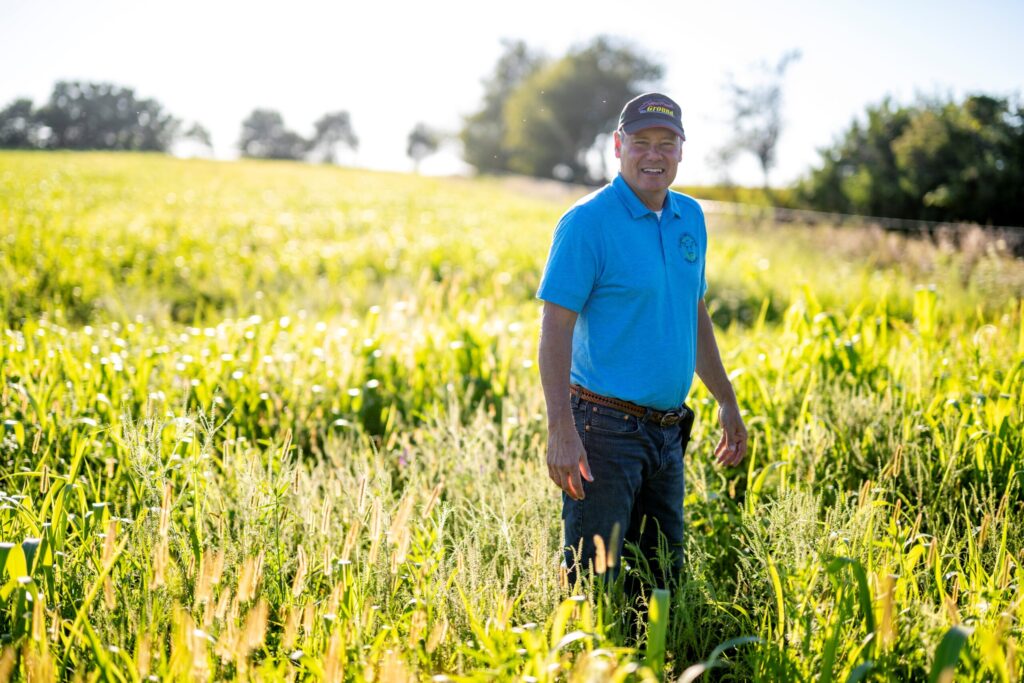
And then, we had grown that cocktail on maybe three or four fields. This spring we green manured it two inches deep. We planted our corn into that, and the corn looks phenomenal. We did do some in-furrow biology, and I think we did one foliar spray of biology. But say the cost of the seed is a hundred bucks an acre, an in-furrow is $10, and a foliar is $10 — that’s $120 — and then planting costs, say $25. We’re going to easily be under $300 an acre here on expense, not including the fixed costs and the mortgages and all that. The jury’s still out on this — I don’t know what the corn’s going to yield, but I pulled some ears today, and it’s going to be well over 150.
Acres U.S.A. That’s great.
Clark. So, that’s where I think we’ve got to get to — we’ve got to come up with systems that will meet people where they are on the journey. How thick is their skin? How much risk do they want to take? All these things have to be taken into account.
Now, we did a similar thing to a field that was coming out of alfalfa last year, and we just planted 30 pounds of wheat to cover the soil and provide some root growth and root exudates. We tilled that down and planted corn, with in-furrow biology and a foliar feeding of biology, and that corn looks about the same as the corn that had the seven-family cocktail. I would guess the field with the seven-way cocktail is going to do about 15 bushel better, but there could be many reasons for that.
But the point here is that we are going to be doing a lot of this, with no manure — with N, P, and K coming only from the previous cover crop — no other outside sources.
Acres U.S.A. How do those corn fields compare to either this year or previous years where you didn’t have that tillage event?
Clark. In the past, without a tillage event, we would’ve been in the low 100s to 140. And with this shallow tillage event, I would say our low end is 150 and the top is going to be somewhere close to 200.
Acres U.S.A. And what does the weed pressure right now look like in those fields?
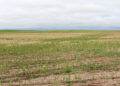
Clark. It’s pretty bad, I’ll admit. The corn came up and got out of the gate in a hurry. We had that clean environment for it to come up. It sent its roots straight down and had good early vigor. We waited till around May 15 to start planting. The ground was warmed up very nicely. All of those things made the corn take off, and it was up to V7 or V8 before the weeds started coming, but we hadn’t quite closed the canopy, so there was just enough sunlight for the weeds. But because the corn crop had a long head start before the weed pressure came, I think we’re going to be okay. Are we going to lose some yield? Oh yeah, we’re going to lose some yield — but we haven’t sprayed any chemistry, and, again, we’ve done very minimal tillage. Everything’s looking pretty good.
Acres U.S.A. Did you think about doing a shallow in-row tillage pass?

Clark. Yeah. There are a couple fields we did row-cultivate. I’m trying to look at the whole picture. We’ve done a little more tillage out there than I want in a couple of fields, but we’re trying to zero in on a system that I think is going to work across many acres.
Acres U.S.A. And did you think about running a ripper through it?
Clark. We might do that. I don’t know. We might do something different this fall. I think the one thing we all have to understand is that no matter how good of a job you think you’re doing, there’s compaction in your fields. We cannot be naive to that. We can’t say, “I’m a no-tiller, and I’m using cover crops, and cover crops are always going to mitigate compaction.” We have to realize there’s probably compaction somewhere within the profile that’s going to hinder the growth of either our cover crop or our cash crop.
Acres U.S.A. Have you been able to run controlled traffic?
Clark. No, we haven’t started that yet. You look at Jason Mauck’s system on the other side of Indiana from me. I really like that idea. I just don’t know how I’m going to control the weeds from when the wheat is planted to when we plant the beans, because that area is a naked strip of soil, and he can use chemistry, and we can’t.
But the other thing is that we’ve got to get over this bickering between the regenerative farmers over whose system’s better. People say my system won’t work — “You can’t do that here.” Well, I never said we were going to be able to do this everywhere. I’ve always told people, be cautious of what I’m doing. I’m not telling you to do it my way. I’m telling you to take one or two ideas from me, plus one or two ideas from lots of other people, and take all these little pieces and take them home and then develop a system. Maybe you don’t want to leave chemistry — fine. Then implement a program that will start to reduce the chemistry you use. You’re in full tillage. Reduce the tillage in some aspect. I don’t want to become a full tiller here — that’s not what I want to do. I don’t want to go back to that, but if we’re seeing huge results because of a little light tillage, then we have to start thinking about how to use it to our advantage.
Acres U.S.A. We just ran an editorial about the difference between first principles thinking and analogical thinking, which is basically following what other people do. Precedent and rules can be good, but pressing the easy button — “This is what Rick does, so I’m going to do that” — doesn’t factor in context. The real key is to understand the first principles of ecology and the biology and what is actually happening when you do a tillage event, as much as you can, and then to decide whether or not to do it.
Clark. Yes. And back to my example of benefits vs. costs — I know it’s simplistic, but if that tillage event is a four, and the end result of exudate being pumped into the soil and feeding that liquid carbon to the plants is an eight, haven’t we gained four?
And, like you said, context is vital, and we have to be careful —- people that are on 30 percent slope shouldn’t think they can go all in on tillage. Can you do this in New Mexico? I don’t know. Maybe not. It’s pretty fragile down there. Can you do it in the driftless areas of Wisconsin? Probably not. So, we still have to understand the mechanics of being a good steward of the land, being conservation minded, and simply looking at this as another tool in the toolbox. We need to know how to properly use that tool.
Acres U.S.A. Right. It’s a disturbance, but chemicals are a disturbance too.
Clark. Here’s another way to look at this: what happens with humans when a tornado goes through a local community? What does everybody do? They join together and rebuild everything, right? Why would we not assume that the microbial family does the same thing? You come through with a tillage event two inches deep, and you slice everything up, but immediately the microbes all come together and rebuild their system.
That’s where my head is now. Until the end of my career here, we’ve got to find these systems. And I think we need an ambassador in each of the nine USDA Farm Resource Regions. That ambassador would help implement the principles of soil health that work within that context. You are not going to farm the same in New Mexico as you are in Iowa. We know that. We have to have different rules for different locations, and I think that’s where all this starts.
Acres U.S.A. Is that something you’ve proposed to USDA? Would it be through NRCS or a separate organization?
Clark. I have, but I don’t know yet. I think that MAHA has the better foothold right now as far as changing what the landscape of ag could look like in the future. I say that because MAHA has the ability to change the food industry — take the dyes out, take all those long words out that none of us can pronounce. That then correlates directly to the consumer — a healthier consumer. The consumer is going to go through a generational change, and they’re going to demand a better food source for themselves and their families. Then USDA will step in and start figuring out how to implement programs to help the farmer — to guide them down the road, to farm in a more regenerative manner, creating a healthier food product.
At that point, everybody is making America healthy again, and you haven’t forced any of this down anybody’s throat. That’s how I think this needs to happen. I think trying to find ways to make our food healthier and safer should be a cause for everyone. It’s just not a political thing. This is for everyone.
Acres U.S.A. For sure. The other day Joel Salatin wrote about how his goal for a long time was that people would all cook their own food, starting with raw ingredients. But he’s finally realized that is not going to happen. He’s accepted the fact that people are going to eat fast food and processed foods, so the goal should instead be to make processed food better. Like you said — remove the dyes and the artificial ingredients and make it as healthy as possible. People are still going to eat processed food, but at least it’ll be not as bad for them.
Clark. Yes, that’s where I’m coming from. I’ve had this purist stance, and I hope I’ve not misled anyone. I’ve tried to publicly say that what I’ve been doing is extremely hard. Please don’t try what I’m doing! If you want to come along, that’s great, but we can meet somewhere in the middle. We can start to take away some inputs.
What Joel’s saying is reassuring to me, because he sees it as well. The next phase of this regenerative movement has to be how to get more healthy food to the masses. How do we move large acres of farmers toward better practices? It’s not going to be with the system I’ve been trying to work on for 10 years. It’s going to be a combination of several systems, like the ones we’ve been discussing.
Acres U.S.A. What’s your take on these technologies that people are trying to develop — either autonomous robots or something pulled by a tractor that identifies weeds and either tills or zaps or sprays them, but leaves the cash crops alone? It sounds great, but maybe this is the ag version of the flying cars we were supposed to have by now — and like Peter Thiel said, the tech we got instead of flying cars was 140-character tweets.
Clark. That’s a good question. I don’t know. I wish we could have chemistry that is safe to the human, safe to the plant, safe to the world. It would be great to be able to go out with a sprayer that bands like seven or eight inches wide and just subdue the weeds for four weeks. If I could just have a four-week delay, that would be huge.
We have to understand that there are certain limitations to everything, and as much as we want to think there’s pie in the sky, there’s really not. It all boils down to profitability. You’ve got to be able to farm again next year. So, what kind of system are we going to build? How far out on the end of the diving board are we going to go before we step off the gang plank? That’s what becomes hard.
I have mixed feelings on this. I think there are some people who are ready to make a change because times are really tough right now. The markets are low, and they know they need to make a change. There’s that group, but then there’s the other group of people who are saying, “I cannot afford to lose a bushel of any crop I raise, so how am I going to step out and try cover crops or no-till?”
Acres U.S.A. Yeah, that’s tough.
About a year and a half ago we ran a short interview in the magazine [January 2024] about how you’ve been developing your own landrace varieties; has that continued to be successful?
Clark. Yes. Some of the best beans we have this year are the ones we’ve been keeping back. Their genetics, when we started, were 23- or 24-year-old off-patent hybrids. Everything was done legally. That’s the majority of our soybean lineup that we plant.
We’re also starting to step out and work with a plant breeder for corn to develop our own open-pollinated variety. We’ll obviously be down on yield from all of the latest and greatest, which is fine. I’m trying to create a product that we can use legally on our farm year after year that fits into our program. That’s where all this is heading.
We’re trying to maximize epigenetics as fully as we possibly can. We do it with our sheep herd, and we do it with our cattle herd. We haven’t brought any outside genetics into any of our livestock in seven or eight years now. I think this is the future —- soybean or corn genetics that are adapted to your system. Whatever your system is, your plants and livestock are adapting to it. That’s what I like about it.
Just one observation on this is that I was driving down the road looking at our neighbor’s beans, and the leaves are about the length of one of my fingers, and they come to a point. And then I went home and looked at one of our beans, and our leaves are about the size of my whole hand. I don’t know why they’ve bred for these little itty bitty triangular leaves, but I have to think my leaves have a much bigger solar array than that.
Acres U.S.A. Any last thoughts you’d like to share?
Clark. I would just reiterate a couple things. First, we can’t forget that the soil is a living, breathing organism.
Second, it seems like a simple principle that we all know, but we really do need to keep a living root in the soil at all times. Even if we do a small tillage event to reset the soil-microbial balance, we need to have the planter out there immediately to get something growing. We can never be satisfied with bare soil.
I’m not giving up on no-till. I want my farm to be no-till — most of the time. I just think that occasionally it is justifiable, and even helpful — as long as the soil health principles are observed, especially getting a plant back in the ground as soon as possible.