


As vineyard margins tighten, growers should rethink under-vine management, shifting from bare soil to biologically active systems
Across much of the vineyard industry in the United States, margins are tightening. Input costs remain elevated, grape prices are under pressure, and wine demand has softened since peaking around 2018. In some regions in California, grapes are being left unharvested, discounted, or diverted to low-value outlets like ethanol production. Growers are responding by reducing inputs and transitioning land to other uses, reflecting a broader reassessment of the long-term viability of viticulture in the U.S.
In this environment, the economic question has shifted from maximizing yield to maintaining a viable system under uncertainty. Reducing input costs without sacrificing long-term productivity has become central.
Most cost-cutting efforts focus on fertilizers, sprays, or labor. Yet one of the most consistently managed, and least reconsidered, areas sits directly beneath the vine. The under-vine strip is typically treated as a weed problem, but it is also the primary root zone of the vine. Rethinking how that space is managed presents a practical opportunity to reduce costs while improving system function and soil tilth.
Ground Control
In most vineyards, under-vine management is built around control. A clean strip is maintained through herbicides or cultivation, minimizing competition and simplifying irrigation and fertility management. The system is effective, predictable, and widely adopted.
However, its efficiency depends on regional conditions. In California, winter rainfall drives early weed growth, but hot, dry summers naturally suppress it, making a clean strip relatively easy to maintain. In contrast, regions with summer rainfall face continuous weed pressure, requiring more frequent and costly intervention. Despite these differences, the outcome is similar: bare soil beneath the vine. This creates a distinct environment: low organic matter input, greater temperature fluctuation, rapid moisture loss, and limited biological activity.
This system has supported consistent production, but it is optimized for control rather than soil function. Under tighter economic conditions, it is worth reconsidering whether this remains the most efficient way to manage the vine’s most active root zone.
Transitioning away from bare soil in viticulture does not require a full redesign. In most cases, it is best approached incrementally, one row or block at a time, with the goal of introducing biological function into the root zone.
Cover crops are often the first consideration. While they offer clear theoretical benefits, they are difficult to maintain under the vine in Mediterranean climates. Winter rainfall supports early growth, but by summer, vegetation senesces. Sustaining cover crops would require expanding irrigation across the vineyard floor, an approach that increases water use, weed pressure, and system complexity. For most operations, this is not practical. As a result, many vineyards default to bare soil, not because it is optimal, but because it is manageable. This creates an opening for more practical alternatives, particularly mulch-based systems.
Mulch-Based Systems
Organic mulch offers a straightforward way to modify the under-vine environment without the demands of a living cover crop. Mulch persists without irrigation, reduces competition with weeds, keeps soil cooler, retains moisture better, and supports biological activity at the soil surface, which is where plants actually take up nutrients.
Common mulch materials include straw, wood chips, compost blends, hemp stalks, almond shells, and other agricultural byproducts. Each varies in decomposition rate and function, but all contribute organic carbon to the system.
Mulch influences several key aspects of the root zone. It reduces evaporation, improving moisture retention, something that alone can justify its use in many climates. It buffers soil temperature during times of peak heat. It gradually builds organic matter. And it supports increased microbial activity.
There are of course trade-offs, though. High-carbon materials can temporarily immobilize nitrogen at the surface. Rodent pressure may increase in some vineyards. Material sourcing, transport, and application also introduce cost and labor. The physical weed suppression of the mulch may lower herbicide and labor costs, but as with any practice, its value depends on how well it fits within the broader system.
Mulch aligns well with California conditions because it works within existing water limitations rather than against them. Instead of trying to maintain living vegetation through a dry summer, it provides similar functional benefits, moisture retention, temperature buffering, and carbon input, without requiring additional irrigation.
Compost and Vermicompost
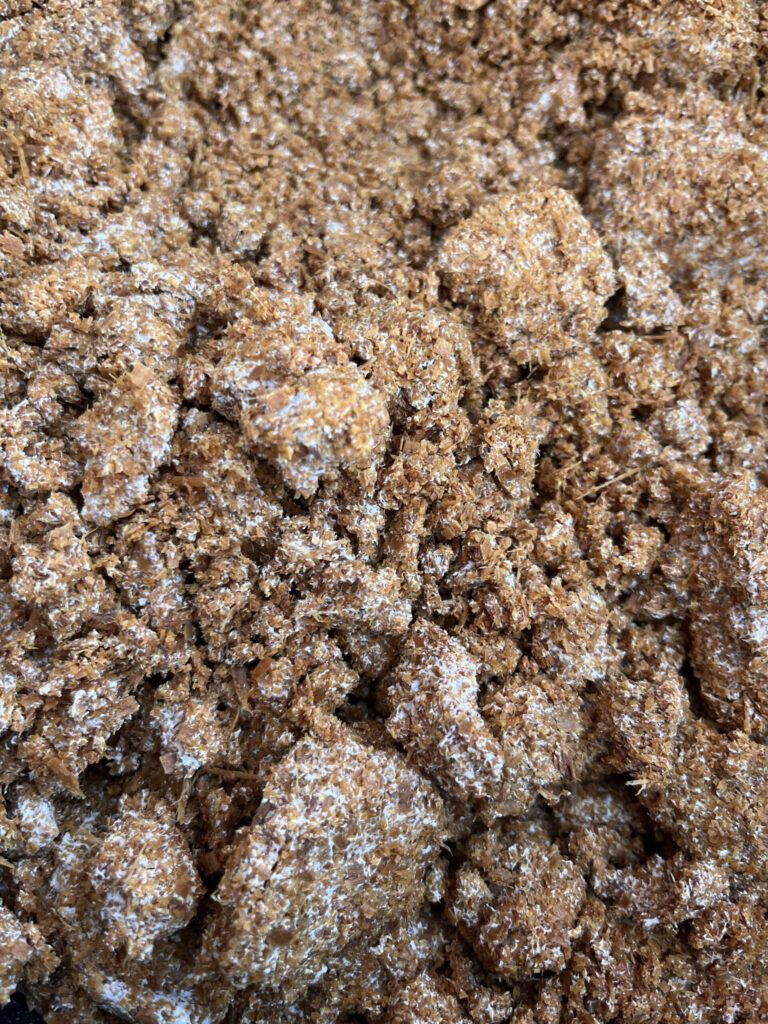
Adding mulch creates additional opportunities beyond organic matter alone, including the ability to inoculate and support bacteria and fungi beneath a protected surface layer. Compost and vermicompost serve both as organic matter inputs and as a means of introducing microbial communities into the root zone. This biological role is often overlooked in systems focused primarily on nutrient content.
Applications are typically straightforward, surface-applied under the vine, sometimes lightly incorporated, and timed before budbreak or early in the season. Their effectiveness depends heavily on context. In low-organic-matter soils or systems transitioning away from synthetic inputs, they can improve structure and nutrient cycling. They are also useful for addressing variability within blocks.
In already-fertile soils, returns may be limited relative to cost. Because of material, transport, and labor demands, broad applications are often difficult to justify. A more effective approach is targeted use, applying modest amounts where constraints exist rather than treating the entire vineyard uniformly.
Consistent application of high-carbon mulch or organic materials can shift soils toward fungal-dominated systems, particularly with perennial crops. These rely less on external inputs and more on a continuous carbon supply to drive decomposition and nutrient cycling. Establishment depends on three factors: consistent organic substrate, adequate moisture, and minimal disturbance. Without these, particularly in dry or non-irrigated systems, fungal development is limited.
Where conditions allow, these systems improve soil structure, enhance aggregation, and promote more gradual nutrient release. The effects are cumulative rather than immediate, contributing to a more stable and buffered soil environment over time.
Partial Adoption: A Low-Risk Entry Point
For most vineyard operations, the practical path forward is not full conversion, but partial adoption. Implementing changes at a small scale allows growers to observe results under real conditions while minimizing financial and operational risk.
This can take several forms, including treating every other row, applying mulch or compost to a single block, or establishing test strips within a vineyard. Each approach creates a built-in comparison, allowing differences in vine performance and soil response to be evaluated within the same site.
Because soil, climate, and management remain constant, this within-vineyard comparison provides clearer insight than external recommendations. It also allows practices to be refined before scaling. Over time, this approach generates the site-specific evidence needed to determine whether expansion is justified.
The Economic Trade-Off
No management shift exists outside of cost. In a tight-margin industry, decisions are less about ideology and more about practical trade-offs.
Bare soil systems remain economically straightforward. Herbicide or cultivation passes are relatively inexpensive, labor is predictable, and the system is efficient and familiar, especially at scale. By contrast, mulch and compost systems introduce new costs that may not be offset by a single growing season. Materials, application labor, and potential equipment adjustments can be significant, often representing the primary barrier to adoption.
Over time, some of these costs can be offset. Reduced or eliminated herbicide use can lower input costs, while improved soil structure and organic matter can enhance moisture retention and reduce irrigation demand. Increased biological activity may also improve nutrient cycling compared to bare ground, allowing for gradual reductions in fertilizer inputs. These benefits develop slowly but can contribute to greater overall system stability.
One of the most important considerations is timing. In the first season, visible changes and yield are usually limited, which can create uncertainty when new costs or labor are already in place. Yield typically remains stable, with any shifts falling within normal seasonal variability. Vine response often lags behind soil changes, as perennial systems rely on existing reserves and established physiological patterns.
Belowground, however, changes begin immediately. Compost and mulch influence microbial activity, moisture dynamics, and early stages of organic matter breakdown. These processes are gradual and not immediately visible, but they lay the foundation for longer-term improvements. Biological systems operate on a longer timeline than synthetic inputs. Benefits tend to accumulate over multiple seasons.
The under-vine strip has traditionally been managed for control, kept bare to reduce competition and simplify operations. While effective, this approach overlooks its role as the primary root zone.
In tighter economic conditions, it may be more useful to treat this space as a system to improve. Managing it as a biologically active zone can enhance moisture retention, nutrient cycling, and overall stability. This shift does not eliminate inputs, and it does not require a complete redesign of the vineyard. It is a practical adjustment, one that moves part of the system from external dependence toward internal function. For growers facing rising costs and increasing uncertainty, that management shift may matter less for what it adds, and more for what it reduces.