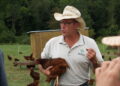


Jay Fuhrer, one of the first to articulate the principles of soil health, discusses how to prioritize soil health, various cover crop strategies, and the ever-present tillage vs. herbicide debate
Acres U.S.A. You’re retired from NRCS, correct? What kind of work are you continuing to do these days?
Jay Fuhrer. Yes, I spent 40 years with NRCS, and it was a good run. Working with a large entity like the federal government can be a challenge, but if you have something they want, you could deal with them.
Now I work part time at Menoken Farm here in North Dakota. I do their soil and plant tissue testing, I host groups, I write grant reports that nobody else wants to write — those types of things. And I do a little work out of my home and a little part-time work now and then for entities like the North Dakota Grazing Coalition and others.
Acres U.S.A. You obviously made it through the government system and were able to make some good changes. Would you say you’re having more of an impact now than when you were at NRCS?
Fuhrer. It’s a different impact. When you’re internal, you’re in the system. Now and then you get to be at the table, and if you’re careful on your timing, you get to state something that is impactful. Now and then. It is not an everyday thing, but occasionally I’ve had the opportunity to be the right place at the right time.
Acres U.S.A. Can you give an example of that?
Fuhrer. One of them was when I made a switch in terms of my emphasis within the agency as a conservationist, and I announced it to my peers at a meeting.
We had high erosion rates and carbon-deficient soils and salinity, and our water erosion was horrendous at the time as well. Our issue was that we couldn’t get water in the profile. I had spent a number of summers on engineering projects, and it was a good way for me to start because I liked math and I liked engineering. I started on the Missouri River bottom, which was all flood irrigation at the time in the ’80s, and it gave me a good understanding of infiltration, or lack thereof. I started to understand some of these concepts, and then I started building waterways. You spend a lot of your summer engineering and drafting and designing and installing and checking out these things. But you only impact that little area where the grass ends up getting seeded eventually; you’re not impacting the drainage area.
So, there was a meeting in Jamestown, North Dakota, and I got up in front of my peers, and I said, “I’m going to start applying the soil health principles, and I’m going to use them as the emphasis in the conservation planning process. I’m not going to spend my time engineering and designing something that is only treating a symptom. These principles, I feel, can treat the problem.” I said, “It’s what I’m going to do.”
It got real quiet. Nobody said a word. Nobody asked a question. Nobody said anything negative or positive. I had lunch alone that day. But I’ve never looked back, because I could see it on the land. I could see it when I put a spade in the ground.
I always had a close association with the soil scientists — initially the engineers, but then eventually the soil scientist division of USDA. I started concentrating on the dynamic soil properties, things you can impact with management that occur in your lifetime.
That was one of the times when I was able to only get a few minutes, but it was enough.
Acres U.S.A. Do you think the people in that meeting understood the carbon cycle — how soil with higher levels of carbon can hold more water and help with erosion?
Fuhrer. They did and they didn’t. I think they understood what we knew in the ’80s, which was a lot different than now.
This brings up another impactful moment. I had a meeting with some NRCS management, and I said, “We have to start teaching the carbon cycle.” “We learned that in school,” they said. “Well,” I said, “this is different. This is how to apply it, how to monitor it, how to see these impacts. We need to teach our employees to look at this as more important than contracting and processing the sign-up. Because if we don’t have that part right, what’s the point of the contract or the sign-up?”
Initially, that didn’t go over well. There wasn’t really a rejection of the soil health principles, but it took a little while until they posted my write-up on the principles.
Another significant event like this was the conversations I had with the Web Soil Survey people. At first it was a total rejection. But if you go into Web Soil Survey today, you’ll see some emphasis on soil health. So that was a process. Web Soil Survey is the largest natural resource database in the world, so we need soil health metrics in there. It’s very important that it be in there for two reasons. One, because of the data, but also because of the psychological importance.
Acres U.S.A. What are those things that are in the Web Soil Survey related to soil health today?
Fuhrer. You’re going to find more of the dynamic soil properties, and descriptions of those. Initially they weren’t in there. And initially the soil health principles weren’t posted on a website. To me, there were always five principles. When USDA got a hold of it, they shrunk it to four.
Acres U.S.A. Which did they take out?
Fuhrer. Livestock. Somebody wasn’t comfortable with it politically, I think. I told them, “Livestock doesn’t always start out as the most important, but ultimately it ends up being the most important.” I can illustrate that on the Menoken Farm with our grazing and our rotational perennials. You start looking at the features that built your soils, and then you start to understand. Then you also start to understand that most of our systems today are not capable of building a soil. They’re capable of growing an energy-type crop — beans, corn, etc. — but they really aren’t capable of growing a crop and building the soil.
You start looking into why, and you start unraveling this whole thing. You start looking at how old the microbial community is — which is way older than the plant community, which is also very old — and you start looking at plants, and you start looking at diversity, and you start looking at the ruminant and the impact it’s had on the landscape. You start to piece these together.

I just started the process of rewriting the principles again. I’ve done this a few times. I can’t believe some of my early efforts; I look at them and think, “That was pretty sad.” It’s a journey. As you connect dots, you see other dots that you couldn’t see before. They weren’t in focus.
Acres U.S.A. I’d love to hear how things are changing in this recent rewrite, but also how the soil health principles that you first started to define have transformed in the last 10 years. Now people are calling them the principles of regenerative agriculture, as opposed to just the principles of soil health.
Fuhrer. That’s a natural progression. You’ll see a lot of conversation about context, and that’s fine too. But why do you need the context? Do you need the context because you never sat down and described it? To me, that’s how the principles were intended to be used. You describe it for your farm, your landscape, your region, etc. That is the context. That puts them exactly into context.
I did a talk here on the farm last summer for a group of soil scientists. They requested a talk on the changes in terminology we used internally and externally, from the 1980s to today. Like “conservation tillage.” That was a big term in the ’80s, even into the ’90s. I always disliked the term because it was 90 percent about tillage and 10 percent about conservation.
Then we got into terms like “no-till.” I never really liked that term because it was just about an opener — it was just about a seeding operation. It wasn’t about what was happening in the context of the entire ecosystem or what was occurring with carbon.
We eventually got to the point where we started looking at principles, but that took a while.
Acres U.S.A. Can you talk about the beginning of Menoken Farm? It’s part of the local soil conservation district, but you worked for NRCS, correct? Could you also just explain the difference between a soil conservation district and NRCS, and Menoken Farm’s relationship to each?
Fuhrer. Let’s just start with the term “Menoken.” In the indigenous language, it means “you reap what you sow.” There’s an archeological dig very close to Menoken, and there’s a little community with that name. The name, to me, is very important. It signifies and represents what we try to do here.
NRCS and SCDs — that’s an interesting thing. Originally in this country, we started out with demonstration farms. There was a demonstration farm or two or three in North Dakota and in many states. These demonstration farms ran for a few years and were determined to be ineffective, and they were disbanded.
Then Roosevelt put in legislation for soil districts, and it was intended to be grassroots — your environment, your area. It was intended to be foundational. The interesting thing about Menoken Farm is that it is a conservation demonstration farm, but it’s owned by the soil district. What’s so unique about it is that it combines the two concepts. You have the soil district local leadership, but also you have a place where you can look at a failure or success. We don’t do research. It’s conservation demonstration.
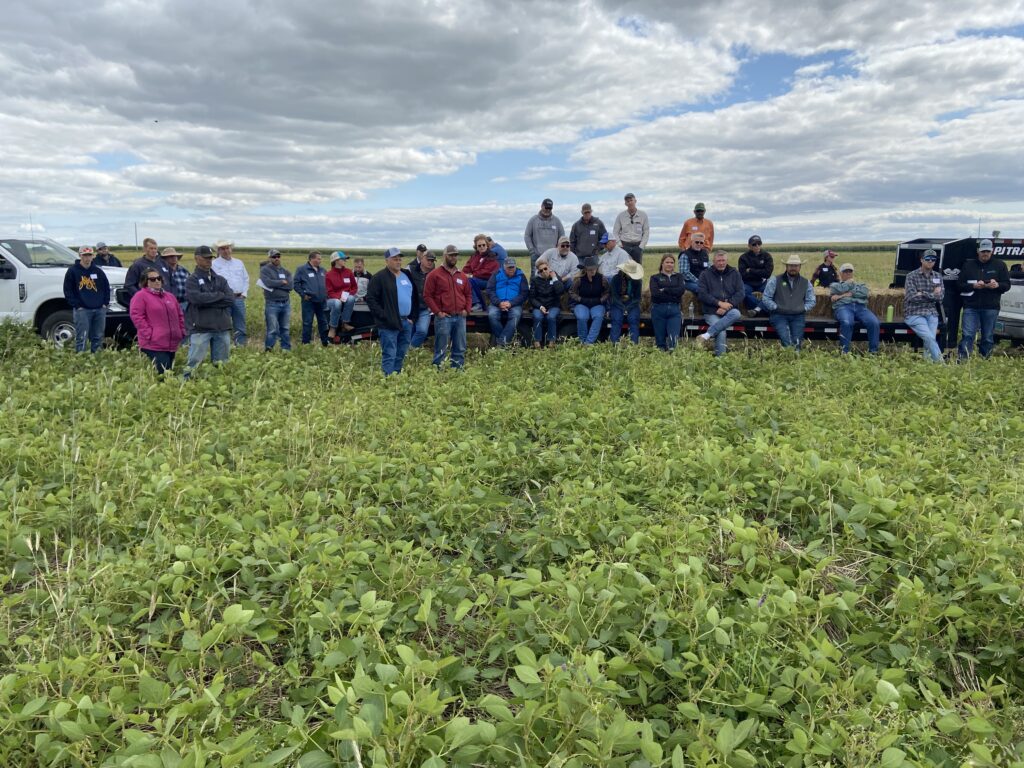
It’s a place where you can go to look at cover crop combinations. You can look at a grazing system management principle. You can take a look at interseeded companion cropping. You can take a look at fields with and without herbicide. You can look at Brix, or you can put the spade in the ground and look at the aggregates. You can do the infiltration testing. This is about soil function, and this is about plant physiology. This is about using the principles that are available to us all.
Menoken Farm started in 2009. Prior to that, we had a miniature version that was maybe five acres. It was on CRP land a few miles from here, and we started there with grass/legume mixtures that we were integrating for livestock use. We started with cover crops in 2006. In 2009, the farm went into full effect. It’s 150 acres, outside of Bismarck. It was really important to the board that they not bid against anyone in the farm community. But this land had been owned by a few speculators over the years and had been for sale for a long time.
I was fortunate to be the district conservationist at that time in Bismarck. The difference between conservation districts and NRCS is that NRCS emphasizes technical assistance and financial assistance, and they can assist a soil district. I think where NRCS has been struggling more recently is that there’s such strong emphasis on the financial assistance, and that comes at a cost. It comes at the cost of the technical assistance.
Through most of my career, I was able to keep a bit of a balance between the two, but that balance within the agency is very difficult; that extreme emphasis on the financial end just consumes people. That then weakens their technical experience. I think soil districts have become way more important now because of their abilities in terms of strengthening the technical background of their employees.
I’ve had a lot of conversations with NRCS employees from different states, and a number of them come to visit Menoken Farm. I always tell them with a bit of a smile that I can see into their soul, and I’m only half joking. Anytime you have a large organization, it’s not easy or quick to change things.
Acres U.S.A. Can we dig into some of your cover crop studies on the farm? I’ve heard of a study you did with different cover crops grown separately and then grown together. Can you talk about that study, or other related studies, that demonstrate the importance of species diversity?
Fuhrer. Sure. That study was done in 2006. That winter I had listened to Ademir Calegari, the agronomist from Brazil, talking at the No-Till on the Plains conference in Salina, Kansas, and he was talking about cover crops. Gabe Brown and I were sitting across the aisle from each other, and when Ademir got done, we didn’t say anything — we just looked at each other, and we both knew what we were going to do. The next spring, we put out six or seven species, and we did them all as monocultures. Then we started putting them together — two together, three together, four together, five together, until we had them all together.
In 2006 there was an extreme drought in this area. At first I thought, “Man, that just sets us back another year” — but I was so wrong. You hate to wish for a drought, but in a way, there was probably nothing better that could have happened that year to us in that plot. By July, the monocultures had just dried up to nothing. They were just stems. The stems were a little bit green, but there weren’t green leaves left on anything. My wife and I were taking a drive and we stopped at the plot. I walked through, and we left, but as we were leaving I noticed something that didn’t look right. So we circled around in the road and went back, and I walked through it again.
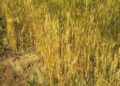
I observed the mixture plots, and the leaves were laying flat out, not even curled. It was hot — triple-digit heat — and it was dry. I walked through the monocultures again, and they were just devastated. But the more species, the better it looked. We clipped them all and weighed them. Then we backhoed through them all and found root depths on the mixes down to three and a half, almost four, feet. To this day, I can remember walking through that trench looking at that root mass. It was a root mass from the top to the bottom in that combination. It looked so interconnected and healthy.

Then I really started to understand. We were starting to mimic native grasslands on our native prairies. Our native prairies here can have 100 species. We had six or seven, but it was a start. We started to lean into it — we saw the impact.
A few years later we had ARS soil scientists and NRCS soil scientists out to do the initial soils foundation information at the farm. Then, 11 years later, we had them do it again. One of the interesting things was that in every field there was something different. We realized that there were some management strategies that were more carbon friendly than others. In some of the fields that had had low-carbon crops like canola, pea or soybean, we lost carbon compared to when we started. Then, in other fields where we had more plant diversity and had more covers, and where we had managed grazing and more high-carbon crops, we gained carbon. We really started to understand harvesting the sunlight. Plants eat sunlight. We started to understand plant physiology — how some of them produce different secondary metabolites.
Here’s another example. We were in a D4 drought, and everybody was chopping corn in the entire county because it was just collapsing down to the ground. There wasn’t any grain — it never got to that point. But Menoken Farm had a 60-inch cornfield with 12 species interseeded into it at around V5. That cornfield refused to go down. In fact, that cornfield wasn’t even sure it was in a drought. It was the last field standing.
The interesting thing was when you chop a countryside, and you have one field standing, everything that can fly, crawl or slither was there. It was just so fascinating to walk through it. We ended up grazing it late that year, but I calculated the yield just based on normal yield trials, and it would have made approximately 40 bushels of grain. It doesn’t sound like much, but there was no other grain in the county. All those fields collapsed. When you put the moisture probe in the ground, you could put it in. It was an amazing field. But again — it was diversity.
Acres U.S.A. When you’re looking to build a cover crop mix, do you go with the standard categories — warm season and cool season, and then grasses, legumes, forbs, broadleaves, etc.? Or do you go by families — different species — in order to make sure that you’ve got diversity in that direction?
Fuhrer. Probably all of the above, to some degree. But certainly one of the factors is “What do I need?” I like to fulfill whatever diversity I’m lacking. This is an opportunity to fill in what you don’t have.
For instance, if I’m lacking in soil aggregates, I lean into the fibrous roots. I’m not going to go 100 percent for those species, but I’m probably going to give them a little bit of favor on the percentage. You always need the supporting cast, but sometimes you need something done. Fibrous covers are such a big item in our standard production systems.

Let’s pick on beans for just a moment — they don’t really build aggregates. Back in the day, when more farmers had a corn-bean-wheat rotation, we could rely on the wheat to build the aggregate. You don’t have that so much anymore, and so when we get the opportunity to lean into a cover crop combination, what can we put in there to build aggregate?
I don’t like eliminating any cover crop species completely, but you might go with a smaller amount of something. They play so many roles that we aren’t even aware of. I like to have some of it in there. It doesn’t have to be a lot. It just needs some.
I think the question becomes, “What built your soils? How did your soils in your region get built?” The other evening I was watching a YouTube video. It was a professor in Iowa who was talking about the soils of Iowa. What I appreciated was that he went into the geology — the glacial impacts there, and how it wasn’t just glacial impacts — it was what the glaciers had gone over previously and picked up and brought to them — and how that had such a big impact. All these things come into play in terms of how your soils were built. Did perennial forests build them? Did perennial grasslands build them?
Acres U.S.A. You mentioned that legumes don’t build aggregates as much as fibrous roots. Do you think it has something to do with nitrogen that the bacteria on the legume roots are producing in the top couple inches? Does that nitrogen tie up carbon and lead to compaction to some degree, or lessen the aggregation?
Fuhrer. If you look at the C:N ratio of a soybean, it might be 30:1. That’s not a lot of units of carbon for a unit of nitrogen, compared to wheat being 80:1. There’s a lot of carbon — there’s a lot of food, if you will — in that wheat plant. And corn is in between those two. You start looking at what was on these prairies or these forest lands. How did they cycle carbon?
I think the thing that’s so interesting is the rhizophagy concept that a lot of us have been reading about recently. We’ve always known that nobody fertilized the forest and nobody fertilized the prairie. But we did not totally understand that. I think when you start looking at the rhizophagy concept, you can start to understand there’s a C:N ratio of the bacteria, for instance. As it comes into the root and goes into the plant and the nutrients get stripped off, and the bacteria goes back out the tip of the root — that’s hard for us to grasp. Because we want to side-dress — we want to do these things in lieu of just helping establish a community of microbes that’s available for plants to use themselves. That’s just another way of emphasizing the importance of cover crops — cover crops with livestock integration.
Our job is to make this community of microbes available to the plant. Then the plant can pick and choose and do a better job of this than we can. Of course, it has to have the aggregates and the pore spaces — because we have aerobic systems, and they have to have air.
I think that when you look at the legume concept, most of the time with a legume like a soybean, we give some N credit to that, but most of that nitrogen was removed in the grain. Really, the N credit is probably more based on the low C:N ratio of the material. It doesn’t take much nitrogen to decompose it in the soil because it has a very low C:N ratio. That’s probably what drives that more than actual nitrogen put in there by that plant, because that nitrogen is going to make grain, and it’s going to put some protein in that grain. That’s a different scenario — when we start to really get into the nuts and bolts of how things function.
The root system on a legume is interesting. It’s not that there are no aggregates on it; there’s just not a lot. A fibrous root system is going to deliver more — you get a lot of root hairs, and that’s where the soil-food-web comes into play. In the first four to eight weeks of a green plant’s life, it’s going to give off sugar exudates into the soil. Then, after that period of time, it’s going to go in reverse and take that energy to make grain so it can reproduce. It wants to make seed and extend the life of the next generation. There’s a lot to that that is so fascinating.
Acres U.S.A. So, in an optimal soil-building situation, do you terminate all the cover crops as they’re going to flower, before they’re starting to make seed, if you can do so economically?
Fuhrer. You can. I think that’s usually called livestock! We bring in the livestock, and we reset the plant. Now you’re going to pump carbon longer, because you reset the plant.
In our high tunnel, I play the role of the ruminant. I usually have scissors in my back pocket. There are 15 beds in our high tunnel. Three of them are in a season-long cover crop, and so I clip them. I’ll let them grow to a certain point, and then I’ll top them. Plants like millets and sudans — these warm-season grasses — we’ve known for some time how even mowing impacts the root system. I just give them a little bit of a haircut.
If I don’t, they’re going to grow to the ceiling. It’s hot and wet in there, so they like that. Then they’re going to have a lot of carbon in the material, and I’m going to lay it on the soil surface. I’m going to need a lot of nitrogen to decompose that. That’s fine, depending on what your goals are. But if I clip it, I keep it in a lower vegetative state, and I keep the emphasis more into the root system, and I have it expel the exudates — the sugars. If you can get regrowth, that’s the key.
Acres U.S.A. If you’re hoping to build aggregate in depth, you want diversity, but would you prefer something like a rye with a huge root structure, or something with a huge taproot? Should we be pulling Canada thistle and dock and these plants that have huge, long taproots? They’re pumping exudates way down deep.
Fuhrer. You start looking at plant succession. Plant succession wouldn’t start that way. But in terms of aggregates and in terms of building deeper into a soil profile, you need macro pores too. A macro pore is the taproot. I like to have the macro pore and the fibrous together. To me, that’s better than either alone. These plants didn’t evolve as monocultures.
In our high tunnel, and in a number of our cropping systems, we emphasize the companions as well. I always tell folks it’s kind of like the cool kids’ table in school. I was never at that table myself, but I think it’s a good illustration of a group that works together. That group got along just fine. So, you look at plants, and you look at things like how carrots love tomatoes. There’s a book with that title that really explains companions and who likes who in the garden world, which is so much larger than the cropping world. You have all the herbs and all the flowers and all the vegetables.
That’s a fascinating scenario — how they impact each other’s taste and help each other in terms of insect resistance. There’s rarely ever one definitive thing in our food systems. It’s always a combination. It’s always a connection.
Acres U.S.A. How would you rank practices that are the most harmful — tillage, herbicides, pesticides, fungicides, etc.?
Fuhrer. It’s a bit relative to where you are. For us, when we farmed through the ’80s and ’90s, this country just about blew away. There’s a reason why all the windbreaks were here at one time. It’s how we got through the ’50s and the ’60s. Now a lot of those windbreaks have been taken out.
For me, the easy part was taking out a fungicide. I can’t build soils if I don’t have the fungal component. The fungicide went away day one at the Menoken Farm; it never was used. Insecticides went along with it, because the insect world is predator-prey. For every evil insect, there’s however many hundred that are good. It’s always a predator-prey relationship. It’s always a balance. We need to work toward the balance.
The first half of my career, I tried to kill things dead. I was pretty good at it, but it didn’t have those long-term impacts you’re looking for. You’re trying to get into this balance ultimately. I had to start making that change, and that’s when I started moving into describing the principles of soil health. So, fungicides and insecticides were pretty easy to eliminate.
Then we get into the herbicide-tillage debate. For us, if I open up the field, I’m going to have some major impacts. I’m going to transfer phosphorus on a clay colloid. We’ve done it. When you get enough of them in the air, you call it wind erosion, but it’s a huge phosphorus transfer. How do I not do that and still grow an annual crop? In a perennial world, yes — it’s a much easier transition. In the annual cropping world, it’s much more challenging.
So, we’ve reduced herbicide, but we haven’t had full years without it. Now, this year, 2024, we have at the Menoken Farm. We identified three fields, and we took the herbicide out for the entire year. Our field days this summer should be pretty interesting on these fields. It isn’t going to be three successes. But we’ll learn something from them. I think we are going to have some success as well.
Acres U.S.A. What are the methodologies in those three fields?
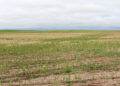
Fuhrer. We have one that’s a winter wheat field. I would call that the easier startup, when you’re taking out the herbicide. We broadcast clovers into it in early April, and it had good armor on it. It had been a pea field the year before and had a good yield. I didn’t know this field was going to get designated to be herbicide free until we went into our winter planting meetings. So, then we decided to broadcast clovers in it. I walked that field a couple of days ago [mid-July], and there’s four clovers in it. There’s weed pressure in it, and so we’ll be windrowing it. I don’t like desiccants, so we’ll windrow it, and we’ll combine it, and we will separate out some of the clover seeds, and we’ll see what’s in there.
We have a screen-type cleaner that I think we can clean it up with. When you walk the field, it’s full of toads and ladybugs. It’s enjoyable to walk in, and there’s life in it. I like that. How could you not? Then, of course, the task becomes what to do with it in 2025. But let’s get through one year first. If I had known in advance that this field was going to be herbicide free, I’d probably have planted some different perennial-type clovers with it in the fall before because our season’s kind of short, and it’s cold and wet in the spring, and it’s tough to get going. But when we windrow the canopy off, I think we’re going to have a nice clover cover crop this fall.
We’re definitely going to be harvesting the winter wheat. I think it’s going to be a nice crop, and it’s had a high Brix level. There’s no commercial fertilizer, there’s no herbicide, there’s no pesticide, but there is plant diversity.
Another one is an alfalfa field. Our alfalfa fields are notorious for poor infiltration and compaction because we are constantly taking the material off and exporting it. When you take all the top growth off, and you have no armor, and you don’t have any carbon returning to the soil surface from that material or any of the nutrients that are in it, that’s difficult.
We had a conversation at the same planning meeting and decided we didn’t want to hay it. So, half of it we’re going to seed with buckwheat, and then we will clip it. Will the buckwheat be able to survive in that environment? Don’t know. Haven’t done that. My first choice would’ve been winter wheat.
Then the other half we put to spring wheat and clipped the alfalfa, and so we mowed the alfalfa as the wheat was just coming up an inch or two. Now we’ve got wheat and buckwheat both headed out in there. That has had zero herbicide.
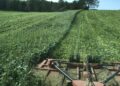
Then our third field is a cereal-rye-soybean field. We’ve tried roller-crimping cereal rye with soybean a number of times over the years. But again, because of our season, it takes a long time for the rye to get to a point where you can crimp it. This year we did it differently. This year we grazed half the field, and we didn’t graze the other half of the field, and then we no-tilled soybean into the standing rye. Then we mowed both of them, and it was just an ocean of rye laying on top of that newly seeded soybean.
Now the soybean has come through, and our temperatures have been real cool. The soybean’s not real happy yet. It’s a bit on the spindly side. Then, because we’ve been cool, and we’ve had good/average precip, the rye now is pushing a new leaf through too.
Now the question becomes, are we going to have soybean or not? We’re going to give it some time. These are 12-acre fields. These are intended to be places that you can fail at something and replan and reapply, and so we’ll see how these play out. But they are unique.
We’re definitely going to be harvesting the winter wheat. I think it’s going to be a nice crop, and it’s had a high Brix level. There’s no commercial fertilizer, there’s no pesticide, but there is plant diversity.
We have some groups coming to look at these fields, and it should be interesting to take a look at them. From a learning viewpoint, people are much more interested in looking at a failed field than they are in looking at one that looks like their neighbor’s.