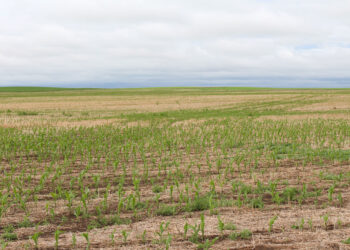

Organic Rising, directed by Anthony Suau
Are we witnessing the beginning of the end of a toxic food and farming system and the dawn of a new one that will produce just as much quantity, but with far higher quality?
Organic Rising is a new farm documentary that presents a robust case for organic production systems and that argues that this new era of farming is nearly upon us.
The film is at its strongest in its presentation of the disastrous effects on the environment and human health from synthetic herbicides and pesticides. Much of it will be familiar to Acres U.S.A. readers, but the general public — and likely most conventional farmers — will be hearing this information for the first time.
After explaining the annual course of synthetic amendments applied to a conventional Midwest corn crop, Dr. Don Huber and other scientists explain how glyphosate is not only a weed killer; it’s also a potent chelator and antibiotic (Huber is one of several Acres U.S.A. speakers/authors featured, alongside Kris Nichols, David Montgomery, Rodale staff, Mark Kastel and others). Huber explains how 20 percent of what is sprayed onto a plant gets sent into the soil as exudate, where it chelates — ties up — nutrients plants need and has adverse antibiotic effects on the soil. Chelated nutrients mean micronutrient deficiencies that lead to crop disease, while the antibiotic effect of glyphosate kills soil biology, further reducing the ability of the plant to obtain nutrients. More than 40 plant diseases thought eradicated have turned up in conventional fields in recent years as soils become more and more nutrient depleted.
Huber also discusses the accumulation of glyphosate in seeds when used as a desiccant and glyphosate’s role as an endocrine disruptor and its effects on gut health. The documentary returns to this topic later when it presents the link between atrazine, another widely used herbicide, and endocrine disruption, low sperm counts and birth defects. The case against synthetic herbicides in the film is clear and devastating.

Organic Rising also delves into organic farming’s place in American agriculture and the policy challenges associated with increasing the amount of organic food produced and eaten in our country. The film discusses the rise of the organic movement in the 1970s, the advent of farmers’ markets and CSAs, and the tension between local organic farmers and larger organic corporations.
This last issue is a particular point of discussion. Are larger organic farms and brands — which are producing healthier food for many more customers than small, local farms — something the organic movement should embrace or keep at arms’ length? The filmmakers do a good job of presenting both sides, while ultimately splitting the difference by celebrating small and local — sometimes praising “peasant agriculture” — while simultaneously concluding that “our best hope is to engage and support the USDA organic process en masse to ensure that it does not become a GMO, intensive, chemical-driven agriculture industry with an organic label.” Citizens are encouraged to engage in the bureaucratic process by participating in public comment and working with industry watchdog groups like OrganicEye, the Organic Consumers’ Association and others. The film doesn’t really engage with the concept of “regenerative” or producers who choose to adopt some of the organic standards or soil health principles but not others.
Production-wise, Organic Rising is a somewhat odd mix of long-form informational content — it runs more than two hours — in the medium of five-second quotes, videos and graphics reminiscent of TikTok or Instagram videos. This form of presentation may attract younger watchers, but it will likely be dizzying to older viewers (of which the farmers who control the millions of acres that need to transition to organic belong). There’s beautiful cinematography, but the film hectically darts back and forth between clips. This is unfortunately because the producers originally planned to make a 10-hour documentary series and later had to shrink it down to two hours — an excruciating process. The audio confusingly uses several different narrators with British and Australian accents (while predominantly discussing American agriculture), and the text contains a few glaring typos. But the filmmakers do use some interesting animation effects to show soil biology, root exudates, and carbon being released and captured from the atmosphere — vital processes that are invisible to us day-to-day — and they refreshingly refrain, for the most part, from engaging in the identity politics that are a mainstay of most recent farming documentaries.
Overall, Organic Rising is at its strongest in making the case against chemical agriculture. Is it the film to show your conventional neighbour, friend or family member to help convince them to change their ways? Possibly, as long as they aren’t distracted by some of the production elements.
| Watch the Film: Organic Rising can be viewed for just $5 online at organicrisingfilm.com — or, watch it with us at a screening at the 2024 Acres U.S.A. Eco-Ag conference! events.acresusa.com. |