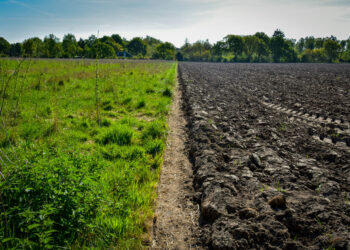


GPS-collared dogs can provide valuable crop protection services

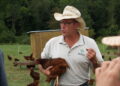
As a full-time farmer in Maryland, I’m no stranger to the challenge of keeping wildlife from damaging crops. Deer, groundhogs and geese can cause major yield loss in soybeans, corn and wheat. Over the years, I’ve tried everything from deterrent sprays to motion lights, but nothing was consistent or scalable across large acreage.
Then last summer, my young border collie chased a deer out of one of my soybean fields. That moment sparked an idea: what if we could pair a dog’s natural instincts with GPS technology to create a new type of crop protection system?
I began researching GPS collars and found a type of electric fence collar that is designed to keep dogs within boundaries using tones, vibrations and optional static correction. I saw potential beyond pet containment and began field-testing them with working dogs. I reached out to the University of Maryland Extension and got connected with Dr. Luke Macaulay, one of the top experts in deer-crop interaction and wildlife management.
Together, we started exploring how this could scale. I added a second dog — a Catahoula, bred for hog hunting and survival in harsh Southern climates — to complement my border collie. The idea was simple: Cinder, my border collie, acts as the scout, with high energy and visibility, while Blue, my Catahoula, is the enforcer, with powerful drive and stealth due to his mottled coat.
| Deer Pressure Slashes Soybean Yields Across U.S. Farms White-tailed deer have been inflicting serious financial losses in recent years on soybean farmers across multiple states. In Michigan, early-season deer defoliation in 2015 led to average yield reductions of approximately 10 percent, equating to a loss of nearly four bushels per acre. South Carolina farmers experienced even more severe impacts in 2022 — local extension research estimated an average loss of 13 to 14 bushels per acre across 405,000 soybean acres. And in Mississippi in 2024, surveys of producers revealed widespread damage across 14,204 acres of soybeans, with yield losses averaging 24 bushels per acre. |
The dogs quickly began making an impact. We noticed a sharp decline in groundhog activity on the farm. They chased geese out of the wheat fields and even pulled deer bones and antlers into the yard — which is a major benefit, since antlers can cost us thousands in tire damage. This alone was a huge value-add.
We also observed that the dogs adapted to deer movement patterns, often patrolling fields at night. With solar-powered motion lights installed, we saw increased roaming and vigilance, suggesting the lights might help dogs maintain visual contact with deer after dark.
After noticing limitations in the consumer-grade collars — especially with high-drive dogs like Blue pushing past boundaries — I’ve been working with a company called SpotOn to develop a more rugged, commercial-grade version. We’re now collaborating on design improvements including rugged housing (potentially Kevlar), recessed or internal buttons, and wider alert zones (beep, vibrate and then static correction). We’re even considering behavioral training and reward signals tied to automated detection systems (camera arrays, motion sensors or even drones) to reinforce patrol behaviors. This version could be valuable not just for farmers but also for hunters, landowners and anyone needing a smart containment solution for working dogs.
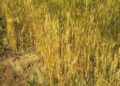
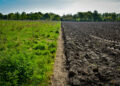
This year gave us something close to proof of concept. We set up control cages in areas with historically heavy deer pressure. These cages excluded deer, showing us what soybeans should look like without browsing. Here’s the remarkable part: in my heaviest-pressure fields, the soybeans outside the cages matched the soybeans inside.
Now, to be clear, we don’t yet have precise yield monitor data, but the visual evidence is striking. In my experience, the dogs have made a huge difference. Last year’s drought worsened browsing damage because beans couldn’t outgrow the deer. This year, with steady rainfall, the beans had the chance to grow — and the dogs kept the pressure low enough that the plants could reach their potential. That combination of rain and deterrence changed the equation. How much is rain and how much is dogs still needs studying, but I am confident the dogs made a significant impact.
It’s not just deer either. Groundhogs that once lived in the woods have been hunted out. Other pests like raccoons and skunks have been pushed back. The fields are holding, and the cages are proof.
What makes this different from how dogs have been used in orchards or vineyards before is several things:
Mobility & flexibility. With GPS collars, these dogs aren’t tethered to buried wire. They can be shifted from farm to farm, or field to field, depending on crop stage and wildlife pressure.
Targeting crop risk windows. Research from Luke McCaulay shows that deer cause the most loss in specific windows of crop development. That means dogs can be deployed at the moments that matter most.
Behavioral & breed study. This isn’t just “dogs chasing deer.” We’re asking the deeper questions: What traits matter most? How many acres can a dog patrol? How much deterrence comes from presence and bark versus direct pursuit?
Regional adaptation. A Maryland “crop dog” might need speed and endurance against deer. In Texas, the same role would mean confronting hogs. In Canada, a farmer might want a thick-coated dog hardy enough for long winters outdoors. Just as bird dogs vary by region, crop dogs will too.
A new category of dog. This is not a herding dog or a livestock guardian. This is the beginning of a new working subcategory: the row-crop protection dog. Not guarding animals — guarding fields. Not herding sheep — chasing deer, driving off hogs, eliminating groundhogs, and protecting the crops that sustain us all.
And that’s where the bigger story lies. The partnership between man and dog is the oldest bond mankind has ever known — older than the written word, older than civilizations, older even than agriculture itself. Dogs joined us first as hunters and protectors, helping us feed ourselves before we ever planted a field. Now, thousands of years later, they may be stepping into their final working role: not hunting for us but protecting the very crops that feed humankind.
What we need now is collaboration. This is a living study. We need farmers, researchers, and trainers to share hard data — yield monitor comparisons, patrol logs, field observations — so we can refine the model. For anyone interested, please reach out to Dr. McCaulay or myself.
From what I’ve seen, this may be the most practical, effective form of wildlife control for row crops in places where firearms aren’t an option at night. On farms with a house nearby, it’s simple. But with dog houses placed strategically, this could scale further.
For farmers facing relentless wildlife pressure, GPS-collared dogs might just be the next frontier in crop protection.