Acres U.S.A.® Magazine
  • Articles
    • News
    • Ecological farming
      • Climate
      • Environmental Issues
      • Farm management & planning
      • Human health
    • Livestock
    • Farm
    • Crop
      • Crop management practices
        • Ag technology
        • Cover crops
        • Crop nutrition
          • Crop protection
          • Diseases
        • Crops
        • Fruits
    • Soil
    • Opinion
  • Resources
    • Magazine
    • Online Learning
    • Newsletters
    • Free Articles
    • Blog
  • Magazine Issues
    • 2026
      • February 2026
      • January 2026
    • 2025
      • December 2025
      • November 2025
      • October 2025
      • September 2025
      • August 2025
      • July 2025
      • June 2025
      • May 2025
      • April 2025
      • March 2025
      • February 2025
      • January 2025
    • 2024
      • December 2024
      • November 2024
      • October 2024
      • September 2024
      • August 2024
      • July 2024
      • June 2024
      • May 2024
      • April 2024
      • March 2024
      • February 2024
      • January 2024
    • 2023
      • December 2023
      • November 2023
      • October 2023
      • August 2023
      • July 2023
      • June 2023
      • May 2023
      • April 2023
      • March 2023
      • February 2023
      • January 2023
    • 2022
      • December 2022
      • November 2022
      • October 2022
      • September 2022
      • August 2022
      • July 2022
      • June 2022
      • May 2022
      • April 2022
      • March 2022
      • February 2022
  • About Us
    • Our History
    • Our Staff
    • Contact Us
    • Community
      • Soil Health Primer Resources
  • Events
    • Eco-Ag Conference
    • Farm Weird Event
    • Viroqua On Farm Event
  • Subscribe
  • Login
  • Register
No Result
View All Result
  • Articles
    • News
    • Ecological farming
      • Climate
      • Environmental Issues
      • Farm management & planning
      • Human health
    • Livestock
    • Farm
    • Crop
      • Crop management practices
        • Ag technology
        • Cover crops
        • Crop nutrition
          • Crop protection
          • Diseases
        • Crops
        • Fruits
    • Soil
    • Opinion
  • Resources
    • Magazine
    • Online Learning
    • Newsletters
    • Free Articles
    • Blog
  • Magazine Issues
    • 2026
      • February 2026
      • January 2026
    • 2025
      • December 2025
      • November 2025
      • October 2025
      • September 2025
      • August 2025
      • July 2025
      • June 2025
      • May 2025
      • April 2025
      • March 2025
      • February 2025
      • January 2025
    • 2024
      • December 2024
      • November 2024
      • October 2024
      • September 2024
      • August 2024
      • July 2024
      • June 2024
      • May 2024
      • April 2024
      • March 2024
      • February 2024
      • January 2024
    • 2023
      • December 2023
      • November 2023
      • October 2023
      • August 2023
      • July 2023
      • June 2023
      • May 2023
      • April 2023
      • March 2023
      • February 2023
      • January 2023
    • 2022
      • December 2022
      • November 2022
      • October 2022
      • September 2022
      • August 2022
      • July 2022
      • June 2022
      • May 2022
      • April 2022
      • March 2022
      • February 2022
  • About Us
    • Our History
    • Our Staff
    • Contact Us
    • Community
      • Soil Health Primer Resources
  • Events
    • Eco-Ag Conference
    • Farm Weird Event
    • Viroqua On Farm Event
  • Subscribe
No Result
View All Result
Acres U.S.A.® Magazine
No Result
View All Result
Home Magazine issues May 2022

Water Conservation in the Southwest

Sam Hilborn by Sam Hilborn
November 29, 2024
in May 2022
0
Water Conservation in the Southwest
0
SHARES
42
VIEWS
Share on FacebookShare on Twitter

Exploring options for better water usage in arid climates

Sam Hilborn

There is a big push to reduce water consumption and to conserve water the western United States. We have had — and will likely continue to have — historic lows of precipitation, reduced snowpack and increased drought conditions. This means less water will be available for agricultural irrigation. 

I’m based in New Mexico, where most farmers use the Rio Grande as their source of water. We share this water source with Colorado, Texas and northern Mexico. While 80 percent of the water is diverted for agricultural uses, it is still one of the most limiting factors in agricultural production — along with other issues such as low soil organic matter (less than 1 percent) and high concentrations of dissolved salts in the water.

Using the water we have wisely is key for continued agricultural production across the country. There are several options for farmers to reduce water consumption: reduce their planted acreage, leave a portion of their land fallow, plant drought tolerant varieties and/or use drip irrigation. Here are a few options for farmers to decrease their water consumption. 

Scheduling Irrigation

Irrigation methods should be based on crop needs. Soil moisture sensors are useful to determine the allowable soil water deficit, and irrigation can be triggered once it hits a certain deficit. Several soil moisture sensors should be spread across the field, within different crop root zones, and should be away from high points and depressions in the field. 

Each crop’s need for water is different — even within different growth stages — and should be taken into consideration. However, this takes additional technical and financial resources. Data loggers are useful to store and log data and to allow for quick interpretation and decision making. A combination of looking at the plants for stress and using a soil moisture sensor will be the best indicator of when to irrigate. Overall, this schedule can conserve water without reducing yields because you can be more precise in water management. 

Drip Irrigation

In addition to scheduling irrigation, drip tape is very good at maximizing water efficiency. You are able to water in the root zone precisely when the roots need it. A combination of surface or subsurface irrigation can be done for annual or perennial systems. Using drip irrigation is best when done with transplants; direct seeding may need supplemental sprinkler irrigation for germination. Drip irrigation has other advantages, such as decreasing disease incidence, and it does not need large pumps to push water out. One drawback is the potential salt buildup in the root zone; however, a deep rainfall event, a flood or sprinkler irrigation can help move the salts below the root zone. 
While drip irrigation is very important in decreasing water use, flood irrigation has its place too. It provides habitat for birds and wildlife and recharges the aquifer. 

Cover Cropping
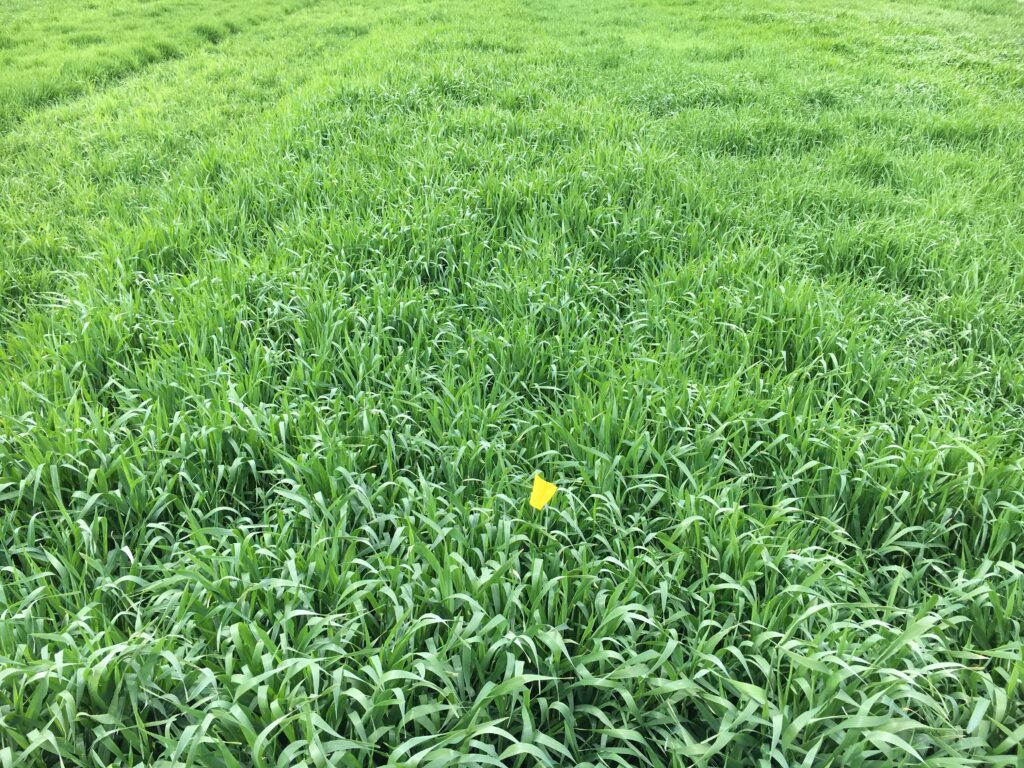
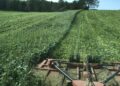
Barley — A robust crop of spring barley, like this, ….

Surprisingly, planting cover crops will increase your soil water holding capacity. This is done mainly through increased soil organic matter (SOM). A 1 percent increase in SOM can hold 20,000 more gallons of water per acre in the soil. Planting a cover crop either in summer or winter will increase SOM. 

There are several crops adapted to the Southwest that can grow with only a few waterings. Barley, sorghum sudangrass, millet and oats will do well and have the added value of being salt-tolerant crops. Alfalfa has been, and will continue to be, an important crop, as it can be cut and baled, fixes soil nitrogen and will increase SOM, despite being water intensive and not as salt tolerant as the crops above. Additionally, cover cropping with no-till or minimal tillage will reduce evaporative losses and further improve your soil health. 

There are ways to offset the costs of cover cropping. The New Mexico Healthy Soils Working Group has provided funding to farmers to reduce the costs of trialing different cover crops on their farms. 

Diversifying Crops 

The major cropping patterns along the Rio Grande are cotton, pecan and alfalfa, which are all water-intensive and salt-sensitive crops. Diversifying into crops that are more drought and salt tolerant is important for water conservation. 

If you’re already considering a perennial system, wine grapes and pomegranates could be alternatives, because they are very drought tolerant. For annual systems, quinoa and sunflowers (both for oilseed and confectionary use) are crops to consider; quinoa especially is growing in demand. 

Sam Hilborn is the New Mexico Organic Consultant at the Rodale Institute and is based in Santa Fe. Please visit rodaleinstitute.org/consulting for more information. 

← Previous Eco-update Next Bringing Trees Back into Agriculture →
Tags: May 2022
Sam Hilborn

Sam Hilborn

Sam Hilborn is the New Mexico Organic Consultant at the Rodale Institute and is based in Santa Fe. Please visit rodaleinstitute.org/consulting for more information.

Next Post

June 2022 • Issue #612

  • Trending
  • Comments
  • Latest
The Most Important Livestock in Our Fields

The Most Important Livestock in Our Fields

July 1, 2024
Glyphosate Does What It’s Designed to Do — Kill

Glyphosate Does What It’s Designed to Do — Kill

February 19, 2025
The Take-Half, Leave-Half Fallacy

The Take-Half, Leave-Half Fallacy

July 1, 2025
USDA organic seal over American farm land

Losing Organic Farms

January 27, 2026
We Don’t Need Another Bridge — We Need an Off-Ramp

We Don’t Need Another Bridge — We Need an Off-Ramp

3
Under One Roof

Under One Roof

3
A Rose By Any Other Name

A Rose By Any Other Name

2
Terra Preta’s Biological Advantage

Terra Preta’s Biological Advantage

2
Roundup glyphosate herbicide referenced in debate over national security executive order

ROUNDUP PIE

March 5, 2026
What Does “Cutting Red Tape” Mean for Eco-Ag?

What Does “Cutting Red Tape” Mean for Eco-Ag?

March 4, 2026
March 2026 • Issue #657

March 2026 • Issue #657

March 1, 2026
Fungicides and Tillage and Bare Soil, Oh My!

Fungicides and Tillage and Bare Soil, Oh My!

March 1, 2026

Recent News

Roundup glyphosate herbicide referenced in debate over national security executive order

ROUNDUP PIE

March 5, 2026
What Does “Cutting Red Tape” Mean for Eco-Ag?

What Does “Cutting Red Tape” Mean for Eco-Ag?

March 4, 2026
March 2026 • Issue #657

March 2026 • Issue #657

March 1, 2026
Fungicides and Tillage and Bare Soil, Oh My!

Fungicides and Tillage and Bare Soil, Oh My!

March 1, 2026

About ACRES USA

Acres U.S.A.® Magazine

Acres U.S.A.® is North America’s oldest publisher on production-scale organic and regenerative farming. For more than 50 years, our mission has been to help farmers, ranchers and market gardeners grow food profitably and sustainably, with nature in mind.

Magazine Issues

  • News
  • 2025
    • June 2025
    • May 2025
    • April 2025
    • March 2025
    • February 2025
    • January 2025
  • 2024 Articles
    • December 2024
    • November 2024
    • October 2024
    • September 2024
    • August 2024
    • July 2024
    • June 2024
    • May 2024
    • April 2024
    • March 2024
    • February 2024
    • January 2024
  • December 2023
    • December 2023
    • November 2023
    • October 2023
    • August 2023
    • July 2023
    • June 2023
    • May 2023
    • April 2023
    • March 2023
    • February 2023
    • January 2023
  • December 2022
    • November 2022
    • October 2022
    • September 2022
    • August 2022
    • July 2022
    • June 2022
    • May 2022
    • April 2022
    • March 2022

Contact Acres U.S.A

  • Contact Us
  • About Us
  • Advertise With Acres U.S.A.
  • My Subscription

Learn

  • Resources
  • Events
  • Magazine
  • Newsletters
  • Free Articles
  • Webinars
  • Online Courses
  • Bookstore

Our All Socials

Follow With Us...

  • My account
  • News
  • Ecological farming
  • Refund and Returns Policy
  • Privacy & Policy

© 2024 Acers USA Magazine

Welcome Back!

Login to your account below

Forgotten Password? Sign Up

Create New Account!

Fill the forms below to register

All fields are required. Log In

Retrieve your password

Please enter your username or email address to reset your password.

Log In
No Result
View All Result
  • HOME
  • ARTICLES
    • News
    • Farm
    • Ecological farming
    • Livestock
    • Crop
      • Crop management practices
      • Cover crops
      • Crop nutrition
      • Crop protection
      • Crops
      • Ag technology
    • Soil
    • Opinion
  • RESOURCES
    • Magazine
    • Online Learning
    • Newsletters
    • Blog
    • Free Articles
  • MAGAZINE ISSUES
    • 2025
      • June 2025
      • May 2025
      • April 2025
      • March 2025
      • February 2025
      • January 2025
    • 2024
      • December 2024
      • November 2024
      • October 2024
      • September 2024
      • August 2024
      • July 2024
      • June 2024
      • May 2024
      • April 2024
      • March 2024
      • February 2024
      • January 2024
    • 2023
      • December 2023
      • November 2023
      • October 2023
      • August 2023
      • July 2023
      • June 2023
      • May 2023
      • April 2023
      • March 2023
      • February 2023
      • January 2023
  • ABOUT US
    • Our History
    • Our Staff
    • Contact Us
    • Community
      • Soil Health Primer Resources
  • EVENTS
    • Eco-Ag Conference
    • On-Farm Viroqua Event
    • Farm Weird
  • SUBSCRIBE
  • Login
  • Sign Up
  • Cart

© 2024 Acers USA Magazine

Are you sure want to unlock this post?
Unlock left : 0
Are you sure want to cancel subscription?