Acres U.S.A.® Magazine
  • Articles
    • News
    • Ecological farming
      • Climate
      • Environmental Issues
      • Farm management & planning
      • Human health
    • Livestock
    • Farm
    • Crop
      • Crop management practices
        • Ag technology
        • Cover crops
        • Crop nutrition
          • Crop protection
          • Diseases
        • Crops
        • Fruits
    • Soil
    • Opinion
  • Resources
    • Magazine
    • Online Learning
    • Newsletters
    • Free Articles
    • Blog
  • Magazine Issues
    • 2025
      • October 2025
      • September 2025
      • August 2025
      • July 2025
      • June 2025
      • May 2025
      • April 2025
      • March 2025
      • February 2025
      • January 2025
    • 2024
      • December 2024
      • November 2024
      • October 2024
      • September 2024
      • August 2024
      • July 2024
      • June 2024
      • May 2024
      • April 2024
      • March 2024
      • February 2024
      • January 2024
    • 2023
      • December 2023
      • November 2023
      • October 2023
      • August 2023
      • July 2023
      • June 2023
      • May 2023
      • April 2023
      • March 2023
      • February 2023
      • January 2023
    • 2022
      • December 2022
      • November 2022
      • October 2022
      • September 2022
      • August 2022
      • July 2022
      • June 2022
      • May 2022
      • April 2022
      • March 2022
      • February 2022
  • About Us
    • Our History
    • Our Staff
    • Contact Us
    • Community
      • Soil Health Primer Resources
  • Events
    • Eco-Ag Conference
    • Farm Weird Event
    • Viroqua On Farm Event
  • Subscribe
  • Login
  • Register
No Result
View All Result
  • Articles
    • News
    • Ecological farming
      • Climate
      • Environmental Issues
      • Farm management & planning
      • Human health
    • Livestock
    • Farm
    • Crop
      • Crop management practices
        • Ag technology
        • Cover crops
        • Crop nutrition
          • Crop protection
          • Diseases
        • Crops
        • Fruits
    • Soil
    • Opinion
  • Resources
    • Magazine
    • Online Learning
    • Newsletters
    • Free Articles
    • Blog
  • Magazine Issues
    • 2025
      • October 2025
      • September 2025
      • August 2025
      • July 2025
      • June 2025
      • May 2025
      • April 2025
      • March 2025
      • February 2025
      • January 2025
    • 2024
      • December 2024
      • November 2024
      • October 2024
      • September 2024
      • August 2024
      • July 2024
      • June 2024
      • May 2024
      • April 2024
      • March 2024
      • February 2024
      • January 2024
    • 2023
      • December 2023
      • November 2023
      • October 2023
      • August 2023
      • July 2023
      • June 2023
      • May 2023
      • April 2023
      • March 2023
      • February 2023
      • January 2023
    • 2022
      • December 2022
      • November 2022
      • October 2022
      • September 2022
      • August 2022
      • July 2022
      • June 2022
      • May 2022
      • April 2022
      • March 2022
      • February 2022
  • About Us
    • Our History
    • Our Staff
    • Contact Us
    • Community
      • Soil Health Primer Resources
  • Events
    • Eco-Ag Conference
    • Farm Weird Event
    • Viroqua On Farm Event
  • Subscribe
No Result
View All Result
Acres U.S.A.® Magazine
No Result
View All Result
Home Magazine issues May 2023

The Potassium Paradox

Drs. S.A. Khan and R.L. Mulvaney by Drs. S.A. Khan and R.L. Mulvaney
June 2, 2024
in May 2023
0
The Potassium Paradox
0
SHARES
13
VIEWS
Share on FacebookShare on Twitter

Research proves that potassium testing and fertilization seldom pay

Drs. S.A. Khan and R.L. Mulvaney

On the pretext of boosting yields and profits, muriate of potash (KCl) has long been heavily promoted for use in the Corn Belt without regard to yield response or economic profitability. Based on research findings published in Renewable Agriculture and Food Systems (RAFS) in 2014, we have serious reservations about the current approach to potassium (K) management that has been in place for the past five decades. This approach, commonly known as buildup-maintenance, relies on a bank account concept that utilizes soil testing for increasing the level of exchangeable K (buildup) with yield-based inputs to replace crop K removal (maintenance).

Soil testing for exchangeable K is widely used throughout the world, on the implicit assumption that this fraction, when measured at a single time point by sampling the plow layer, adequately represents profile supplies of plant-available K. There is, unfortunately, a fundamental flaw, because exchangeable K exists in a very dynamic equilibrium with two vastly larger fractions that play a key role in supplying K for plant uptake: nonexchangeable K held between clay layers and the K in soil minerals, which together total hundreds of thousands of pounds per acre within the depth of active rooting. The implication is that no critical test level can be established, precluding the utility of soil testing for fertilizer K management.

A further complication arises from the much greater abundance of K in vegetation than grain. In the case of a corn crop yielding 200 bushels per acre, for example, K removal in grain totals 46 pounds as compared to more than 300 pounds for total aboveground biomass. The subsoil supplies the majority of this K, which occurs entirely in inorganic and water-soluble salts that are readily leached from the residue and recycled into the surface soil. Such enrichment explains why there was a 68 percent increase in K test for an unfertilized subplot in the Morrow Plots following 51 years of continuous corn that removed nearly 800 pounds of K in the grain harvested (see our RAFS paper for detail).

Given the profile abundance, dynamic nature, and persistence of K as inorganic forms that readily dissolve in the soil solution, it is not surprising that crop uptake of this nutrient often exceeds what is required, leading to luxury consumption. Under these circumstances, no meaningful relationship would be expected between grain yield and K test levels for the plow layer. This was indeed confirmed for a 40-acre field under a corn-soybean rotation, which was intensively sampled on the same 16 x 16 grid for soil testing and yield measurement. As reported in an RAFS commentary (doi.org/10.1017/S1742170514000453), the K test level was totally unrelated to spatial differences in corn yield, despite the fact that half the field was below the so-called critical test level (300 pounds per acre).

If crop growth normally utilizes an abundant supply of soil K that is largely replenished by returning residues, there should be little if any need for intensive use of KCl by grain producers in the midwestern U.S.A. This view is totally consistent with more than 2,100 yield response trials surveyed in our RAFS paper, including 774 under grain production in North America. Of the latter group, KCl was 93 percent ineffective for increasing grain yield, while the remaining 7 percent mainly occurred when K supply was inherently limited for sandy, shallow or compacted soils. Regardless of soil type, there was a significant risk of yield reduction from KCl fertilization of corn, soybean, wheat, sugarbeet, sugarcane, alfalfa, peanut, rape and cowpea. In several studies that report such findings, yield loss was intensified by increasing the rate of KCl application, and in some cases a higher rate transformed significant yield gain to loss. This fertilizer can have adverse effects on germination and seedling growth because of its high salt index and is especially problematic for legumes that are sensitive to chloride toxicity, due in part to the suppression of nitrogen fixation in root nodules. To make matters worse, chloride has an inhibitory effect on soil microbial processes and reduces plant uptake of nitrate, which exacerbates leaching losses of calcium as well as nitrate.

Fertilizer use of KCl has long been promoted as a prerequisite to improve the quality of food and feed crops, but this claim could not be substantiated by a survey of more than 1,400 field trials reported in the scientific literature. On the contrary, potassium depresses the uptake of calcium and magnesium, which can lead to grass tetany or milk fever in livestock and to human diseases such as osteoporosis, rickets and colon cancer. Moreover, the chloride supplied by KCl increases plant uptake of cadmium and other heavy metals, thereby contaminating many common foods we eat, such as potatoes and cereal grains. There are also negative implications for agricultural productivity because intensive K inputs under the auspices of buildup-maintenance recommendations contribute to compaction by degrading soil structure, thus reducing root penetration and profile storage of water and nutrients.

In lieu of soil K testing and the prevailing approach to K management, producers should conduct their own strip trials with and without a reduction of 20-30 pounds of K2O per acre that can be increased when these trials are repeated in subsequent years. Soils differ considerably in their physical and chemical properties, and these differences must be taken into consideration in order to maximize profitability, rather than following a one-size-fits-all approach that has long been promoted by university recommendations for traditional NPK fertility and a corn-soybean rotation. 

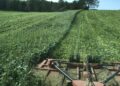
The possibilities are evident from the accompanying photo, which shows a striking contrast between the soybean crops grown in adjacent fields on a fine-textured Swygert soil that is known for a limited rooting depth due to subsoil compaction. The crop on the right side, utilizing traditional management, had little prospect for recovering input costs by hardly exceeding 25 bushels per acre when harvested, whereas this yield is more than doubled by the crop on the left, which was loaded with pods and still growing in mid-September. 

The obvious difference occurred after replacing KCl fertilization with annual application of two tons per acre of calcitic limestone followed by deep chiseling, which loosened the soil and allowed soybean to be grown for two or three years following corn. Fertilizer costs were dramatically decreased, not only by eliminating the need for N fertilization when soybean was grown, but also because soybean residues do not tie up N during decomposition, reducing the N rate for corn.

Drs. Khan and Mulvaney are professors at the University of Illinois.

← Previous What’s Inside? May 2023 • Issue #623 Next Perennial Diversification →
Tags: May 2023
Drs. S.A. Khan and R.L. Mulvaney

Drs. S.A. Khan and R.L. Mulvaney

Drs. Khan and Mulvaney are professors at the University of Illinois.

Next Post
Perennial Diversification

Perennial Diversification

  • Trending
  • Comments
  • Latest
The Most Important Livestock in Our Fields

The Most Important Livestock in Our Fields

July 1, 2024
Glyphosate Does What It’s Designed to Do — Kill

Glyphosate Does What It’s Designed to Do — Kill

February 19, 2025
The Take-Half, Leave-Half Fallacy

The Take-Half, Leave-Half Fallacy

July 1, 2025
White snakeroot

Toxic Forages?

September 1, 2025
We Don’t Need Another Bridge — We Need an Off-Ramp

We Don’t Need Another Bridge — We Need an Off-Ramp

3
Under One Roof

Under One Roof

3
A Rose By Any Other Name

A Rose By Any Other Name

2
Terra Preta’s Biological Advantage

Terra Preta’s Biological Advantage

2
Don’t You Dare Disparage Sugar!

Don’t You Dare Disparage Sugar!

February 3, 2026
February 2026 • Issue #656

February 2026 • Issue #656

February 1, 2026
Fungal Exchange Capacity

Fungal Exchange Capacity

February 1, 2026
ECO-MEETINGS

ECO-MEETINGS

February 1, 2026

Recent News

Don’t You Dare Disparage Sugar!

Don’t You Dare Disparage Sugar!

February 3, 2026
February 2026 • Issue #656

February 2026 • Issue #656

February 1, 2026
Fungal Exchange Capacity

Fungal Exchange Capacity

February 1, 2026
ECO-MEETINGS

ECO-MEETINGS

February 1, 2026

About ACRES USA

Acres U.S.A.® Magazine

Acres U.S.A.® is North America’s oldest publisher on production-scale organic and regenerative farming. For more than 50 years, our mission has been to help farmers, ranchers and market gardeners grow food profitably and sustainably, with nature in mind.

Visit Our Advertisers

Magazine Issues

  • News
  • 2025
    • June 2025
    • May 2025
    • April 2025
    • March 2025
    • February 2025
    • January 2025
  • 2024 Articles
    • December 2024
    • November 2024
    • October 2024
    • September 2024
    • August 2024
    • July 2024
    • June 2024
    • May 2024
    • April 2024
    • March 2024
    • February 2024
    • January 2024
  • December 2023
    • December 2023
    • November 2023
    • October 2023
    • August 2023
    • July 2023
    • June 2023
    • May 2023
    • April 2023
    • March 2023
    • February 2023
    • January 2023
  • December 2022
    • November 2022
    • October 2022
    • September 2022
    • August 2022
    • July 2022
    • June 2022
    • May 2022
    • April 2022
    • March 2022

Contact Acres U.S.A

  • Contact Us
  • About Us
  • Advertise With Acres U.S.A.
  • My Subscription

Learn

  • Resources
  • Events
  • Magazine
  • Newsletters
  • Free Articles
  • Webinars
  • Online Courses
  • Bookstore

Our All Socials

Follow With Us...

  • My account
  • News
  • Ecological farming
  • Refund and Returns Policy
  • Privacy & Policy

© 2024 Acers USA Magazine

Welcome Back!

Login to your account below

Forgotten Password? Sign Up

Create New Account!

Fill the forms below to register

All fields are required. Log In

Retrieve your password

Please enter your username or email address to reset your password.

Log In
No Result
View All Result
  • HOME
  • ARTICLES
    • News
    • Farm
    • Ecological farming
    • Livestock
    • Crop
      • Crop management practices
      • Cover crops
      • Crop nutrition
      • Crop protection
      • Crops
      • Ag technology
    • Soil
    • Opinion
  • RESOURCES
    • Magazine
    • Online Learning
    • Newsletters
    • Blog
    • Free Articles
  • MAGAZINE ISSUES
    • 2025
      • June 2025
      • May 2025
      • April 2025
      • March 2025
      • February 2025
      • January 2025
    • 2024
      • December 2024
      • November 2024
      • October 2024
      • September 2024
      • August 2024
      • July 2024
      • June 2024
      • May 2024
      • April 2024
      • March 2024
      • February 2024
      • January 2024
    • 2023
      • December 2023
      • November 2023
      • October 2023
      • August 2023
      • July 2023
      • June 2023
      • May 2023
      • April 2023
      • March 2023
      • February 2023
      • January 2023
  • ABOUT US
    • Our History
    • Our Staff
    • Contact Us
    • Community
      • Soil Health Primer Resources
  • EVENTS
    • Eco-Ag Conference
    • On-Farm Viroqua Event
    • Farm Weird
  • SUBSCRIBE
  • Login
  • Sign Up
  • Cart

© 2024 Acers USA Magazine

Are you sure want to unlock this post?
Unlock left : 0
Are you sure want to cancel subscription?