
David Knop shares how he started the Midwest’s second-largest blackberry operation on his row-crop farm
Acres U.S.A. Can you tell us some of the basics of your context — where do you farm? How many acres? What do you grow?
David Knop. I’m in southern Illinois, between Steeleville and Chester, in Randolph County — out in the country. There’s 220 acres on this farm. Fourteen of that is blackberries. And then I farm a total of about 1,100 acres of corn and soybeans. I do cover crops in the offseason when the cash crops aren’t growing.
My father passed away about four-and-a-half years ago, and that’s when I took over the farm. He did heavy, conventional tillage with the corn and beans. I started changing that from day one, basically.
With the blackberries, this will be our fifth harvest year. We planted them six-and-a-half years ago. The first full season we didn’t harvest — we just pruned them back to make the root structure stronger. When we started, I was just using conventional fertilizer with pesticides.
Acres U.S.A. Had you been farming before that with your father?
Knop. I had, but I was pretty much under his direction. I ran a little bit of my own ground, but I hadn’t really gotten involved at that point with watching YouTube videos about soil health, which really changed my mind on that. Because you don’t know what you don’t know.
I took over the farm four years ago. He’d already planted rye in the fall, but he’d always burn it down with glyphosate in the spring. That’s when I started investigating rolling the rye, and letting it go to the anther stage, and planting beans before that. So I started doing that from day one. He already had the rye there, which he used to terminate as soon as the first nice day of spring came along. But I let it go and get five-six feet tall.
Acres U.S.A. Would he burn it down and then till, or would he just plant straight into the dead rye?
Knop. He was pretty heavy tillage. He would rotate corn and beans every year, and he’d no-till his beans, but he was always scared to no-till corn. One year he’d had a loss from a mouse problem — the mice ate a lot of the seed — and so that scared him from doing no-till corn. So he would do no-till beans and then conventional-till corn the next year.
I went complete no-till from the get-go, with the exception of some bottom ground that I’ve been fixing up; heavy tillage over the years had created washouts and low spots and voids in the ground. On that ground, I’ve been going through field by field and laser leveling it to get it back to level. Then I no-till going forward.
Acres U.S.A. So that first year you already had rye; did you buy a roller-crimper? How did you get a hold of one?
Knop. I actually made one. I bought a McFarlane reel disk — a 44-footer — and it’s got the rolling baskets on it. It has a disk gang on front — it’s made for a minimum-tillage type of application. But I took the disk gages off the front and put roller baskets on, and so it’s like a huge roller. It’s almost 44 foot, but it’s got two sets of rolling baskets on it. It works really well. It’s got two wings on the sides, so it pivots a lot. On some of our land that has high spots and low spots, it kind of forms to the field to get all the rye crimped down. It’s very heavy — it’s probably 20,000 pounds or more.
Acres U.S.A. And you plant your beans green — before you roll the rye.
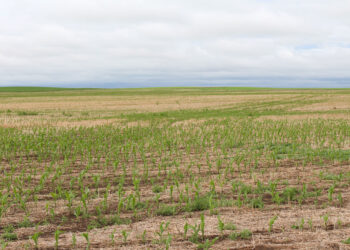
Knop. Yeah. We plant at the boot stage, and we let the beans emerge, and then we get to the anther stage of the rye — that’s when we roll it. Two years ago, we didn’t have very good success because we got our cereal rye in pretty late, and so a lot of it didn’t come up. But then last year, we did more of an early-season bean variety, so we got the beans out earlier in the fall and got our rye planted. So right now, in February, the rye is very well established across almost all the ground we planted.
Acres U.S.A. What’s your goal for the date for planting rye?
Knop. September would be good. I think we got the first field by the middle or end of September. We just follow the combine with the drill to plant the cereal rye. Fall is our busy season. Spring we go out there and plant and apply biologicals; fall is really the busy season because we’re pushing to get the crop out and to get the cereal rye put in the ground the same day, preferably.
Acres U.S.A. Are you doing corn the year after the beans?
Knop. I’m not yet because I’m scared of my nitrogen issue right now. I don’t want to go out and put on anhydrous; I’ve been four years without any synthetics. I don’t want to go back in with anhydrous and ruin my earthworm populations. I have huge earthworm populations now that I didn’t have before. We went out last year and dug up a foot-by-foot-by-six-inch section, and we found 18 to 33 worms in that square foot. And I know that if I go through with anhydrous, I’m gonna ruin that. I’m working with my agronomist to figure out how to address this nitrogen issue.
So, I’m beans-on-beans right now, but I’ll be changing that to add more diversity. This year I’ve got an even earlier-season variety of soybeans, so I can get some legume cover crops out there. Instead of just going with the cereal rye, it’ll be a diverse six- or seven-way mix.
Acres U.S.A. Yeah, there’s a lot of research that says that if you use a mix of different types of covers, your effects will be compounded. And how will you terminate that? That’s the one nice thing about having a monocrop of rye — you can terminate it all at once, and it’s uniform.
Knop. Vetch and winter peas will roller-crimp. I’d like to find a mix that I can roller-crimp, because this glyphosate’s gotta go. We’ve got to figure out a way to work without it. It kills a lot of the soil microbes, it accumulates trace minerals, it makes minerals not available to crops. And of course there’s the human health effects.
So, I would like to find a cover crop mix that I can roller-crimp. And maybe partial winterkill — radishes and turnips will winterkill. But they can do a lot of good in the fall, with that big taproot.
In the program we’re using right now, I drilled a hundred pounds per acre of cereal rye last fall. So I’m hoping I’ll get some weed suppression from that rye all year, but that’s probably not going to happen. I’m hoping I’ll only have to spray it one time. I do get late-season foxtail and some other weeds.
Acres U.S.A. From compaction, right?
Knop. From compaction, lack of calcium. There’s several things to work on.
Acres U.S.A. You’re getting there, though. You’re on the path, taking the right steps. Are there some other possibilities for crops to put in the rotation beside corn? Does anyone in your area grow anything else?
Knop. Not really. Our local co-op just buys corn and beans, and some wheat and milo. So I guess wheat would be another choice. We’re limited. But I’ve heard of people creating their own mix of grains and selling it to a dairy. But that’s not something I know a lot about. I don’t think many farmers know a lot about that — direct marketing to get rid of the middle guy
Acres U.S.A. Yeah, you’d have to have your own silos. Distribution and supply chains actually become a really big limiting factor in trying to move regenerative agriculture forward. If you get into non-GMO and certified, you have to have separate facilities. You’re growing better stuff than other people, because you aren’t using herbicides, but it looks the same at the local co-op.
Knop. Right. You do all this work, and you mix it in with all this other stuff, and it doesn’t really matter. But maybe there are dairy farmers or hog farmers who are buying non-GMO grains. They are out there, from what I’ve been told.
And then you’ve got transportation costs. Our co-op is two miles from our farm. So it’s just very convenient.
Acres U.S.A. How did you make the decision to get into blackberries — something totally different?
Knop. I did that on my own, after my dad died. I do real estate also, and a guy that used to do appraisal work for me, he had heard about growing blackberries. And he was gonna do it, but he was scared because of the labor aspects — which is a very viable point. But it grabbed my attention, and I just went with it.
I had ground right around my house. I wanted to be able to see the berries every day and not have to travel very far to inspect them. We decided to do 14 acres, and it’s all right next to my house. It’s some beautiful rolling hills. I just decided to go with my gut, and so I did it.
Acres U.S.A. And what does that all involve? How did you learn how to grow blackberries? It’s a very complicated thing to start up a totally new operation like that.
Knop. Yeah, and there’s not that much information online about how to do this. There’s a little bit here and there, but not like the resources on how to grow soybeans or something like that, obviously.
The blackberries are on raised beds, and they’ve got dripline irrigation under each bed. We can put fertilizer in with the irrigation water. We tilled everything and formed beds about six inches high and two feet wide. There’s dripline irrigation underneath the bed and a plastic weed barrier on top. The tractor we used had GPS, so each row is perfectly parallel. Then we went through and burned holes with a torch every five feet, and then we took a plug of dirt out of the ground and planted these little plants, just a few inches tall. It took two years before we had a harvest. It’s kind of a tough pill to swallow when you put that much work in and have to wait two years before any potential income comes in.
Acres U.S.A. Yeah. Can you talk a little bit in generalities about numbers — like how much it cost to put this in?
Knop. Half a million dollars for the 14 acres. And then no income for the first two years — but you still have expenses. You have to care for the plants and prune them, you know. It’s all very hands on.
Acres U.S.A. How long did it take to do all the establishment — forming beds and planting?

Knop. I took a while. I’ve had a pretty good response from local labor. We have a big Hispanic community here. That’s who I rely on to pick — because picking is all done by hand as well.
Acres U.S.A. That was gonna be another question — how you harvest.
Knop. There are actually prototypes of drones now that do this. It’s pretty neat. They have these arms, and they fly around 24 hours a day, picking and dropping the berries off.
Acres U.S.A. That’s incredible.
Knop. It’s pretty neat. They have four drones hooked to a power cord that’s on a central battery pack, all going around and picking blackberries.
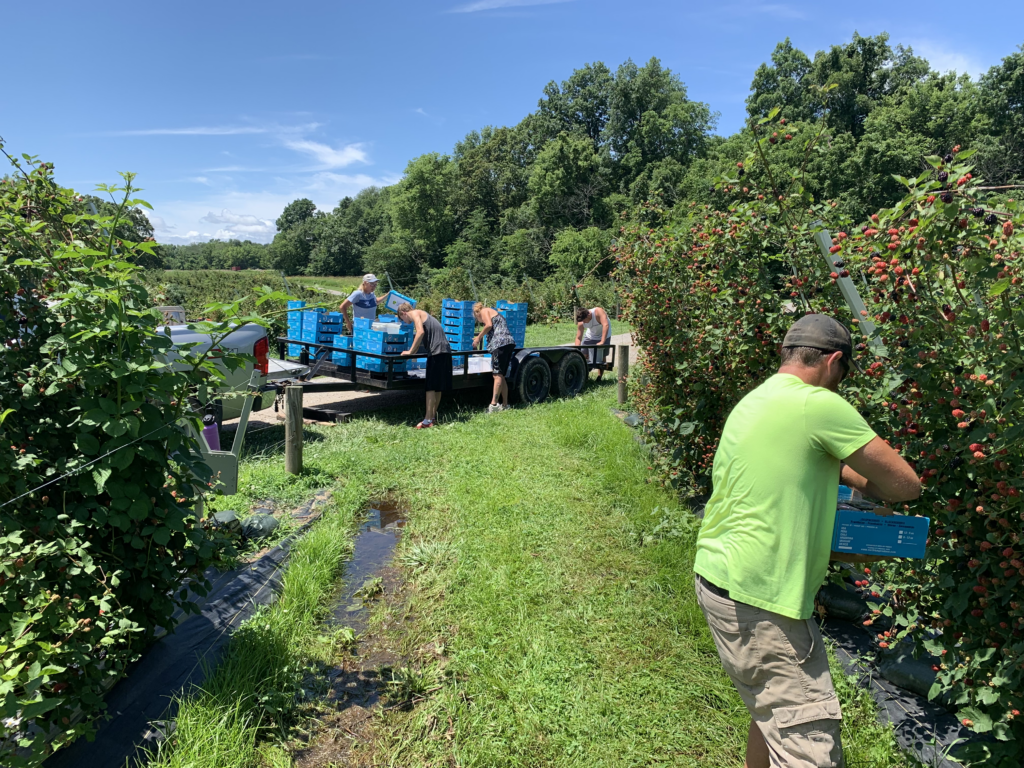
But right now, it’s all picked by hand. I’ll have around 40 to 45 people each summer to pick. Like I said, we’ve got a good Spanish-speaking community around here. I’ve had high school kids, and I don’t want to paint them all with the same brush — some of them are really good workers. But we pay based on how much people pick. You can’t pay by the hour — you’d go broke. So you’re paying for performance. Some guys might be making $1,400 a week while the local high school kids would make $100 a week, and then his parents start a complain.
Acres U.S.A. And what’s your harvest window? That would be complicated too, because you have a lot of work, but only for a certain period of time.
Knop. Our first berries usually come in about June 27 or so. We’ve got three different varieties, so it’s kind of staggered. The last variety comes in the first week of August — so the harvest window is a little over a month.
Acres U.S.A. And you’re selling these to a distributor, right?
Knop. Yeah. Our berries go across the United States. As far as I know, we’re the second-biggest operation in the Midwest.
Acres U.S.A. Wow, that’s great. Is the distributor selling them to eat fresh, or are they for products?
Knop. For eating fresh. We can pick in the morning, and they can be on a dinner table in Texas that evening. Because they’re very perishable. They don’t last very long.
Acres U.S.A. What about storage facilities? You have cold rooms?
Knop. Oh, yeah. It’s 20 by 60 — 1,200 square feet of cold storage. You have to get them cold right away. I even put a reefer truck out in the field when they’re picking; they pick directly into the clamshell that you buy in the store. The berries are only touched one time. It might be 100 degrees out there, and they can’t stay outside; they’ll go directly into the reefer trailer, and from there into the cold storage building. And then we’ll call the truck and say, “Hey, we’ve got X amount ready,” and he’ll come down and pick them up.
The first year our berries went to 19 different states in the Midwest and the East Coast, down to Florida, Texas, Michigan, Kansas — all over the place.
Acres U.S.A. That’s really neat. Can you talk about how you’ve dealt with SWD issues? And maybe more generally about your nutrition program.
Knop. The first few years, we just used regular synthetic fertilizer. But we were never really getting the results we wanted. We had to spray pesticides, including for SWD. Spotted wing drosophila is a fruit fly. The female has a saw-like apparatus on her back end, and she’ll eat the fruit — especially a little bit overripe fruit — and burrow in there and lay her eggs, and it ruins the fruit.
We always had an SWD problem, up until last year. And what we did is we took out all pesticide applications and replaced them with nutrition products. We didn’t do a fall primer the year prior, but we started with multiple foliar applications and soil fertigation dredges, and we didn’t have any SWD at all. They’re still there, out the woods, but we didn’t have them on our fruit plants at all. And you could tell the fruit was better quality. It tasted a lot better than past years. In previous years, when the fruit would start to get ripe there’d be some that would start to fall onto the ground, so we’d lose revenue there. But this past year the fruit stayed on the vines much better. You had to actually tug at them to get them off. And the quality was better. We still didn’t get the yield we wanted, but it was twice as good as the year before. I’m curious to see what happens this year, because we’re going with all biologicals this year. We’re not using any synthetics.
Acres U.S.A. Are you sap testing? What has that revealed so far?
Knop. We are. It shows that our trace minerals are kind of in line — they’re not too bad. We did two sap tests last year.
Acres U.S.A. Are you going to expand the blackberries, or maybe add another type of berry?
Knop. I don’t know. We’ve got 200-some acres on his farm, so there’s a lot of room for expansion. There are a lot of different options. Lavender, garlic, mushrooms — there’s a lot of different things.
Acres U.S.A. That’s great.
This is a bit of a personal question, but can you talk about the influence of your father? Are the things you’re doing now — the cover cropping and planting green, and especially the blackberries — would it have been difficult to do those things if he were still alive and on the farm?
Knop. Oh, yeah. He was a good guy. He loved me, and I loved him. He was a typical hard-headed farmer!
You know, I watch a lot of videos about regen ag, but one thing I don’t see is that issue being addressed very much. Because I know that a lot of father-son relationships on farms probably aren’t that good. I hear about a lot of them — how people complain about the other, or vice versa.
But yeah — it wouldn’t have happened with him still being here. Not at this rate. Because I risked a lot — trying to convert everything right away.
The thing to me is that just the simple aspect of tillage and soil loss — that isn’t going to work for very long. Just look at the dead zone in the Gulf of Mexico and the cancer rates at the mouth of the Mississippi River, how they’re higher than anywhere in the world right now. There’s a reason for that. It’s runoff of our phosphorus and nitrogen and glyphosate. I just wish that farmers would do their research on this. You don’t have to change it all overnight. I didn’t know about this before I started really reading books and watching videos about how detrimental we are to our ground — to our environment. A lot of people think that since we’ve done this for a hundred years, it must be working. But it’s not.
Acres U.S.A. Do you think that part of the reason people are more reluctant to take up some of these regenerative practices is just that it’s so much more complicated? That requires a lot more work and, and listening to nature, than conventional farming?
Knop. Yeah, there’s a lot of reasons they probably don’t. They don’t really know how harmful this stuff is, because they don’t do the research. They don’t know that we’re losing 1 percent of topsoil a year. They don’t know that autism follows the rate of glyphosate usage. Change is hard, and they’re worried about what their neighbors are gonna say.
Acres U.S.A. Have you thought about adding livestock? That gets even more complicated.
Knop. I need to. I’ve got a niece who’s 21, and she’s a thinker, and she’s talking about getting into livestock. The trouble I see with it is that I have a lot of fields in different areas. If I had 1,000 acres in one block, it’d be pretty simple to move livestock. But to have to load cattle on trailers all the time would be tough. I’ve thought about seeing if people around here who have livestock might want to use my ground. And I’ve got so much going on — I feel like I couldn’t manage it. But I see the importance of it, for sure.
Acres U.S.A. You were at our Acres U.S.A. conference in December, weren’t you?
Knop. I was. It was great to see John Kempf and Rick Clark. I actually took my siblings with me. My dad owned 1,000 acres, so now I and all my siblings are landowners, and I’m farming their ground. A few of them didn’t exactly understand what I’ve been doing, so I wanted to take them to the conference so they could hopefully get a little better understanding of what I’m doing. So I took my three sisters and my niece.
Acres U.S.A. And what did they think?
Knop. Oh, they loved it. My one sister is huge on soil health now. But I think it took that professional — like Rick or John — to get that through to them. It’s not like they didn’t believe in me, but it really helped to see several professionals explaining it and showing it — that they’re doing this on their farms.
So they’re all for it. My one sister is like, “Go organic. I’ve got your back — go organic on my ground.”
Acres U.S.A. That’s great. Most people probably don’t have that kind of support.
Knop. No. I’ve got great family support.