Acres U.S.A.® Magazine
  • Articles
    • News
    • Ecological farming
      • Climate
      • Environmental Issues
      • Farm management & planning
      • Human health
    • Livestock
    • Farm
    • Crop
      • Crop management practices
        • Ag technology
        • Cover crops
        • Crop nutrition
          • Crop protection
          • Diseases
        • Crops
        • Fruits
    • Soil
    • Opinion
  • Resources
    • Magazine
    • Online Learning
    • Newsletters
    • Free Articles
    • Blog
  • Magazine Issues
    • 2026
      • February 2026
      • January 2026
    • 2025
      • December 2025
      • November 2025
      • October 2025
      • September 2025
      • August 2025
      • July 2025
      • June 2025
      • May 2025
      • April 2025
      • March 2025
      • February 2025
      • January 2025
    • 2024
      • December 2024
      • November 2024
      • October 2024
      • September 2024
      • August 2024
      • July 2024
      • June 2024
      • May 2024
      • April 2024
      • March 2024
      • February 2024
      • January 2024
    • 2023
      • December 2023
      • November 2023
      • October 2023
      • August 2023
      • July 2023
      • June 2023
      • May 2023
      • April 2023
      • March 2023
      • February 2023
      • January 2023
    • 2022
      • December 2022
      • November 2022
      • October 2022
      • September 2022
      • August 2022
      • July 2022
      • June 2022
      • May 2022
      • April 2022
      • March 2022
      • February 2022
  • About Us
    • Our History
    • Our Staff
    • Contact Us
    • Community
      • Soil Health Primer Resources
  • Events
    • Eco-Ag Conference
    • Farm Weird Event
    • Viroqua On Farm Event
  • Subscribe
  • Login
  • Register
No Result
View All Result
  • Articles
    • News
    • Ecological farming
      • Climate
      • Environmental Issues
      • Farm management & planning
      • Human health
    • Livestock
    • Farm
    • Crop
      • Crop management practices
        • Ag technology
        • Cover crops
        • Crop nutrition
          • Crop protection
          • Diseases
        • Crops
        • Fruits
    • Soil
    • Opinion
  • Resources
    • Magazine
    • Online Learning
    • Newsletters
    • Free Articles
    • Blog
  • Magazine Issues
    • 2026
      • February 2026
      • January 2026
    • 2025
      • December 2025
      • November 2025
      • October 2025
      • September 2025
      • August 2025
      • July 2025
      • June 2025
      • May 2025
      • April 2025
      • March 2025
      • February 2025
      • January 2025
    • 2024
      • December 2024
      • November 2024
      • October 2024
      • September 2024
      • August 2024
      • July 2024
      • June 2024
      • May 2024
      • April 2024
      • March 2024
      • February 2024
      • January 2024
    • 2023
      • December 2023
      • November 2023
      • October 2023
      • August 2023
      • July 2023
      • June 2023
      • May 2023
      • April 2023
      • March 2023
      • February 2023
      • January 2023
    • 2022
      • December 2022
      • November 2022
      • October 2022
      • September 2022
      • August 2022
      • July 2022
      • June 2022
      • May 2022
      • April 2022
      • March 2022
      • February 2022
  • About Us
    • Our History
    • Our Staff
    • Contact Us
    • Community
      • Soil Health Primer Resources
  • Events
    • Eco-Ag Conference
    • Farm Weird Event
    • Viroqua On Farm Event
  • Subscribe
No Result
View All Result
Acres U.S.A.® Magazine
No Result
View All Result
Home Magazine issues June 2023

The Heat Is On

Allen Williams by Allen Williams
May 30, 2024
in June 2023, Opinion
0
The Heat Is On

Williams photo (Soil Health Academy photo by Kim Barmann) — Understanding Ag managing partners Allen Williams (right) and Shane New work with farmers and ranchers throughout North America to understand and apply key soil health and adaptive grazing principles to protect the soil microbiome and improve soil function and resiliency.

0
SHARES
18
VIEWS
Share on FacebookShare on Twitter

Without education, the promise of climate-smart farm practices will wilt on the vine

Allen Williams

The digital screen displayed 162 degrees F.

I pointed my infrared thermometer and squeezed the trigger again. No change. The readout showed 162 F, which just happens to be the safe food preparation temperature for ground beef and sausage.

But I wasn’t pointing the thermometer at my dinner. I was pointing it at a conventionally tilled, recently harvested wheat field near Gordon, Nebraska. Regrettably, I would discover that field wasn’t an anomaly.

During a weeks-long trip in August, I visited farms and ranches in Utah, Idaho, Wyoming, South Dakota and Nebraska. I consistently measured soil temperatures topping 150 degrees. With the ambient air temperature ranging from 97 to 102 F, I measured soil surface temperatures on a variety of fields, including mowed hay fields (alfalfa, grass) that had temperatures consistently above 150 degrees. Any temperature above 140 F essentially pasteurizes the soil microbiome and kills the essential soil microbes that play a critical role in the photosynthetic process — the process that enables all terrestrial life.
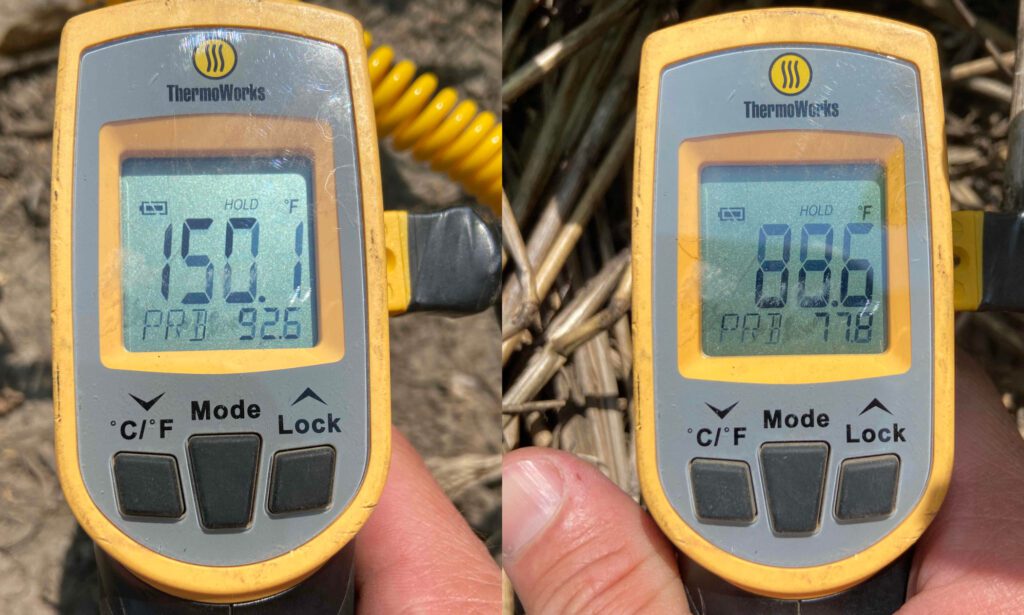
Thermometers (Courtesy of Understanding Ag) — The temperature of soil covered with plant matter is much lower than an adjacent bare spot.

Anywhere the soil was even somewhat exposed to direct sunlight, soil temperatures were 150 F and above. But the high ambient air temperatures aren’t the only factors producing soil surface temperatures that can literally cook eggs.

Conventional farming practices, including our stubborn addiction to tillage, are increasingly creating micro-to-macro climates across large swaths of our heartland, further disrupting the normal water cycle of transpiration, evaporation, condensation and precipitation. Sadly, the fields I visited are representative of hundreds of thousands of fields and millions of cropland acres throughout the nation.

Facts can be stubborn things. So, too, can our habits. Despite what we see and experience on our own farms and ranches, the conventional farming mindset of tillage, fallow fields and monocultures of corn and wheat have rendered our soils lifeless and less able to capture and retain water — and to be part of a functioning water cycle.

The conventional mindset persists because of status quo bias, tradition and fear of the unknown. A key antidote to this mindset is education.

The recently enacted Inflation Reduction Act provides roughly $8.5 billion to pay for projects and practices that restore the ecosystem or reduce emissions on farmland through USDA’s Environmental Quality Incentives Program. The program provides funding for cover crop seeds and incentivizes farmers to implement other climate-friendly, regenerative practices.

Despite this good news, USDA’s emphasis on financial assistance — absent accompanying soil health education and training — will inevitably lead to wasted funding, farmer frustration and climate-smart practice failures. And once a farmer has a bad experience with a practice, there’s little chance he or she will ever try it again.

That’s why education is critical to the success of this important investment. And while government agencies are not well equipped to provide regenerative farming education to farmers and ranchers, there are proven non-government organizations that are already conducting farmer-to-farmer regenerative ag learning sessions. Programs like these need to be scaled up to reach many more farmers. Combined with online training options, these efforts can help ensure the successful implementation of soil-health-focused, climate-smart, regenerative agricultural practices.

Finally, it’s also important that USDA examine the “not-so-climate-smart” elements in its existing farm programs. The so-called “safety net” of crop insurance programs, for example, continues to enable and perpetuate ag practices that are undeniably contributing to the climate crisis and reducing our food security — offsetting the overall positive impact of the climate-smart effort. Likewise, farm programs that subsidize monoculture commodity crops also provide financial disincentives for climate-smart practice adoption.

As it stands, the farm fields I referred to above will be tilled and planted again, using many of the same conventional practices and the same costly synthetic inputs that continue to degrade our soil resources and our collective futures — all thanks to taxpayer-funded crop insurance and support programs.

For climate-smart farming to truly succeed, USDA must couple its climate-smart farming funding with education and eliminate the long-standing policies that continue to perpetuate climate-damaging conventional agricultural practices. If it doesn’t, the promise of a climate-smart future will quickly cool, and the temperatures in our farm fields will rise well above 162 F.

Dr. Allen Williams is a founding partner of Understanding Ag and Soil Health Academy. Learn more at understandingag.com and soilhealthacademy.org. This article was originally published on the Understanding Ag blog and is used with permission.

← Previous View from the Country Next Are Organic Processed Foods Really Healthier? →
Tags: June 2023Opinion
Allen Williams

Allen Williams

Dr. Allen Williams is a founding partner of Understanding Ag and Soil Health Academy. Learn more at understandingag.com and soilhealthacademy.org. This article was originally published on the Understanding Ag blog and is used with permission.

Next Post
What’s Inside? July 2023 • Issue #625

What’s Inside? July 2023 • Issue #625

  • Trending
  • Comments
  • Latest
The Most Important Livestock in Our Fields

The Most Important Livestock in Our Fields

July 1, 2024
Glyphosate Does What It’s Designed to Do — Kill

Glyphosate Does What It’s Designed to Do — Kill

February 19, 2025
The Take-Half, Leave-Half Fallacy

The Take-Half, Leave-Half Fallacy

July 1, 2025
USDA organic seal over American farm land

Losing Organic Farms

January 27, 2026
We Don’t Need Another Bridge — We Need an Off-Ramp

We Don’t Need Another Bridge — We Need an Off-Ramp

3
Under One Roof

Under One Roof

3
A Rose By Any Other Name

A Rose By Any Other Name

2
Terra Preta’s Biological Advantage

Terra Preta’s Biological Advantage

2
Roundup glyphosate herbicide referenced in debate over national security executive order

ROUNDUP PIE

March 5, 2026
What Does “Cutting Red Tape” Mean for Eco-Ag?

What Does “Cutting Red Tape” Mean for Eco-Ag?

March 4, 2026
March 2026 • Issue #657

March 2026 • Issue #657

March 1, 2026
Fungicides and Tillage and Bare Soil, Oh My!

Fungicides and Tillage and Bare Soil, Oh My!

March 1, 2026

Recent News

Roundup glyphosate herbicide referenced in debate over national security executive order

ROUNDUP PIE

March 5, 2026
What Does “Cutting Red Tape” Mean for Eco-Ag?

What Does “Cutting Red Tape” Mean for Eco-Ag?

March 4, 2026
March 2026 • Issue #657

March 2026 • Issue #657

March 1, 2026
Fungicides and Tillage and Bare Soil, Oh My!

Fungicides and Tillage and Bare Soil, Oh My!

March 1, 2026

About ACRES USA

Acres U.S.A.® Magazine

Acres U.S.A.® is North America’s oldest publisher on production-scale organic and regenerative farming. For more than 50 years, our mission has been to help farmers, ranchers and market gardeners grow food profitably and sustainably, with nature in mind.

Magazine Issues

  • News
  • 2025
    • June 2025
    • May 2025
    • April 2025
    • March 2025
    • February 2025
    • January 2025
  • 2024 Articles
    • December 2024
    • November 2024
    • October 2024
    • September 2024
    • August 2024
    • July 2024
    • June 2024
    • May 2024
    • April 2024
    • March 2024
    • February 2024
    • January 2024
  • December 2023
    • December 2023
    • November 2023
    • October 2023
    • August 2023
    • July 2023
    • June 2023
    • May 2023
    • April 2023
    • March 2023
    • February 2023
    • January 2023
  • December 2022
    • November 2022
    • October 2022
    • September 2022
    • August 2022
    • July 2022
    • June 2022
    • May 2022
    • April 2022
    • March 2022

Contact Acres U.S.A

  • Contact Us
  • About Us
  • Advertise With Acres U.S.A.
  • My Subscription

Learn

  • Resources
  • Events
  • Magazine
  • Newsletters
  • Free Articles
  • Webinars
  • Online Courses
  • Bookstore

Our All Socials

Follow With Us...

  • My account
  • News
  • Ecological farming
  • Refund and Returns Policy
  • Privacy & Policy

© 2024 Acers USA Magazine

Welcome Back!

Login to your account below

Forgotten Password? Sign Up

Create New Account!

Fill the forms below to register

All fields are required. Log In

Retrieve your password

Please enter your username or email address to reset your password.

Log In
No Result
View All Result
  • HOME
  • ARTICLES
    • News
    • Farm
    • Ecological farming
    • Livestock
    • Crop
      • Crop management practices
      • Cover crops
      • Crop nutrition
      • Crop protection
      • Crops
      • Ag technology
    • Soil
    • Opinion
  • RESOURCES
    • Magazine
    • Online Learning
    • Newsletters
    • Blog
    • Free Articles
  • MAGAZINE ISSUES
    • 2025
      • June 2025
      • May 2025
      • April 2025
      • March 2025
      • February 2025
      • January 2025
    • 2024
      • December 2024
      • November 2024
      • October 2024
      • September 2024
      • August 2024
      • July 2024
      • June 2024
      • May 2024
      • April 2024
      • March 2024
      • February 2024
      • January 2024
    • 2023
      • December 2023
      • November 2023
      • October 2023
      • August 2023
      • July 2023
      • June 2023
      • May 2023
      • April 2023
      • March 2023
      • February 2023
      • January 2023
  • ABOUT US
    • Our History
    • Our Staff
    • Contact Us
    • Community
      • Soil Health Primer Resources
  • EVENTS
    • Eco-Ag Conference
    • On-Farm Viroqua Event
    • Farm Weird
  • SUBSCRIBE
  • Login
  • Sign Up
  • Cart

© 2024 Acers USA Magazine

Are you sure want to unlock this post?
Unlock left : 0
Are you sure want to cancel subscription?