

John Kempf and Dr. James White discuss how plants receive much of their nutrient requirement via endophytes — from microbes inside the plants
John Kempf: James, you’ve been a pioneer in the development of the rhizophagy cycle — the concept of plants feeding and getting nutrition from microbes. This is one of the fundamental pieces that we need to understand; we need to develop a completely different paradigm for how plants get nutrients.
The contemporary model has been based on the idea that plants get their nutrition primarily from soluble ions in the soil solution. Yet we know that model has all kinds of problems because it’s obviously not how wild plants and undomesticated ecosystems get nutrition, because soluble nutrients don’t exist in large concentrations in unmanaged soils.
I’ve been really interested in understanding this phenomena and in seeing how we can develop agronomic management systems that can give us exceptional levels of plant health and productivity without degrading our soil ecosystems with salt-based fertilizers. You’ve described how organisms such as Fusarium, which we consider to be pathogenic, can actually develop symbiotic or collaborative relationships with plants that are not pathogenic, dependent on the soil environment. A lot of people are starting to pay attention, and I’m really excited about that.
Dr. James White. Thank you, John. Just to add to what you said about Fusarium and how microbes impact the behavior of pathogenic fungi, all fungi take in endophytic bacteria. If you look inside their hyphae, you’ll see bacteria in there. They utilize those endophytes for nutrients — nitrogen mostly — that’s what we’re finding.
Of course, the big picture is that if you consider a pathogen, the behavior of that pathogen changes when it has bacteria inside it. We think that’s because of the need for nutrients — for nitrogen in particular — and that if a pathogen can get its nutrients from endophytic bacteria, it doesn’t have to attack plants to get those nutrients. It’s the principle that you can use microbes to protect plants and to build soils that are healthy; microbes don’t cause disease in those kinds of soils.
Kempf. I’ve thought of disease-suppressive soils as soils that contain suppressive bacteria — suppressive microbial populations that suppress pathogens from expressing themselves. But what you’re describing is actually that these are soils that have such abundant bacterial populations that they can supply the nutrients that the fungus requires, and that alters the nature of the relationship. So, in fact, a disease-suppressive soil is not so much about specific types of bacteria or specific strains as it is the ability to provide bacterial nitrogen to the fungus.
White. Yes, that’s what we’re seeing. There’s not any kind of silver bullet — that you could take one microbe and give it to a plant, and that’s going to be everything the plant needs. Same with fungi. There’s no silver bullet. A suppressive soil is a soil that’s rich in microbes that work with fungi and plants.
Kempf. I learned recently that fungal mycelia is a single cell, and I’ve been wondering about this. I’ve marveled at the speed at which bacterial endophytes can move through fungal hyphae, and so it makes sense that it’s not cell-to-cell transport. And I’ve also learned that the DNA is identical in a single mycorrhizal fungi that is in some cases miles across. How does that translate to fungi being a single-celled organism or not?
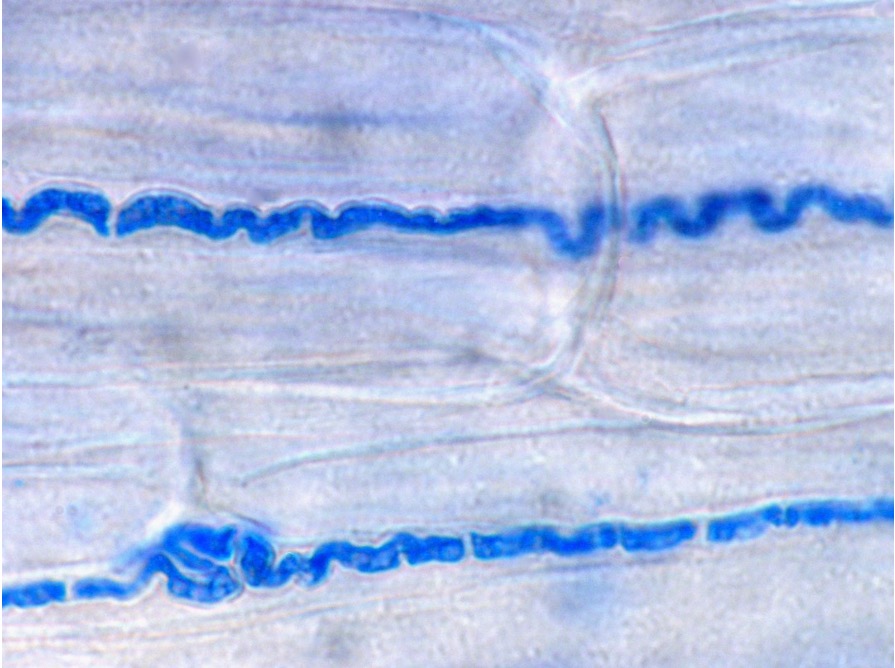
White. Well, you have to think of the fungal structure. The main fungus that I’m going to talk about now are the ascomycetes. It’s a group of fungi that have septa or cross walls in the hyphae — the chain — the tubular growth of the fungus. It has cross walls, but the cross walls have holes in the middle. They have a pore in the middle. It’s just a wall that goes down and then goes back, and then there’s a hole right in the middle.
There’s constant movement of nuclei through that hole. And even bacteria go through that hole, and they can move between the hyphae. It’s going to slow them down a little bit because of the septa that are there, but they still have free movement. There isn’t that hindrance of movement until you look at the mushrooms — the basidiomycetes — because they have plugs in their septa, and it’s more difficult to move bacteria between the cells, but they still do it, because those bacteria are important.
Kempf. So there are multiple cells, but the cell membranes in some of these groups are very open and facilitate free movement back and forth.
White. There are multiple cells, but there are holes in the walls between the cells. In a sense it’s a single cell, but that can be a little bit confusing because there are multiple genetically different nuclei in many of those hyphae. They have this process where they just move DNA from one hypha to the next, and so many times you’ll get a hyphal network that has multiple nuclei in it — multiple sets of DNA.
A fungus is like a little community in that it has multiple individual nuclei or genotypes in it. Not all — this is typically why we single-spore fungi to grow them, because you want to get only one nucleus. But if you don’t single-spore, there’s a high probability of more nuclei in the hypha than you expected — a mixed bag of characteristics.
Kempf. When you have multiple nuclei, how does that translate or correspond to different species exchanging genetic information — different species of fungi, or different species of bacteria with fungi? What does the exchange of genetic information look like?
White. Well, there is this process called “parasex.” It’s supposed to be similar to sex, but sexual reproduction is actually a very organized process. This parasexual process is not organized, at least not as far as we know. Hyphae will just fuse, nuclei will go in, and then they’ll be in there, and then at some point, for this to happen, those nuclei will fuse. They’ll fuse together, and then you’ll have double the DNA. And then little by little, as the nuclei divide, some chromosomes are thrown off and it goes back down to the original level of DNA in the fungus, with some variation happening. This is the parasexual process. We think this happens a lot in nature. A lot of fungi just lost their sexual reproduction capacity completely, and we think they rely on parasex mostly.
Kempf. Would it be accurate to say that these various fungal species that we’ve identified contain genetic information from many other fungal species in the environment around them? In other words, how do you define the boundaries between various species?
White. It’s very ill-defined, isn’t it? Species still tend to be separate in that respect. Typically, you have species that don’t cross. But that’s not a good rule because you have plenty that do cross. Can you really define the separateness of an individual in fungi? Well, you have to go all the way down to the nuclear level. Unless you wanted to say that a fungus can be a mosaic of different individuals — kind of a multi-personality-type condition for a fungus.
And it does mean that fungi are particularly plastic in what they’re able to do. They have genetic capacity — when they have multiple sets of chromosomes, multiple genotypes — then they can express those as they need to express them. They can partially express them. If they need to break something down and they don’t have an enzyme to do it in one of the nuclei, they may have it in the other, and then they produce that. And so they’re much more capable with those multiple sets of DNA. It’s just how fungi work. There’s nothing special about them. This is just how they function. This is their biology.
Kempf. This is another incredible explanation of the amazing resilience that exists in these natural ecosystems, and fungus in particular. I’m amazed frequently when we work with farmers, as they begin going down a pathway of managing their soils differently, how rapidly soils recover and how rapidly plant health recovers. There’s this incredible resilience — once you start getting out of the way, we have this amazing recovery that happens.
White. But it doesn’t work if farmers can’t recycle their same seed and grow it year after year on their soil. If that’s made illegal and they have to buy a certain type of seed in order to grow it, then they can’t recover. They can’t heal their crops by growing them in healthy soils.
Kempf. Are you implying that seed that has grown on foreign soil, or soil that isn’t biologically healthy, that seed doesn’t work right? I had understood from our previous conversation that even seeds that don’t have a functional microbiome can still recruit organisms from the soil that they’re planted into. Obviously that is an energy-extensive process that delays the ultimate expression of what those seeds and plants would actually be capable of. But I’d love to hear you elaborate on that a little bit; where’s the dysfunction coming from?
White. I’m thinking mostly of commercial cultivars of corn and the way that those cultivars are produced using lots of fertilizers. Typically, in soils that are poor in microbes because they’ve received a lot of fertilizer, glyphosate and so forth, if you get these seeds, they’re weaker. This is based on the work with corn by Walter Goldstein at the Mandaamin Institute in Wisconsin. If you grow these commercial cultivars after a couple of years on regenerative soils, then you can get back those microbes. But you still lose some.
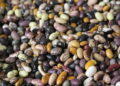
For example, some of the landrace corn has endophytes in them that keep the corn going — that provide nitrogen to the plants and keep it growing and green for most of the season — whereas a lot of the cultivated varieties won’t do that. The microbes that are lost from commercial varieties may be critical for the best growth of that corn — for low-input, low-disease corn that stays green and has lots of nutrients in it. It’s got phenolics and antioxidant amino acids like lysine and methionine.
Kempf. So if you have these landrace varieties that have these beneficial endophytes, and they’re grown in close proximity with, or perhaps in sequence with, commercial corn varieties, is it possible to transfer the microbes in those landrace varieties to the more modern varieties?
White. It’s quite easy, actually. We’ve been playing with that. We take the leaves of the landrace plants — there are important microbes all over the plant, and most of the nitrogen fixation is in the roots, but some of it’s in the leaves. To try to limit the number of microbes we use, we take young, growing leaves, grind those up, extract the sap out of them, and get the microbes out. Then we take our recipient plant, we clean it up using Clorox to remove some of the microbes that are already on it, then we germinate it in the liquid of the cell sap from the leaves of the donor plant. The roots come out and the shoots come out, and they’re colonized. We then transfer that into a garden to compare it to the parental material — to study the effect that the microbes are having on the recipient plant.
It’s easy to do. It’s the easiest thing in the world, and it’s not patentable. This is the Iroquois corn medicine. We’re doing the same thing, in a very similar way. The Iroquois had their own way to stimulate their crops using microbes. They would take their corn to produce corn seed and would dry it — so some microbes are lost in the drying process because the microbiome needs moisture to mature on the seed, but there’s still plenty there. Then they would go out into the woods and gather woodland grasses, or grasses that were along creeks — things like Phragmites, Elymus, Canada wild rye, Virginia wild rye, common reed grass; very common plants. They would take those, dig them up, take the roots, clean some of the dirt off of them, beat them up in water, grind them in water, and then warm that up a little bit. That reduces the titer of microbes; a lot of the gram-negatives are reduced, the ones remaining are the gram-positives.
And what remains is a manageable quantum of endophytic microbes that the Iroquois — and probably all the cultivating indigenous corn cultivators — were creating. You germinate the seed in that, the root comes out, the microbes colonize the roots, and then the plants grow much better. They did this because they saw positive results, even though they didn’t understand the microbiology. The microbes are invisible. It’s like us with a lot of our other science where we can’t see — it’s just a black box. They were doing a black box thing with corn, but as it turns out, it was microbiology related, bio-stimulant related.
Kempf. That’s an incredible story and one of many of indigenous wisdom. You described how you are using this process on an experimental basis for small-scale production, but do you have any thoughts as to how this can be implemented if someone is planting a thousand acres of corn? Could this method be applied to a seed at a rate of a couple quarts per ton and have those organisms transfer through to serve as an effective inoculant?
White. I don’t know. Our experiments are on a very small scale, and we’re doing them to develop principles — to understand how things work. We’re not so practically oriented!
Kempf. My assumption is that this plant-leaf extract, which is alive, probably can’t be stored very well. It would need to be utilized almost right away. Could that extract be produced for, let’s say, that day’s planting — we simply spray it on as corn seed is being loaded into the planter?
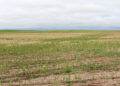
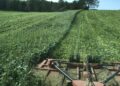
Comparison (Courtesy of Dr. James White & Rutgers University)
White. I would freeze dry it, so it doesn’t have to be done on that day. It’s tricky to get the plants at the right stage when you need them. I think it would work similar to these bioreactors — something like the Johnson-Su bioreactor, where you create a mix of microbes and then you put a little bit on the seed.
Kempf. Let’s say you have a Johnson-Su bioreactor and you were to grow this landrace corn in the bioreactor, so they’re actively cultivating these microbes in that microbial substrate, and then you use that material.
White. It might work. It might not. Endophytes grow better in the plant. You’re going to get different kinds of microbes. You’ll get some that will be useful microbes, but with the Johnson-Su bioreactor, I’m pretty sure the main thing that’s left after the maturation process is Bacillus endospore formers and those that are very much like the biostimulants. So it’s a way of getting some endophytes from those plants. But these ones that are nitrogen fixing are not the spore formers.
We did a collaboration with Ward Labs where they showed that this landrace corn has gram-negative bacteria — so no endospores there. Those are good nitrogen fixers. They have rhizobia, as in root nodules. Many people think that rhizobia are only in legumes, but these landraces have many compared to commercial cultivars. They also, believe it or not, have protozoans in the leaves of the plants.
Kempf. That’s a surprise.
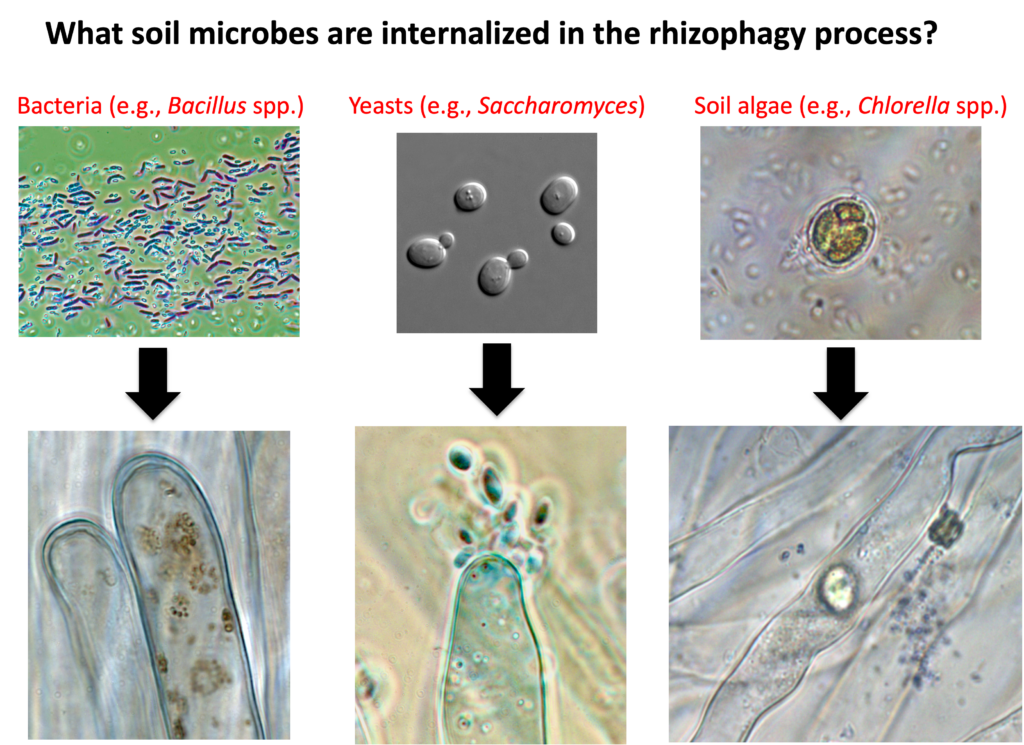
White. That is a surprise. We’ve seen in the past year that in the rhizophagy cycle, roots can actually uptake not only bacteria and fungi but also green algae. They can absorb algae into their cells, and if they’re absorbing algae, maybe they’re actually able to absorb some protozoans as well. We don’t know the fate of the protozoans, but plants may be taking in a more broad-based selection of that healthy soil community than we know of — than we currently understand.
In that sense, plants growing in good, healthy regenerative soils may — in terms of their microbial community, their endophyte community — come to resemble that healthy soil more closely than our cultivated plants produced under intensive cultivation methods, with high fertilization and so forth. That’s the importance of this. It emphasizes the importance of healthy soil. Plants absorb microbes from that healthy soil because they need them.
Kempf. I’m intrigued by the parallel conversation here that we had around fungi exchanging genetic information. It occurs to me that this local adaptation is also fundamental to resilience. Healthy soils improve a farm’s resilience, or a crop’s resilience, because they improve drought resilience and improve freezing stress resilience, in addition to all the other benefits of improving soil health, like water infiltration and so forth.
But we also see that a healthy soil changes the crop’s expression. And what you’re describing just makes me wonder, if we see effects of soil health in a single generation, how much could those effects be compounded over multiple generations?
White. It’s a brilliant question. A mutual friend of ours, Harriett Mella from Austria, is a very focused scientist, and she says that plants rich in microbes typically have a certain pattern of expression, a pattern of how they look. They’ll have thicker epidermis and thicker leaves. There’s more variation in the plants.
What we’re seeing with corn is exactly the same thing. When we move microbes into plants, we see plants with bigger root systems, more branching root systems, more rhizophagy cycle happening in the plant. They have bigger trichomes, bigger epidermal cells, cell growth, bigger plants in general, greener plants, plants that stay green. The chloroplasts have bacteria around them, and they’re not breaking down. The chloroplasts aren’t recycling — they stay intact.
So, the microbe directly impacts the development of the plant. But there’s another impact that we think is happening. This is a hypothesis, but it’s logical. And that is that these bacterial endophytes that go into plants are actually causing the plants to become more genetically variable. Walter Goldstein says that these microbial plants are evolving in the breeding nurseries. You can see them evolving and differentiating. You come back after six months and they look very different than the cultivated types that are all the same. They develop variation. That’s the variation you need to improve that crop.
Now, there’s a phenomenon that may be happening that, in part, can explain some of that variability. Some of these bacterial endophytes are going into the nuclei of the plant — in the nuclear envelope. The nucleus of the plant has this double membrane that goes around it, and these bacteria are getting trapped in that double membrane, and we can see, around those nuclei, that they’re producing ethylene and they’re producing nitrogen — nitrate nitrogen. Both of those chemicals — the hormone ethylene coming from the bacteria and the nitrogen coming from the bacteria — have an effect on the DNA of the plant. They cause the DNA of the plant to replicate.
And particularly in corn, that may mean that you’ve got transposons, or jumping genes, that move around every time the plant replicates. In fact, big cells — for example, larger trichomes on the plant, where the endophytes are — the growth of those organs directly uses those hormones, ethylene and nitrogen, and they’re also causing the DNA to replicate. So there’s more DNA in those cells, and so the cells get bigger.
This is not totally new. It’s new in that we’re seeing that endophytes may be causing it, but it’s not new in that it is known that nitrate and ethylene cause plant DNA to replicate. It’s a process that’s called endoreduplication — basically just meaning that the DNA in the chromosomes in the plant nucleus are dividing. The microbes themselves may cause evolution. If we have more and more microbial plants, we may see more and more variability.
But that also empowers growers. If growers start to grow their crops using biology, they may see this variation happening, and then they can select from it, and then they can take those selections and they can get superior types — types that are genetically different.
Kempf. Wow. This is incredible. One of the conversations we’ve been having with growers for years is that when you change your nutrition management system and your plants start getting a lot of nutrition from biology, plants begin expressing themselves differently. All of a sudden you see different node spacing, you see different leaf width-to-length ratios, you see different phenotypic expression. And so what you’re describing is not at all a surprise from that macro perspective.
But what really intrigues me is that what you’re describing, in essence, is rapid genetic variation and genetic changes, not as a result of crossing and the exchange of genetic information with other plants, but inside the plant itself, in a single generation. When we think about these plants that “self-pollinate,” there are many stories of people planting older varieties in their gardens or on their farms and those varieties completely changing their expression in a matter of sometimes as little as two or three growing seasons.
I can think of two examples that come to mind where there were significant changes in genetic expression in a single growing season. People dismiss these stories and say, “Oh, well, you got your breeding plot contaminated — there was pollen coming in from somewhere else.” But in fact, in the two cases that I have in mind, the growers have a high degree of certainty that couldn’t have happened, and there were significant genetic changes.
So, I get goosebumps having this conversation because I see the possibility and the vision for being able to rapidly accelerate the development of localized varieties, or localized landraces, that can occur much faster than people might be expecting — when you have the association with these symbiotic organisms. I’m quite excited by that revelation.

White. But you have to let people grow their own seeds. And here’s another thing that’s important. The bacteria are actually in the pollen. And the cells that gave rise to the pollen — the pollen mother cells — are the cells that are doing meiosis and giving the variation, producing the gametes, the pollen grains. Those cells — the pollen mother cells — are full of bacteria, and using histochemical stains, we can see that they’re producing lots of nitrogen in those pollen mother cells. That would stimulate this genetic replication and possibly more jumping genes and so forth.
And of course, that’s the source of that variation — in the pollen. We didn’t even know that these bacteria went through the pollen, much less possibly having an effect on the DNA of the plant.
Now we’ve got to get in and figure out exactly how we test that. We have some ideas. It’s going to take us a little bit to do these experiments to see if we can document what’s happening, because of the endophytes, to the DNA of the plant.
Kempf. Yeah, this is incredible.
In our last conversation, you spoke a lot about these endophytes in the rhizosphere and an association with fungi providing nitrogen that was fixed outside the plants and moving into the plant root system. And that’s a very important process, so I’d like to dig deeper and better understand, in addition to this DNA replication process, what the endophytes are doing inside the plant. How are they benefiting the plant specifically in terms of additional nutrition — particularly nitrogen fertilization?
White. Well, the biggest issue is that plants have to have these bacteria to grow. They really can’t grow without them. If they lose these bacteria, germination goes way down. Roots don’t grow properly. You get disease. You get things like root hairs not forming. Trichomes don’t form very well. Plants become very weak without them.
Our concept for how plants work is that you just have a plant and you put fertilizer there and it sucks it up and grows. But in fact, that’s not a correct view of how plants work. Actually, plants, from the very earliest stage, absorb those microbes into their cell tissues and put them all over their cells — all over and around their vascular tissues. They’re on the epidermis area, sometimes they’re in subepidermal layers, sometimes there’s specialized cells that have the microbes in there.
The growth of the plant is dependent on having these microbes inside it, producing these little bits of biostimulant chemicals — hormones. When you give plants nitrate, they respond like it’s a hormone. These microbes all over the plant and inside the plant are what is actually feeding the plant nitrogen and ethylene, causing the plant to grow. Especially inside the cells of the plant. That’s the radical difference of what we’re seeing compared to what we thought was happening.
Every time someone asks me to talk about this, I try to get to yes, because I think it’s so important that everybody understands what plants are actually doing — because it’s fundamental to how we grow crops. If we understand better how plants work — how they use these microbes to do what they need to do — then it makes more sense for us to change how we do agriculture.
Kempf. The agricultural community in general has been indoctrinated with the paradigm that we’re better off without organisms, and that we want to kill these potential pathogens, and that bacteria and fungi causes problems. We consider the epitome of technology to be sterile cell culture and growing plants in sterile environments — in substrate and in peat moss-based mediums and so forth that don’t have microorganisms in them.
This prevailing paradigm loves the idea of plants getting nutrients from simple ions in the soil solution — that they can function essentially as hydroponics. And now you just said something that, if it’s fully grasped — if we really get it into our heads and into our hearts — plants cannot grow without these organisms inside their cells. That’s the seed of a revolution.
White. They really can’t. Now, it turns out that even when you put some plants in hydroponics, they still have some microbes. It’s not the way to grow plants, but they do still have some microbes. Their development may not be totally compromised. But it is impacted. And certainly there’s degrees — for example, if you grow plants hydroponically, with minimal microbes, they’ll probably develop right in terms of the structure. But if you look inside the plant, you’re going to see that the phenolics are low. These plants are not going to be rich in antioxidants. If you look at the individual cells, they may not be fully developed.
Whereas a normal, healthy plant growing in soil, with microbes, is going to be rich in all these nutrients — all these amino acids and antioxidants and phenolics and healthful compounds. They’re going to be rich in it. The reason for that is because it’s an oxidative interaction between the plant — inside the plant cell — and the microbe. The plant secretes reactive oxygen onto the microbe. The microbe then is secreting nutrients. And that interaction causes the plant then to produce all those other good chemicals.
Kempf. And this is fundamentally why a hydroponic tomato doesn’t taste as good as a tomato grown in an organic garden. It’s because of all of these different phenolics, these different aromatic compounds and flavor compounds that are produced.
Let’s talk for just a bit about hormones. Every decade or two, it seems that there is this cycle — there’s this wave of interest — in how biostimulants and phytohormones are going to solve all the world’s problems. And they become this popular set of products that gets widely used for a couple of years, and then the wave fades away. And a decade later, it’s back.
First of all, we know that hormones can have some very powerful effects, but I’ve observed over and over again where a grower makes a hormone application on two different fields at the exact same application rate and produces radically different outcomes. And what I’ve been able to associate that with is the nutritional status of the plant and the microbiome that it’s associated with. And obviously, we haven’t been able to measure this very well historically, but we do know that based on the quality of the soil microorganisms, there is a radically different degree of plant response to an applied product based on what was already present in the environment.
We call these phytohormones plant hormones, but I’m curious if you have any insights into what proportion of the hormones inside a plant are actually produced by the plant versus what proportion are actually produced by the associated microorganisms. We call these organisms in the soil PGPRs — plant-growth-promoting rhizobacteria — because of the phytohormones that they produce. It’s a question of scale, but how much cytokinin is produced by growing root tip cells versus by microorganisms? I have this sneaking suspicion that it might be a lot more in the soil microbiome than we give allowance for.
White. I think that’s right. I think that because we haven’t been able to see inside plants very well, to see these endophytes and see them interacting, we really didn’t know how much there were inside plants — how plants are just filled with these microbes and producing these hormonal substances. It’s a good question. And it comes up when you see how full plants become with soil microbes and seed-vectored microbes too, because the best ones go onto the seed — like in the corn, they go through the seed.
Kempf. Speaking again of corn seed, if the drying processes is problematic, is there a way to overcome that? How can we reduce the loss of microbes as farmers and growers through the seed-saving process? Is there a pathway to accomplish that?
White. Yeah, that’s a good question. Maintaining more moisture around seeds is one thing. As it develops, moisture could be a problem because you get other organisms growing.
Let’s consider corn in nature. What would happen? The whole cob would stay on the plant as that corn degraded. Eventually it would fall off or birds would attack it or something like that. It’s got a lot of moisture. It rains periodically, then dries. That’s going to stimulate the microbiome — the microbes, the bacteria that are on it; maybe some fungi that are on it are going to proliferate a little bit.
The fungi that are there, they may have bacteria there with them. That’s going to affect them so that they’re not pathogenic necessarily. So you have microbiome development that happens when you have enough moisture, when these plants and seeds mature in nature. There’s another term for that: “after-ripening process.” You develop the seed, and you say, “Well, that’s ripe,” but not really. There is this microbiome ripening that still has to happen. And that’s when we harvest it. That’s when the indigenous peoples collected their seed too; that’s why they’re getting losses and need to stimulate the seeds. It’s because that process reduces that microbiome.
To better preserve this microbiome in the seed, we could leave the seeds in nature. There’s one lady that I talked to who’s interested in landrace gardening who was interested in taking seed that she was saving and putting it in an animal dung of some sort that’s not fully desiccated. I don’t know if that worked or not, but people are thinking about that.
Kempf. I think it would be a valuable question to resolve, particularly if we can develop some technologies or practices that were useful at a larger scale.
The last time we spoke, I asked you what proportion of a plant’s nutrition can be derived from this rhizophagy cycle process? And given what I’ve observed in the fields of some growers that we’ve worked with, and given what we can see in wild ecosystems, I’m developing the opinion, just based on observation, experience and not a lot of data, that it can be a great deal. The majority even. I’m thinking of upwards of 80 percent at least.
When you were speaking about the landrace corn varieties earlier and their association with rhizobium and their association with nitrogen-fixing bacteria, what are the possibilities? What are the ideals that we should be striving for? And what is the potential of using this rhizophagy cycle and using these endophytes to supply a crop’s nitrogen requirements in particular?
White. All plants in nature do this. This is what they do; this is what they’ve always done. Even when you look at the earliest plants, the mosses and the liverworts, they have these endophytes in them. They’re all doing it. That’s how they’re getting nitrogen — from these endophytes. No plant in nature needs fertilization.
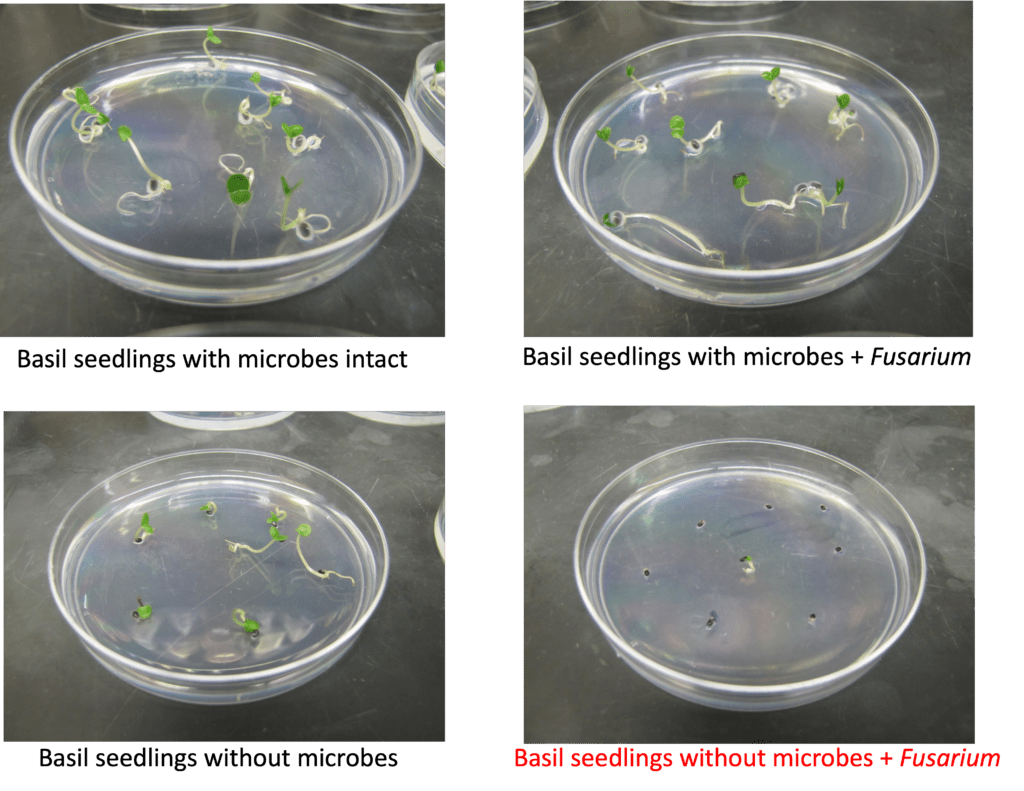
In one of our types of experiments, we remove the microbes and then we put some microbes back on and we grow the plants. When we do that, and we can remove most of the microbes, and then we put them into soils that are also sterile — minimal microbiology — to grow the plant. And we see that it’s very hard to grow plants without microbes.
In fact, in some experiments, the plants don’t live very long. Without the microbes, pathogens come in and take them out. And the difference between the ones without and the ones with microbes, where we added the microbes back, is a huge growth differences — two or three times the size, with roots that are multiple times — sometimes 10 times — different in terms of root growth. I would say not all the nutrients come through the rhizophagy cycle and nitrogen-fixation in plants, but I’ll just throw a number out there — 70 or 80 percent. It’s a pretty high number.
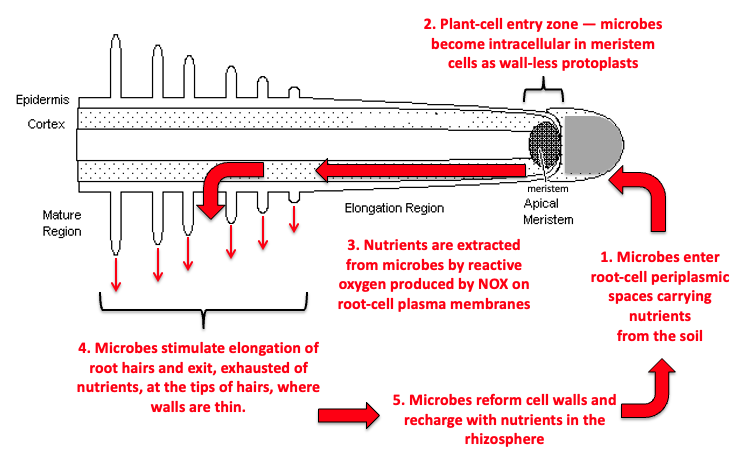
Now, plants can get solubilized forms of 20 or 30 percent of the nutrients they need from the soil, even without microbes. But that’s not the main way plants get nutrients. In nature, plants are not seeing a lot of solubilized nitrogen in the soil.
Kempf. No, certainly not nitrogen.
Occasionally people bring up the response, “Well, you can’t compare domesticated crops that we’re growing in the fields with these wild plants because our crop performance is so different. Our yields are so different. We’re talking about harvesting hundreds of bushels of carbohydrates per acre as compared to a wild ecosystem that produces nothing. Just because a wild plant can absorb 70 or 80 percent of its nutrients and its nitrogen from endophytes via this rhizophagy cycle doesn’t mean that a domesticated plant would be able to do the same thing.” What are your thoughts?
White. I am talking about domesticated plants. Tomato plants and soybean plants, corn plants — we use them in these experiments. Those are domesticated plants. Domesticated plants are only wild plants that we took in and started to manage, and in the process we lost some of the microbiology, and we developed techniques to grow them using chemistry. That’s all they are.
Kempf. I think the point that’s being made is a question of the volume of nitrogen that needs to be fixed. The argument is that these older landrace varieties might only need — I’m making up numbers here — 50 pounds of nitrogen or a hundred pounds of nitrogen per acre to sustain the yield levels that they’re able to produce, while our modern cultivars need 200 units of nitrogen. Is the biology actually capable of fixing such a volume of nitrogen in that acre? I know I have my answer to that question, but I’d love to hear yours.
White. Well, clearly it is, because that’s what we’re seeing in these breeding nurseries where they’re being managed either with very low or no nitrogen — 20 percent of what people normally use. It’s like using nitrogen as a biostimulant — like it’s a hormone. Not too much — just a little bit, just enough to get it going.
But even without nitrogen — I grew this landrace corn last summer in my backyard with no nitrogen at all. They grow fine. Someone who actually knows what they’re doing could get good yields out of some of these landrace corn varieties!
Kempf. Earlier you spoke about bacteria changing the behavior of fungal populations as a result of providing them with nutrients. And there is the opinion that I suspect is incomplete about the need for a certain fungal-to-bacterial ratio in different soils. The common perspective is that our agricultural soils, because of tillage and oxidation and our historical management practices, are very bacterially dominant soils — that we don’t have adequate fungal populations and therefore we need to change the way we manage the soils.
The argument is that we need to look at no-till practices and incorporating different types of compost and inoculants and using different types of cover crops and so forth in an effort to build our fungal population species and to alter the fungal-to-bacterial biomass ratio. And I think there is an element of truth here.
But what I’ve observed, I think, is that there is almost this obsession with bacterial-to-fungal biomass ratios without enough consideration for the absolute levels. I suspect that if the bacterial population is really low and the fungal population is really low, it doesn’t matter what the ratios are. We first need to have a conversation about dramatically elevating the absolute levels of those populations before a conversation about the ratios becomes relevant.
I bring this up because of several experiences that we have had where we dramatically stimulated soil bacterial population with bacterial food sources — carbohydrates, for example — and we get this proliferation of bacterial biomass. And a couple of weeks later, we get this tremendous development of the fungal populations. So I’m of the persuasion that at least for some species, the best way to build soil fungal communities is to feed bacteria. Not to feed fungus, but to feed bacteria — to give them a food source to be able to thrive and proliferate.
White. I agree that the bacteria are the most critical, so feeding the bacteria is a really good idea. That’s the best way, actually — feed those bacteria, increase the bacteria, increase plant growth, then fungal growth also will increase.
So, I agree with that strategy, but the ratio is important. If you consider the components of the soil — the fungi, the bacteria, other groups too — they all have their own functions. They all have their own ways of working. A fungus has a mycelium that goes down into the soil that goes around and colonizes plant material, secreting enzymes onto it to break it down. The bacteria can benefit in that because they can get some of those nutrients that the fungi are releasing.
You have these different components of the soil microbial community. The bacteria benefit the plant directly in the rhizophagy cycle, being absorbed into the plant and moving throughout the plant. Others help break down organic material in the soil, and these bacteria can then get some of those nutrients and move them back to the plant. You have a healthier system with the fungi and bacteria together. If you take one out of the system, it’s less healthy.
But you’re still probably going to have some fungi there and you can build them up if you focus on that, putting organic material into the soil and so forth.
My point is that the most efficient nutrient production and absorption is going to happen when there’s both fungi and bacteria. As that ratio changes, there’s going to be an optimum ratio that’s most efficient for the most amount of nutrients. But that doesn’t mean that if it’s not optimum, it’s not going to be good at all. If you have good bacteria there, it’s going to work and you can easily build up your fungal populations, like you said.
Kempf. I just wonder, when the microbial population becomes rich enough and there’s this incredible microbial fertility in the soil, whether the ratio conversation becomes a lot less relevant. In other words, you have such a vigorous total population that the exact ratio isn’t the most important factor anymore.
White. I think it’s not. I think the whole question comes back to efficiency and nutrient acquisition from the soil and absorption. If you’ve got lots of microbes, it’s probably going to be highly efficient.
Kempf. I’m intrigued by one of your other revelations on protozoa being inside plants. You mentioned algae being inside plant cells, and in one sense it’s not really a surprise because we’ve known that algae have been on leaf surfaces and have been associated with plants for some time. But protozoa is a surprise.
When I think of protozoa, I think of them being in the soil rhizosphere as grazers, if you will, grazing on the bacterial population and mineralizing nutrients that they contain and making them available to plants through that means. Do you imagine they’re having a similar function inside the plant cells as well?
White. We have not actually seen them in plants — we’ve measured them using fatty acid analysis in our Ward Lab study. My thought is that they are being absorbed and fully degraded — so it’s back to the idea of plant-eating — rhizophagy. Some microbes are fully degraded, so if they take in algae or they take in protozoans, they may be fully degraded. I don’t know. What we see in plants are generally bacteria and sometimes fungi.
I have also seen algae in plants before from some researchers in Germany. But I think they may be fully degraded in a lot of the cases. This is an area that we need to understand better. Are they being degraded in the roots, and then we’re getting the fatty acids that move all over the plant?