Acres U.S.A.® Magazine
  • Articles
    • News
    • Ecological farming
      • Climate
      • Environmental Issues
      • Farm management & planning
      • Human health
    • Livestock
    • Farm
    • Crop
      • Crop management practices
        • Ag technology
        • Cover crops
        • Crop nutrition
          • Crop protection
          • Diseases
        • Crops
        • Fruits
    • Soil
    • Opinion
  • Resources
    • Magazine
    • Online Learning
    • Newsletters
    • Free Articles
    • Blog
  • Magazine Issues
    • 2026
      • March 2026
      • February 2026
      • January 2026
    • 2025
      • December 2025
      • November 2025
      • October 2025
      • September 2025
      • August 2025
      • July 2025
      • June 2025
      • May 2025
      • April 2025
      • March 2025
      • February 2025
      • January 2025
    • 2024
      • December 2024
      • November 2024
      • October 2024
      • September 2024
      • August 2024
      • July 2024
      • June 2024
      • May 2024
      • April 2024
      • March 2024
      • February 2024
      • January 2024
    • 2023
      • December 2023
      • November 2023
      • October 2023
      • August 2023
      • July 2023
      • June 2023
      • May 2023
      • April 2023
      • March 2023
      • February 2023
      • January 2023
    • 2022
      • December 2022
      • November 2022
      • October 2022
      • September 2022
      • August 2022
      • July 2022
      • June 2022
      • May 2022
      • April 2022
      • March 2022
      • February 2022
  • About Us
    • Our History
    • Our Staff
    • Contact Us
    • Community
      • Soil Health Primer Resources
  • Events
    • Eco-Ag Conference
    • Farm Weird Event
    • Viroqua On Farm Event
  • Subscribe
  • Login
  • Register
No Result
View All Result
  • Articles
    • News
    • Ecological farming
      • Climate
      • Environmental Issues
      • Farm management & planning
      • Human health
    • Livestock
    • Farm
    • Crop
      • Crop management practices
        • Ag technology
        • Cover crops
        • Crop nutrition
          • Crop protection
          • Diseases
        • Crops
        • Fruits
    • Soil
    • Opinion
  • Resources
    • Magazine
    • Online Learning
    • Newsletters
    • Free Articles
    • Blog
  • Magazine Issues
    • 2026
      • March 2026
      • February 2026
      • January 2026
    • 2025
      • December 2025
      • November 2025
      • October 2025
      • September 2025
      • August 2025
      • July 2025
      • June 2025
      • May 2025
      • April 2025
      • March 2025
      • February 2025
      • January 2025
    • 2024
      • December 2024
      • November 2024
      • October 2024
      • September 2024
      • August 2024
      • July 2024
      • June 2024
      • May 2024
      • April 2024
      • March 2024
      • February 2024
      • January 2024
    • 2023
      • December 2023
      • November 2023
      • October 2023
      • August 2023
      • July 2023
      • June 2023
      • May 2023
      • April 2023
      • March 2023
      • February 2023
      • January 2023
    • 2022
      • December 2022
      • November 2022
      • October 2022
      • September 2022
      • August 2022
      • July 2022
      • June 2022
      • May 2022
      • April 2022
      • March 2022
      • February 2022
  • About Us
    • Our History
    • Our Staff
    • Contact Us
    • Community
      • Soil Health Primer Resources
  • Events
    • Eco-Ag Conference
    • Farm Weird Event
    • Viroqua On Farm Event
  • Subscribe
No Result
View All Result
Acres U.S.A.® Magazine
No Result
View All Result
Home Crop management practices Crops Fruits

Rethinking Orchard Sanitation

Chuck Schembre by Chuck Schembre
May 2, 2026
in Fruits, May 2026, Nuts
0
Rethinking Orchard Sanitation

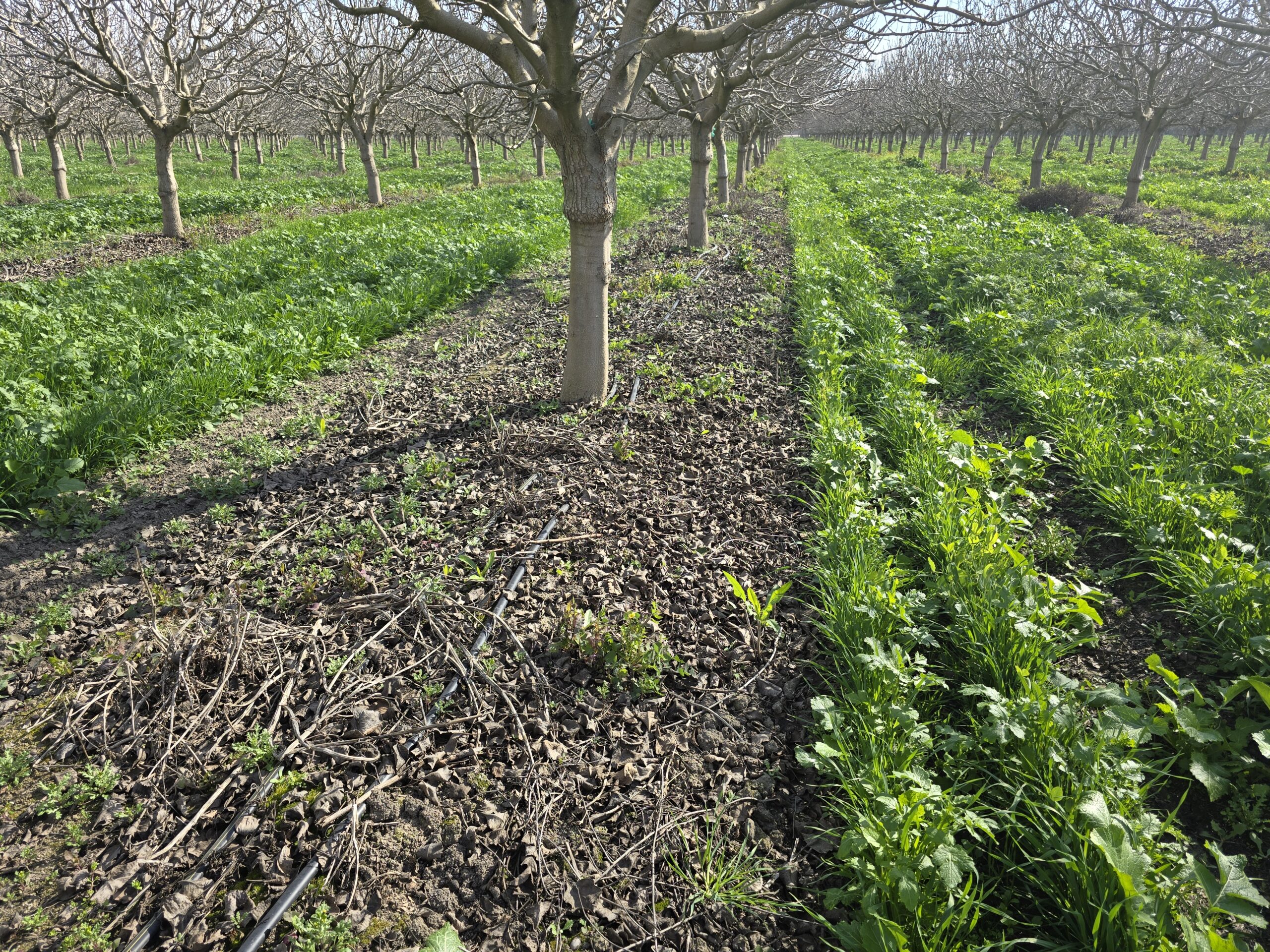
Fallen leaves and plant residue fill the row in this pistachio orchard — fostering symbiotic relationships with soil organisms.

0
SHARES
846
VIEWS
Share on FacebookShare on Twitter

Are we solving the wrong problem when we strip away everything under our trees?

By Chuck Schembre

As the orchard industry transitioned into large-scale commercial systems many decades ago, growers faced a new reality: increasing disease and insect pressure. In response, universities, researchers, and crop advisors promoted a practice now widely accepted as standard, orchard sanitation.

Sanitation, in its simplest form, involves removing leaves, prunings, woody debris, and fallen fruit from the tree row. This material is often swept or blown into rows, then shredded, burned, or treated with nitrogen fertilizers to accelerate decomposition. The reasoning is straightforward: this debris serves as an overwintering site for disease pathogens and insect pests. Remove the habitat, and you reduce next year’s pressure.

Support authors and subscribe to content

This is premium stuff. Subscribe to read the entire article.

Login if you have purchased

Subscribe

Gain access to all our Premium contents.
More than 100+ articles.
Subscribe Now
← Previous Stockpiling It On Next The Lipid Spark →
Tags: Orchard sanitation
Chuck Schembre

Chuck Schembre

Chuck Schembre is a Regenerative Specialty Crop consultant for Understanding Ag, and serves clients across a broad geographical range in the United States, with an emphasis on California and the West. He specializes in orchards, vineyards, and diversified vegetable cropping systems, and has experience working with small grains, hay crops, and pastures. Chuck provides a diversity of services to his clients, addressing each client’s specific needs and opportunities to begin their regenerative journey, and advance strategies to take their regenerative practices to the next level. As with all the consultants on the UA team, Chuck focuses on building soil health and farm ecosystem function through the implementation of UA’s 6-3-4 rules and principles, and he provides additional expertise in soil health analysis, regenerative crop fertility, biological disease and pest management, advance horticulture practices, input reduction strategies, and ecosystem restoration. Chuck also assists clients in small livestock integration, specializing in orchard and vineyard livestock integration, providing the core understanding of adaptive grazing principles and how to manage livestock regeneratively while complying with food safety regulations. Chuck has studied and practiced many agroecological farming disciplines and draws on many of these disciplines in his own farming and consulting, including permaculture, biointensive growing, natural Korean farming, organic farming, and holistic farming principles. He believes the most powerful common thread between all these disciplines is an emphasis to emulate nature’s design, promote life below the soil, and harness the power of the earth’s free resources – sun, water, air, and mineral. Chuck has been working in agriculture and natural resource positions for 20 years, which includes managing small-diversified farms, fruit orchards and larger scale vineyards, and working as a soil scientist, agronomist, and resource conservation specialist in California and Nevada. Throughout Chuck’s multiple positions, he has served as a soil health educator, conducted many presentations and trainings, and has worked with 100’s of farmers and landowners providing on-farm technical assistance and soil health consulting. He holds a bachelor’s degree in Earth and Soil Science from California Polytechnic State University, San Luis Obispo, and is a Certified Professional Soil Scientist (CPSS), and Erosion and Sediment Control Specialist (CPESC). Chuck did not grow up on a farm and found his journey into agriculture through a passion for food and nutrition, and a desire to get back to the land. He began volunteering on small organic farms, and he cut his teeth in production farming at the Cal Poly Organic Farm, a 15-acre, diversified commercial vegetable farm. Chuck began seeking wisdom from many of the Ecological Farming Association pioneers in California, which he believes ignited his passion to pursue natural farming systems and his soil health journey. Out of college, he served in the AmeriCorps Watershed Stewards Project in Northern California, working on water quality projects and continued working at a diversified farm owned by a local tribe. Chuck continued to pursued farming after the AmeriCorp, managing diversified vegetable and fruit farms, focusing on agroecological practices and homesteading. Chuck eventually moved on to manage vineyards in Northern California and landed a position to manage a regional soil health demonstration vineyard for the Napa Resource Conservation District (RCD) where he was able to trial and experiment with many cutting edge soil health practices. While at the RCD, he helped found the North Coast Soil Health Hub and co-developed a soil health monitoring protocol for vineyards. He worked with many vineyard producers conducting soil health assessments, developing water quality farm plans, carbon farm plans, providing erosion control assistance, and water use efficiency evaluations. The work at the RCD also allowed Chuck to integrate many technologies, such as soil moisture probe monitoring, vine water stress measuring, eddy conference, and remote sensing. In an effort to live closer to family and a change in culture, Chuck and his family moved to Nevada and where he took over the direction and management of the Desert Farming Initiative, an educational, demonstration, and research farm focused on high-desert foods systems at the University of Nevada Reno, Experiment Station. Chuck was able to advance this organization’s role in regenerative agriculture in Nevada. He currently resides in the high desert in Carson Valley, Nevada, with his wife and two children. He finds beauty in the high desert, and he believes his experience farming and living in the most arid State gives him an advantage towards understanding the possibilities of building soil health in any climate. In Nevada, Chuck provides his time through grassroot efforts to help advance soil health adoption by conducting education and providing assistance to private, local and state government entities who have a vested interested in developing legislation and funding opportunities to advance soil health in Nevada.


Next Post
Yes, There Are Enough Organic Wastes

Yes, There Are Enough Organic Wastes

  • Trending
  • Comments
  • Latest
The Most Important Livestock in Our Fields

The Most Important Livestock in Our Fields

July 1, 2024
Glyphosate Does What It’s Designed to Do — Kill

Glyphosate Does What It’s Designed to Do — Kill

February 19, 2025
USDA organic seal over American farm land

Losing Organic Farms

January 27, 2026
The Take-Half, Leave-Half Fallacy

The Take-Half, Leave-Half Fallacy

July 1, 2025
We Don’t Need Another Bridge — We Need an Off-Ramp

We Don’t Need Another Bridge — We Need an Off-Ramp

3
Under One Roof

Under One Roof

3
A Rose By Any Other Name

A Rose By Any Other Name

2
Terra Preta’s Biological Advantage

Terra Preta’s Biological Advantage

2
Sulfur Shortage

Sulfur Shortage

May 21, 2026
An Inconvenient Rule

An Inconvenient Rule

May 14, 2026
Yes, There Are Enough Organic Wastes

Yes, There Are Enough Organic Wastes

May 7, 2026
Do GMO Crops Uptake Nutrients Differently?

Do GMO Crops Uptake Nutrients Differently?

May 2, 2026

Recent News

Sulfur Shortage

Sulfur Shortage

May 21, 2026
An Inconvenient Rule

An Inconvenient Rule

May 14, 2026
Yes, There Are Enough Organic Wastes

Yes, There Are Enough Organic Wastes

May 7, 2026
Do GMO Crops Uptake Nutrients Differently?

Do GMO Crops Uptake Nutrients Differently?

May 2, 2026

About ACRES USA

Acres U.S.A.® Magazine

Acres U.S.A.® is North America’s oldest publisher on production-scale organic and regenerative farming. For more than 50 years, our mission has been to help farmers, ranchers and market gardeners grow food profitably and sustainably, with nature in mind.

Magazine Issues

  • News
  • 2025
    • June 2025
    • May 2025
    • April 2025
    • March 2025
    • February 2025
    • January 2025
  • 2024 Articles
    • December 2024
    • November 2024
    • October 2024
    • September 2024
    • August 2024
    • July 2024
    • June 2024
    • May 2024
    • April 2024
    • March 2024
    • February 2024
    • January 2024
  • December 2023
    • December 2023
    • November 2023
    • October 2023
    • August 2023
    • July 2023
    • June 2023
    • May 2023
    • April 2023
    • March 2023
    • February 2023
    • January 2023
  • December 2022
    • November 2022
    • October 2022
    • September 2022
    • August 2022
    • July 2022
    • June 2022
    • May 2022
    • April 2022
    • March 2022

Contact Acres U.S.A

  • Contact Us
  • About Us
  • Advertise With Acres U.S.A.
  • My Subscription

Learn

  • Resources
  • Events
  • Magazine
  • Newsletters
  • Free Articles
  • Webinars
  • Online Courses
  • Bookstore

Our All Socials

Follow With Us...

  • My account
  • News
  • Ecological farming
  • Refund and Returns Policy
  • Privacy & Policy

© 2024 Acers USA Magazine

Welcome Back!

Login to your account below

Forgotten Password? Sign Up

Create New Account!

Fill the forms below to register

All fields are required. Log In

Retrieve your password

Please enter your username or email address to reset your password.

Log In

Create a free account, or log in.

Gain access to read this article, plus limited free content.

Yes! I would like to receive new content and updates.

Upgrade your subscription

Support Acres USA and get full access to all content.
Upgrade Now
No Result
View All Result
  • HOME
  • ARTICLES
    • News
    • Farm
    • Ecological farming
    • Livestock
    • Crop
      • Crop management practices
      • Cover crops
      • Crop nutrition
      • Crop protection
      • Crops
      • Ag technology
    • Soil
    • Opinion
  • RESOURCES
    • Magazine
    • Online Learning
    • Newsletters
    • Blog
    • Free Articles
  • MAGAZINE ISSUES
    • 2025
      • June 2025
      • May 2025
      • April 2025
      • March 2025
      • February 2025
      • January 2025
    • 2024
      • December 2024
      • November 2024
      • October 2024
      • September 2024
      • August 2024
      • July 2024
      • June 2024
      • May 2024
      • April 2024
      • March 2024
      • February 2024
      • January 2024
    • 2023
      • December 2023
      • November 2023
      • October 2023
      • August 2023
      • July 2023
      • June 2023
      • May 2023
      • April 2023
      • March 2023
      • February 2023
      • January 2023
  • ABOUT US
    • Our History
    • Our Staff
    • Contact Us
    • Community
      • Soil Health Primer Resources
  • EVENTS
    • Eco-Ag Conference
    • On-Farm Viroqua Event
    • Farm Weird
  • SUBSCRIBE
  • Login
  • Sign Up
  • Cart

© 2024 Acers USA Magazine

Are you sure want to unlock this post?
Unlock left : 0
Are you sure want to cancel subscription?