

Rhizophagy and cyanobacteria should force us to rethink the role of energy in the root zone
By Deac Jones
For more than a century, plant physiology has operated under a foundational assumption: plants generate energy through photosynthesis. Sunlight strikes chlorophyll, carbon dioxide is fixed, sugars are produced, and plants grow.
Yet this framework may not be complete. What if photosynthesis is not the only meaningful energetic contribution within a plant-soil system? What if the root zone plays a more dynamic role in plant energetics than we have traditionally acknowledged?
Lipid-rich Microbes
Cyanobacteria, often referred to as “blue-green algae,” are metabolically versatile bacteria capable of oxygenic photosynthesis. Many species fix atmospheric nitrogen. Many influence soil structure through extracellular compounds that bind particles. And importantly, their cellular composition is rich in lipids. Lipids are dense carbon structures—energy-rich molecules that store metabolic potential.
Cyanobacteria interact with fungi, bacteria, and plant roots as part of dynamic biological networks. Microalgae, their eukaryotic counterparts, also inhabit soil environments and similarly produce lipid-rich biomass.
If soils contain lipid-rich photosynthetic microorganisms, does the energetic density of that biomass influence crops?
Beyond Nutrients: The Energy Dimension
Agriculture has become highly sophisticated at managing nutrients. We measure nitrogen, phosphorus, potassium and calcium; we monitor pH and cation exchange capacity; we quantify organic matter. But we rarely consider energy density.
Carbon is often treated as a uniform metric: percentage organic matter. Yet carbon exists in many forms. Fresh microbial biomass behaves differently than stabilized humus. Lipid fractions differ from cellulose residues. Living carbon cycles differently than inert carbon.
Key to our concern here, lipids contain more than twice as much energy per gram as they do carbohydrates. In ecological systems, they function as compact energy reservoirs.
Dr. James White’s research into plant-microbe interactions, particularly his work describing the rhizophagy cycle, has demonstrated that roots actively internalize and oxidize microbial cells in order to acquire nutrients. This reframes the rhizosphere as a site of intimate biochemical exchange — not simply dissolved mineral uptake.

Microbial cells are complete biochemical systems composed of proteins, carbohydrates and lipids. When lipid-rich photosynthetic microorganisms — including microalgae and cyanobacteria — are part of this living soil matrix, the energetic dimension of that exchange warrants attention. If energy-dense microbial biomass participates in root-level exchange, the implications extend beyond simple nutrient transfer. Energy entering through the root interface — whether through microbial turnover near root hairs or internalized microbial oxidation — may influence plant metabolic intensity itself.
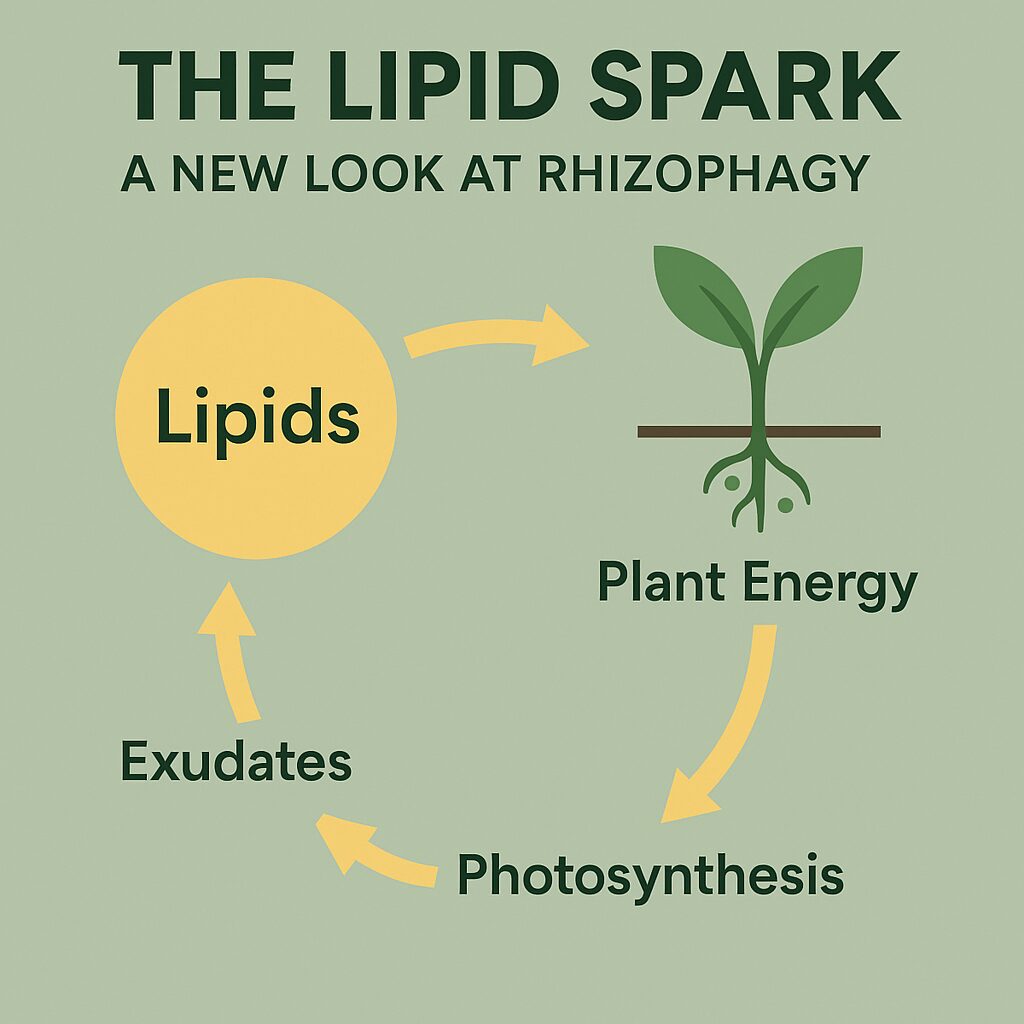
Plant metabolism and photosynthesis are tightly linked. When metabolic activity increases, photosynthetic capacity often rises in response. Elevated photosynthesis increases carbohydrate production, and a portion of those carbohydrates are released into the rhizosphere as root exudates.
Exudation is not incidental — it regulates microbial activity and nutrient cycling. Greater exudation stimulates microbial populations and accelerates mineralization processes in soil. The biological cascade becomes clear: Increased metabolic intensity → enhanced photosynthesis → greater exudation → accelerated mineralization.
Rather than bypassing photosynthesis, a biologically active root zone may amplify it.
Agriculture Under Energy Constraint
Modern cropping systems frequently operate under energetic limitations. Plants don’t photosynthesize as much as they could due to a variety of factors, including extended cloud cover, smoke events, temperature extremes, compacted soils that limit oxygen exchange, reduced microbial diversity, and more.
Under these conditions, photosynthetic output can be constrained even when nutrients are adequate. Growth responses may lag despite fertility. And while fertilizer supplies building blocks, it does not supply metabolic energy. Energy drives assimilation, lignification, and stress recovery. While nutrients enable potential, energy determines expression.
If biologically active soils contain dynamic pools of lipid-rich microbial biomass — and if elements of that biomass participate in rhizophagic exchange — then soil systems may provide metabolic support that enhances photosynthetic performance and downstream nutrient cycling. This does not replace the leaf as the primary energy generator. It merely suggests that the soil food web may complement plant energetics in ways that remain underexplored.
A Broader View of Soil Function
Soil health discussions have matured considerably over the past several decades. We now emphasize microbial diversity, aggregation, carbon cycling and resilience. Perhaps the next refinement is not only how much carbon is present, but what form it takes — and how dynamically it moves.
Cyanobacteria and microalgae function quietly in soils. They succeed by capturing light and constructing energy-dense cellular structures.
The lipid spark is not a rejection of photosynthesis. It is a recognition that living soils may contribute energetically in ways historically underestimated. Field observations in biologically active systems suggest that lipid-rich microbial turnover may influence plant resilience, stress recovery, and structural development through amplified metabolic and exudative processes.
We have become adept at measuring soil chemistry and increasingly skilled at measuring soil biology. The next frontier may be understanding soil as a dynamic carbon energy system. Photosynthesis remains foundational. But in biologically active soils, it may not operate alone.