
Acres U.S.A.® Magazine
  • Articles
    • News
    • Ecological farming
      • Climate
      • Environmental Issues
      • Farm management & planning
      • Human health
    • Livestock
    • Farm
    • Crop
      • Crop management practices
        • Ag technology
        • Cover crops
        • Crop nutrition
          • Crop protection
          • Diseases
        • Crops
        • Fruits
    • Soil
    • Opinion
  • Resources
    • Magazine
    • Online Learning
    • Newsletters
    • Free Articles
    • Blog
  • Magazine Issues
    • 2025
      • October 2025
      • September 2025
      • August 2025
      • July 2025
      • June 2025
      • May 2025
      • April 2025
      • March 2025
      • February 2025
      • January 2025
    • 2024
      • December 2024
      • November 2024
      • October 2024
      • September 2024
      • August 2024
      • July 2024
      • June 2024
      • May 2024
      • April 2024
      • March 2024
      • February 2024
      • January 2024
    • 2023
      • December 2023
      • November 2023
      • October 2023
      • August 2023
      • July 2023
      • June 2023
      • May 2023
      • April 2023
      • March 2023
      • February 2023
      • January 2023
    • 2022
      • December 2022
      • November 2022
      • October 2022
      • September 2022
      • August 2022
      • July 2022
      • June 2022
      • May 2022
      • April 2022
      • March 2022
      • February 2022
  • About Us
    • Our History
    • Our Staff
    • Contact Us
    • Community
      • Soil Health Primer Resources
  • Events
    • Eco-Ag Conference
    • Farm Weird Event
    • Viroqua On Farm Event
  • Subscribe
  • Login
  • Register
No Result
View All Result
  • Articles
    • News
    • Ecological farming
      • Climate
      • Environmental Issues
      • Farm management & planning
      • Human health
    • Livestock
    • Farm
    • Crop
      • Crop management practices
        • Ag technology
        • Cover crops
        • Crop nutrition
          • Crop protection
          • Diseases
        • Crops
        • Fruits
    • Soil
    • Opinion
  • Resources
    • Magazine
    • Online Learning
    • Newsletters
    • Free Articles
    • Blog
  • Magazine Issues
    • 2025
      • October 2025
      • September 2025
      • August 2025
      • July 2025
      • June 2025
      • May 2025
      • April 2025
      • March 2025
      • February 2025
      • January 2025
    • 2024
      • December 2024
      • November 2024
      • October 2024
      • September 2024
      • August 2024
      • July 2024
      • June 2024
      • May 2024
      • April 2024
      • March 2024
      • February 2024
      • January 2024
    • 2023
      • December 2023
      • November 2023
      • October 2023
      • August 2023
      • July 2023
      • June 2023
      • May 2023
      • April 2023
      • March 2023
      • February 2023
      • January 2023
    • 2022
      • December 2022
      • November 2022
      • October 2022
      • September 2022
      • August 2022
      • July 2022
      • June 2022
      • May 2022
      • April 2022
      • March 2022
      • February 2022
  • About Us
    • Our History
    • Our Staff
    • Contact Us
    • Community
      • Soil Health Primer Resources
  • Events
    • Eco-Ag Conference
    • Farm Weird Event
    • Viroqua On Farm Event
  • Subscribe
No Result
View All Result
Acres U.S.A.® Magazine
No Result
View All Result
Home Crop management practices Crops

Promoting Local Food

Marty Travis by Marty Travis
March 31, 2024
in Crops
0
Promoting Local Food
0
SHARES
7
VIEWS
Share on FacebookShare on Twitter

Strengthening the regenerative supply chain through a new USDA grant program

Marty Travis

You have heard it said that timing is everything. I have always thought it is important to have a market for your products before going great guns and planting the farm into a specific crop or crops. Understanding the market has always been key to cash flow and managing any business. 

It’s no different with local foods. Many growers have had good experiences with CSAs, farmers markets or on-farm sales. Some have gone to local food co-ops or restaurants and developed great relationships with those avenues. I would like to offer another possibility that we are exploring and plan to participate in for the coming winter and 2024 season. 

Some may be aware of the Local Food Promotion Assistance grants that are being made available through many state departments of agriculture. Here is the basic information from the USDA website: 
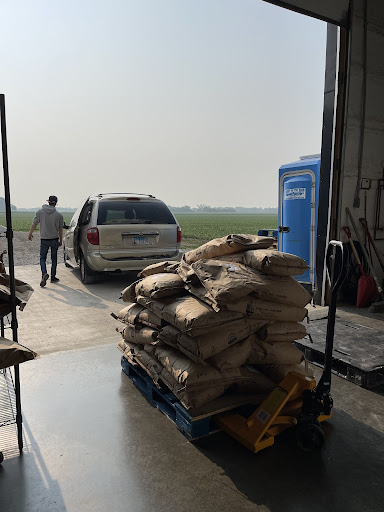
The Local Food Purchase Assistance Cooperative Agreement Program (LFPA) uses non-competitive cooperative agreements to provide up to $900 million of American Rescue Plan (ARP) and Commodity Credit Corporation (CCC) funding for state, tribal and territorial governments to purchase foods produced within the state or within 400 miles of the delivery destination to help support local, regional and underserved producers. The purpose of this program is to maintain and improve food and agricultural supply chain resiliency. The cooperative agreements allow the states, tribes and territories to procure and distribute local and regional foods and beverages that are healthy, nutritious, unique to their geographic areas and that meet the needs of the population. The food will serve feeding programs, including food banks, schools and organizations that reach underserved communities. In addition to increasing local food consumption, the funds will help build and expand economic opportunity for local and underserved producers.

I must admit that when I was first made aware of this program and I understood it was potentially going to be funded for possibly a year or two, I was pretty skeptical. My hesitation revolved around gearing up for this and then, at the end of the grant cycle, watching the funds go away and being left with a system in place and our demand diminished. In our area there was also very little support for scaling up infrastructure to meet this program. 

For some context, we operate a collaboration of farmers called Down at the Farms, LLC. We are a group of nearly 90 producers working together to sell our products into the Chicago and downstate Illinois food scene. We service restaurants, not-for-profits, local grocery stores and corporate employee cafeterias. We are always tuned in to being aware of demand or needs that can be filled by our existing group of farmers as well as any new and beginning farmers looking for an opportunity to break into our expanding market.

As we began to think about and explore the Local Food Promotion Assistance Grant, we saw it as a way to diversify even more and as an opportunity for our new and existing farmers to sell more products. Philosophically, we also thought that this was a good way to serve those underserved communities downstate with great local food — something many of them are unable to access. So much of our current production goes to high-end restaurants and to those who can easily afford access to healthy food. With this grant program, we felt we could serve more of our local communities and potentially have an impact on families living in these communities. 
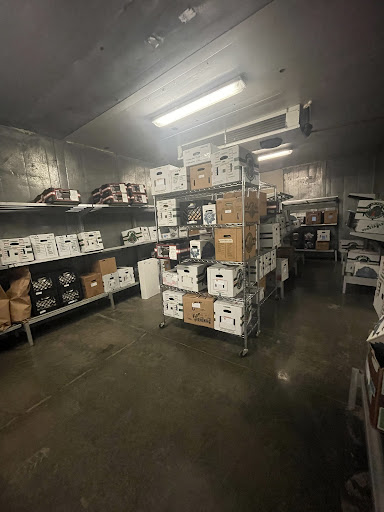
Additionally, this program would allow many of our farmers to produce and to scale up their production with limited risk, as we will need to fill between 300 and 400 farm boxes with food each week. Filling the boxes with a vast variety of farm products will keep excitement and interest for the recipients but will also offer a greater purpose for us as farmers. We will provide these boxes in addition to our regular restaurant accounts. 
There is another aspect to this program. Our group also has a new, larger grocery account that will be taking products in 2024. The grant program allows us to scale up, bring on new farmers, and create cash flow for all of our farms as we prepare to serve this new account. It will also enable us to scale up our distribution facilities. Learning to work together to produce more good food and to develop systems to assist in the consolidation and distribution of that food is really important. 

So, yes, for our area farmers, now is a great time to get into local foods. We will have plenty of demand to fill our regular accounts, to provide weekly food boxes to local families and to vision expansion into a new market in 2024. 
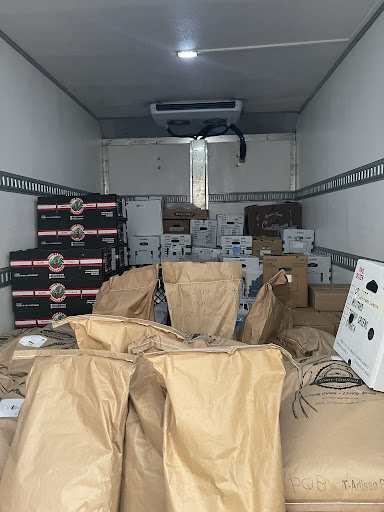
Now let me talk about how all of this reflects on a regenerative supply chain operation. Down at the Farms was founded to serve the needs of our local food producers as a marketing, consolidation and distribution entity. We provide a service to our producers that encompasses the whole food system experience, selling to restaurants and institutions. We deliver 50 out of 52 weeks, taking just Christmas and New Years off. For this service we charge a small percentage of sales from each of the producers to cover costs of the warehouse, cold storage, and labor for the warehouse and drivers of the delivery trucks and the marketing, invoicing and pay outs to farmers.

For this grant program we have also helped create satellite distribution hubs throughout the state on our existing farmers’ properties to receive and then distribute the weekly farm boxes to families in their communities. Down at the Farms acts as the consolidation point for the whole group of farmers and then distributes the bulk products to the satellites, where it is assembled into family farm boxes and distributed to those in their communities. Again, it puts a face to the food as someone in their community serving the community. It also spreads the reach of Down at the Farms farmers without having to individually distribute to each of those customers. It creates a somewhat closed-loop supply chain where we are all working together to keep the food dollars in our communities. 

Since the announcement of the grant program, there have been other funds allocated for scaling up the infrastructure statewide. Those funds will assist individual farmers to acquire or update cold storage, wash and pack facilities, or refrigerated delivery vehicles. By using these funds and the profits from the other existing avenues — i.e., family farm boxes and regular restaurant sales — we feel we can continue to build a very resilient food system in our area of the state that honors the work of each of our producers.

We are working to lift everyone to a higher level of quality, quantity and pride. We are working to empower young growers and provide mentoring as a group to those who want to have this information and experience. We want to own the supply chain and provide the best products and experiences to all. 

John Ikerd talks about how healthy local food systems value relationships. They respect farmers and encourage compassion, trust and responsibility. Groups have shared social and ethical values. Cooperation is encouraged over competition. These are the things that we can all aspire to. Providing this kind of service has been extremely rewarding. It’s an honor to serve our farmers and to deliver great local food to so many. 

Isn’t this the reason we want to feed people?

Marty Travis is a seventh-generation farmer at Spence Farm in Fairbury, Illinois. He runs a co-op that markets the products of over a hundred small farms to chefs in Chicago and throughout the state. Marty is the author of My Farmer, My Customer, published by Acres U.S.A.


← Previous Funding On-Farm Research Next Time to Leave Carbon Markets Behind →
Tags: Community Supported Agriculture (CSA)Local Food Promotion
Marty Travis

Marty Travis

Marty Travis is a seventh-generation farmer at Spence Farm in Fairbury, Illinois. He runs a co-op that markets the products of over a hundred small farms to chefs in Chicago and throughout the state. Marty is the author of My Farmer, My Customer, published by Acres U.S.A.

Next Post
Time to Leave Carbon Markets Behind

Time to Leave Carbon Markets Behind

  • Trending
  • Comments
  • Latest
The Most Important Livestock in Our Fields

The Most Important Livestock in Our Fields

July 1, 2024
Glyphosate Does What It’s Designed to Do — Kill

Glyphosate Does What It’s Designed to Do — Kill

February 19, 2025
The Take-Half, Leave-Half Fallacy

The Take-Half, Leave-Half Fallacy

July 1, 2025
White snakeroot

Toxic Forages?

September 1, 2025
We Don’t Need Another Bridge — We Need an Off-Ramp

We Don’t Need Another Bridge — We Need an Off-Ramp

3
Under One Roof

Under One Roof

3
A Rose By Any Other Name

A Rose By Any Other Name

2
Terra Preta’s Biological Advantage

Terra Preta’s Biological Advantage

2
Don’t You Dare Disparage Sugar!

Don’t You Dare Disparage Sugar!

February 3, 2026
February 2026 • Issue #656

February 2026 • Issue #656

February 1, 2026
Fungal Exchange Capacity

Fungal Exchange Capacity

February 1, 2026
ECO-MEETINGS

ECO-MEETINGS

February 1, 2026

Recent News

Don’t You Dare Disparage Sugar!

Don’t You Dare Disparage Sugar!

February 3, 2026
February 2026 • Issue #656

February 2026 • Issue #656

February 1, 2026
Fungal Exchange Capacity

Fungal Exchange Capacity

February 1, 2026
ECO-MEETINGS

ECO-MEETINGS

February 1, 2026

About ACRES USA

Acres U.S.A.® Magazine

Acres U.S.A.® is North America’s oldest publisher on production-scale organic and regenerative farming. For more than 50 years, our mission has been to help farmers, ranchers and market gardeners grow food profitably and sustainably, with nature in mind.

Visit Our Advertisers

Magazine Issues

  • News
  • 2025
    • June 2025
    • May 2025
    • April 2025
    • March 2025
    • February 2025
    • January 2025
  • 2024 Articles
    • December 2024
    • November 2024
    • October 2024
    • September 2024
    • August 2024
    • July 2024
    • June 2024
    • May 2024
    • April 2024
    • March 2024
    • February 2024
    • January 2024
  • December 2023
    • December 2023
    • November 2023
    • October 2023
    • August 2023
    • July 2023
    • June 2023
    • May 2023
    • April 2023
    • March 2023
    • February 2023
    • January 2023
  • December 2022
    • November 2022
    • October 2022
    • September 2022
    • August 2022
    • July 2022
    • June 2022
    • May 2022
    • April 2022
    • March 2022

Contact Acres U.S.A

  • Contact Us
  • About Us
  • Advertise With Acres U.S.A.
  • My Subscription

Learn

  • Resources
  • Events
  • Magazine
  • Newsletters
  • Free Articles
  • Webinars
  • Online Courses
  • Bookstore

Our All Socials

Follow With Us...

  • My account
  • News
  • Ecological farming
  • Refund and Returns Policy
  • Privacy & Policy

© 2024 Acers USA Magazine

Welcome Back!

Login to your account below

Forgotten Password? Sign Up

Create New Account!

Fill the forms below to register

All fields are required. Log In

Retrieve your password

Please enter your username or email address to reset your password.

Log In
No Result
View All Result
  • HOME
  • ARTICLES
    • News
    • Farm
    • Ecological farming
    • Livestock
    • Crop
      • Crop management practices
      • Cover crops
      • Crop nutrition
      • Crop protection
      • Crops
      • Ag technology
    • Soil
    • Opinion
  • RESOURCES
    • Magazine
    • Online Learning
    • Newsletters
    • Blog
    • Free Articles
  • MAGAZINE ISSUES
    • 2025
      • June 2025
      • May 2025
      • April 2025
      • March 2025
      • February 2025
      • January 2025
    • 2024
      • December 2024
      • November 2024
      • October 2024
      • September 2024
      • August 2024
      • July 2024
      • June 2024
      • May 2024
      • April 2024
      • March 2024
      • February 2024
      • January 2024
    • 2023
      • December 2023
      • November 2023
      • October 2023
      • August 2023
      • July 2023
      • June 2023
      • May 2023
      • April 2023
      • March 2023
      • February 2023
      • January 2023
  • ABOUT US
    • Our History
    • Our Staff
    • Contact Us
    • Community
      • Soil Health Primer Resources
  • EVENTS
    • Eco-Ag Conference
    • On-Farm Viroqua Event
    • Farm Weird
  • SUBSCRIBE
  • Login
  • Sign Up
  • Cart

© 2024 Acers USA Magazine

Are you sure want to unlock this post?
Unlock left : 0
Are you sure want to cancel subscription?