Acres U.S.A.® Magazine
  • Articles
    • News
    • Ecological farming
      • Climate
      • Environmental Issues
      • Farm management & planning
      • Human health
    • Livestock
    • Farm
    • Crop
      • Crop management practices
        • Ag technology
        • Cover crops
        • Crop nutrition
          • Crop protection
          • Diseases
        • Crops
        • Fruits
    • Soil
    • Opinion
  • Resources
    • Magazine
    • Online Learning
    • Newsletters
    • Free Articles
    • Blog
  • Magazine Issues
    • 2025
      • October 2025
      • September 2025
      • August 2025
      • July 2025
      • June 2025
      • May 2025
      • April 2025
      • March 2025
      • February 2025
      • January 2025
    • 2024
      • December 2024
      • November 2024
      • October 2024
      • September 2024
      • August 2024
      • July 2024
      • June 2024
      • May 2024
      • April 2024
      • March 2024
      • February 2024
      • January 2024
    • 2023
      • December 2023
      • November 2023
      • October 2023
      • August 2023
      • July 2023
      • June 2023
      • May 2023
      • April 2023
      • March 2023
      • February 2023
      • January 2023
    • 2022
      • December 2022
      • November 2022
      • October 2022
      • September 2022
      • August 2022
      • July 2022
      • June 2022
      • May 2022
      • April 2022
      • March 2022
      • February 2022
  • About Us
    • Our History
    • Our Staff
    • Contact Us
    • Community
      • Soil Health Primer Resources
  • Events
    • Eco-Ag Conference
    • Farm Weird Event
    • Viroqua On Farm Event
  • Subscribe
  • Login
  • Register
No Result
View All Result
  • Articles
    • News
    • Ecological farming
      • Climate
      • Environmental Issues
      • Farm management & planning
      • Human health
    • Livestock
    • Farm
    • Crop
      • Crop management practices
        • Ag technology
        • Cover crops
        • Crop nutrition
          • Crop protection
          • Diseases
        • Crops
        • Fruits
    • Soil
    • Opinion
  • Resources
    • Magazine
    • Online Learning
    • Newsletters
    • Free Articles
    • Blog
  • Magazine Issues
    • 2025
      • October 2025
      • September 2025
      • August 2025
      • July 2025
      • June 2025
      • May 2025
      • April 2025
      • March 2025
      • February 2025
      • January 2025
    • 2024
      • December 2024
      • November 2024
      • October 2024
      • September 2024
      • August 2024
      • July 2024
      • June 2024
      • May 2024
      • April 2024
      • March 2024
      • February 2024
      • January 2024
    • 2023
      • December 2023
      • November 2023
      • October 2023
      • August 2023
      • July 2023
      • June 2023
      • May 2023
      • April 2023
      • March 2023
      • February 2023
      • January 2023
    • 2022
      • December 2022
      • November 2022
      • October 2022
      • September 2022
      • August 2022
      • July 2022
      • June 2022
      • May 2022
      • April 2022
      • March 2022
      • February 2022
  • About Us
    • Our History
    • Our Staff
    • Contact Us
    • Community
      • Soil Health Primer Resources
  • Events
    • Eco-Ag Conference
    • Farm Weird Event
    • Viroqua On Farm Event
  • Subscribe
No Result
View All Result
Acres U.S.A.® Magazine
No Result
View All Result
Home Magazine issues September 2022

Practicing Responsible Tillage

Nicholas Podoll by Nicholas Podoll
September 29, 2024
in September 2022
0
Practicing Responsible Tillage
0
SHARES
7
VIEWS
Share on FacebookShare on Twitter

How to reduce tillage through diverse crop rotations

Nicholas Podoll

Conversations about tillage continue to be a hot topic in agriculture, and we have seen organic systems come under fire for their reliance on tillage compared to conventional, chemically based no-till systems. 

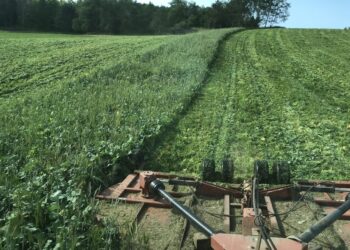
However, there are good reasons for practicing responsible tillage — other than for preparing seed beds and killing weeds. When a properly diverse crop rotation with cover cropping is practiced in an organic system, tillage that does occur is done with a purpose, in ways that offset the physical impact with other benefits to the soil and cropping system. Opportunities to significantly reduce tillage also arise.

There are a handful of soil-building principles regarding tillage to abide by. A major goal of any organic rotation should be to keep the ground covered with living plants as much as possible. Fall tillage with bare soil exposed in the winter should be avoided. When tillage does occur, it should be done slower to lessen the negative impact on soil structure, with the intention of incorporating organic matter in the form of animal manure and/or green manure, and to keep residues on the surface. Do not work the soil when it is too wet, and do a good job of tilling the first time so that it does not have to be done over. Lastly, allow the soil to rest and regenerate by incorporating periods of one year or more without tillage into your rotation. Ideally, this would be done in combination with at least one substantial biomass green manure that overwinters and is allowed to grow into maturity. This is incredibly effective in building soil, controlling weeds, and managing fertility.

One barrier to building diverse crop rotations that is typical of conventional systems — but is now increasingly shared by organic producers — is the over-reliance on corn and soybeans in the rotation. Both crops create major challenges in terms of including cover crops in a rotation and reducing tillage in organic systems. However, marketing a more diverse crop rotation is a major concern. To overcome this barrier most readily, it is recommended to find an experienced organic grain marketer who will work hard to market your entire rotation, such as those from the OFARM network. Rodale Institute’s consulting department also has on staff a market coordinator who works to discover organic market opportunities, build relationships and connect producers with buyers. These are just a couple examples of the resources that are available. Also, don’t underestimate the value of networking and building relationships with other organic producers. Through a little determination, marketing a diverse rotation of crops can be accomplished and can make your system more profitable in the long term.

Supposing that the question of marketing can be answered, the challenge then often becomes what other crops to plant and how to sequence them effectively with corn and soybeans. To answer that question, we need to understand the impact that each potential crop and its management has in terms of ability to build soil tilth or take away from it. The topsoil building choices would be deep-rooted legumes such as alfalfa and sweet clover, followed by annual small grains and shallow-rooted legumes such as peas and clover. Solid-seeded broadleaves such as buckwheat and flax also contribute some to soil building. However, row crops that require cultivation — corn, soybeans, dry edible beans and vegetables such as potatoes, onions, carrots, etc. — are destructive of soil tilth and also often contribute to challenges with weed control and managing fertility. This must all be taken into account and balanced accordingly in order to have more years in the rotation that build soil than that take away, as well as to contribute to your ability to effectively control weeds and manage fertility. This usually means the incorporation of alfalfa hay or green-manure soil-building years into the rotation.

When thinking about the sequence of crops in a rotation, it is helpful to reduce potential crops to their season. There are cool season annuals, warm season annuals and winter annuals. To maximize soil-building and weed-suppression potential, each of those should be incorporated into a full rotation. It is also helpful to start writing a rotation with the soil-building green manure or alfalfa hay year(s) at the top. Proceeding from there, either the mature green manure or hay crop should ideally be terminated in late summer. 

In keeping with the principal of living roots in the ground as often as possible, that should immediately be followed by a winter annual such as rye or triticale and a cover crop. The cover crop can be no-till drilled after harvest or often just be volunteers from the previous crop. That can be terminated in the spring and followed by a warm-season annual. Without a manure application, this could be soybeans or a small grain such as buckwheat. 

Following the warm season annual would ideally be another soil-building green-manure year. For example, sweet clover could have been undersown in the previous warm season crop or sorghum sudangrass could be planted the following year. However, in systems that are more advanced, with a low weed seedbank and good weed control, it is also possible to follow with a manure application and one more warm-season annual — likely corn — before going back to a green manure. 

After the green manure, fitting in a cool-season annual small grain such as wheat, oats, barley, etc. would be ideal, followed by either a volunteer or no-till-seeded cover crop. The following spring would then be another warm-season annual. If at this point in the rotation a manure application had not been made and no corn grown yet, then it would be advantageous to do so. A warm-season small grain such as millet could also be grown here, giving the opportunity to undersow sweet clover or alfalfa and avoid tillage before rolling back to the top of the rotation with another soil-building green manure or alfalfa hay crop year(s).

With this type of sequencing, even with tillage ahead of and following corn and soybeans, there are still three periods of over one year without tillage in the rotation. If cultivated row crops are eliminated from this scenario and only crops that contribute to building soil are grown, the full potential of diverse organic crop rotations in reducing tillage can be illustrated. Four different periods of more than one year without tillage would be achieved over the rotation. Only four tillage operations would be necessary over the course of at least six — but up to nine — years, and each one of those operations would be incorporating animal manure and/or green manure.

There are many different possible rotations that may work for any number of farmers, depending on their climate, soil and other factors, but this scenario gives a good framework to work from to fulfill the soil-building principles we should be striving to meet in our rotations.#

Nicholas Podoll is a Midwest Organic Consultant at the Rodale Institute. He has served as an extension agent and educator at North Dakota State and the University of Minnesota.

← Previous Eco-update Next Combating Parasites in Sheep →
Tags: September 2022
Nicholas Podoll

Nicholas Podoll

Nicholas Podoll is a Midwest Organic Consultant at the Rodale Institute. He has served as an extension agent and educator at North Dakota State and the University of Minnesota.

Next Post
Don’t Stray Away

Don’t Stray Away

  • Trending
  • Comments
  • Latest
The Most Important Livestock in Our Fields

The Most Important Livestock in Our Fields

July 1, 2024
Glyphosate Does What It’s Designed to Do — Kill

Glyphosate Does What It’s Designed to Do — Kill

February 19, 2025
The Take-Half, Leave-Half Fallacy

The Take-Half, Leave-Half Fallacy

July 1, 2025
White snakeroot

Toxic Forages?

September 1, 2025
We Don’t Need Another Bridge — We Need an Off-Ramp

We Don’t Need Another Bridge — We Need an Off-Ramp

3
Under One Roof

Under One Roof

3
A Rose By Any Other Name

A Rose By Any Other Name

2
Terra Preta’s Biological Advantage

Terra Preta’s Biological Advantage

2
Don’t You Dare Disparage Sugar!

Don’t You Dare Disparage Sugar!

February 3, 2026
February 2026 • Issue #656

February 2026 • Issue #656

February 1, 2026
Fungal Exchange Capacity

Fungal Exchange Capacity

February 1, 2026
ECO-MEETINGS

ECO-MEETINGS

February 1, 2026

Recent News

Don’t You Dare Disparage Sugar!

Don’t You Dare Disparage Sugar!

February 3, 2026
February 2026 • Issue #656

February 2026 • Issue #656

February 1, 2026
Fungal Exchange Capacity

Fungal Exchange Capacity

February 1, 2026
ECO-MEETINGS

ECO-MEETINGS

February 1, 2026

About ACRES USA

Acres U.S.A.® Magazine

Acres U.S.A.® is North America’s oldest publisher on production-scale organic and regenerative farming. For more than 50 years, our mission has been to help farmers, ranchers and market gardeners grow food profitably and sustainably, with nature in mind.

Visit Our Advertisers

Magazine Issues

  • News
  • 2025
    • June 2025
    • May 2025
    • April 2025
    • March 2025
    • February 2025
    • January 2025
  • 2024 Articles
    • December 2024
    • November 2024
    • October 2024
    • September 2024
    • August 2024
    • July 2024
    • June 2024
    • May 2024
    • April 2024
    • March 2024
    • February 2024
    • January 2024
  • December 2023
    • December 2023
    • November 2023
    • October 2023
    • August 2023
    • July 2023
    • June 2023
    • May 2023
    • April 2023
    • March 2023
    • February 2023
    • January 2023
  • December 2022
    • November 2022
    • October 2022
    • September 2022
    • August 2022
    • July 2022
    • June 2022
    • May 2022
    • April 2022
    • March 2022

Contact Acres U.S.A

  • Contact Us
  • About Us
  • Advertise With Acres U.S.A.
  • My Subscription

Learn

  • Resources
  • Events
  • Magazine
  • Newsletters
  • Free Articles
  • Webinars
  • Online Courses
  • Bookstore

Our All Socials

Follow With Us...

  • My account
  • News
  • Ecological farming
  • Refund and Returns Policy
  • Privacy & Policy

© 2024 Acers USA Magazine

Welcome Back!

Login to your account below

Forgotten Password? Sign Up

Create New Account!

Fill the forms below to register

All fields are required. Log In

Retrieve your password

Please enter your username or email address to reset your password.

Log In
No Result
View All Result
  • HOME
  • ARTICLES
    • News
    • Farm
    • Ecological farming
    • Livestock
    • Crop
      • Crop management practices
      • Cover crops
      • Crop nutrition
      • Crop protection
      • Crops
      • Ag technology
    • Soil
    • Opinion
  • RESOURCES
    • Magazine
    • Online Learning
    • Newsletters
    • Blog
    • Free Articles
  • MAGAZINE ISSUES
    • 2025
      • June 2025
      • May 2025
      • April 2025
      • March 2025
      • February 2025
      • January 2025
    • 2024
      • December 2024
      • November 2024
      • October 2024
      • September 2024
      • August 2024
      • July 2024
      • June 2024
      • May 2024
      • April 2024
      • March 2024
      • February 2024
      • January 2024
    • 2023
      • December 2023
      • November 2023
      • October 2023
      • August 2023
      • July 2023
      • June 2023
      • May 2023
      • April 2023
      • March 2023
      • February 2023
      • January 2023
  • ABOUT US
    • Our History
    • Our Staff
    • Contact Us
    • Community
      • Soil Health Primer Resources
  • EVENTS
    • Eco-Ag Conference
    • On-Farm Viroqua Event
    • Farm Weird
  • SUBSCRIBE
  • Login
  • Sign Up
  • Cart

© 2024 Acers USA Magazine

Are you sure want to unlock this post?
Unlock left : 0
Are you sure want to cancel subscription?