

Cover crops are the cornerstone of regenerative cropping systems
Cover crops are the cornerstone of any sustainable or regenerative cropping system because they offer so many benefits: providing green soil cover, suppressing weeds, creating soil biology habitat with living roots, improving soil tilth, and creating beneficial insect habitat. In addition, cover crops are versatile. The same species can be used multiple ways. Farmers use them like a Swiss army knife.
My work with cover crops is twofold. In the early years of the sustainable agriculture movement, I compiled resources on cover crops and green manures that reached thousands of farmers. Nowadays, managing the Horticulture Research Farm at the University of Kentucky, my focus is hands-on use of cover crops for every kind of vegetable and orchard situation.
Past Publications

In 1989, the National Center for Appropriate Technology hired me to advise farmers on sustainable agriculture and organic farming. I already had experience as an extension horticulture agent in Oklahoma and managing an organic farm in Missouri. The project I worked on was called ATTRA, or Appropriate Technology Transfer for Rural Areas. ATTRA — which is still around — provides technical advice and resources to farmers and extension agents in all 50 states on A-to-Z topics relating to sustainable agriculture, organic farming, alternative crop and livestock enterprises, IPM pest control, and alternative farming systems.
The first ATTRA publication I wrote was “Green Manures and Cover Crops.” Soon after that I compiled the “Alternative Soil Testing Laboratories” resource list. These were hot topics farmers were asking about — before the internet and social media. When sustainable agriculture first got started, there weren’t many resources for farmers looking for alternatives to NPK fertilizers and pesticides.
I mention this because I wound up in Mullins Library at the University of Arkansas digging through pre-1960s agricultural bulletins published by USDA and landgrant colleges. In addition to cover crops and green manures, I came across bulletins on crop rotations, mechanical weed control, flame weeding, weeder geese and soil organic matter. Digging through older agricultural literature was a common strategy in the organic farming movement. How did farmers in previous generations cultivate crops without so many fertilizers and herbicides? These old agricultural bulletins were a goldmine.
Suppressing weeds with cover crops, interseeding cover crops, soil improving and nitrogen-fixing cover crops, guides on cover crop species, cover crops for orchards and vineyards, grazing livestock on inter-sown cover crops after the main crop is harvested — all of these regenerative agricultural practices were commonly described in these old agricultural bulletins and circulars.
Digital versions of these old bulletins can be found online at the Internet Archives (archive.org). As an example, these twelve titles provide a synopsis of what you can dig into:
| Title | Series | Year |
|---|---|---|
| Leguminous Crops for Green Manuring | USDA Farmers Bulletin No. 278 | 1907 |
| Orchard Green-Manure Crops in California | USDA Bureau of Plant Industry Bulletin No. 190 | 1910 |
| Green Manuring | USDA Farmers Bulletin No. 1250 | 1922 |
| Green-Manuring Crops for Soil Improvement | Maryland Agricultural Experiment Station Bulletin No. 268 | 1924 |
| Winter Legumes for Green Manure in the Cotton Belt | USDA Farmers Bulletin No. 1663 | 1931 |
| Soil-Depleting, Soil-Conserving, and Soil-Building Crops | USDA Leaflet No. 65 | 1938 |
| The Use of Cover and Green-Manure Crops | Soils and Men; USDA Yearbook of Agriculture | 1938 |
| Summer Crops for Green Manure and Soil Improvement | USDA Farmers Bulletin No. 1750 | 1939 |
| Cover Crops for Soil Conservation | USDA Farmers Bulletin No. 1758 | 1942 |
| Winter Covercrops | California Agricultural Extension Circular No. 174 | 1951 |
| Conquest of the Land Through 7,000 Years | USDA Agriculture Information Bulletin No. 99 | 1953 |
| Interseeding Legumes in Corn | USDA Leaflet No. 435 | 1958 |
I recall Eric Kindberg — an early adopter of the keyline plow technology in America — describing crop soil-depleting and soil-building rotations. This struck me as insightful. Later I found USDA Leaflet No. 65, published in 1938, on “Soil-Depleting, Soil-Conserving, and Soil-Building Crops.” These kinds of farmer-friendly concepts help connect the dots. In this instance, it points to the importance of a pasture sequence in crop rotations to build soil organic matter from sod-forming grasses and their soil-stitching root systems.

As an example, here in Kentucky we have two large organic vegetable farms that practice a pasture sequence in rotation. Elmwood Stock Farms in Scott County and Rootbound Farms in Oldham County both employ a rotation that flips back and forth — after several years each — between vegetable fields and sod-forming forage crops that support grazing with cattle, sheep or poultry. This kind of 50:50 flip simplifies the traditional 7-year long rotation extolled by the Soil Conservation Service. Just think of all the carbon dynamics and nutrient cycling from grazing animals and forage plants pumping out root exudates and sloughed-off rhizo-deposits.
When the USDA Sustainable Agriculture Research and Education Program (SARE) was established in 1988 — providing grant dollars to support fresh ideas on agricultural research and extension — one of the top themes that emerged was cover crops. Cover crop resources have exploded over the last 35 years through efforts by SARE, Rodale Institute, ATTRA, land-grant universities, NRCS, trade magazines, and non-profit organizations. Seed companies are another key source. Green Cover Seed in Nebraska has published eleven editions of their Soil Health Resource Guide.
When growers ask for a starting point, my top three go-to online sources on cover crops include 1) “Managing Cover Crops Profitably,” 3rd edition, published by SARE, 2) the UC-SAREP Cover Crops Database, and 3) Mark Schonbeck’s leaflets published by the Virginia Association of Biological Farmers, the Organic Farming Research Foundation, and eOrganic.
Present Production
At our research farm, we have about 70 fields to manage — mostly vegetables, but also tree-fruit orchards, grape vineyards, and small-fruit plantings. Out of 105 acres, 30 are certified organic. We are one of the few college ag farms that offer both conventional and organic research plots. About half of this certified organic acreage is devoted to research while the other half is geared to production of fresh organic vegetables for the UK-CSA (community supported agriculture) program, which has 250 members.
That’s a lot of fields to manage, and each one employs some kind of a cover crop scheme in order to get the work done or to try out new sequences and mixes. Here are some of the concepts I keep in mind when designing and teaching cover crops.
Soil health benefits: Cover crops provide a multitude of soil health benefits: keeping the soil covered, moderating the soil temperature, adding organic matter, improving soil aggregation and water infiltration, fixing nitrogen and increasing nutrient cycling, suppressing soil-borne diseases, creating beneficial insect refugia, enhancing soil biology — the list goes on. While the primary goal is to keep the soil covered between vegetable and orchard crops, multiple layers of soil health development are taking place. But any cover crop scheme we choose needs to provide weed suppression.
The weed seed bank is guaranteed: Every farm has a weed seed bank. A single pigweed plant can produce 500,000 to 1 million individual seeds, which can remain viable in the soil for 40 years. The Beal Seed Experiment at Michigan State University — which buried seeds of 23 weed species in sand-filled glass bottles — found that three species were still viable after 80 years (two varieties of mullein and one of mallow) and one species after 141 years (moth mullein). Mowing off seedheads before they shed is ideal, but hardly any farm handles this perfectly every growing season. A weed seed bank is guaranteed.
Ecological succession: Weeds are a natural response to ecological succession. When you till the soil to prepare a seedbed, you are exposing the weed seed bank to sunlight and moisture. Nature abhors a vacuum. These environmental cues instruct the seed bank to germinate and rapidly cover the soil. Cover crops offset a weedy succession through their ability to germinate quickly, cover the soil, exude allelopathic exudates, and function as a smother crop. Buckwheat drilled on 7-inch row spacing suppresses between-row weed seed germination by releasing allelopathic exudates from both leaves and roots.

Living mulches: A living mulch is a cover crop that is intercropped with an annual or perennial cash crop, primarily for weed suppression. Naturally they are multi-dimensional and provide ancillary soil health benefits. Every time you use a cover crop, it adds to the cropping system effect — the sum total — which contributes to biological soil fertility and biological pest control. Living mulches are easy to establish and maintain in alleyways between plastic mulch beds and orchard middles. However, they also require periodic mowing, which means the right equipment to match the job.
Perimeter strips. The sides and ends of crop fields often have patches where it’s not feasible to plant a crop, due to field corners or crop planning. Leaving this soil bare guarantees a weedy mess. This is another place where weed-suppressive living mulches perform beautifully. Perimeter strips can also function as bio-islands by growing floral-rich cover crops like buckwheat or sunflowers, which attract beneficial insects or serve as pollinator habitat.
Seeding rates: A key concept behind living mulch cover crops is using a higher seeding rate. Most charts for cover crops like buckwheat, cowpeas, or spring barley show a range of seeding rates. At a minimum, go with the higher seeding rate. Eric Brennan, a USDA scientist in California, has shown that selected cover crops sown at 2x to 3x seeding rates provide superior weed suppression. This is easy to do with teff as a living mulch in alleyways between plastic mulch beds in vegetables. Whereas the seeding rate to raise teff as a forage crop is 12 pounds per acre, we bump it up to 36 pounds per acre or even higher for use as a living mulch.

Winter-killed mulch: In spring, wet soils make it challenging to prep fields in advance of planting cool-season vegetable crops. Winter-killed mulches are frost-sensitive cover crops that get established in early fall, put on substantial biomass, then die back after freezing temperatures. This way the soil is covered with a carbon-rich organic mulch. These fields are easier to transition the following spring. A mix of spring oats and Austrian winter peas works well in our region. In contrast, hardy winter cover crop mixes like rye-vetch-clover or barley-vetch-clover — with their green vegetation and active roots — retain too much soil moisture. These mixes are better for warm-season vegetables, whether rolled-down or flail-mowed.
We also use spring-planted winter cereals, practice interseeding and undersowing, and make use of catch crops (fast-growing crops like buckwheat, grown between crops to “catch” resources like sunlight, water and nutrients). Cover crops are flexible. The same cover crop species can be used multiple ways. Terms are often used interchangeably.
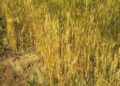
Buckwheat is a versatile, fast-growing broadleaf plant that creates an ocean of floral habitat for beneficial insects. We use it as a living mulch and in perimeter strips, as a stand-alone summer cover crop for quick cover, in summer bi-culture and tri-culture mixes such as buckwheat-cowpeas and buckwheat-cowpeas-millet, and in ten-way multispecies cocktails. Buckwheat has a small root system, but it manufactures a powerhouse of root exudates that condition the soil and etch out tied-up soil phosphorus.
A novel crop we helped breed is red-leaf sorghum, to extract antioxidant pigments. One year we finger-weeded red-leaf sorghum, and it cleaned the field plots up nicely. However, it rained shortly after we finished — which happened to be on a Friday — and the pigweed seedlings we’d just uprooted pegged down and re-established over the weekend. After some in-row hand weeding, we cultivated these fields with a Farmall 140. Just prior to final cultivation at lay-by, I overseeded with buckwheat. The buckwheat emerged quickly and smothered out future weeds as an intercrop.
Practices to Pump Up Cover Crops’ Power
A lot of effort goes into sourcing seed and establishing and terminating cover crops, but the benefits they provide are worth it. The following two practices can extend the power of cover crops.
Seed treatments work well with cover crops because inoculated roots multiply and spread rhizospheric soil biology. Mycorrhizal fungi, plant–growth–promoting microbial inoculants, trace elements, and humic/fulvic acids are some of the seed coating ingredients that can make a big difference.
Mycorrhizal inoculants contain propagules (spores, hyphal fragments and plant roots) that are raised on host plants, including many cover crop species like sorghum, sudangrass, corn, millet, clover, sunflowers, oats and barley. Ana Primavesi, the Brazilian soil ecologist, found that treating rice seeds with copper and manganese induced resistance to rice blast, a disease that infects leaves and seed heads. Cover crop seed nutrient treatments are also gaining traction. A no-till farmer I know in Kentucky used seed inoculants and nutrients and got impressive rhizosheath formation on his cover crop roots.
While no-till is popular in regenerative agriculture, many vegetable farms, including ours, still use tillage and mechanical cultivation. Researchers in Australia found that adding nitrogen, phosphorus and sulfur to wheat straw residues — followed with soil tillage incorporation — results in greater carbon sequestration than no-till by itself. This phenomenon is related to the universal ratios of carbon, nitrogen, phosphorus and sulfur found in stable humus across all ecosystems. In other words, balanced ratios of these four elements promotes humification, which is essentially microbial break-down (decomposition) and build-up (polymerization), resulting in darker-colored soils with increased soil carbon levels.
In eco-farming, fall-applied amendments like nitrogen, sulfur, molasses and various enzymes and bio-inoculants are used to aid crop residue digestion. I’m suggesting that a similar program containing dry materials or a bio-spray tank blend — additionally including phosphorus and low-cost farm-brewed biofertilizers — can be used to inoculate green manure residues prior to incorporation.
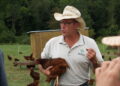
Steve Diver is the farm superintendent of the Horticulture Research Farm at the University of Kentucky. He was the winner of the 2024 Acres U.S.A. Eco-Farmer Achievement Award.