

There are many innovative ways to incorporate cover crops into a corn and soybean rotation
Editor’s note: This is an edited transcript of Keith Berns’ presentation from the 2023 Acres U.S.A. Eco-Ag Conference. Join us this December 2-5 in Madison, Wisconsin, for lots more in-depth content like this!

My brother and I grew up on a farm in southcentral Nebraska. We still farm a couple thousand acres there, and we started looking at cover crops back in 2006. In 2009 we decided to start a cover crop seed business — Green Cover Seeds. We stress education so much in what we do because we feel that if you understand what’s going on in the soil, the only conclusion you can come to is that you have to have a living plant — a living root — in the soil to make things work. And in most operations, unless you’re growing perennials, you’re going to need a cover crop to do that well.
Growers in a corn-bean rotation, in particular, often struggle to know how to integrate cover crops. We often hear people say, “I would’ve planted a cover crop, but harvest ran late, so we ran out of time.” I’d like to address this issue — while not belittling the fact that there is a crunch at that time of year. We raise a lot of corn and beans ourselves, so we understand.
But I’d like to share some of the many innovative ways that growers are including cover crops these days. The real problem is not that you run out of time; the real problem is that you simply lack diversity when you only have corn and beans. And even if you’re not in a strictly corn-bean rotation, a lot of these principles can still apply.
Strategies to Open the Window
I’m excited to announce that we have a new cover crop that’s going to be available coming soon. It overwinters great, but it’s not a challenge to control in the spring. You can plant it as late as you want. It fixes NP and K and any other nutrient you need. It’s going to grow tons of biomass, but it’s not going to be hard to plant into. It’s very inexpensive, and it fixes compaction, pH and salinity.
We call this new cover crop “Jack’s magic beans” — because as much as we all want a cover crop that meets what I just described, it doesn’t exist!
So, when we have a short window in between corn and beans, or whatever other crop, our goal is to try to open that window as much as possible. Here are a number of different strategies to make this happen.
Use short-season cash crop varieties. One strategy is simply to plant the shortest-season corn and soybean varieties possible without giving up significant yield. As Rick Clark says, “Do I give up yield to increase my soil health? You bet I do. I do it every day.” That’s a tradeoff he’s willing to make because he knows in the long run it’s going to work.
Now, with soybeans, you can go to much shorter varieties with almost no yield penalty. In fact, in our area — southern Nebraska — there are a lot of guys planting 3.2, 3.3 and 3.4 bean varieties, and some are going down to 2.4, 2.5, 2.6 beans and seeing no decrease in yield. Michigan State University did some research on bean varieties from 1.8 up to 2.9 and found that there wasn’t more than a two- or three-bushel yield difference between the variety groups. So, at least on part of your ground, go to shorter-season varieties. That gives you an opportunity to start planting cover crops sooner.
Plant fields that need cover crop help first. We like to use short-season varieties with corn as well. We identify which fields need the most help with cover crops and then plant those fields first with the shortest-season varieties. You can’t harvest everything all at once anyway; why would you plant all the same relative maturity? You can often pick up two weeks’ worth of cover crop growing season in the fall this way.
And those two weeks are really going to be more like a month because one week in September is like two weeks in October. In terms of growing-degree days and heat units, it’s really important.
Take advantage of silage, earlage, high-moisture and seed corn fields. If you’re growing silage, earlage, high-moisture or seed corn, you’ll have additional opportunities for cover crops. There’s a lot of seed corn grown in southcentral Nebraska; I think it’s almost a crime not to have a cover crop on those fields. It’s easy, it’s cheap, it sequesters so much nitrogen; those seed corn fields always have been given too much nitrogen.
Any cash crop that allows for early harvest is a great opportunity to get a cover crop established sooner, and that makes all the difference with how well it does and how effective it is in accomplishing your goals.

Relay-seed cover crops by air. Another option is to relay-seed cover crops with an airplane, drone or highboy prior to harvest. We’ve seen this work, but we’ve also seen it fail miserably. Flying cover crop seed on works better the farther east you go (unless you have irrigation). More rain always means a better chance of working.
Timing is really critical for this. If you seed too soon, it may germinate, but if it doesn’t start getting some sunlight within a couple of weeks of germination, there will be a high mortality rate. If you seed too late, your growth will be limited; you may just as well have waited another 10 days and put it in with a drill.
Timing is critical, but in my opinion it’s a little easier to do with beans. When beans have about 30 percent of their leaves turning yellow, fly it on and let the leaves all fall down on top of the seed; that helps with some moisture conservation.
With corn, it’s a little bit different. It depends on how thick your corn is and how much sunlight is coming through the canopy. On a healthy crop of corn, the bottom leaves need to be dried up almost to the ear before you’ll have significant sunlight coming in. Now, if your corn was stripped up with hail, or if you had a bad stand for some reason — if there’s sunlight hitting the ground — get the cover crop seed out there.
Use the most cold-tolerant cover crop species. Another thing that we recommend is to use the most cold-tolerant species possible for our area. Cereal rye is just a no-brainer. It’s the number-one-selling cover crop for a reason, and part of that reason is that it comes up in cold soils. Cereal rye will germinate in 34-degree soils. Nothing else does that. If it’s 38 degrees or above, and the sun is shining, cereal rye will be photosynthesizing — not very fast, and it’s not growing significantly, but it is doing its job of photosynthesizing.

When people say, “It’s too late to plant a cover crop,” it might be too late to plant most cover crops, but if you can get a drill in the ground, it’s not too late to plant cereal rye. Annual ryegrass, in my opinion, needs to be seeded a couple of weeks before first frost for best results. Annual ryegrass cannot withstand nearly as cold of weather, especially if it does not have good root establishment. If you have good root establishment, it can survive some pretty cold weather, especially if you have some snow cover. But you can throw cereal rye out on the ground, and it’ll get a little bit of a root established, and it’s probably going to survive.
With rye, sometimes it’s not just about the species but the cultivars within that species. We like to use Elbon rye instead of northern rye varieties, especially if you’re tight on time and you need to get as much growth as you can before you terminate. Elbon rye was bred in Oklahoma, so it has a short dormancy period because Oklahoma has relatively short, mild winters compared to farther north. It grows longer in the fall, and it will start growing earlier in the spring. It’s still very winter hardy; we rarely see it winterkill, even with Nebraska winters. And it’s generally a smaller seed size as well, which can be an advantage when you look at cost.
Oats is also a wonderful cover crop. It’s not going to survive winters unless you’re way down south. We like to see at least two to four weeks of growth before first frost. Spring oats will winter kill once you start dropping into the low 20s. There are also winter varieties of oats that can be pretty effective, and in more mild climates they’ll survive the winter well. We’ve only had winter oats overwinter in Nebraska a couple times in the last 10 to 12 years, and it’s always related to having good snow cover on the ground. I’ve seen winter oats survive 30 below zero in Nebraska with 10 inches of snow on the ground.
Radishes should also be seeded a couple weeks before the first frost. You can push that a little later, but you’ll have less growth. The later you plant things, the lower your expectations should be of how much growth you’re going to get, and that has to be tempered with how much it costs. Rapeseed, for example, is the least expensive of all the brassicas and one of the most cold hardy; we can push that out quite a bit later. In a lot of areas it may even overwinter; it’s essentially like winter canola.
Hairy vetch is another wonderful cover crop. It’s the best winter legume we have. You can seed it by first frost or even a couple weeks later, but planting a month before first frost gives you good establishment, and the more growth you have in the fall, the faster it’s going to get going in the spring, which means the more nitrogen it will produce before you have to terminate it to plant your next crop. If you’re an organic farmer and you’re depending on hairy vetch for nitrogen for your corn, and you don’t want to be waiting until the middle of June to plant your corn, then you need to change your rotation so you can get your vetch planted a month before first frost.
Winter peas are a bit hit and miss. Plant them deep and time them like wheat for best overwintering. You have to keep the growing point under the ground for them to survive. Rick Clark has talked about trying to plant them as deep as three inches.
Crimson clover is a great cover crop if you can get it to overwinter. In Nebraska, we rarely see that; maybe 20 or 25 percent of the time it will overwinter. As you move south of I-70, it gets much more consistent in how it overwinters.

Fixation balansa clover is the most cold-tolerant of the annual clovers that are available. There are other balansa clovers imported from Australia and other areas that aren’t nearly as cold tolerant as fixation. But with fixation balansa clover, you’re going to look at it in the spring and you’re going to go, “Man, that thing is just not doing anything. It’s just sitting there, and my crimson clover and hairy vetch are growing faster.” I’ve never seen a crop that, once it decides to start growing — and it all has to do with ground and air temperatures — will look pitiful one week and then three or four weeks later, once it starts growing, grows really fast. When it’s not growing on top, it’s growing a big, deep root system, and then it’s using that big root system to produce a fantastic amount of aboveground growth. But again, you can’t plant in November and expect to get that kind of growth. Somewhere around three to four weeks before your first frost is ideal to get the root system of balansa clover established.

Let your covers grow as long into the spring as possible. This is typically easier with beans than it is with corn, simply because of nitrogen cycling. Corn needs nitrogen early on; with beans you don’t want any early nitrogen. Letting your cover crops grow later in the spring and letting them tie up all the nitrogen in the soil is good for your beans.
This is why some people say you shouldn’t ever plant corn into cereal rye. I don’t think that’s true, but I think you need to be prepared to manage your nitrogen in that situation. It’s also an increased risk on dryland farms or in dry springs out east. You need to terminate cereal rye at the proper time if moisture is going to be a limiting factor.
Nutrient management is also much more important with corn. You have to be prepared to plant your corn a little later if you’re going to plant corn after cover crops. As Steve Groff says, “Cover crops will make a good farmer better and a bad farmer worse.” If you’re not prepared to manage the cover crops within your system, it’s probably going to hurt you, and then you’ll be the guy at the coffee shop saying, “I tried cover crops once and it cost me 50 bushels of corn.” Well, it wasn’t the cover crop that cost you 50 bushels of corn; it was the way you managed it — or, more accurately, the way you didn’t manage it.

Terminate the cover crop ahead of soybeans. If you’re going to terminate the cover crop with herbicides, instead of spraying it with Roundup or Gramoxone or something that kills it pretty quickly, you can spray Select/Clethodim, which produces a slower termination. It slows down the decomposition process and provides more overall biomass.
Plant soybeans ahead of cover crop termination. Another method for soybeans is one advocated by Erin Silva from the University of Wisconsin in which you plant your beans at the boot stage of the rye, which is about the right time to plant beans. Then you come back later, at rye anthesis, which is about two or three weeks later, and roller-crimp the rye. The beans may be two to four inches tall, but you can roll right through that.
Is this going to work everywhere? No, but if you’re in a wetter climate than western Nebraska, I think this is a great opportunity.
Plant winter barley ahead of corn. Winter barley is another potential option for a cover crop ahead of corn. If you’re worried about cereal rye being somewhat allelopathic or tying up your nitrogen, winter barley is easier because it doesn’t have as much biomass ahead of the corn. There’s less risk of nutrient tie up, and barley won’t get away from you like rye might.
Winter barley’s smaller biomass compared to rye doesn’t provide as good of weed control, and it’s not as winter hardy as rye, but it will survive a lot of winters across the country. Every time we’ve planted winter barley, it looks completely dead in the middle of the winter. But then it starts growing back from the roots. Now, cereal rye stays green all winter long and can photosynthesize — but winter barley is another option.
Plant cover crops in the spring. Planting covers in the spring may be an option if you couldn’t get it done in the fall. You can get out there as early as you can and try to plant oats, peas, chickling vetch, or rapeseed. Be aware that winter annuals like rye, if they don’t vernalize, will not grow more than about three inches tall. Now, maybe you want that, but typically you’re going for biomass.
Interseed into corn. Lots of people want this to work. Some have had good results, but there’s a lot of issues with it.

First, you have to get the cover crop going soon enough. You can’t be planting the cover crop when your corn is already at V6 or V8 — it’s all about sunlight. You have to get the cover crops up and going before the canopy of the corn closes, so that the plant has a root system and can try to survive under the shaded canopy.
We used to tell people to do this at V4 or V5, but when we told them that, it was typically V7 to V8 before they got out there and did it. I think you can get out there at V2 to V3 and get the cover crop going.
The other thing that’s important, in my opinion, is that you get the seed in the ground. If you surface broadcast the seed, it doesn’t come up as fast and it’s much more inconsistent.
Now, the challenge is of course weed control. If you’re a herbicide-based farmer, you have very few weed control options. You have to use chemistry ahead of time that is not going to have long residual. If you’re organic, you don’t have to worry about that. This practice might also disqualify you for crop insurance programs; make sure you talk to your crop insurance agent ahead of time.
This practice may fail in very dry years or when weather does not promote dormancy. But the only time I heard about this method hurting the corn was when the grower planted the cover crop, it got really cold, and the corn basically stopped growing. The cold weather didn’t bother the cool-season cover crops, and they kept growing and got out ahead of the corn. But for the most part, when this fails, it’s the cover crop that fails, not the corn. The first rule of interseeding is to not harm your cash crop. This is why we don’t want to plant the cover at the same time as the corn. Corn is sensitive to early-season competition.
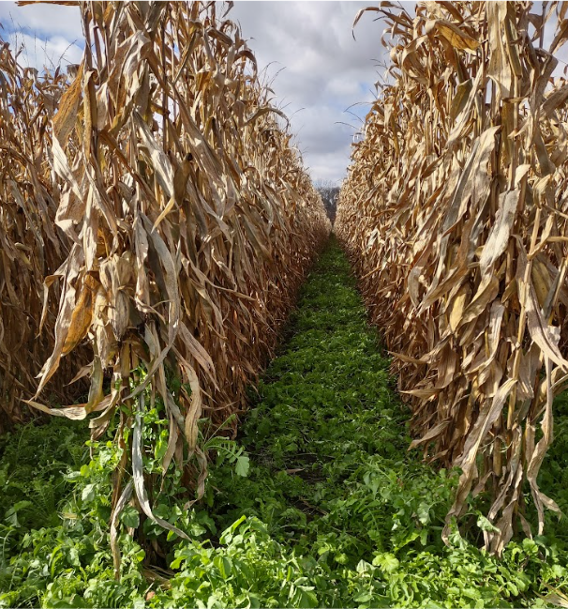
Another possibility is to plant wide-row corn — 45 to 60 inches between rows. This gets more solar energy in to your cover crop. Practical Farmers of Iowa has done a lot of good research on this. The guys that are doing it well are seeing anywhere from no yield decrease to maybe 5 percent yield decrease. A lot of that has to do with which variety of corn you choose; with that extra sunlight from the edge, you can grow bigger ears. Don’t reduce your overall population that much, and if you can maintain your yield, this is a fantastic option for cattle guys because you can grow two to three tons of high-quality dry matter in addition to your corn.

The Real Problem with Corn and Beans
The real problem with corn and beans is that there’s simply a lack of crop diversity. And crop diversity is so important — God created plants to grow in diverse communities.
Yet in our modern agricultural systems, we’ve stripped so much of that away. Dwayne Beck, who ran the Dakota Lakes Research Station, said, “Weeds and diseases are nature’s way of adding diversity to a system that lacks that diversity. Nature’s efforts to add diversity can be countered by adding beneficial diversity to the system.”
Dwayne is a big advocate of better crop rotations, and he was an early adopter of cover crops. When we can add that diversity to the system, it de-incentivizes the field to promote weed growth — to put the diversity out there that you’re not giving it.
It’s hard to get enough diversity in your cash-crop rotation, and that’s why cover crops are so important. Hats off to the people who are growing 10 or 12 different cash crops, but that’s really hard. You often need specialized knowledge, specialized equipment and specialized markets in order to do additional cash crops. But with cover crops, because you’re not taking it out to grain, and the harvesting mechanism is either a cow or simply the microbes in your soil, you don’t need specialized equipment. You don’t really need specialized knowledge, and you certainly don’t need specialized markets because your market is the soil.
You can’t do diversity effectively if all you’re growing is corn and beans. Every once in a while, at least, your soil needs a boost from a diverse cover crop mix. And in order to do a 10-, 12-, 15-way mix that has some warm-season species in it, you have to add a third crop to your rotation. This could be a summer-harvested crop — a cereal grain or peas. It might be once every three years or every five years. When you can do this, it gives you the opportunity to put that massive cover crop out there.
People often say, “I’d love to put wheat in my rotation, but I can’t afford to do it.” I get that, but here’s another way to look at it.
Say that in a two-crop rotation we can produce 180-bushel corn that we make $1 a bushel on, and we can produce 55-bushel beans that we profit $3 an acre on. If corn and beans are split 50/50, we’re going to make an average of $172.50 per acre. Now, when you add wheat in, say we get 60-bushel wheat at $1 margin. We’re only making $60 a year growing the wheat. So, yes — wheat is not as profitable.

But I think that anybody who’s done this would agree with me that when you add that third crop into the rotation, it will increase your corn yield, and it will increase your margin, because those additional bushels you’re growing will typically come without any additional input. So, if we can increase our corn yield by 10 percent and our margin by 10 percent — which I think is very doable by adding a third crop, especially if we follow it with that massive cover crop — we now have increased our profit for that year. I think we’ll also increase our bean yield by 10 percent the next year.
So, with increased profitability from yield and better margin by adding that third crop, now our average is $152 instead of $172. I.e., the net cost to add a third crop is only $20 an acre, and we can make that $20 up from the additional nutrients that we cycle from that cover crop. And if we’ve got livestock, we can easily make all that up, plus a whole lot more, from the value of grazing.
The real benefit is that we can get a massive summer cover crop in with 10, 12, 15 species. It’s so easy to grow 150 to 200 pounds of nitrogen on a cover crop planted in July or August. It’s hard to do that if you’re planting it in October or November.
Keith Berns is the co-founder of Green Cover Seed and a farmer in southcentral Nebraska.