


The term “fertilizers” is misleading – more accurately, modern amendments are “chemical plant nutrients”
Do commercial fertilizers actually increase soil fertility? The very word “fertilizer” suggests that it makes something — in this case, soil — fertile. But is this accurate?
Soil fertility refers to the ability of a soil to sustain plant growth by providing plants with a habitat and enabling sustained and consistent yields of good quality. A fertile soil therefore supplies all essential plant nutrients and water in adequate amounts and proportions for plant growth and reproduction.
A common perception is that soil fertility can be enhanced by applying “fertilizers” to the soil. Encyclopedia Britannica defines fertilizer as a “natural or artificial substance containing the chemical elements that improve growth and productiveness of plants. Fertilizers enhance the natural fertility of the soil or replace the chemical elements taken from the soil by previous crops.” Consequently, it is assumed that soil fertility can be remedied by applying a chemical fertilizer.
I am afraid, though, that we are dealing with a far-reaching misperception. Can we safely assume that chemical elements can substitute organic substances and have similar effects on soil and the environment?
The Term Itself
The word “fertilizer” was first used around 1660 denoting “something that fertilizes (land).” About 180 years later it became a synonym for manure. Manure simply is dung — excrement of livestock — added to the soil to render it more fertile.
The lack of fertility in soils, however, is a man-made problem. Natural ecosystems do not encounter this kind of challenge. Natural vegetation always exists in accord with the soil below it. Both have evolved in timespans of millennia or even much longer periods. Components of ecosystems and innumerable lifeforms exist in symbiotic relationships and are linked to cycles of substances, gases, water, and energy.
Everything that grows in a certain spot will eventually also perish there, fall to the ground, and decompose partially above the ground before soil animals and microorganisms incorporate the partially decayed organic matter into the topsoil. We can speak of infinite cycles. Various soil organisms assist plants to access water and nutrients, including in the fixation of nitrogen. Mycorrhizae (root fungi) are even able to connect decomposing matter with the roots of plants. This way, many plants receive part of their nutrients directly as organic compounds, and nitrogen bound in organic molecules is absorbed by plants.
At the beginning of agriculture about 10,000 years ago, farmers did realize that many practices interfere considerably in natural cycles. By burning the original vegetative cover and by removing the crop at harvest, the organic matter on top and in the soil rapidly reduces. In several places, people noticed that applying compost and animal manure helped to stabilize the soil fertility to some degree. For example, Chinese farmers consciously used manure and composts as fertilizers in the past 4,000 years. The use of green manure crops was known among farmers in the Roman Empire more than 2,000 years ago.
Essential Plant Elements
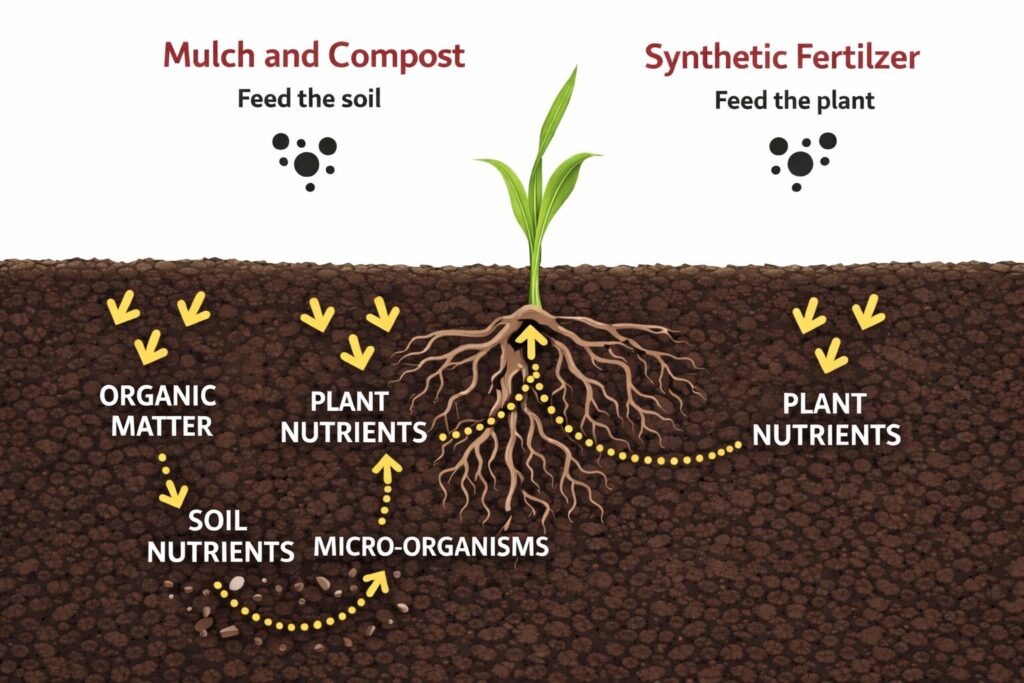
Yet the application of modern chemical fertilizers, especially of nitrogen, phosphorus, and potassium, is a completely different story. In contrast to manure or any organic matter, which brings carbon into the soil, commercial fertilizers are applied to provide nutrients directly to the plants.
And here is the crux. They do not provide any element that soil organisms can utilize to enhance the humus content, and thus the fertility of soils. It is more likely that the opposite is the case. Several long scientific trials have found that high doses of synthetic nitrogen fertilizers reduce soil fertility compared to organic plots. In other words, to suggest that chemicals such as nitrogen, phosphorus and potassium are “fertilizers” is misleading. More accurately, we are dealing with “chemical plant nutrients” added to the soil to be absorbed by the crop.
Thus far, the first paradox.
Troubling Implications
But this is only a part of the story. Farmers and farm managers commonly base the application of chemical plant nutrients on blanket recommendations for the specific crop. This is especially true for nitrogen. This raises several concerns.
First, the application of synthetic nitrogen is particularly likely to interfere with metabolic processes of individual plants. This can lead to an abundance of free amino acids, which may attract herbivorous insects.
Second, nitrogen presents several negative implications for soils. A global analysis concluded that “soil pH decreased linearly with the increasing amount of N addition.” Soil acidification is also considered to be the main chemical factor responsible for aggravating soilborne diseases. A lower pH level makes it more difficult for plant roots to access phosphorous as well as several other essential nutrients such as zinc, which are otherwise abundant in the soil — another paradox.

Moreover, the more acidic the soil, the higher the emissions of nitrous oxide. Long-term N fertilization also leads to increases in monovalent ions (H+ and NH4+), which contribute to a declining soil aggregation. Likewise, a decrease in the microbial biomass has been observed. As microbes are essential in shaping and maintaining soil aggregates, a decline negatively affects soil structure and consequently reduces potential water retention.
Synthetic Nitrogen and Carbon Emissions
The capacity of soil organisms to fix nitrogen for plants is commonly disregarded. Likewise, the capacity of soils to supply the necessary nutrients and trace elements for the crops is frequently ignored.
Since 1950, most synthetic nitrogen is obtained from the air through the Haber-Bosch synthesis as ammonia. Even though this process requires considerable amounts of energy, preferably fossil gas, between 1961 and 2020 production has increased more than nine-fold — from about 13 to 123 million metric tons. It is estimated that the production of ammonia currently accounts for approximately 2 percent of the worldwide consumption of fossil fuels, representing 1.2 percent of the annual global CO2 emissions.
Another worry is that more than 60 percent of the nitrogen applied in fields is wasted — another paradox. This is first of all based on inappropriate recommendations. Second, unhealthy soil doesn’t have the capacity to provide soil nitrogen to the crop and to efficiently convert external nitrogen inputs for plant uptake. Even decades ago, rice farmers worldwide had noticed that they had to increase their application of ammonium sulfate or urea to maintain yields.
But where does the excess nitrogen go? A part is leached by soil water into the environment and contaminates ground and drinking water. Another significant part is converted by soil organisms into nitrogen gases, among them nitrous oxide (N2O), commonly called “laughing gas,” which contributes to global warming.
Earth’s Nitrogen Cycle
Like carbon dioxide, atmospheric nitrogen is absorbed by soil organisms and plants. In due course, the gases are emitted back the atmosphere. Hence, we speak of cycles. Earth’s nitrogen cycle is one of nine processes that regulate the stability and resilience of the Earth system. Regrettably, nitrogen emissions have already arrived at a critical level, as human activities convert more atmospheric nitrogen into reactive forms than all the Earth’s terrestrial processes combined.
This brings us back to soil. Instead of enriching the soil, as the word “fertilizer” implies, it is apparent that synthetic nitrogen is messing up soils, ecosystems, and the atmosphere, not to mention the enormous expenses shouldered by farmers and the public. This is another aspect of the nitrogen paradox.
Parallel to the nitrogen paradox, we have the phosphorus and the potassium paradoxes. Like nitrogen, a relatively small proportion of phosphorus fertilizers applied in crop production systems is taken up by plants. A recent report states that in cereals, only 16 percent of the applied phosphorous was utilized by the respective crops. Recommendations for phosphorus application frequently disregard the fact that soils can supply considerable quantities, especially with the help of mycorrhizae.
Similarly, potassium is mostly overapplied. Recommendations commonly overlook the potential of the soil, especially of deeper layers, to supply this nutrient.
An Unnatural Situation
The main lesson is that the application of chemical nutrients intended to enhance crop performance constitutes an unnatural situation. Since the beginning of agriculture, farmers commonly take away the harvest, and often also the crop residue, while not recognizing the gradual deterioration of their soils. Several civilizations did not realize that their agricultural practices were at odds with nature’s way and eventually collapsed.
During the 19th century, several scientists, among them Justus von Liebig, believed they had found a solution to the problem of low soil fertility by applying external chemical substances. After World War II, the production and application of fertilizers became the dominant way to produce crops. The increase in agricultural production since then is commonly attributed to the 19th century theory that plants only need mineral nutrients. To this day, many agricultural scientists disregard the capacity of soils to supply most nutrients and argue that the application of nitrogen, phosphorus and potassium is necessary to assure the production of sufficient quantities of food.
Fertilizer recommendations are often based on the anticipated harvest. It is deplorable that most inorganic plant nutrients applied are lost in soil-plant system and, instead, pollute the environment. It increasingly becomes evident that the chemical approach to crop production has created a whole bunch of new problems.
This should encourage us to rethink this approach from beginning. However, sustainable options, proven by dedicated farmers and scientists around the world, were repeatedly rejected, despite the evidence that an increasing number of farmers produces food sustainably without sacrificing yields. Their experiences show that the recycling of available organic matter alone helps to alleviate many problems related to the use of farm chemicals, while the integration of cover crops and green manure in cropping cycles enables soils to gradually recover and maintain their fertility.
The large-scale use of commercial fertilizers can, and needs to be, phased out as soon as possible.