

Nutrition Strategies for Managing Pest and Disease Pressure
In-season pest and disease pressure is often approached reactively. Once symptoms appear — whether powdery mildew, aphids, mites, or a bacterial infection — the usual response is to apply a control product. In many cases this suppresses the symptoms, but the plant remains vulnerable.
A more effective approach begins with a different question: what conditions made the plant susceptible in the first place?
Within a holistic framework, pests are not viewed as isolated problems. They are indicators of imbalance somewhere within the plant. When plant metabolism is running properly, nutrients are assimilated efficiently, and structural integrity is intact, then susceptibility to pests and pathogens can be significantly reduced. A fertilizer program becomes less a tool for driving growth or maximizing yield potential than a way to regulate plant physiology and support resilience, efficiency, and stability throughout the season. Integrating nutrition into pest and disease management fundamentally shifts the approach from reactive to proactive.
Nitrogen Metabolism
Plant health follows a cascading sequence of processes. Mineral nutrition influences energy production through photosynthesis and respiration. That energy drives protein synthesis and enzyme function. Those proteins and enzymes in turn support the development of strong structural components such as cell walls, membranes, and vascular tissue. Those structures ultimately determine the plant’s ability to resist environmental stress, insect feeding, and pathogen invasion. When any part of this cascade is compromised, weakness develops. These weaknesses are often subtle at first, but they create the initial conditions that pests and diseases exploit.
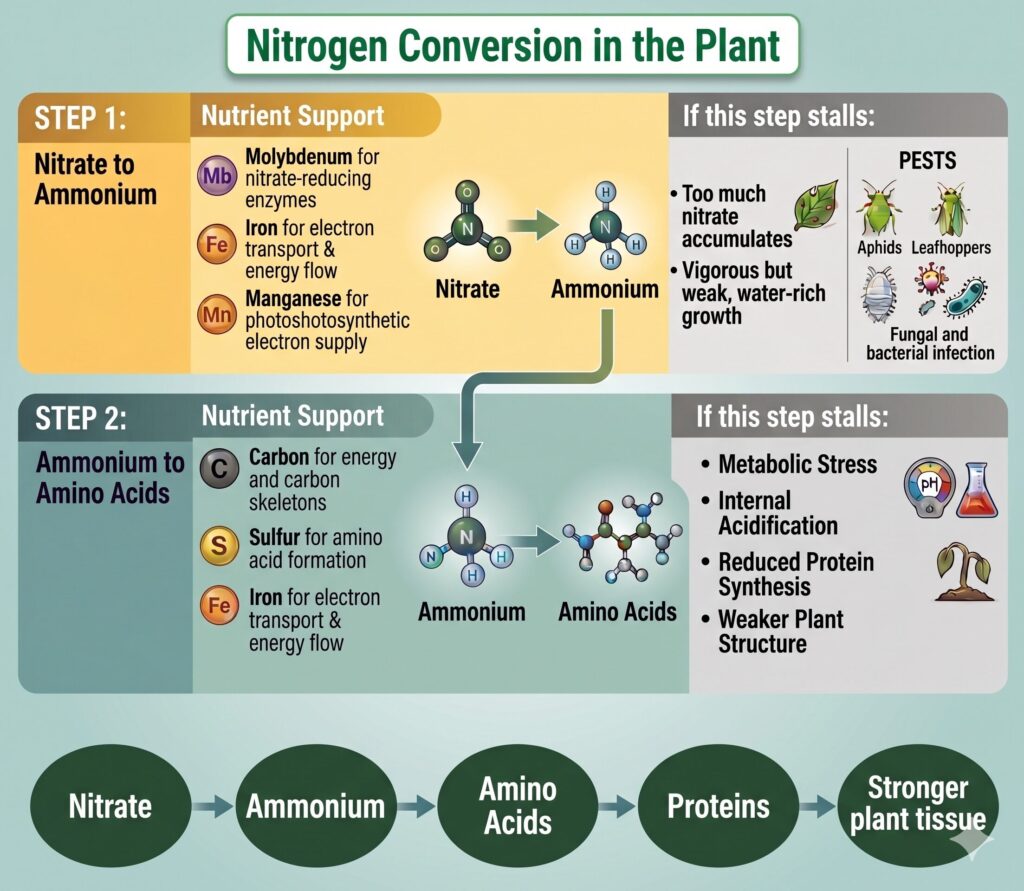
One of the most influential points of breakdown occurs in nitrogen metabolism. Nitrogen is essential for plant growth, but the form it takes and the timing of its availability significantly influence plant health. When nitrate accumulates in plant tissue faster than it can be converted into ammonium, the plant becomes metabolically imbalanced. The result is typically vigorous, weak, water-rich growth. That kind of tissue is extremely attractive to sap-sucking pests such as aphids, leafhoppers, and mealybugs, as well as fungal and bacterial infections.
This situation often develops during periods of rapid growth, especially when nitrogen availability exceeds the plant’s capacity to assimilate it. However, the issue is not simply the amount of nitrogen applied but the forms of nitrogen not being used efficiently. The critical point is the conversion of nitrate to ammonium, ideally followed by rapid incorporation of that ammonium into amino acids. While ammonium is the form plants use to build proteins, it is also highly reactive and potentially toxic if it accumulates in plant sap, so it must be assimilated quickly into organic compounds. If this lags, the plant experiences metabolic stress and internal acidification that prevent it from functioning efficiently.
It is important to remember that to produce a great yield, we are asking these crops to perform at an incredibly high level, but the crop’s primary job is survival. If ammonium levels surpass what the plant can utilize, the plant will spend all of its time playing catch-up just to stay alive. It is like punching the gas with no steering. Eventually, you are going to crash. With this understanding, using nitrogen more efficiently becomes less of a guessing game and more of a deliberate strategy. In current market conditions, where every input dollar matters, it is even more critical to think carefully about your next step. Rewiring a nutrition protocol mid-season becomes far more manageable once you start thinking about the whole system and how its parts work together.
Co-Factors that Make Nitrogen Work
Nitrogen utilization depends on several important supporting factors, including micronutrient availability and energy supply.
- Molybdenum plays a critical role in the enzyme that reduces nitrate to ammonium. Without adequate molybdenum, nitrate reduction slows and accumulation begins.
- Iron is equally important because it supports electron transport and energy production, both of which are required for nitrate reduction and ammonium assimilation.
- Manganese is a key component of the oxygen-evolving complex which splits water molecules in photosynthesis. Without manganese, fewer electrons are available to drive the rest of the photosynthetic process.
- Carbon, derived from photosynthesis or supplemental sources, provides both the energy and the carbon skeletons required to incorporate ammonium into amino acids.
- Sulfur is needed for the formation of amino acids such as cysteine and methionine, which are critical for stabilizing nitrogen into functional proteins.
When any of these components are limited, nitrogen begins to accumulate in unprocessed forms. In plant sap, this can appear as elevated nitrate and depleted ammonium, depleted nitrate and elevated ammonium, or elevated levels of both. In every case, the result is the same: the plant has access to nitrogen but lacks the metabolic capacity to convert it into structural and functional components. That leads to an accumulation of soluble nitrogen, reduced protein synthesis, and increased susceptibility to environmental and biological stress.
From a holistic standpoint, managing nitrogen effectively means getting ahead of these metabolic bottlenecks and aligning availability with the plant’s capacity to assimilate at each stage of the pathway. That involves supporting not only nitrate reduction but also the rapid conversion of ammonium into amino acids.
In practice, it often means pairing nitrogen inputs with carbon sources while ensuring that molybdenum, iron, manganese, and sulfur are present in adequate amounts. The goal is to maintain a steady, efficient flow of nitrogen throughout the system, preventing accumulation at either the nitrate or ammonium stage and ensuring full conversion into the proteins that support plant health and resilience.

What This Looks Like in the Field
Theory is useful, but it only matters if it shows up in the field. Over time, a pattern becomes clear. In fields where nitrogen is being processed, not just applied, insect pressure becomes more sporadic and less intense. Pests do not disappear, but they lose much of their edge, and in some cases, pressure drops off entirely. Growth looks more balanced instead of cycling between rapid push and burnout.
This doesn’t just happen in ideal conditions, either. I’ve seen this play out on real farms dealing with weather swings, soil limitations, and everyday management challenges. The difference was not the absence of problems but in how the plant handled them.
Thrips, for example, are often a problem for Pacific Northwest onion growers. In areas where nitrogen is pushed hard early and left largely unbalanced, thrip pressure builds quickly, and silvery streaking becomes a persistent issue. In fields managed with precise foliar applications, though, we have supported the conversion of nitrogen into proteins with targeted micronutrients and small amounts of carbon, rather than just continually pushing nitrogen. The difference is noticeable. Thrips are still present, but feeding intensity and visible streaking are reduced. In some cases they disappear entirely. The crop maintains color and leaf integrity longer into the season compared with more conventionally managed fields.
In Idaho corn, similar patterns show up during mite flare-ups, and the damage can be severe. Once mites take hold, feeding damage typically accelerates and the crop quickly loses color and photosynthetic capacity. By prescribing a targeted foliar aimed at nitrogen processing, bringing in key micronutrients, and adding a light carbon source, the corn regains some metabolic balance rather than being pushed further into metabolic stress with a miticide. The mites’ impact is reduced and, in some cases, is entirely eliminated. Feeding slows, leaf tissue holds together longer, and the crop maintains function instead of continuing a rapid decline.
Calcium: The Structural Backbone
While nitrogen sets the stage for either resilience or vulnerability, calcium ultimately determines the plant’s structural integrity. Calcium is fundamental to the formation of strong cell walls, where it cross-links pectins in the middle lamella to provide rigidity and stability. Pathogens often rely on weak cell walls to gain access to plant tissue, and calcium plays a central role in preventing that.
In addition to its structural role, calcium regulates membrane function and nutrient uptake. It helps maintain membrane selectivity, ensuring that nutrients are absorbed in balance while excluding harmful substances. Calcium also plays a role in cellular signaling, particularly stress response. When calcium is ample and properly distributed, plants are better able to regulate internal processes and respond to environmental challenges. Circling back to nitrogen, when excess weak growth is brought on by unbalanced nitrogen, calcium has a much harder time catching up to form strong tissue.
When calcium is deficient or poorly mobilized, the consequences can be significant. Cell walls become weaker, membranes become more permeable, and the plant loses its ability to regulate nutrient flow effectively. That often results in increased susceptibility to bacterial infections, crop quality issues, and general stress sensitivity. In contrast, plants with adequate calcium are structurally sounder and more physiologically stable, making them less prone to disease and physical damage.
Effective calcium management requires a season-long approach. Calcium is relatively immobile within the plant, which means it must be constantly supplied and properly distributed during periods of active growth. Early fruit development, especially during cell division, is when monitoring plant calcium levels is most important. Pairing calcium with boron enhances its mobility and utilization, ensuring it reaches developing tissue where structural strength is being established. Other micronutrients also play important roles as catalysts for a range of biochemical reactions that underpin plant health.
- Zinc influences hormone regulation and enzyme activity, helping coordinate growth and stress responses.
- Copper contributes to lignin formation and improves cell flexibility.
- Boron supports both cell wall formation and sugar transport, linking structural development with energy movement.
Sugars, Carbon, and the Energy to Defend
Another important aspect of plant resilience is the availability and movement of sugars. Sugars produced through photosynthesis serve as the primary energy source for all plant processes, including growth, nutrient assimilation, and defense. When sugar levels are sufficient, plants have the energy to produce defensive compounds such as phenolics and secondary metabolites that deter pests and inhibit pathogen development.
Low sugar levels, on the other hand, are often associated with increased susceptibility. Insects are more attracted to plants with imbalanced nutrient profiles and lower energy reserves. At the same time, pathogens are more likely to establish themselves in tissues that lack the metabolic capacity to respond effectively. Supporting carbon flow within the plant can involve using simple sugars, seaweed extracts, or fish-based inputs to stimulate photosynthesis and provide additional energy.
Maintaining a balance between carbon and nitrogen is essential. Excess nitrogen without sufficient carbon leads to the accumulation of non-structural nitrogen compounds, which increases susceptibility. Conversely, adequate carbon supply supports the conversion of nitrogen into stable, functional proteins.
Monitoring the System in Real Time
The ability to monitor plant status and make on-the-spot adjustments is mandatory for a nutrition-focused approach. Tools such as sap analysis provide detailed insight into nutrient dynamics within the plant, allowing growers to detect imbalances before they become visible problems. By tracking parameters such as nitrate and ammonium levels, calcium status, sugar levels, and micronutrient sufficiency, it becomes possible to make targeted interventions that prevent issues rather than react to them after the fact. Without sap analysis, these concepts become much harder to clearly observe in real time, turning what could be a precise, responsive process into more of a guessing game.