

Growers can leverage endophytic bacteria to transform disease-causing fungi into beneficial allies
Editor’s note: the following is an edited excerpt from the Regenerative Agriculture Podcast in which John Kempf (founder of AEA and Acres U.S.A. executive editor) and Dr. James White (professor at Rutgers University) discuss endophytic bacteria, rhizophagy, and how growers can leverage these microbial interactions to protect their crops.
John Kempf. What exactly is an endophyte?
James White. An endophyte is any microbe that will enter into tissues of plants. In many cases they’ll be soil microbes, but they’ll go into the plant tissues and will not cause any type of disease or outward symptoms. Plants may, in fact, appear healthier when those endophytes are there. The important thing about an endophyte is that it does not cause disease.
Kempf. So, essentially, endophytes are organisms that have a symbiotic relationship with a plant. They live inside plant vascular tissue. Many of us as growers and agronomists only think about endophytes in the context of producing endophyte-free fescue. Do all plants have these endophytes?
White. All plants have endophytes — not just the fescue grasses and the rye grasses. And it’s not just the vascular tissues — all of the tissues of the plant can have endophytes in them, even to the extent that they go inside the plant cells. There are all kinds of endophytes, and they tend to be distributed all over the plant tissues.
Kempf. What are the implications of endophyte research for crop production in the future?
White. I think the main point is that these microbes are present in all plants. They’re important in plants, and we need to conduct agriculture and manage soils — and manage plant seeds — so that we maintain those microbes in the soil and also in the plant.
In the past, we thought microbes weren’t so critical — that we could just keep churning up the soil and putting nitrogen fertilizer on it, and that that’s what it takes to grow a plant. But in fact, what happens when we do that is we destroy soil communities. And also, by removing the opportunity for the plants to actually cultivate microbes to get nutrients, we also weaken the plant, because when plants internalize the microbe, they apply superoxide onto the microbe, and that causes the plant itself to upregulate antioxidants — to become more oxidatively stress tolerant. So, the plants that are cultivating microbes are more stress tolerant than plants that we’re applying nitrogen and other fertilizers to. They’re hardier than if we just give them liquid fertilizer.
An example of this is cotton. Growers typically prepare the seed by removing the hairs on the seed by dipping the cotton seed in acid. It’s called cotton acid de-linting. The acid will destroy all the fibers on the cotton seed, but many of the microbial endophytes are actually vectored in those cotton fibers and on the surface and crevices of the seed. When we apply acid, we’re killing all those microbes. Then, when we germinate the cotton seed, we get a seedling that is weak. It doesn’t have its defensive microbiome. No microbes are on the surface, so the plant is susceptible to disease.
Then, we typically use lots of pesticides and fungicides and nutrients to grow that cotton. It’s a dirty crop because of everything we need to put on it in order to cultivate it, and this is contaminating the environment. If we changed the way we grow cotton — for example, to consider the microbes, by instead of removing all the fibers with acid, using some other process that’s less destructive of the seed microbiome — that should provide a healthier cotton crop that requires fewer fertilizers and protective pesticides.
Kempf. There’s a growing trend of growers planting seeds “naked” — without any fungicidal seed treatments at all — and observing very nice responses. It seems to me that what you’re describing is an explanation, or a mechanism, for why they might be getting this crop response.
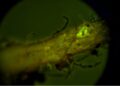
White. Yes, I think that’s probably what’s going on there. Besides going into the seedling and stimulating seedling growth and stress tolerance, providing nutrients into the soil, and going back into the seedling, when bacteria go into the soil — Pseudomonas or Bacillus, for example — they will actually colonize fungi — potential pathogens, like Fusarium — and they’ll colonize that fungi and cause it to have reduced virulence.
These bacteria take some of the nutrients from those fungi and make it so that the fungi are not virulent — they won’t cause disease. The bacteria don’t kill the fungus; they just colonize the fungus and weaken it and reduce its virulence so that it cannot cause disease. In fact, in some cases, those soil fungi will actually become endophytic fungi in the plant — things like Fusarium oxysporum, for example, that once it’s colonized by the bacteria will grow slower and will grow into the plant. As long as the bacteria are there, there’s no disease caused by Fusarium.
So, if you have a healthy plant microbiome and seed microbiome and seedling microbiome, and you pair that with a healthy soil, then you should have much reduced disease — reduced damping off and so forth. But if you remove that microbiome — if we sterilize seeds to remove the surface microbes — then the Fusarium will just eat up the seedling; the seedlings are highly susceptible without their microbes. The microbes are very important in terms of disease protection.

Kempf. This is really incredible. Another topic I’m really passionate about is the development of disease-suppressive soils, and you just described, it seems, a fundamental principle of disease suppression. Is it possible for these organisms to develop resistance to the process that you’re describing?
White. I don’t think so. The reason is that microbes aren’t just like a fungicide. You apply a fungicide to actually kill the fungal pathogens, and then any pathogen that isn’t killed will begin to grow again — plus you have the development of resistance to your fungicide.
But these microbes don’t kill the fungus. Instead, they colonize the fungus. Bacillus, for example, will use lipopeptides — secondary metabolites produced by the bacteria — to cause nutrient leakage out of those fungal hyphae through the pores that the lipopeptide forms in the membranes of the fungus. And then the bacterium can get those nutrients and actually take the nutrients back to the plant.
But you don’t have this killing phenomenon, where the fungus is forced to develop resistance. Instead, you essentially have a fungus that has reduced virulence — that doesn’t cause disease. It becomes part of the soil microbial community that benefits the plant itself. You should not have resistance to bacteria that are not killing the fungi themselves.
Kempf. My understanding in the past had been that when you have this beneficial soil microbiome, you can prevent infection of Fusarium, for example, and it will change the Fusarium from a potential pathogen into a saprophyte — a possible decomposer. But what you’re describing is not actually a saprophyte; it’s changing the behavior of the fungus to actually be beneficial — to be an endophyte and to enhance the plant. You’re saying that these “pathogens,” given the right microbial environment, can actually support and benefit plants.
White. Yes, no doubt about it. We see that in laboratory experiments. It’s much less complicated than soil, where you have a huge diversity of microbes interacting; but in simpler, more controlled experiments, where we have, say, a fungus and one or two bacteria, we see exactly that: rather than being pathogenic, having the fungus there increases the benefit to the plant.
What we think is going on is that the fungus that would be pathogenic is acquiring from the soil — perhaps, like you said, through saprophytic activity — some nutrients that the bacterium then can carry back to the plant. But at the same time, that fungus that would have been a pathogen, some of the mycelium will actually go into the tissues of the plant but will not cause disease. That establishes a situation where nutrients can flow into the plant more readily, and so the plant does benefit.
I’d also like to point out some other ways in which microbes are necessary for the seedling to develop properly. If we take all the microbes away from a seed and then we germinate that seed, the seedling doen’t develop properly. The roots no longer show a gravitropic response. Instead of going down, they’ll stay on the surface of the soil or of the lab media.
The other thing we observe is that roots don’t form root hairs without these bacteria. To form a root hair, those microbes need to be inside those root cells. If they’re not there, you have no hairs — you have hairless roots. What we think is going on is that the microbes themselves are actually participating in the process of root development. We think the microbes are secreting nitric oxide, which is one of the signaling molecules that the plant responds to. The other possibility is that it’s ethylene; we’re trying to determine that right now. We think that the microbes are secreting the signal that causes root hairs to elongate. When we remove all the microbes, we get no root hair elongation.
Kempf. This raises a question about the impact of these symbiotic microbes — these endophytes — on the development of the overall root system architecture and its structure and strength. There’s been a recurring conversation about the differences between older varieties and more modern genetics — in fruit and vegetable production as well as in grain production. The general dialogue is that older varieties used to have much larger and more robust root systems, they appeared to absorb more nutrients, the fruit itself appeared to have a higher nutritional content, and the plants appeared to be better at absorbing some trace minerals such as cobalt and nickel than many of the more modern varieties and more modern hybrids. I understand that I’m making some very broad generalizations here, but what do you think would be the impacts of these endophytic organisms in developing the structure of the overall root system and also the overall nutritional absorption capacity of the crop itself?
White. That’s a good question. I would propose that endophytes are being lost in many of our crops due to the way we’re managing those crops and managing seeds — and storing seeds —and not managing to maintain the microbes.
For example, if we’re cultivating plants using constant fertilizer applications, we make it so that the plant no longer needs these microbes. In fact, it’s entirely possible that some of these microbes are being lost over time in this process, and as they’re lost, we lose some of the functionality in terms of micronutrient absorption capacity in plants.
There actually was an experiment published a couple years ago in Proceedings of the National Academy of Sciences where some investigators collected a wild annual tobacco plant and then brought it into a lab for cultivation. Every year they would grow it and then store the seed in the winter, and then go back and cultivate it the next year. After about seven years, the wild tobacco started getting a wilt disease caused by some fungi — a disease they didn’t see in the wild populations. So they went back to the wild populations of that tobacco and started isolating microbes out, and they isolated some bacteria and started treating their plants in the lab — their seed that they’d had in cultivation for several years — and they found that when they put the bacteria back in, their disease disappeared.
What apparently happened in their process of cultivation is that they lost these beneficial microbes in the seeds, and that led to the disease. The same thing could be happening in the cultivation of some of our crops. The older varieties may have been more efficient because they had those microbes, and in our modern cultivation methods we may have lost many of those microbes.