

Verifying that a product has been grown regeneratively means assessing management practices, land effects and the quality and nutrient density of the product itself
What is regenerative agriculture, and how do you evaluate it? In recent years, those questions have been asked many times by people around the world. As the term gains momentum, it’s becoming more important to understand what “regenerative” actually means and how to measure whether it’s really happening.
This matters to more than just farmers and ranchers. Processors, retailers, brands and consumers are all paying attention. When food or fiber make a regenerative claim, people want to know what is behind it. That means we need clarity on what is being measured, how it is measured and why it matters.
Regeneration Must Be Evaluated on Three Fronts
To know if a system is truly on a regenerative path, it can’t be measured with a narrow focus. Regeneration needs to be evaluated across the following three areas, which must all work together:
Management practices — what’s actually being done on the land. Is the soil staying covered, what kind of rotations are in place, how often is it tilled, and what inputs are being applied? Management choices determine the outcomes.
Ecosystem processes — how the land responds. Are plants absorbing sunlight and storing carbon? Is water soaking in and being held where it falls? Are nutrients cycling through biology instead of being applied as a fertilizer?
Product integrity — what’s coming off the land. If the system is truly regenerating the land, the crop or the animal should reflect that. Higher nutrient density and better flavor offer another pathway to see the impact of a regenerative journey.
None of these measurements on their own are enough. But, taken together, they give us a picture of whether regeneration is truly happening.
Management Practices: The Principles of Soil Health
The first step in understanding regenerative agriculture is looking at how the land is managed. Over the past two decades, these principles have been widely adopted as the foundation of regenerative land management. These are not abstract concepts. They are practical, rooted in experience and science, and can be applied and evaluated on any operation.
Context. Context drives every decision. What is the ecological, economic, and cultural reality of the farm or ranch? What are the natural limitations of the landscape? What are the goals of the operation? Understanding context ensures that the other principles are applied in a way that makes sense for each farm.
Minimize disturbance. Tillage, synthetic inputs and overgrazing all disrupt biological systems. Limiting these disturbances helps protect soil structure, microbial life and the water cycle. Disturbance can be tracked through tillage passes, herbicide and pesticide use, and grazing practices to show how management is influencing soil function over time.
Keep soil covered. Bare soil is vulnerable soil. Keeping it covered with plants and plant residues protects against erosion, buffers temperature swings and supports microbial activity. Ground cover is a visible and measurable sign of soil health.

Maximize living roots. Living roots feed soil biology. The more days of the year they are active, the more carbon is cycled, the more aggregates form, and the more water can infiltrate. Evaluating root presence, depth and season length helps gauge biological support.
Encourage diversity. Monocultures limit ecosystem function. Including multiple species, both above- and belowground, enhances resilience. Crop rotations, interseeding, multi-species cover crops and diverse grazing systems all contribute. Plant counts and species inventories help track diversity gains.
Integrate livestock. When managed well, livestock stimulate growth, cycle nutrients and bring life to a landscape. Their presence and movement can be measured in stocking density, rotation frequency, rest periods and observable effects like manure distribution or hoof impact.
These practices provide a roadmap, but practices alone don’t tell us if the land is getting better. That’s why it’s also important to measure how the land is responding. The management practices drive the change; outcomes confirm that it’s working.

Ecosystem Processes: What the Land Is Telling Us
The natural world runs on four essential processes: the energy cycle, the water cycle, the mineral cycle and community dynamics. These ecosystem processes function together. When they are improving, the system is regenerating. When they break down, the land begins to degrade.
Energy cycle. Photosynthesis brings energy into the system. The more sunlight we can convert into plant material, the more energy feeds the soil biology and supports life. Canopy cover and plant diversity are indicators of solar capture. Lab tests for total carbon, along with bulk density, show how much carbon is being stored as organic matter.
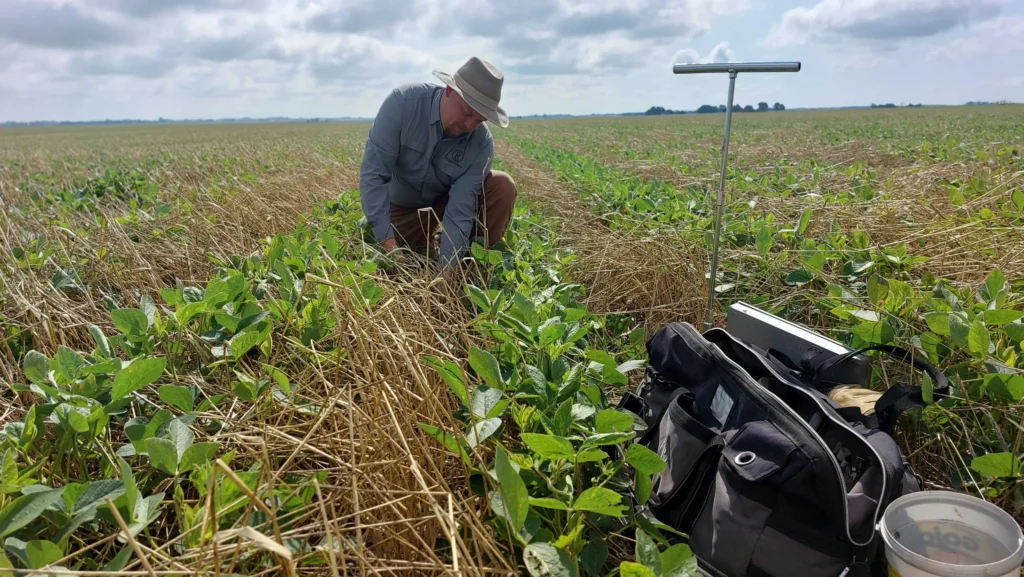
Water cycle. Soils that function well absorb water and store it. Infiltration testing tells us how quickly water enters the soil. Aggregate stability and water-holding capacity soil tests reveal how well the soil resists erosion and retains moisture. These data points help explain how a field responds to drought or heavy rain.
Mineral cycle. Nutrients must move through the system to support plant and animal life. When soil biology is functioning, nutrients are released and recycled without external inputs. Tests like the Haney (WEON, WEOC, MAC), along with respiration and organic matter turnover, provide insight into how well minerals are cycling.
Community dynamics. Diversity is not just about plant species. It includes soil microbes, insects, birds and larger animals. Tracking plant species, counting beneficial invertebrates, and measuring fungal-to-bacterial ratios through PLFA testing all contribute to a picture of ecosystem health. Greater diversity leads to greater resilience.
As land function begins to improve, you start to see the system take on a life of its own. Farmer, author and educator Gabe Brown often says, “Nature is self-healing, self-regulating and self-organizing.” That’s exactly what begins to happen when the four ecosystem processes are working. Inputs go down. Resilience goes up. Yields become more stable. And the land starts to work for you — not the other way around.
Product Integrity: Measuring What Comes Off the Land
Healthy soils produce nutrient-dense food. That’s the final place to look for proof. Nutrient-density testing examines the concentration of functional compounds like antioxidants, omega-3s and phytonutrients. These tend to increase when soil biology and plant health improve.
Testing is straightforward. Samples are sent to laboratories that specialize in nutrient analysis. When producers run these tests over multiple seasons and pair them with improvements in soil function, patterns begin to emerge. For example, a pasture system with improved microbial activity and plant diversity may show beef with higher omega-3s or more favorable fat ratios. This kind of data helps confirm that land management is not only improving the soil but is also enhancing the nutritional value of what it produces.
A 2024 analysis of 158 nutritional compounds compared tomatoes from Tomato Bliss to a leading conventional brand. The results showed that the regenerative system increased nutrients in 75 percent of the compounds measured, including minerals, vitamins and antioxidants. The nutrient benefits ranged from two times to 5,000 times higher.
This kind of testing highlights how regenerative practices can lead to measurable improvement in the nutritional quality of food. It’s another reason why tracking what comes off the land matters just as much as what’s being done on it.
This data is starting to matter across the supply chain. Buyers want products that are not only regenerative by claim, but better by composition. When producers can connect soil function to food quality, the story becomes much harder to ignore.
Why Verification Matters
The marketplace is asking for more than good intentions. As regenerative agriculture grows, the term itself is at risk of being greenwashed. Trusted third-party verifiers offer accountability. Verification gives producers confidence in what they’re building. It gives buyers a basis for trust. And it helps consumers choose food that aligns with their values.
Measurement also drives improvement. When you have data from a verifier to track soil carbon, water infiltration, soil respiration, diversity and nutrient outcomes, you start to see what is working. That builds better decisions. And better decisions build healthier land.
Growing Interest
Recent consumer research conducted by Regenified found that while broad awareness of regenerative agriculture is growing quickly across the general population, interest rises sharply once the concept is explained. In fact, 65 percent of consumers say they’re interested in regenerative agriculture after learning what it means. Within that group, 20 percent stand out: they are what the research calls Emerging Regenerative Shoppers. These consumers are already going to the shelf looking for products that reflect their values: clean labels, ethical animal treatment, biodiversity and environmentally responsible farming. But they aren’t just looking for a feel-good message; they want substance. They want to know that the “regenerative” claim on the label is backed by real data and that the land, and the system behind it, is genuinely improving.
These measurement systems play a vital role. They give producers the tools to understand what’s changing. They give buyers the data to back up their sourcing decisions. And they give consumers a way to know that what they’re buying reflects meaningful change.