

Q. What are some of the significant factors that limit the establishment of the large populations of soil biology that are necessary for quorum sensing?
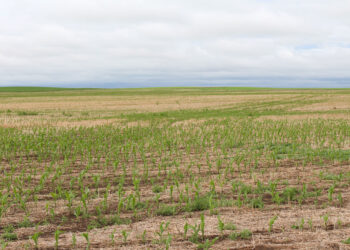
A. Many people would say tillage, but I don’t believe that to be the case. As soil health improves, and as we get more diversity, tillage is not the most destructive thing that we do to soil biology. There are contexts in which tillage is very problematic — I’m not disputing that — but in most environments, tillage is not as damaging as fungicide applications and bare soil.
Fungicide applications are pretty much at the top of the list of what suppresses soil biology. Herbicides are a drop below fungicides and insecticides. I’m speaking in very broad brushstrokes — there are individual exceptions — but fungicides are the most detrimental, followed by herbicides, followed by insecticides.

We should also start managing our soil as though we’re trying to propagate microbes in a Petri dish in a laboratory. That means we need to limit direct exposure to sunlight. This is so detrimental — not just because of ultraviolet and other radiation, but purely as a function of heat. We know that enzymes are denatured at around 110 degrees Fahrenheit, and in almost any environment you can easily reach 140 degrees Fahrenheit on bare soil on a summer day. That means you have no enzymatic activity, and therefore next to no biological activity, in the top six inches.
If you have intentionally grown a diverse cover crop in order to establish quorum sensing, how long does that legacy effect last? Well, it’s not gonna last very long if you have bare soils and you put two applications of fungicide on it.
From John Kempf’s Eco-Ag U presentation at the 2025 Acres U.S.A. conference. Recordings of the conference are available at conference.acresusa.com.recordings-2025.