

North Dakota farmer Gabe Brown demonstrates how understanding ecosystem processes enables profitable farming
Acres U.S.A. Do you feel like there’s a general negativity toward economic success right now in agriculture, even in our space — more than there used to be?
Gabe Brown. I figure there’s economic pressure in agriculture, but the majority of that is brought upon by the current industrialized, commoditized market. It’s all based on yield instead of quality, and this yield mentality that we’ve been under for the last 70-plus years has depressed all the markets.
People say, “Well, right now, pastured proteins, especially beef, are at a high.” But look at the reasons for that — first, very low cow numbers because of the mass exodus from the beef industry because of the amount of capital it takes to stay in there. Two, low-priced imports. Look at grass-finished beef right now — approximately 1 percent is born and raised in the U.S. The rest is all imported. And that’s a shame because it means that we’re not producing it here. We’re not capturing that. Pastured proteins have grown in demand over 20 percent for the past 30 years in a row. Think about that — now there’s an industry I want to be in!
But, back to your original question, the reason there’s this oppressing weight on agriculture is simply because of the disconnect between consumers and where their food comes from — the industrialized, commodity market, the oversupply of commodities and food-like substances — all that’s just weighing on it right now.
Acres U.S.A. It seems like commodities are on a giant downturn, but I think it’s probably because interest rates are higher than they were five years ago, and you have lower prices. But when you look at the historical records, the interest rates aren’t that crazy. And the commodity prices are not that crazy, but we went through a spike a couple years ago.
Brown. Yeah, look at corn right now, and then go look at corn prices in 1972. They’re the same. That’s insane. Why would anyone want to farm? And what’s our answer? Oh, more government subsidies.
Acres U.S.A. That really is the reason. In theory, at least, it’s a no-loss business plan.
Brown. Exactly. Look at revenue insurance. That’s the most ridiculous thing I’ve ever seen. I can’t tell you how many flights I’ve spent seated across the aisle from North Dakota state senators. They won’t even look at me anymore because I chewed their ears so much about just how ridiculous that program is. But they just can’t see it.
The other problem is that there’s so many jobs and industries that are tied to agriculture. “Let’s just keep bailing out the farmers, giving them these subsidies, because of all these other industries that rely on it,” they say.
Acres U.S.A. I always feel like it’s like a slap in the face, or that farmers get talked down to. They’re this little person that can just be manipulated, and they go along with it. But why?
Brown. We should be putting farmers on a pedestal because our health directly depends on what farmers or ranchers do. I look forward to the day when we’re really tying nutrient density into what’s being produced, because then a farmer will have the opportunity to be rewarded for what they’re truly producing.
Now, that happens somewhat when you’re direct marketing. You’re rewarded for that. People are making that association, getting to know their farmer or rancher. But we need much more of that.
People say, “Oh, it’s too big. You can’t do that.” Look, my son is shipping product to New York City, to L.A. — anybody can do that. You can get food to your door. Now, we might argue it takes too much carbon to do that, and I don’t deny that. We all need to source it local as much as we can, but anyone can have access to good food.
Acres U.S.A. We talk a lot about farmers having economic success, and the opportunities are there. It just isn’t easy.
Brown. Exactly, and you have to be able to work. As I often say, farmers are very good at producing yield, but they’re terrible marketers. Allan Nation said that the best return on your time always has been, and always will be, time spent on marketing. And we’ve forgotten that.
Acres U.S.A. How do we educate folks to do that? You almost need a business degree — not that I think business degrees from colleges are that great — but you do need to go through a school of some sort or get lessons on it in some way.
Brown. I think what you need is a good mentor. And one of the beautiful things about the internet — and I realize I’m aging myself, but the internet wasn’t around when I started — is that nowadays you can have access to that type of information. Acres U.S.A. puts out good information. You can have access to it. You need to latch on and study and learn.
Then the other thing is, number one, you need to know your cost of production. I’ll guarantee you, 95 percent of farmers out there do not know their true cost of production. Too many use their Schedule F as their cost of production. No, you need to know, down to the last penny, what it costs you to produce a product, whatever that might be.
And then, how did I get out of debt? I became a price maker, not a price taker. I wasn’t going to sell things for below my cost of production, and if I couldn’t sell them, I wasn’t going to produce ’em.
Also, I simply didn’t do what everybody else did, because there wasn’t enough money in it to get me out of debt. So yeah, I had to seek out and make markets and find markets and then capitalize on it. The beauty of it is that if you do that, there’s considerable money to be made in agriculture.
Acres U.S.A. Yeah. I think it’s because of all the busy work. When you talk about the ROI on the work that you do, marketing always wins supreme. But then we’re busy cleaning out a pen of manure, and there’s all this busy work — there’s always an excuse to do this busy work, and there’s never an excuse to do the marketing.
Brown. And to that I’d say, why are those animals in a pen?!?
Acres U.S.A. Right! I’m just saying that people make those excuses.
Brown. I know. And then it comes down to the question, are you doing $100-an-hour jobs or $10-an-hour jobs? You can hire people to do the $10-an-hour jobs.
Now, some people say, “Oh, those people aren’t available.” Don’t even begin to give me that. When we ran an internship program all those years, we had seventy-five to a hundred applicants who would want to come to the middle of nowhere in North Dakota and intern. Why? Because they wanted that experience of doing a $10-an-hour job, and we gave them a good education while they were here.
So, there are opportunities. Young people need to start small and figure out if they really like an enterprise. Can they make money at that enterprise? Do they know their cost of production? Can they build a business from it and then expand it? And, as they do that, others in the community will take note and will say, “Hey, I have this 10 acres back here — it’s not good farmland, but you could sure graze your sheep on it if you want.”
I hear those stories almost on a daily basis. There are good people in this world who want to help young people and see them succeed. Look at where we live — this $10- to $20,000-an-acre land that’ll produce 50-bushel wheat. There’s no money in commodities on it, and even with stacked enterprises, it gets difficult if you buy the land. But the beautiful thing with stacked enterprises is that you really don’t need as much land to make a good living.
Acres U.S.A. Yeah. We’ll have thousands of people show up for a webinar on soil health. Everyone’s interested in soil health, and I think the underlying thing that they’re looking for is, “How can I produce my crop cheaper and get better yield?” But then we have a marketing webinar or a business webinar and there’s like 12 people there.
Brown. Exactly. I can’t tell you how many times clients say, “We can’t do that. We can only sell corn and soybeans.” Really? Your semi doesn’t have tires? Don’t give me that. If you can move the commodity, you can move something else. You can’t tell me there’s not a demand for feed oats somewhere. With most of these larger cities, there’s horse arenas and everything. People are looking for high-quality feed. Don’t tell me that there’s not other opportunities to grow something else. Diversify the crop rotation. Lower your input costs. There’s a lot of opportunities.
Acres U.S.A. On the farms you’ve worked on the past couple of years, the people that are having success — what is the common denominator with them?
Brown. Education. Hands down. It’s education. A farmer cannot implement what they do not know and what they do not understand. You need to educate yourself.
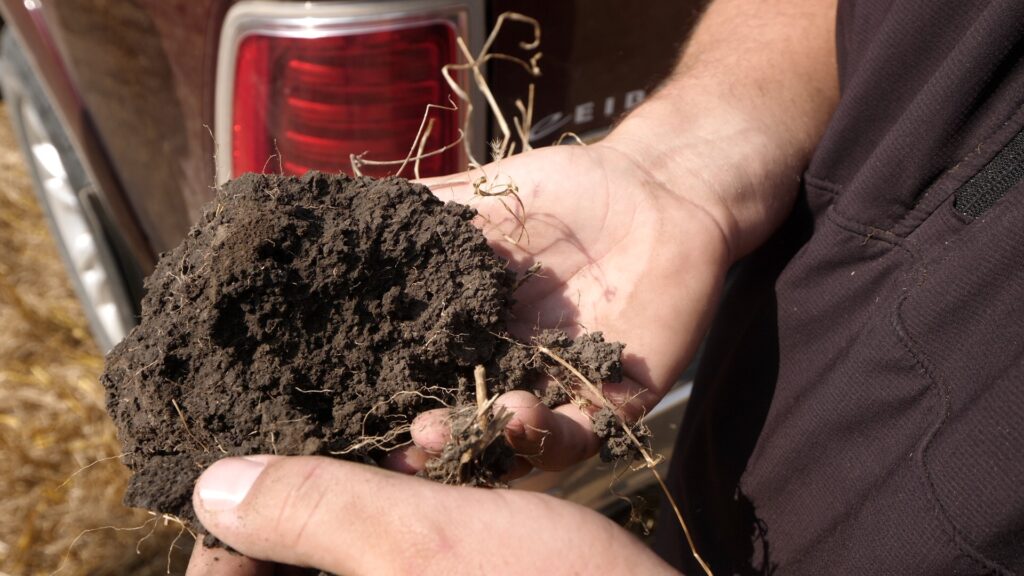
I tell people over and over again that I have two college degrees, but never in any of those college classes did they talk to me about the four ecosystem processes. Never did they talk about how a soil aggregate was formed. Never did they talk about the natural nutrient cycle, protozoa-eating bacteria, and how to drive that.
On this farm of ours, we haven’t used a pound of any type of fertilizer, synthetic or organic, besides what drops out of an animal, in over 30 years, and there’s no need to. It’s all there. You just got to be smart enough to understand it. You got to educate yourself. Above every surface acre of earth, there’s approximately 32,000 tons of nitrogen. Why any farmer would write a check for nitrogen, I can’t understand. That’s beyond me. You shouldn’t have to do that if you get your soils working properly.
So, it’s education. You’ve got to educate yourself, and most farmers just don’t want to take the time.
Acres U.S.A. Our audience definitely takes the time to learn about soil health. I think we almost have an overabundance of education when it comes to soil health. But I’m pushing speakers this year at our conference to share examples of economic success.
Brown. Well, let me tell you an example of economic success. True story. Here in North Dakota, the fall of 2018, a gentleman reached out to me and was interested in regenerative agriculture and what that meant. The first thing I did was to get him and his wife — and to his credit, he brought his wife with him — to a soil health academy. After the event he became very intentional.
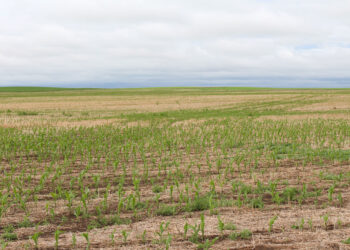
This is a 4,500-acre farm, approximately, all rented cropland, with a pretty diverse crop rotation, and he was no-till, but he immediately started doing proper soil testing. What’s the biology in the soil? What’s the difference between a biological test and a standard soil test? We showed him how he could make more nutrients available via that biology, and then we helped him do a strip trial on half a field. We backed him off approximately 15 percent on the fertility because the test showed that he had the biological activity to do that. Then we started backing him off by not putting all that fertility on upfront — it was split during the growing season. Then he started cutting back on fungicides, and he removed the seed treatments also.
He became very intentional. This is in northern North Dakota, with approximately 120 frost-free days, but he would combine in the afternoon, and the next morning he was in that field seeding the cover crop. We kept the cost of that cover crop low because there were no livestock to graze it, so it was not tremendous diversity. But what were we doing? We were cycling solar energy. We were capturing some of those nutrients.
He then started to cut back even more the following year, based on the biological tests we were doing. He removed all seed treatments and started applying some homemade compost tea to the seed. It was easy for him to do — he had the equipment because he was applying inoculum to legumes.
By the spring of 2024, he had a 40 to 60 percent decrease in fertilizer, depending on the crop, 100 percent elimination of seed treatment, 100 percent elimination of fungicides — which is huge in northcentral North Dakota — and 100 percent elimination of crop burndown. He’s reduced his herbicide by well over 50 percent, and it’s mostly pre-plant only.
And he told me, “Gabe, I just went out and paid cash for half a section of farmland.” Do you know what that land costs? That’s a lot of money.
But then he said, “The thing I’m most happy about is that my two children want to come back and farm.” They’re high-school-age children.
Acres U.S.A. They’re in a position to access success.
Brown. Yes. He said, “This has opened up a whole new door for me.” He’s really beginning to understand soil health, plant health, animal health, human health. He’s got neighbors now that are bringing their animals over to graze his cover crops. If he can’t get in because it’s too wet in the field, he’ll seed a full-season cover crop and let the neighbor graze it. He knows that’s improving his soil health. He isn’t spraying insecticides. He’s letting natural predators come in and take care of that.
He said, “It’s so much more profitable now, farming this way.”
Acres U.S.A. What do you think his margin went to?
Brown. I wouldn’t want to quote anything without talking to him, but it’s a significant increase.
Acres U.S.A. I think that’s what frustrates me the most — you have all this land that’s been tied up by generational farms, and you hear, “I’m not making any money — nobody’s making money.” But with the appreciation of land, how can you not pass a successful business on the next generation? I mean, there isn’t really a good excuse for that right now.
Brown. Well, the excuse is you’re just not that good a manager. You haven’t educated yourself. I’m sorry — in my old age I get pretty blunt about what I say. Yes, I’m sympathetic toward people, but there’s no excuse nowadays, like you said.
Let give you this example. My son, who will be 38 next month, in his ag classes in high school there were about 50 students. Of those, at least 30 were from farms. Today, to our knowledge, he’s the only one that’s farming. And I put that not on the children — not on his fellow classmates. I put it directly on the parents. Because the parents didn’t make it conducive. We knew from when Paul was young, he was going to take over the farm. That’s all he is ever wanted to do. Now, some days he might question that decision — when he’s having a tough day on the farm. But he’s very successful at it.
Acres U.S.A. What did you guys do differently, though? Did you let him play sports or go do other things?
Brown. Yeah, Paul was very active in FFA, and that’s what he wanted to do. He was very active in fishing and hunting.
Acres U.S.A. But your kid isn’t slave labor, either.
Brown. No, he wasn’t slave labor. Did he work with me, though? Yeah, he did.
But Paul saw a future there. When he was young, we went through some really tough times. But Paul’s never known tillage. He’s never known not to be regenerative — in the manner of not caring for the resource. And don’t take that wrong — all farmers care — I firmly believe that. But many don’t put an emphasis on the ecosystem processes. That’s all Paul’s ever known, and it tied in with nature and outdoors and what he loves to do. He’s always loved to care for animals. It was just a natural progression.
Acres U.S.A. How do you see things progressing in agriculture as a whole? Like we talked about earlier, commodities are in a tough spot — although you just gave an example of someone who has success with it. But where do you see this going?
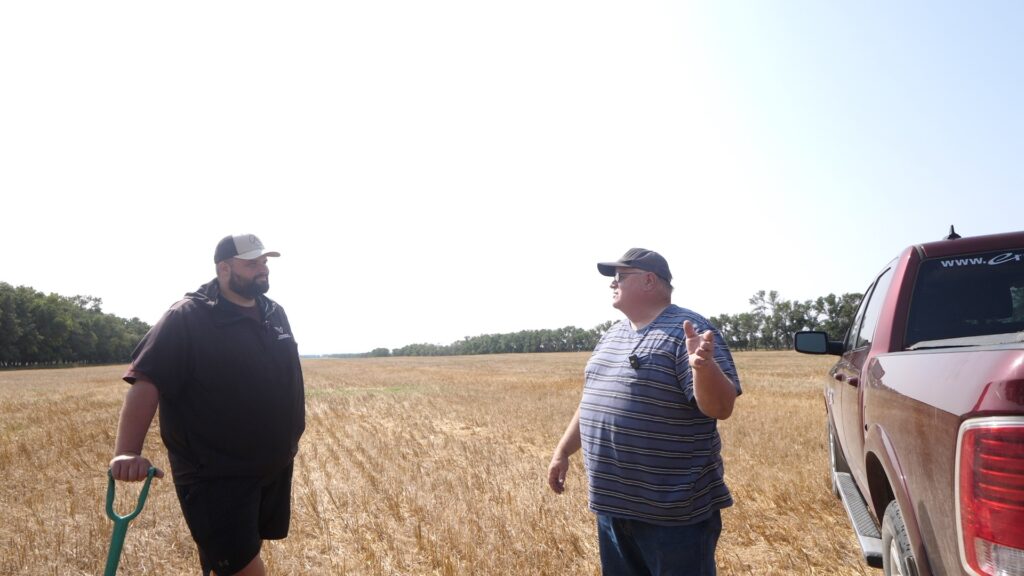
Brown. We have to change mindsets. Farmers are going to have to be much better marketers. They’re going to have to seek out markets that will provide them with decent returns, and then, in turn, the farmer’s going to have to produce. What do companies want? Companies want a consistent supply of high-quality product.
They also want the farmer’s stories to sell, because the marketing becomes much easier if you have that story — that picture, that farm family walking through that wheat field, etc. That’s got to be worth something.
The other thing is I really believe that in the future we’re going to be paid for the nutrient density of the food we’re producing, where food is preventative medicine. That’s coming from the work of Dr. Van Vliet and Dr. Provenza and others. Using a mass spectrometer, they can now identify 2,500 phytonutrient compounds. I really believe that in the future you’ll be able to take your phone and scan a product, and it’ll be able to tell you chemical residues, herbicide residues, and the phytonutrient density of the food. We won’t be talking “organic” or “regenerative” — that’s not going to matter. Everything will be right there, and it’ll put all farmers on a level playing field. You either have it or you don’t.
Acres U.S.A. How long do you think we’re away from that?
Brown. I really believe, the way it’s advancing, 10 years.
Acres U.S.A. What’s going to prevent groups from stopping it? I mean, that’d be a pretty inconvenient tool that could come out.
Brown. And no doubt there will be a lot of naysayers, especially in big business. But I would counter that with what we’re seeing in big business now: a lot of those chemical companies, fertilizer companies — what are they selling? Biologicals, right? Microbial fungi, right? Things like that. So, they’re making the progression. They will realize that as they help farmers advance their soil health, farmers are going to be able to advance those phytonutrient compounds in food. What goes around comes around.
Acres U.S.A. Do you think there’s a way for big ag businesses to make enough money to be happy with that?
Brown. I don’t care! That doesn’t bother me. I get asked that all the time. They can make a living in this space too. I am not going to lose sleep over that. I’m more concerned about the marked increase in all these chronic diseases.
No doubt, there’ll be some that try and play the system. We’ll see a lot of naysayers. Look what’s going on in Washington now. There’s a lot of ’em saying, “We can’t stop this ultraprocessed food.” To me, it’s absolutely ridiculous that people are actually fighting the amount of junk food that the SNAP program provides. That’s just stupid.
Again, it’s really about education. The consumer is becoming much more educated, like it or not. COVID did educate a lot of people. A lot of people took more of an interest in where their food’s grown and raised, and I really think we need to get back to more regionalized, localized food systems. There’s nothing wrong with that. There’s nothing wrong with eating seasonally, eating local. I only eat tomatoes this time of the year. It’s the perfect season for them. That little orange pale thing that you get in a grocery store the rest of the year — I only eat tomatoes for a short window of time. That doesn’t bother me.
Acres U.S.A. Earlier we discussed examples of people who have had success. But what are the examples of folks who have reached out to you, asked for help, and then didn’t follow through? What’s the common denominator there?
Brown. The common denominator is intentionality. They just weren’t intentional enough.
Acres U.S.A. They were hoping you would sell them a bug in a jug and a quick-fix solution.
Brown. Exactly. They weren’t ready. They didn’t educate themselves.
And we’re firm believers that you start according to your aversion to risk. We all have different contexts. My context financially today is much, much different than it was in 1998 when I was $1.5 million in debt! I can afford to try things today that I couldn’t back then. Each person has a different aversion to risk.
We often hear people say, “I’m going to plant a cover crop, and then I’m not going to fertilize the cash crop the next year.” No, your soil’s not ready. Is it biologically ready? Do you have the predator population in there to consume all the bacteria to drive that nutrient cycle? You have to understand these things.
I’m happy to say, though, from a business standpoint, our success rate with clients is way over 90 percent, which is very, very high. But that’s because we take the time to educate, and we’re in their fields and on their farms. That’s huge. That drives that success rate.
Now, we can’t determine that intentionality. We can help walk people through it, but it’s up to them to carry it out. If they’re not going to plant that cover, if they’re going to go out and till multiple times when we’re telling them not to — those are things you can’t control.
Acres U.S.A. Hard-headedness. How do you get that out of farmers?
Brown. You don’t!
Acres U.S.A. How’s your certification program, Regenified, going?
Brown. Unbelievable. The interesting thing is it’s not so much about the label. The food companies want the data and the proof points — that this is what we’re really doing for agriculture. Our standards for Regenified include over a hundred different data points and observations. Nobody else has that kind of data. And so now we’re getting banks and insurance companies asking about it. They want that data.
In 2020 through 2022 — our three driest years — Paul harvested a crop every year off of this ranch. Not a bumper crop, but a profitable crop. All the neighbors harvested one out of three. That’s resilience. It’s soil health. So, if we can prove out that data, what does that mean for their actuary tables for insurance? What does it mean for the tables for financials — paying back loans, etc.?
Acres U.S.A. That would lead to more intelligent lending.
Brown. Exactly.
Acres U.S.A. Who’s working with AI in that business? I think that would make things a lot easier.
Brown. We’re exploring that. Regenified does have a young person on staff who looks at that. That stuff’s scary. It’s way beyond me. But it’s still got a ways to go. I look at AI cover crop recommendations, and there’s still a ways to go there. It’s not context specific enough, etc. But you’ve got to start somewhere and build the data.
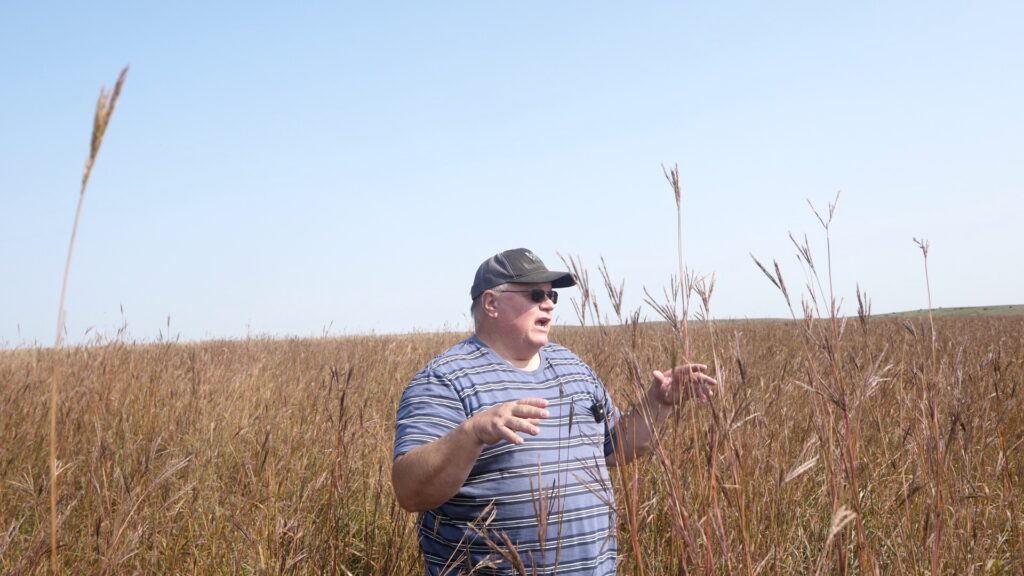
I tell people, “Gabe Brown’s not a very intelligent person, but I know a lot of intelligent people.” And that’s key to my success — what can I glean from everyone else? And then you glean it a bit and you put it to work. Like with my big bluestem — a warm-season grass that just started coming up here on our farm. I’m pretty proud of that big bluestem.
Acres U.S.A. It’s pretty amazing.
Brown. I haven’t seen anything like that in North Dakota or anywhere in the upper Midwest to that degree.
Acres U.S.A. Where have you seen it?
Brown. You get down to Nebraska — the sandhills and some places like that that are true warm-season environments. What does that tell you? You’re changing the microclimate of the soil enough that those warm seasons are just exploding. And that’s exciting to see. We’re still a cool-season environment, so the cool seasons are going to thrive, but when you look at how a smooth brome is taking over everything up here, and then you see things like that, it’s like, wow.
Acres U.S.A. It really needs a good rain in July, but it doesn’t after that?
Brown. It does. But the rooting depth is so extensive.
Acres U.S.A. The warm seasons are such a drought hedge.
Brown. I really believe that. And I’m going to give my son, Paul, the credit for doing some of those grazing things to help stimulate that latent seed bank and to get some of that going. You don’t know unless you experiment and find out what works.
I had a researcher here just a few weeks ago, and I showed him that big bluestem, and I told him this is the kind of research we need done. I get asked all the time, “What grasses should I seed?” And I say, first of all, why do you want to seed? We need to stimulate the latent seed bank. I told the researcher there should be research done on how much latent seed bank is there as you build aggregation deeper and get those pore spaces and air moving deeper. Because for centuries and centuries, seed was being produced here and laid down. That seed went somewhere; it all wasn’t eaten.
Acres U.S.A. Do you guys bale graze that area?
Brown. Yeah, there was some bale grazing in there, but we didn’t bale graze with big bluestem plants.
Acres U.S.A. How do you speed up that process? Is it just the grazing?
Brown. I believe that the years of cover cropping helped to advance — jumpstart — soil biology, and then we bale grazed on there during the winter months. But let’s be honest — there are 480 acres there. Not every spot saw a bale, by any means. And we’ve only been doing that 10 years.
Acres U.S.A. And how long has it been perennial?
Brown. It’s been perennial since 2009. It takes some time. And you have to remember that in nature, a hundred years is a blink of an eye. We want the future yesterday. It doesn’t work that fast.
Acres U.S.A. That’s not cheap seed, either.
Brown. No. That’s just it. There are times I seeded some big bluestem and nothing happened. It never established.
So, I think we need more research. Every Monday morning, our team has a consultant call, and we discuss any questions or any issues anybody wants help with. And one of our consultants recently had a client trying to decide whether to seed perennials or to rely on the latent seed bank. And the overwhelming response — from incredible guys on our team like Burke Teichert and Fernando Falomir and Allen Williams — the consensus was, no, don’t seed anything. Let nature do it through longer recovery periods.
Cover crop, graze, and repeat, and then after a couple years, you’ll start to see the species coming. Primarily it’ll be weeds — forbs — to start with. Think of a road ditch. When a highway department builds a road, what do you see along the side of the road? You see weeds — forbs first, then annual grasses like foxtails, then it starts moving into perennials. It’s just succession.
In cropland situations, those cover crops are starting to build soil aggregation and are starting to jumpstart the system, so you don’t need as long a period in forbs — weeds — before you move into the perennial grasses. Now, if you have a perennial pasture, don’t tear that all up and start over. Just start with long recovery periods. Grow some biomass first. Lay it down with higher stock densities, and have long recovery and rest periods. Grow more biomass. Lay it down. The key is that, during that recovery and rest, you have some periods of precipitation. That’s probably not quite as key in your area — in Wisconsin — as it is in more brittle environments.
Acres U.S.A. Yeah, this year we’ve had the best, most consistent rain I’ve experienced. But just a couple years ago we had our worst drought in 75 years. I thought I had made a bad mistake getting into cattle.
Brown. Yeah, and you know, it probably won’t be the last time you’ll think that! I’ll tell you one thing: nature can humble you.
Acres U.S.A. It does. But it’s been a good experience.
I’m excited to have you back this year at our conference. Can you give us a shameless plug on what your experience was there last year and what you’re planning to talk about this year?
Brown. It had been a number of years since I had attended an Acres conference, and I was really happy to see the focus on farm profitability and on education. To me, that was different than a few of the other experiences I’d had in previous years. I really thought there was a good vibe there at the conference, too, from young people who were really taking an interest in wanting to learn.
And the thing I like about the conference, probably as much as anything else, is the willingness for the participants to share and the associations you get by attending that conference. You learn some things with the speakers, but you learn much more visiting with the individuals that are there. I’ve always said that the regenerative ag space is about sharing, and it’s about community, and I really look forward to that.
I’ve had the good fortune in my career to travel to many places in the world, and as long as there’s sunlight, rainfall, and soil, this works. I want to show people that it doesn’t matter where you are — you can create healthy soil that’ll function. That’s the beauty of this. If you’re educated and understand how these processes work, it works.